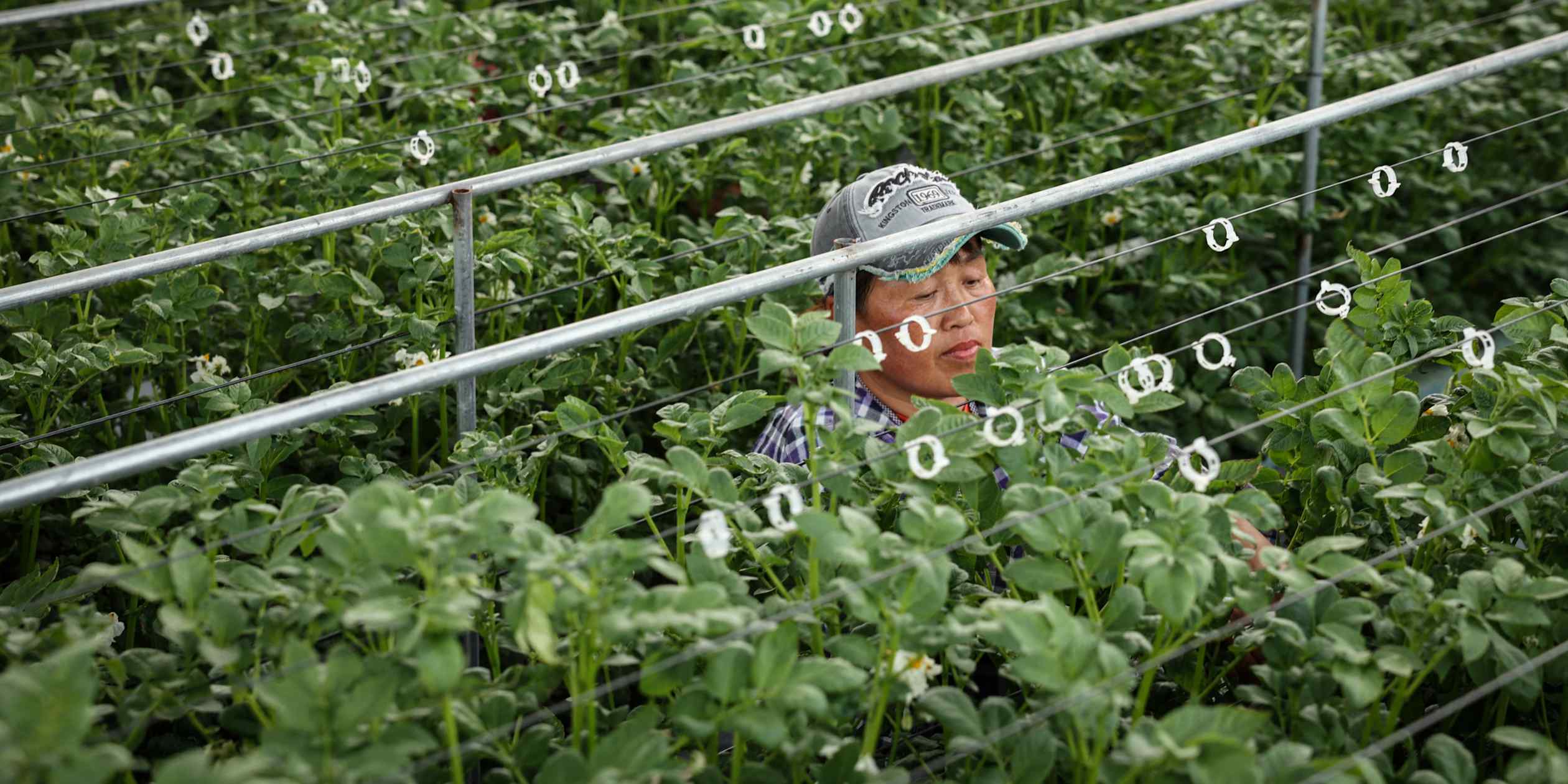
汉堡,德国 -- 荷兰园艺供应商正从向中国出口完整温室转向,中国在这些建设方面行业已发展先进,转而专注于先进技术、专有软件和系统集成——这些是他们仍然占优势的领域。
HAMBURG, Germany -- Dutch horticultural suppliers are shifting from exporting complete greenhouses to China, where the industry has advanced in these constructions, to focusing on advanced technology, proprietary software and system integration -- areas where they still hold an edge.
荷兰公司长期主导着能够种植樱桃番茄到兰花的高端作物系统的全球市场。由于土地有限且人口密度高,荷兰一直是温室建设的前沿。
Dutch companies have long dominated the global market for premium-crop systems that can grow cherry tomatoes to orchids. With limited land and a high population density, the Netherlands is at the forefront of greenhouse construction.
中国面临类似的压力,需要用更少的资源生产更多:它养活了世界约20%的人口,但只有10%的土地是可耕地。
China faces a similar pressure to produce more with less: it feeds roughly 20% of the world's population, but only 10% of its land is arable.
中国的农业公司转向荷兰,以建造他们可以控制的种植系统。好处显而易见。在高科技温室中,番茄产量可从每平方米约15公斤提升至80至90公斤。用水量也会大幅下降,因为水可以被回收利用,这在中国西部和内蒙古等干旱地区尤为有用。
Chinese farming companies have turned to the Dutch to build growing systems that they can control. The benefits are clear. In high-tech greenhouses, tomato yields can rise from about 15 kilograms per square meter to 80 to 90 kg. Water use also falls sharply because it can be recycled, particularly useful in arid places like western China and Inner Mongolia.
需求还受到中国消费者的推动,他们认为在这种受控环境中种植的农产品更安全,这意味着这些产品往往在无化学物质、清洁基质中种植,而不是可能受污染的土壤中。
Demand is also driven by Chinese consumers who view produce grown in these kinds of environment as safer because of the controlled conditions, which means that they tend to be farmed without chemicals and in clean substrates rather than potentially polluted soil.
虽然中国农业部门已经成熟,公司现在能够制造或复制许多温室部件,但荷兰在将这些部件集成到可靠且具商业可行性的生产系统方面仍然占优势。"这就是国际公司和研究组织仍能通过专有算法、专用设备、系统集成、生产经验、知识产权和长期技术专长提供价值的地方,"英国皇家农业大学农业技术高级讲师帕特里夏·马萨贝说道。
While the Chinese agricultural sector has matured and companies can now make or replicate many greenhouse components, the Dutch still hold an edge in integrating them into reliable, commercially viable production systems. "This is where international companies and research organizations can still bring value through proprietary algorithms, specialized equipment, system integration, production know-how, intellectual property and long-term technical expertise," said Patricia Mathabe, senior lecturer in agricultural technology at Britain's Royal Agricultural University.
马萨贝表示,荷兰的优势不在于某项单一技术,而在于能够将园艺科学、数据和工程与种植者、研究机构和政府支持相结合。
Mathabe said the Dutch advantage lies not in any single technology, but in the ability to connect horticultural science, data and engineering with growers, research institutions and government support.
正是这种方法被农业工程公司Ridder所采用。这家第三代荷兰家族企业生产通风和遮阳驱动装置,以及气候控制、水资源管理和劳动力管理系统。
This is the approach taken by agricultural engineering company Ridder. The third-generation Dutch family business produces ventilation and screening drives, along with climate-control, water-management and labor-management systems.
多年来一直向中国出口后,它正在上海浦东扩建生产设施,在那里将组装诸如控制面板和灌溉单元等低技术硬件。但核心研发、高端软件和知识产权将保留在荷兰,而这部分业务是其最有价值的部分。"虽然本地生产的硬件更容易被复制,但如果没有荷兰的专有软件,它就是无效的,"Ridder中国区总经理Joep van den Bosch表示。
After years of exporting to China, it is expanding a production facility in Pudong, Shanghai, where it will assemble lower-tech hardware such as control panels and irrigation units. But core research, high-tech software and intellectual property will remain in the Netherlands, and this part of its business is the most valuable. "While locally produced hardware is easier to copy, it is ineffective without the proprietary Dutch software," said Joep van den Bosch, managing director of Ridder China.
中国占Ridder全球收入8000万欧元(约合8960万美元)的近10%,公司预计这一份额将在五年内翻一番以上。
China accounts for nearly 10% of Ridder's 80 million euros ($89.6 million) in global revenue, and the company expects that share to more than double within five years.
另一家公司范德霍文也走了一条类似的路。该公司不再向中国运输钢铁、铝、玻璃、PVC和供暖管等大宗商品。相反,一家合资企业在当地以相当的质量和更低的成本制造更简单的部件。荷兰业务则专注于更高价值的系统集成,包括遮阳和气候控制计算机。
Another company, Van der Hoeven, has followed a similar path. The company no longer ships commodities such as steel, aluminum, glass, PVC and heating pipes to China. Instead, a joint venture manufactures simpler components locally at comparable quality and lower cost. The Dutch business concentrates on higher-value system integration, including screening and climate computers.
范德霍文公司首席商务官Bas Duijvestijn表示,中国实体可以复制硬件,但目前仍需要荷兰的专业知识才能使一切正常运作。
Bas Duijvestijn, Van der Hoeven's chief commercial officer, said that Chinese entities can copy the hardware but for now, still require Dutch expertise to make it all work.
中国买家进口荷兰技术,随后转向本地解决方案,认为他们可以自给自足,但随后出现了性能差距,导致重新进口,"他说。"这一循环反映了成本、能力和可靠性认知之间的平衡。范德霍文预计在未来五年内将保持竞争力,尽管高资本成本和经济疲软使其系统更难以销售,"他说。
"Chinese buyers import Dutch tech, then shift to local solutions believing they can self-supply, which was then followed by performance gaps that trigger renewed imports," he said. "This cycle reflects a balance between cost, capability and reliability perceptions." Van der Hoeven expects to remain competitive over the next five years, although high capital costs and economic weakness make its systems harder to sell, he said.
市场确实已经相当拥挤。根据荷兰温室联盟的格特·德拉尔的说法,至少有50家荷兰园艺技术公司在中国运营,涵盖温室建设和优化、种子和育种以及兰花栽培。他们不仅与中国公司竞争,还与国际供应商竞争,尤其是来自以色列、法国和西班牙的供应商。"一个主要挑战是公共采购法规要求80%的项目工作必须在当地完成才能有资格获得某些补贴,这优先考虑了本地公司,并迫使外国公司寻找本地合作伙伴或设立本地子公司才能参与,"德拉尔说。
The market is indeed already crowded. At least 50 Dutch horticultural technology companies operate in China, spanning greenhouse construction and optimization, seeds and breeding, and orchid cultivation, according to Gert Dral of Dutch Greenhouse Delta. They compete not only with Chinese companies but also with international suppliers, particularly those from Israel, France and Spain. "A major challenge is a public procurement regulation requiring 80% of project work to be done locally to be eligible for certain subsidies, prioritizing local companies and compelling foreign firms to find local partners or establish local subsidiaries to participate," Dral said.
与此同时,中国正在通过派学生前往荷兰的瓦赫宁根大学——该国领先的生命科学机构——来建立自身的专业知识。
At the same time, China is building its own expertise, partly through sending students to Wageningen University, the Netherlands' leading life sciences institution.
瓦赫宁根学院项目经理刘震估计,大约有500名中国学生正在该大学的专业农业食品和环境项目中学习,其他亚洲学生的人数大约是这个数字的三倍。她认为亚洲大学在学术上正在赶上,但存在知识转移的差距。
Liu Zhen, program manager at Wageningen Academy, estimated that about 500 Chinese students are enrolled in the university's specialized agri-food and environmental programs, with other Asians making up roughly three times that size. She sees Asian universities as catching up academically but with transfer gaps.
在荷兰,大学的基础研究和瓦赫宁恩研究所的应用研究推动技术推进,而强大的产业参与则创造了市场拉力,刘解释道。"相比之下,在中国,技术推进存在,但市场拉力较弱。如果没有紧密的产业联系,研究主题可能与实际挑战脱节,从一开始就降低效率和相关性。" Jens Kastner 是一名撰稿人。
"In the Netherlands, fundamental research by universities and applied research by Wageningen Research drive technology push, while strong industry engagement creates market pull," Liu explained. "By contrast, in China, the tech push is present, but the market pull is weaker. Without close industry links, research topics can misalign with real challenges, reducing efficiency and relevance from the start." Jens Kastner is a contributing writer.