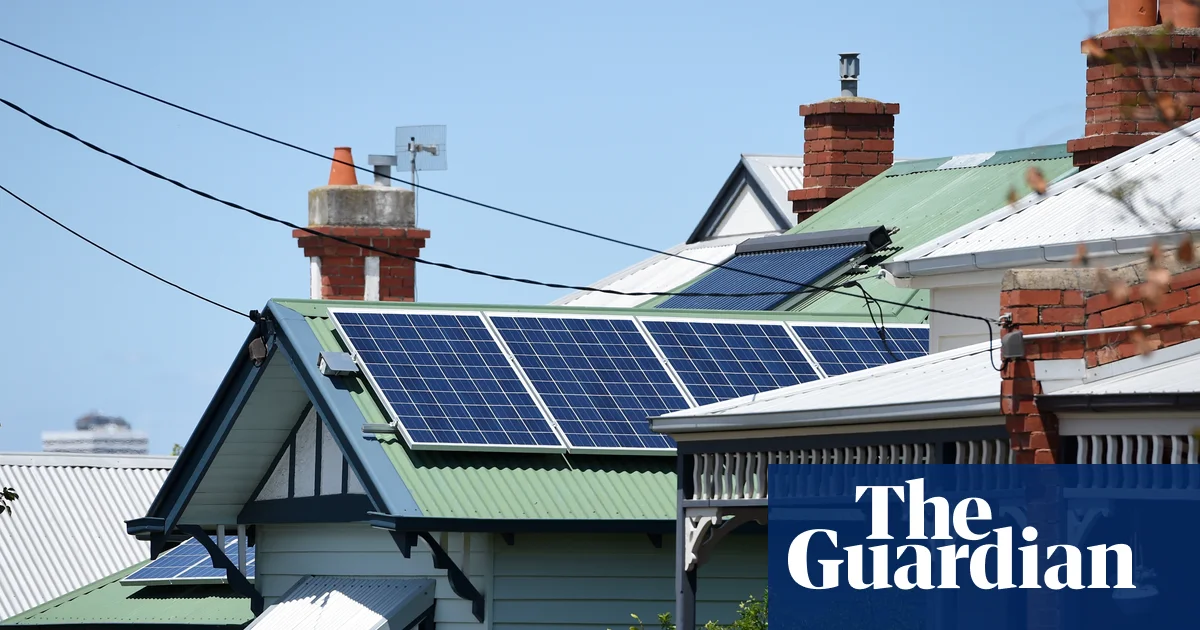
走在澳大利亚的任何住宅街道上,你很可能会看到屋顶上的太阳能光伏板。
Walk down any residential street in Australia and chances are you will see roof-top solar panels.
照片:Tracey Nearmy/AAP 放大墨尔本邮编3029的卫星图像,一个特征会变得格外明显——屋顶上布满了太阳能光伏板。
Photograph: Tracey Nearmy/AAP Zoom in on satellite pictures of the Melbourne postcode 3029 and one feature becomes glaringly obvious – there are lots and lots of solar panels on lots and lots of roofs.
“如果你沿着街道走,实际上很难看到一栋没有安装太阳能板的房子,”住在塔尼特的软件工程师萨吉德·尼扎姆说,他和妻子、两个孩子以及屋顶上的6.6千瓦时太阳能系统一起生活。
“If you walk along the streets, it’s actually hard to see a house without solar panels,” says Saajidh Nizam, a software engineer who lives in Tarneit with his wife, two children and a 6.6kWh solar system on the roof.
这个墨尔本西部的邮编地区拥有澳大利亚最多的屋顶太阳能装机量。根据澳大利亚清洁能源监管局的数据,自2001年以来,该地区已安装超过28,000套太阳能系统。
This western Melbourne postcode has more rooftop solar than anywhere else in Australia. More than 28,000 systems have been installed there since 2001, according to Australia’s Clean Energy Regulator.
澳大利亚人均从太阳能板发电量位居世界首位,使得邮编3029成为澳大利亚住宅太阳能行业的典型代表。
Australia generates more electricity per person from solar panels than anywhere else in the world, making postcode 3029 the poster child for Australia’s residential solar sector.
卫星图像:屋顶上的房屋 维多利亚州邮编3029的屋顶太阳能装机量超过澳大利亚任何其他地区。
satellite view of house roofs The Victorian postcode of 3029 has more rooftop solar installations than any other in Australia.
目前,澳大利亚约有400万户住宅和小企业安装了屋顶太阳能系统——大约36%的家庭拥有这样的系统——而国家对光伏板的热情仍在持续增长,2026年有望成为安装量创纪录的一年。
There are about 4m homes and small businesses with rooftop solar – about 36% of households have a system – and the country’s enthusiasm for the photovoltaic panels is only building with 2026 on track to be a record year of installations.
但澳大利亚相比其他国家拥有的充足阳光并不是太能蓬勃发展的唯一原因。
But the copious amounts of sunshine hitting Australia compared with other countries isn’t the only reason solar is booming.
超过20年来,澳大利亚政府一直在向安装屋顶太阳能的住宅和企业发放证书,以降低前期成本。该计划本月已扩大,纳入了企业场所的更大规模系统。
For more than 20 years, the Australian government has been issuing certificates to homes and businesses that erect rooftop solar, cutting the upfront costs. The scheme has been extended this month to include larger systems on corporate premises.
绿色能源市场研究与分析公司(Green Energy Markets)分析与咨询部门主管特里斯坦·埃迪斯表示,相对较高的电价以及相比其他国家(尤其是美国)更为宽松的法规,是澳大利亚人如此热情采纳太阳能的两个主要原因。
Tristan Edis, the director of analysis and advisory at research and analytics firm Green Energy Markets, says relatively high electricity prices together with less onerous regulations than other countries, in particular the United States, are two reasons why Australians have adopted solar so enthusiastically.
其他的是全国各地建造的房屋类型,采用“低密度住宅和大量屋顶空间,使得[太阳能]安装更加容易”,Edis 表示。
The other is the types of homes built around the country with “low-density housing and a lot of roof space, making [solar] easier to install,” Edis says.
根据代表可再生能源行业的行业组织清洁能源委员会的数据,今年第二季度,澳大利亚每个州的安装量均创历史新高,屋顶安装系统达到 102,234 套——这是有史以来单季度最高的安装量。
According to the Clean Energy Council, an industry group representing the renewables sector, in the second quarter of this year, records were broken in every Australian state for installations, with 102,234 systems installed on roofs – the highest quarter on record.
十年前,屋顶光伏发电仅占全国电力供应的不足3%,而煤炭供应占比达75%。而在过去12个月中,屋顶光伏发电已贡献近14%的电力,煤炭供应降至50%。
Ten years ago, rooftop solar was generating less than 3% of the country’s electricity while coal supplied 75%. In the last 12 months, electricity from rooftops supplied almost 14%, while coal was down to 50%.
“澳大利亚的屋顶太阳能系统数量已经超过了后院游泳池的数量,”澳大利亚能源市场运营商的一位发言人表示。
“There are more rooftop solar systems in Australia than there are swimming pools in backyards,” said a spokesperson for the Australian Energy Market Operator.
他们表示,太阳能的普及“从根本上改变了电力系统”,并“让数百万消费者在电力的生产、使用以及如今随着住宅电池的涌入而进行储存方面发挥了更主动的作用”。
They said uptake of solar had “fundamentally changed the electricity system” and “given millions of consumers a more active role in how they produce and use electricity, and now store it with the influx of residential batteries”.
他们还说,太阳能的发展导致对电网电力的需求下降,且在白天中段,批发电价曾降至零甚至出现负值。冬季虽然日照时间减少,但屋顶光伏仍能覆盖全国电力市场所用电量的10%,而该市场供电人口占全国超过85%。
Solar had seen demand for grid electricity falling and wholesale electricity prices reaching zero, or even going negative, in the middle of the day, they said. In winter, with less sunshine hours, rooftop solar still covered 10% of the electricity used in the national electricity market, which supplies more than 85% of the population.
在全国电力市场中,屋顶光伏如今在白天中段 routinely 提供超过40%的用电量;在某些日子,这一比例甚至峰值超过60%。为应对如此规模的太阳能发电,大多数地区已出台新规,要求电力零售商每天向客户提供三小时免费电力。
In the national market, rooftop solar now routinely supplies more than 40% of the electricity used during the middle of the day; on some days, it peaks above 60%. To cope with all of that solar power, new rules have been introduced requiring electricity retailers in most areas to offer customers three hours of free electricity every day.
政府企业监管机构的报告发现,安装光伏和储能系统的家庭电费比普通用电客户低20%至52%;参与虚拟电厂的家庭——即电池输出可与其他家庭联动并由零售商统一控制——其电费降幅达57%至63%。
report from the government’s corporate watchdog found households with solar and batteries had bills that were between 20% and 52% lower than regular electricity customers, and households who participated in a virtual power plant – where the battery’s output can be linked with other households and controlled by a retailer – had bills 57% to 63% lower.
随着家庭储能系统的突然普及——得益于联邦政府的一项自去年7月以来已促成50万套安装的计划——埃迪斯表示,传统的晚间用电高峰正因太阳能充电的储能系统启动而被削平。“这将摧毁化石燃料发电机的经济性,”埃迪斯说。光伏储能销量上升趋势图 规模将有多大?但澳大利亚屋顶光伏的增长潜力究竟有多大?
Now, with the sudden arrival of home batteries – supported by a federal government program that has seen half a million installed since July last year – Edis says the traditional evening peak for electricity use is being flattened as solar-charged batteries kick into gear. “That is going to destroy the economics of fossil fuel generators,” says Edis. graph showing rising sales of solar batteries How much bigger? But how much bigger could Australia’s rooftop solar boom get?
负责运营全国主电力市场的政府机构每两年发布一次蓝图,预测电力系统的最可能发展路径。
The government agency that operates the main electricity market produces a blueprint every two years for the most likely development of the electricity system.
该蓝图预测,屋顶光伏系统的装机容量将从目前的20吉瓦增长至2050年的87吉瓦——意味着56%的家庭将安装屋顶光伏系统,“这一增长由持续下降的成本驱动”。其中三分之二的家庭还将配备储能系统。若这一趋势得以实现,能源市场运营商表示,仅靠屋顶光伏就能满足全国约27%的用电需求。
This blueprint forecasts that the capacity of rooftop solar systems will grow from its current level of 20GW to 87GW by 2050 – meaning 56% of homes would have rooftop solar systems, “driven by ever-falling costs”. Two-thirds of those homes would also have batteries. If that change materialised, the energy market operator said rooftop solar alone would be supplying about 27% of the country’s electricity.
该机构指出,挑战在于“不仅仅是容纳更多光伏板,而是最大化利用它们所产生的电能。”埃迪斯的自身预测表明,屋顶光伏的装机规模甚至可能更高。
The challenge, the operator said, was “not simply accommodating more solar panels but making the most of the electricity they produce.”Edis’s own projections have suggested even higher amounts of rooftop solar could be possible.
他表示,澳大利亚典型的10千瓦光伏系统即使为家庭充电电动汽车,也能产生足够满足日常用电的电量。
He says a typical 10kW solar system in Australia can produce more than enough electricity for an average household, even if they run an electric car.
“他们的用电需求几乎完全由光伏和储能系统满足。住宅用电实际上已经从电网中消失,”他说。
“Their demand for electricity is almost entirely taken care of by their solar and their battery. Residential electricity consumption disappears from the grid,” he says.
澳大利亚人购买太阳能系统的一个日益增长的动因,据Edis所说,是电动汽车的普及。
A rising motivator for Australians buying solar systems, says Edis, is the advent of electric cars.
“电动汽车和太阳能之间正在形成一种关系。对许多澳大利亚人来说,给汽车充电将变得非常便宜,”他说。
“There’s a relationship developing between electric cars and solar. For a lot of Australians, charging up their car will be incredibly cheap,” he says.
一些电力系统分析师,包括Edis,指出商业建筑和租赁单元是一个“缺失的中间层”,在这些地方,如果有更好的规定,屋顶太阳能的发展还能进一步扩大。“十亿太阳能公民”本周,在斐济举行的为11月在土耳其召开的联合国全球气候谈判做准备的会议上,澳大利亚成为首个支持一项全球自愿承诺的国家,承诺到2030年将拥有屋顶太阳能的住宅数量从1.5亿增加到3亿。
Some electricity system analysts, including Edis, point to commercial buildings and rental units as a “missing middle” where, with better rules, rooftop solar could grow even further. ‘A billion solar citizens’This week in Fiji at a preparatory meeting ahead of November’s UN global climate talks in Turkey, Australia became the first country to endorse a global voluntary pledge to double the number of homes with rooftop solar from 150m to 300m by 2030.
“屋顶太阳能是全球气候外交中的沉睡巨人,”太阳能公民组织的首席执行官Heidi Lee Douglas表示,该组织代表着超过20万屋顶太阳能用户。
“Rooftop solar is the sleeping giant of global climate diplomacy,” says Heidi Lee Douglas, the chief executive of Solar Citizens, an advocacy group representing more than 200,000 rooftop solar owners.
“这将创造十亿太阳能公民,”Douglas说,她当时正在斐济参加此次宣布。“[屋顶太阳能]在政治上很受欢迎,并且因为生活成本的好处而受到人们的欢迎;如今,随着能源安全问题的凸显,政府的动机也更强了。”
“This is going to create a billion solar citizens,” says Douglas, who was in Fiji for the announcement. “[Rooftop solar] is politically popular, and it appeals to people because of the cost of living benefits and now, with energy security issues, governments are more motivated.
“许多能源部长将对此予以关注。屋顶太阳能有潜力做很多好事,但一直被低估。我们知道它是安全的,是一个已知的量,而且易于快速部署。”太阳能公民组织成立于16年前的澳大利亚,旨在为太阳能用户发声,并围绕屋顶系统构建一种新的政治经济。
“A lot of energy ministers are going to sit up and take notice of this. Rooftop solar has the potential to do so much good but it has been so underrated. We know it is safe and it is a known quantity, and it is easy to deliver quickly.”Solar Citizens was set up in Australia 16 years ago to advocate for solar owners and create a new political economy around rooftop systems.
Douglas表示,该慈善机构正在与日本、台湾、巴基斯坦、瓦努阿图、马来西亚和印度尼西亚的民间社会团体合作,以建立“太阳能公民运动”并开展倡导活动。
The charity is working with civil society groups in Japan, Taiwan, Pakistan, Vanuatu, Malaysia and Indonesia to set up “solar citizen movements” and build advocacy campaigns, says Douglas.
在澳大利亚,Douglas正在推动未来三年内将屋顶太阳能与储能电池连接的规模翻倍。
In Australia, Douglas is pushing to double the amount of rooftop solar that is connected to batteries over the next three years.
回到塔尼特,萨吉德·尼扎姆表示,他正在计算为屋顶上的太阳能系统添加电池的成本。“这主意不错,”他说着,环视着自己所在的创纪录郊区。
Back in Tarneit, Saajidh Nizam says he is doing the sums on adding a battery to the solar system on his roof. “It’s a good idea,” he says, looking around his record-setting suburb.
“我们对电网的压力没有那么大,同时我们也在努力变得更自给自足一些,对环境的破坏也更小一些。“在这方面,我们做得不错。”
“We’re not putting as much pressure on the grid, and we’re trying to be a bit more self-sustaining and a bit less damaging on the environment. “We’re doing good on that front.”