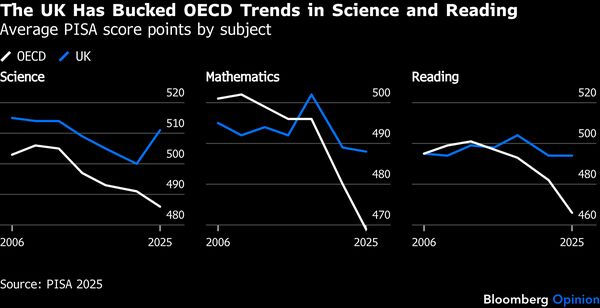
拉拉·威廉姆斯(Lara Williams)报道,尽管英国政治不稳定、增长乏力,但该国近日传来好消息:在经合组织(OECD)国际学生评估项目(PISA)最新测试结果中,英国学生在所有受测科目中均进入前十名。英国仅为八个实现此成就的国家之一——共有92个国家和城市参与测试——并且通过提高平均科学成绩、避免阅读成绩下降,逆转了全球普遍的下降趋势。
The UK, for all its political instability and sluggish growth, recently got some good news: British students ranked in the top 10 across all tested subjects in the latest results from the OECD’s Programme for International Student Assessment (PISA). The UK was one of just eight countries to achieve that feat — 92 countries and cities participated — and also managed to buck wider downward trends by improving its average science score and avoiding a decline in reading.
但深入分析结果后,这种“全A”的喜悦开始褪色。一方面,成绩因英国不同地区而异:英格兰坚持知识驱动型课程,未跟随威尔士和苏格兰注重技能和能力的潮流趋势,在所有科目中均优于其他三国。更令人担忧的是,一种令人意外的性别差距正在显现。
But dive deeper into the results and that straight-A feeling starts to fade. For one thing, the scores vary depending on what part of the UK you look at: England, which has stuck with a knowledge-driven curriculum rather than following Wales and Scotland’s trendy bets on skills and competency, outperformed the other three nations in all subjects. Even more worrying: A surprising gender split is emerging.
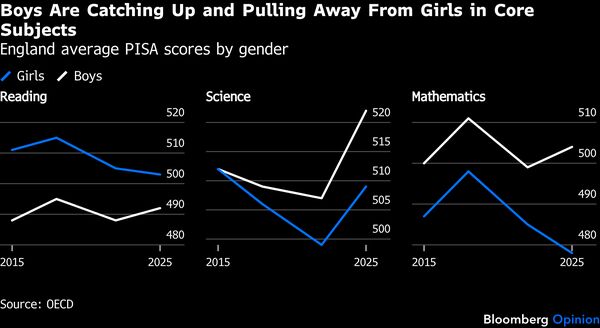
在PISA的阅读评估中,英格兰女生的平均分略有下降,而男生则有所提升。女生在数学上的成绩出现显著下降,科学成绩仅部分恢复。男生在两科中的领先优势进一步扩大。
In PISA’s reading assessment, English girls’ average score declined slightly, while boys improved. Female students also experienced a significant drop in math scores and only a partial recovery in science. Boys pulled further ahead in both.
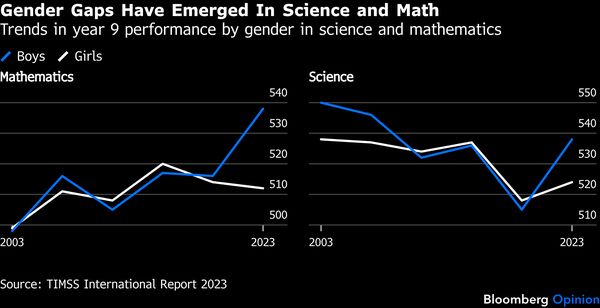
美国也出现了类似趋势,但这并非全球性现象。经合组织国家平均来看,女生在阅读和科学方面均领先于男生,而两性在数学表现上均有下降。此外,英国其他三国——威尔士、苏格兰和北爱尔兰——并未出现英格兰般的性别差距(尽管它们的总体测试成绩远低于英格兰)。但PISA结果并非个例:2023年,国际教育成就评价协会(IEA)的一项研究发现,英格兰九年级学生中出现了性别差距,这一差距在72个参与国家中是最大的。此前的评估中,男生和女生的表现大致相当。
The US has seen a similar trend, but it’s not a global pattern. On average, girls in the OECD are ahead in both reading and science, while both genders have seen drops in mathematics performance. And the other UK nations — Wales, Scotland and Northern Ireland — don’t have the same gender gap as England (though they have much lower test scores overall). But the PISA results aren’t an outlier: In a 2023 study by the International Association for the Evaluation of Educational Achievement, researchers found that a gender gap opened for students in England in year 9 — the widest gap seen in any of the 72 participating countries. In previous assessments, girls and boys had performed similarly.
英格兰的男生现在在A-level(针对17至18岁学生的预科考试)中获得最高等级的成绩上已经连续两年超过了女生。男生在数学方面的优势正在进一步扩大,并且在小学阶段已经缩小了阅读能力的差距,这一点已被教育政策研究所智库所指出。女生在中学阶段的整体表现仍然更好,但她们的平均成绩分数现在是自2019年该指标首次引入以来的最低水平。与此同时,男生的表现有所提升。
English boys have now outperformed girls in securing the top grades at A-level (pre-university exams for 17- and 18-year-olds) for two years. Boys are pulling further ahead in math and have closed the reading gap in primary school, as noted by the Education Policy Institute think tank. Girls still perform better overall in secondary school, but their average attainment score is now the lowest since the measure was first introduced in 2019. Boys, meanwhile, have seen improvements.
承认这一现实将需要学术思维的根本转变。男生的困难长期以来一直是英国教育的重点关注对象。1998年,时任学校总督察克里斯·伍德黑德称成绩不佳的男生是“教育体系面临的最令人担忧的问题之一”。近三十年后,许多人仍然持有这种观点。今年早些时候,男性与男孩政策研究中心启动了“男孩教育委员会”,旨在“找出男孩在各个教育水平上落后的原因,以及如何确保他们能够茁壮成长”。
而2025年高等教育政策研究所的一份报告则呼吁在学校中营造“男孩友好”的环境,并增加对提升男生教育的资金投入和关注。
Acknowledging this reality will require a sea change in academic thinking. Boys’ struggles have long been a key focus of UK education. In 1998, then-Chief Inspector of Schools Chris Woodhead called underachieving boys “one of the most disturbing problems facing the education system.”Almost three decades later, many people still share that view. Earlier this year, the Centre for Policy Research on Men and Boys launched the “Boys’ Education Commission” to “find out why boys are falling behind at all levels of education and how to ensure they thrive,” while a 2025 report from the Higher Education Policy Institute called for a “boy-positive” environment in schools, as well as more funding and focus on improving male students’ education.
当然,仍然存在一些男生落后的领域。但最新的测试数据清楚地表明,女生需要紧急关注。年轻女性为何日益落后?目前尚无明确答案——但有一些线索。
To be sure, there are still areas where boys lag. But the latest testing data makes it clear that girls need urgent attention. Why are young women increasingly falling behind? There’s no clear answer — but there are some clues.
在COSMO研究中——这是一项于2021/2022年进行的、关于英格兰青少年的重大研究——研究人员发现,54%的自认是女性的学生报告了高水平的心理困扰,而男性学生这一比例为33%。超过两倍的女生比男生表示自己有自伤行为——分别为23%和11%。总体而言,女生学生报告的幸福感和动机较低,孤独感和焦虑感较男生同伴更高。其他研究也得出了类似的结果。
In COSMO, a major 2021/2022 study of English youth, researchers found that 54% of students identifying as female reported high levels of psychological distress compared to 33% of males. More than twice as many girls than boys said they self-harmed — 23% vs 11%. Overall, female students reported lower wellbeing and motivation and greater loneliness and anxiety than their male counterparts. Other research has yielded similar results.
导致女孩心理健康压力的来源多种多样,但社交媒体及其连锁影响是主要嫌疑。一项日本研究将两性心理健康差异与女孩的孤独感和对瘦身的渴望联系起来。法国食品、环境与职业健康安全局关于数字营销与青少年的大规模报告作者指出:“在社交媒体上,遭受霸凌和成为性别羞辱受害者的女孩比男孩更多。” 另一方面,媒体和政治界对“男性圈”及其对青少年男孩的影响给予了大量关注,电视热播剧《》和《》助推了这一话题。女孩与互联网的关系却未受到同等程度的审视。
The sources of that stress to girls’ mental health are varied, but social media and its knock-on effects are the main suspects. A Japanese study linked mental-health differences between the sexes to girls’ loneliness and desire for thinness. The authors of a large-scale report on digital marketing and adolescents by the French Agency for Food, Environmental and Occupational Health & Safety, told that “more girls than boys on social media are being bullied, and becoming victims of gender shaming.”On the flip side, there’s been a great deal of media and political attention paid to the “manosphere” and its impact on teenage boys, helped along by TV hits such as and . Girls’ relationship to the internet hasn’t gotten the same scrutiny.
当然,这些是蔓延的社会问题,不能完全由学校解决(或归咎于学校)。那么教育系统能做些什么来更好地支持年轻女性?提高对问题的认识是一个开始。学校和教师应当知道女孩面临更高的心理健康问题风险,可能需要更多关注。虽然针对16岁以下人群的政府社交媒体禁令将于明年春天生效,但在青少年(合法)下载TikTok和Instagram之前,让他们掌握更多数字素养将是明智之举——尤其是考虑到许多人会找到规避禁令的方法。
Of course, these are sprawling societal problems that can’t be entirely solved by (or blamed on) schools. So what can the education system do to better support young women? Increasing awareness of the problem would be a start. Schools and teachers should know that girls are at greater risk of mental-health problems, and that they may need more attention. And although a government social-media ban for those under the age of 16 is due to kick in next spring, it would be wise to arm teenagers with more digital literacy before they’re able to (legally) download TikTok and Instagram — especially given that many will find ways to circumvent the ban.
至少,学校有责任确保自己不是损害年轻女性学习能力的力量之一。在这方面学校仍有工作要做:PISA报告中最令人痛心的统计数据是,英国女孩表示在学校有归属感的可能性明显低于男孩。以此为基础,她们落后难道不令人意外吗?
At the very least, schools have a responsibility to make sure they’re not one of the forces hurting young women’s ability to learn. And they have work to do on that front: The saddest statistic from the PISA report is that girls in the UK are significantly less likely than boys to say they belong at school. With that as a foundation, is it any wonder they’re falling behind?