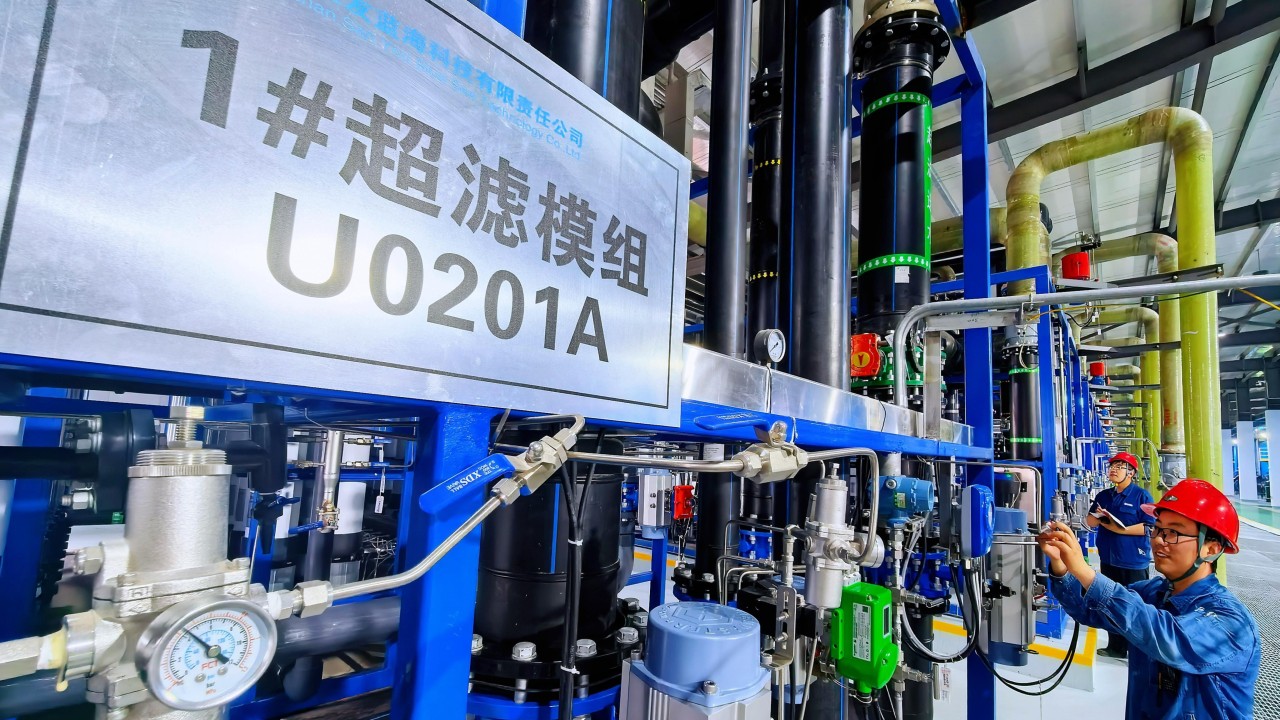
位于渤海湾的大型海水淡化厂实现了能源效率突破,在将数百万吨有毒废盐水转化为高价值化工盐的同时,电力消耗降低了一半以上。
A large desalination plant on Bohai Bay has achieved an energy efficiency breakthrough, slashing electricity consumption by more than half while converting millions of tonnes of toxic waste brine into high-value chemical salt.
该设施位于河北省唐山市曹妃甸工业区,据国家运营的《科学技术日报》上月报道,该厂最近进入试产阶段。
Situated in the Caofeidian industrial zone of Tangshan, Hebei province, the facility recently entered its trial production stage, the state-run Science and Technology Daily reported last month.
据报道,该技术为解决全球浓缩海水向海洋排放的挑战提供了一条可行途径。
This technology provides a viable pathway to solving the global challenge of discharging concentrated seawater into the sea, according to the report.
该设施以三比一的比例处理废盐水,生产出1吨精炼浓缩海水(盐度为每升120克)以及2吨淡水。
The facility processes waste brine at a three-to-one ratio, yielding 1 tonne of refined concentrated seawater – with a salinity of 120 grams per litre – alongside 2 tonnes of fresh water.
精炼浓缩海水随后通过管道直接输送至50公里(31英里)外的化工厂,用于生产纯碱——一种在玻璃、冶金、造纸、纺织印染和食品工业中广泛使用的基础原材料。
The refined brine is then piped directly to a chemical plant 50km (31 miles) away to produce soda ash, a fundamental raw material used extensively across the glass, metallurgical, papermaking, textile-dyeing and food industries.
唐山三友集团研发负责人赵林表示,该公司正是该项技术的创新主体,该项目在全球可比技术中规模最大、能耗最低。
According to Zhao Lin, head of research and development at Tangshan Sanyou Group, the firm behind the innovation, the project boasts the largest scale and lowest energy consumption globally among comparable technologies.
赵林对《科学技术日报》表示:“该厂每生产价值1万元(约合1490美元)的产品,相比传统海水淡化方法,用电量降低60%。”
“For every 10,000 yuan (US$1,490) of value produced, the plant uses 60 per cent less electricity than conventional desalination methods,” Zhao told Science and Technology Daily.
同一报道中,中国海洋大学(山东)高级工程师刘兰称,浓缩海水的大规模资源利用是“前所未有的”。
In the same report, Liu Lan, a senior engineer at the Ocean University of China in Shandong, described the large-scale resource utilisation of concentrated seawater as “unprecedented”.
刘兰表示:“该技术实现了海水淡化、精炼浓缩海水和盐化工业的循环产业链闭环。”该工厂是多年来高校与企业协同研究的成果。
“This technology has completed the circular industrial chain linking seawater desalination, refined concentrated seawater and the salt chemical industry,” Liu said. The plant is the culmination of several years of collaborative research between universities and business.
在预处理设施中,首先从盐水中过滤出不溶性杂质,随后才开始主要的技术挑战:分离出钙、镁和硫酸盐等二价离子。
Within the pre-treatment facilities, insoluble impurities are first filtered from brine before the primary technical challenge begins: separating out divalent ions such as calcium, magnesium and sulphate.
在高倍浓缩过程中,这些离子会迅速沉淀,就像水壶中的水垢一样。这会堵塞管道并损坏膜设备,清理起来极其困难。
During high-ratio concentration, these ions precipitate rapidly, much like limescale in a kettle. This blocks pipes and damages membrane equipment, proving notoriously difficult to clear.
此外,生产线必须保留盐水中的盐分——这对技术和经济可行性而言是一个更大的挑战。根据报告,研究团队在经过数百次试验后,成功识别并解决了这一关键瓶颈。2023年9月,唐山公司正式启动了其试点工厂。
Furthermore, the production line must retain the salt within the brine – an even steeper hurdle for both technical and economic viability. Following hundreds of trials, the research team successfully identified and resolved this critical bottleneck, according to the report. In September 2023, the Tangshan-based company officially launched its pilot plant.
该工厂同时运行五条生产线,精准拦截了钙和镁离子——这些是导致顽固水垢的矿物质——同时成功保留了高纯度的氯化钠溶液,即普通食盐。
Operating five production lines simultaneously, the facility precisely intercepted calcium and magnesium ions – the minerals responsible for stubborn scaling – while successfully retaining a high-purity solution of sodium chloride, or common salt.
随后的挑战是将废盐水的浓度或盐度从每升40至45克提高到每升120克。
The subsequent challenge was to increase the concentration, or salinity, of the waste brine from 40 to 45 grams per litre to 120 grams per litre.
传统方法通过施加巨大的物理压力来从如此高浓度的盐水中抽出水分子。根据研究团队的说法,这种极端压力不仅能耗极高,还可能导致过滤过程中使用的脆弱膜变形甚至完全破碎。
Traditional methods of forcing water molecules from a brine of such high concentration require immense physical pressure. According to the research team, this extreme pressure is not only highly energy-intensive but also threatens to warp or completely crush the fragile membranes used in the filtration process.
为规避这一问题,团队提出了一种创新方案:将浓缩过程划分为四个不同的阶段。他们根据每个阶段的特性匹配了不同的膜组件,并确定了这些组件连接的最佳顺序。
To circumvent this, the team devised an innovative solution by dividing the concentration process into four distinct stages. They matched different membrane components to the specific characteristics of each stage and determined the optimum sequence for their connection.
然而,即使理论框架已经建立,将其应用于生产线仍面临诸多实际挑战,其中首要的是选择理想的膜组件。
Yet, even with a theoretical framework established, scaling it for the production line presented a host of practical challenges, chief among them being the selection of ideal membrane components.
主要研究员赵林解释说,团队对国内外主流制造商的产品进行了严格测试。他们进行了反复比较和交叉验证,最终选择了一个国内品牌。
Lead researcher Zhao Lin explained that the team rigorously tested products from mainstream domestic and international manufacturers. They conducted repeated comparisons and cross-verifications before ultimately selecting a domestic brand.
今年6月,整条生产线成功整合,项目第一阶段正式进入调试阶段。
In June this year, the entire production line was successfully integrated and the first phase of the project officially entered its commissioning stage.
根据该设施所在工业园区的一位官员的说法,一旦第三阶段完成,该工厂预计每年将处理近1亿吨浓缩废海水,这将大幅减轻渤海湾的生态负担。由Dannie Peng提供
According to an official from the industrial zone where the facility is based, once the third phase is completed, the plant is expected to process nearly 100 million tonnes of concentrated waste seawater annually, substantially relieving the Bohai Bay of a heavy ecological burden.