哈维尔·布拉斯“买入时听炮声,卖出时听号角声。”这句古老的股市格言在今天的中东地区产生了共鸣。虽然美国和伊朗正在交战,但石油巨头们正把目光投向邻国伊拉克。
By Javier Blas“Buy to the sound of cannons, sell to the sound of trumpets.”The ancient stock market maxim resonates in today’s Middle East. While the US and Iran fight, Big Oil is heading into neighboring Iraq.
19世纪英国银行家、拿破仑战争的融资者纳森·罗斯柴尔德男爵,很可能从未说过许多人归于他的那句投资格言。但我们今天从石油高管那里听到的言论,确实与他的理念有所呼应:“看,收益伴随风险;而且,你知道,我们不怕风险,”雪佛龙公司首席执行官迈克·沃思在最近的一次行业聚会上这样说道,解释了他为何正在与巴格达进行谈判。
Baron Nathan Rothschild, the 19th-century British banker who financed the Napoleonic wars, probably never uttered the investment precept many attribute to him. But there are echoes of his philosophy in what we hear today from oil executives: “Look, returns follow risk; and you know, we're not afraid of risk,” Mike Wirth, the head of Chevron Corp., told a recent industry gathering, explaining why he’s negotiating with Baghdad.
在场的听众几乎没有人对此感到惊讶。没错,伊拉克是一个风险高昂的目的地,尤其是如今邻近地区战火纷飞。但几十年来,这个国家首次为石油巨头们提供了他们所渴望的那种回报。
Few if any in the audience raised an eyebrow. Yes, Iraq is a risky destination, even more so today with a war raging in the neighborhood. But for the first time in decades, the country offers Big Oil the kind of returns it aspires to.
当炮声平息时,巴格达很可能会成为这场地区危机的赢家,吸引雪佛龙、英国石油公司、康菲菲利普斯甚至埃克森美孚控股公司等巨头的数十亿美元投资。法国石油巨头道达尔能源公司已经是伊拉克的主要投资者之一。
When the cannons fall silent, Baghdad is likely to emerge as a winner of the regional crisis, attracting billions of dollars from the likes of Chevron, BP Plc, ConocoPhillips and even ExxonMobil Holdings Corp. TotalEnergies SE, the French oil giant, is already a major investor.
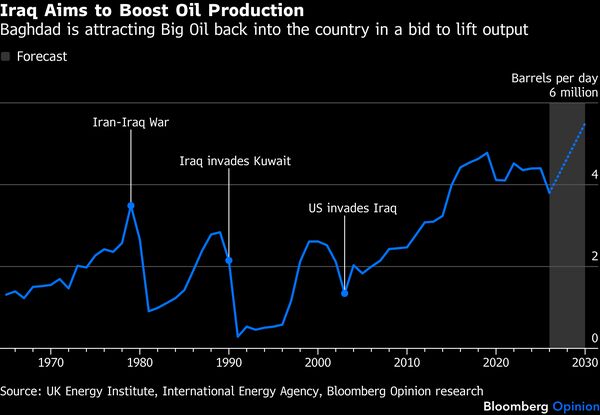
伊拉克目前已签署的新合同以及正在谈判中的合同表明,该国有望在2030年前将其原油产能提升至每日550万桶。战争爆发前,伊拉克的日产量约为450万桶。巴格达长期以来一直雄心勃勃地希望将产量提升至每日600万桶,这将使其在中东地区仅次于沙特阿拉伯。
With the new contracts Iraq has signed so far, and the ones it’s currently negotiating, the country could boost its output capacity to 5.5 million barrels per day by 2030. Before the war, Iraq pumped about 4.5 million barrels a day. Baghdad has long ambitioned increasing its production to 6 million barrels a day, which would make it second in the Middle East region only to Saudi Arabia.
伊拉克总理阿里·阿尔-扎伊迪在最近几个月里曾谈到,希望在2035年后将石油产能提升至每日800万桶,甚至1000万桶。尽管资本正在涌入,但这些目标显然不切实际。然而,将产量提升更为合理的20%-30%,将是一项巨大的成就,更别说是在今天美伊冲突的背景下。
Iraqi Prime Minister Ali al-Zaidi has talked in recent months about increasing oil production capacity to 8 million barrels a day, and even 10 million barrels a day, beyond 2035. Despite the influx of capital, those targets are unrealistic. Still, boosting output by a more sensible 20%-30% would be an enormous feat, more so considering the US-Iran war today.
未解决的关键问题是:伊拉克和欧佩克如何平衡巴格达对大幅提高产量的需求?我认为有两种可能的结果:欧佩克将睁一只眼闭一只眼,像过去对待阿尔及利亚和阿拉伯联合酋长国等其他成员国那样,对超产行为视而不见;或者伊拉克将直接无视欧佩克,最终退出该组织。
Left unanswered is a key question for Iraq and OPEC: How would the cartel accommodate Baghdad’s desire for much higher pumping? I see two likely outcomes: OPEC would turn a blind eye to the overproduction, as it did in the past with other members including Algeria and the United Arab Emirates, or Iraq would simply ignore the cartel and ultimately leave it.
如果霍尔木兹海峡仍处于战争状态,伊拉克可能会面临障碍。但它确实有绕过的选择。巴格达已经通过一条穿越土耳其北部进入地中海的旁通管道,运输有限数量的原油,在那里油可以装载到油轮上。叙利亚内战的结束则开辟了另一种可能性:一条更短的向西输油管道,同样终点在地中海。
Iraq could face hurdles if the Strait of Hormuz remains a war zone. But it does have options to bypass it. Baghdad already ships limited quantities of crude using a bypass pipeline that runs north throughout Turkey into the Mediterranean, where the oil can be loaded into tankers. The end of the Syrian civil war opens another possibility: a shorter pipeline toward the West, also ending in the Mediterranean.
石油行业长期以来一直渴望获得伊拉克的石油资源。第一次机遇出现在2003年,当时美国在乔治·W·布什领导下入侵伊拉克,并迅速推翻了萨达姆·侯赛因政权。萨达姆自1979年上台后,一直将伊拉克丰富的地质资源 largely 拒绝外国公司进入。
The petroleum industry has longed for the Iraqi prize for decades. The first opportunity came in 2003 after the US under George W. Bush invaded the country and quickly overthrew Saddam Hussein, who had kept Iraq’s vast geological endowment largely off limits to foreign companies after he reached power in 1979.
但石油巨头们最终并未从巴格达获得他们所期望的——以及布什和他的副手迪克·切尼所承诺的。他们没有得到他们渴望的产量分享协议(production-sharing agreements),这种协议能让公司受益于油价上涨,并在账簿上记录储量;相反,他们只获得了服务合同,仅按每桶支付少量固定费用,且不允许在账簿上记录储量。
But Big Oil never got from Baghdad what it had hoped — and what Bush and his lieutenant Dick Cheney had promised. Rather than the sought-after contracts known as production-sharing agreements, which give exposure to rising oil prices and allow companies to book reserves on their ledgers, they got service contracts, which only paid a small flat rate per barrel and didn’t allow booking the reserves.
然而,许多大型石油公司签署了协议,但几年后因回报无法弥补风险而离开该国。如今,伊拉克正提供一项新协议,其内容更接近于产量分享协议而非服务合同。该协议赋予行业价格上涨的收益,并允许其确认储量。“伊拉克的财政条款已经变得更具吸引力,”Wirth上周在伦敦能源情报论坛上表示。“经济前景如今更好。”
Still, many major oil companies signed deals, only to leave the country a few years later after finding the returns didn’t compensate for the risk. Now Iraq is offering a new deal that has more in common with a production-sharing agreement than a service contract. It gives the industry the price upside and allows it to book reserves. “The fiscal terms in Iraq had become more attractive,” Wirth told the Energy Intelligence Forum in London last week. “Economics look better today.”
三年前,法国道达尔能源成为首家在更优合同条款下进入伊拉克的石油巨头,计划在多年内对石油和天然气田进行270亿美元的投资。道达尔首席执行官帕特里克·普亚内表示,尽管战争仍在进行,他毫无悔意。“中东仍然拥有最便宜的石油,”他在同一行业聚会上如此说道。
Three years ago, France’s TotalEnergies became the first oil major to move into Iraq under better contractual terms, with a $27 billion investment over multiple years in both oil and natural gas fields. Patrick Pouyanné, Total’s chief executive officer, has no regrets despite the war. “The Middle East still has the cheapest oil,” he told the same industry gathering.
去年,BP紧随其后签署了另一份合同,并在几个月前将康菲菲利普斯纳入了该项目。但最重要的进展是雪佛龙的到来——该公司已与巴格达签署初步协议,以获取曾由俄罗斯石油巨头卢克石油股份公司所有的资产,最终合同预计将在2027年签署。
BP followed suit last year with another contract and it roped ConocoPhillips into the project a few months ago. But the most important arrival is that of Chevron, which has signed a preliminary deal with Baghdad for assets once owned by Russian oil major Lukoil PJSC, with a final contract expected in 2027.
石油市场具有周期性;短缺总是随后出现过剩。目前,由于美伊冲突的影响,伊拉克的原油产量远低于其最大生产能力。但世界应预期,在不久的将来,巴格达将提供更多原油。
Oil is cyclical; shortages are always followed by surpluses. Today, Iraq is pumping well below its maximum production capacity due to the impact of the US-Iran war. But the world should expect more crude from Baghdad in the very near future.