查克·霍斯金 Jr. 回忆起曾看到一屋子切罗基语沉浸式教学的学生们围在屏幕前观看《驯龙高手》。只是,赫卡普和阿斯特丽德此时不是在说英语——主角们用的是切罗基语,由当地社区的声音配音。
Chuck Hoskin Jr. fondly recalls watching a room full of Cherokee immersion students crowd around a screen to watch How to Train Your Dragon. Except Hiccup and Astrid weren't speaking English—the protagonists were speaking Cherokee, dubbed by voices from the local community.
“他们正在用我们的母语听这个——一代人以前根本不可能发生这样的事,”切罗基民族首席酋长霍斯金 Jr. 对《WIRED》说。“幸运的是,我们已经远离了死记硬背的课堂教学和死记硬背,进入了一个孩子们能看到那种点燃想象力、帮助每个孩子变得更善于表达、更有文化素养的创造力的世界。”切罗基民族目前大约还有1500名活跃的使用者,其中大多数人年龄超过70岁。
“They're hearing it in our mother tongue—that didn't happen a generation ago,” Hoskin Jr., principal chief of the Cherokee Nation, tells WIRED. “We're a long way, thankfully, from rote classroom instruction and memorization to a world where kids can see the sort of creativity that sparks imagination and helps every kid become more articulate and literate.”The Cherokee Nation has around 1,500 active speakers left, and most are over 70.
霍斯金 Jr. 表示,社区正在迅速失去这一代人,这就是为什么他们花时间培训第二语言学习者。他们甚至有一个婴儿沉浸式项目,希望孩子的第一句话就是切罗基语。
Hoskin Jr. says the community is rapidly losing that generation, which is why it has spent time training up second-language learners. It even has a baby immersion program, hoping their first words are Cherokee.
“我们历史上曾面对的敌人是所谓的‘发现时代’,殖民,以及我们人民在经济和地理上的流离失所,还有寄宿学校,”他说。“但这些都不及我们如今正面对的数学难题。这就是为什么我们每天都充满紧迫感,想尽一切办法寻找能帮助我们加速实现目标的合作伙伴。”其中一个推动力量是苹果。切罗基民族长期与这家iPhone制造商合作,切罗基语是2010年首次被纳入iOS的美洲原住民语言。
“The foes we’ve had historically are the so-called Age of Discovery, colonization, the displacement of our people economically and geographically, boarding schools,” he says. “But it's nothing compared to the mathematics we’re up against now. Which is why we’re filled with this urgency every day to do all we can to find partners that can help us accelerate what we want to do.”One of those accelerants is Apple. The Cherokee Nation has long collaborated with the iPhone maker, and Cherokee was the first Native American language included in iOS in 2010.
如今,苹果表示其iOS键盘支持超过200种语言和语言变体,去年在iOS 26中新增了几种,如海地克里奥尔语和内兹珀斯语。在iOS 27中,他们将对原住民语言的支持扩展到包括其他美洲原住民语言,如黑脚族语、科曼奇语和北部东克里语。
Today, Apple says its iOS keyboard supports more than 200 languages and language variants, with a handful added last year in iOS 26, like Haitian Creole and Nez Perce. In iOS 27, it expanded support for Indigenous languages to include other Native American languages like Blackfoot, Comanche, and Northern East Cree.
目标是在人们已经花费大量清醒时间的地方与他们接触:手机屏幕。Hoskin Jr. 表示,要让一种语言复兴并得以保存,必须让它变得易于获取。Apple 说,这项工作并不像翻译单词那样简单。它是一项需要多年时间、深入研究的工程,公司依赖社区成员的专业知识。
The goal is to meet young people where they already spend much of their waking hours: phone screens. Hoskin Jr. says that to revitalize and save a language, it has to become accessible. Apple says the effort isn't as simple as translating words. It’s a multi-year endeavor that requires deep research, and the company leans on community members for their expertise.
但这一过程并不是在库比蒂诺开始的。它实际上是从 Unicode 开始的。你可能听说过这个名字——它是每年批准并标准化智能手机上新表情符号的组织。它还负责时区本地化、货币名称、英制与公制等。
But the process doesn’t start in Cupertino. It actually begins with Unicode. You may have heard of the name—it’s the organization that approves and standardizes the new emoji that appear on your smartphone every year. It also handles time zone localization, currency names, imperial versus metric, and so on.
在智能手机屏幕上输入或阅读一个字符之前,它必须先作为 Unicode 标准中认可的字符存在。Unicode 首席执行官 Toral Cowieson 说:“在语言层面上,一切都始于 Unicode,但实际上是从字符和文字体系开始的。我们现在已收录超过 157,000 个字符。”Cowieson 将 Unicode 称为一种数字瑞士——一个中立的联盟,Apple、Microsoft、Google 等竞争对手与语言学家和志愿贡献者坐在同一张桌子旁。
Before you can type or read a character on a smartphone screen, it needs to exist as a recognized character in the Unicode Standard. “Everything does start with Unicode in terms of a language, but it actually starts with characters and scripts,” says Unicode CEO Toral Cowieson. “We now have more than 157,000 characters that are included.”Cowieson calls Unicode a kind of digital Switzerland—a neutral consortium where rivals like Apple, Microsoft, and Google sit at the same table as linguists and volunteer contributors. (Cowieson told WIRED earlier this year that Unicode had only four full-time employees.)
(Cowieson 今年早些时候对《WIRED》透露,Unicode 只有四名全职员工。)提出一种语言、验证它并对字符集进行编码可能需要三到五年时间。
Proposing a language, verifying it, and then encoding the character set can take three to five years.
文字体系编码完成后,Apple、Google 等平台需要添加字体支持。没有这一步,字符可能会显示为空白方框——通常被称为“豆腐”。接下来是正字法:一套书写语言的规则和系统。通常,语言都有明确的正字法,但当正字法未标准化时,社区会使用临时替代方案,因为历史上可用的键盘并不支持该语言的书写。
After a script is encoded, platforms like Apple and Google need to add font support. Without this step, a character could appear as an empty box—often called “tofu.”Next is orthography: a set of rules and systems for writing a language. Often, languages have a well-defined orthography, but when it’s not standardized, communities use ad hoc replacements because historically available keyboards don't support it.
考虑一下声门塞音——当你说“uh-oh”时,在音节之间喉咙里发出的语音。一些语言有专门表示声门塞音的字符,但由于某些键盘不支持这些字符,许多土著文化会使用替代符号,比如问号,来表示该音。这时苹果会与社区合作,探讨在数字文本中表示这些声音的最佳方式。
Take the glottal stop—the speech sound made in the throat between the syllables when you say, “uh-oh.”Some languages have distinct characters for glottal stops, but as some keyboards don’t support them, many indigenous cultures use alternatives, like a question mark, to represent the sound. That's when Apple connects with the community to figure out the best way to represent the sounds in digital text.
这引出了键盘布局的问题。当一个社区已经有既定的物理键盘布局时——比如奥塞奇语——苹果会直接将其适配到软件键盘上。有些文化更倾向于人们已经熟悉的QWERTY布局。
That brings us to the keyboard layout. When a community already has an established physical keyboard layout—like Osage—Apple adapts it directly to the software keyboard. Some cultures prefer the QWERTY layouts people are already familiar with.
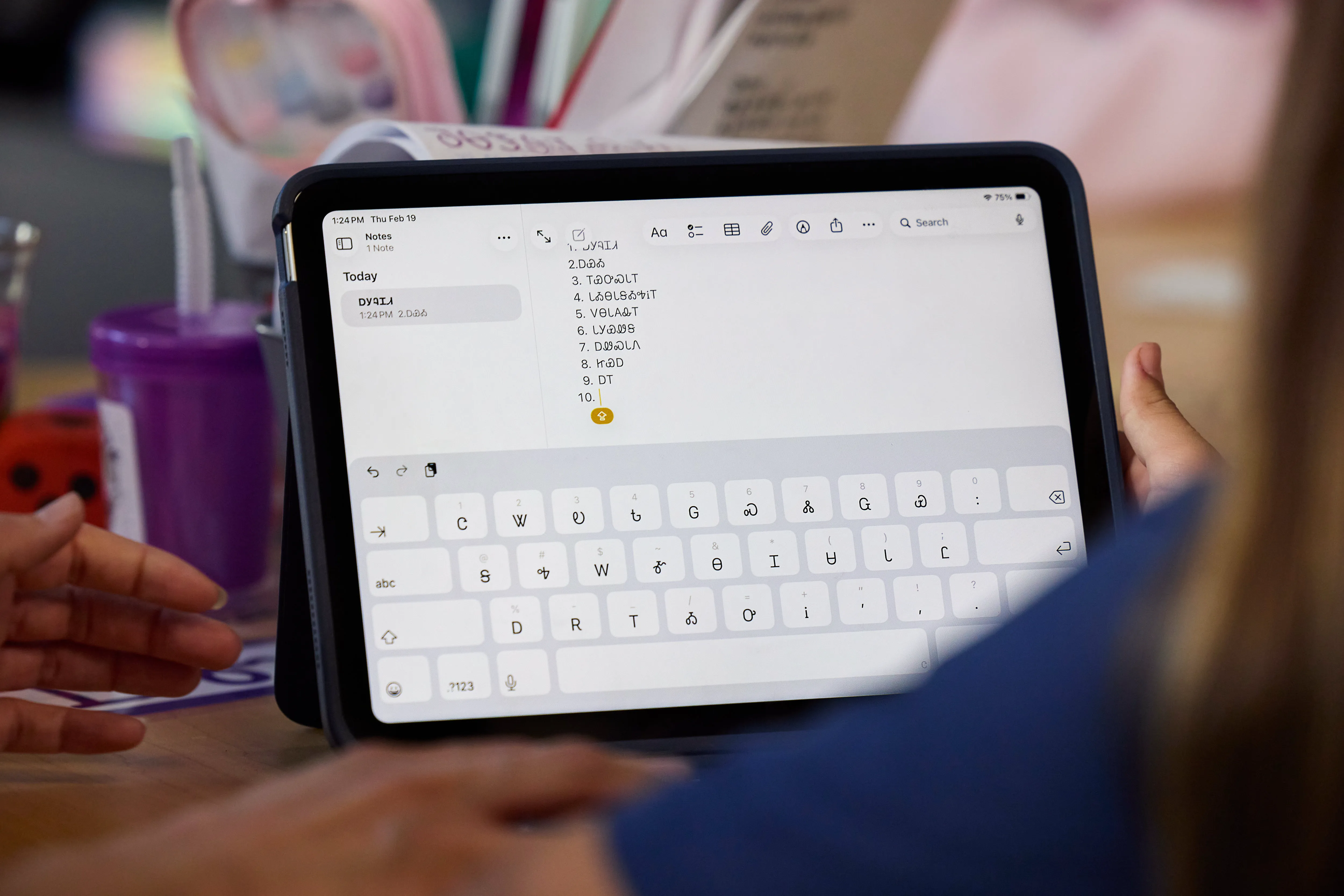
其他语言则需要更定制的方案。例如,内兹珀斯语,或称尼米普提姆语,不使用大写字母。苹果没有让Shift键切换传统的大写字母,而是将其重新用于显示带重音的次级层,这样用户就不必长按单个键来查看这些字符,从而避免打字变慢。在切罗基语中,每个字符大多代表一个辅音与一个元音的组合,这种形式称为音节文字。苹果在底部行添加了自适应元音键,因此当用户输入一个辅音时,这些键会变化以显示它们可以组合的元音。
Other languages need more custom approaches. For example, Nez Perce, or Nimipuutímt, does not use capital letters. Rather than having the Shift key toggle traditional uppercase letters, Apple repurposed it to reveal an accented secondary layer, so users don’t have to hold down individual keys to see those characters, which can slow typing. In the Cherokee language, each character mostly represents a consonant combined with a vowel sound, a form known as syllabary. Apple added adaptive vowel keys on the bottom row, so when a user types a consonant, these keys change to show the vowel combinations they can make.
这是对切罗基键盘的较新改动——苹果曾就此与社区进行沟通,这也意味着为一种语言构建键盘并不是一次性完成的项目。
That’s a newer change to the Cherokee keyboard—one Apple approached the community about, meaning building a keyboard for a language isn’t a one-and-done project.
但将土著文化的语言数字化并不总是无害的。主教大学的玛雅学者兼研究员杰纳尔·兰内斯-奥尔蒂斯研究土著人民如何利用数字技术来重建语言遗产。他回忆起毛利语使用者曾拒绝向科技公司出售其语言的提议。
But digitizing an indigenous culture’s language hasn't always been harmless. Genner Llanes-Ortiz, a Maya scholar and researcher at Bishop's University, studies how Indigenous people use digital technologies to reclaim language heritage. He recalls how Māori speakers rejected proposals to sell their language to tech companies.
“世界各地的原住民曾经历过剥夺的方式,这段历史记忆仍然存在,”兰内斯-奥尔蒂斯说。“毛利人在自身的复兴工作中一直非常坚定地保护其语言资料的访问和存储权,因为他们过去曾被剥削。他们曾经历过知识的掠夺。”
“There’s a historical memory about the ways of dispossession that Indigenous peoples have experienced in the world,” Llanes-Ortiz says. “Māori working in their own revitalization efforts have been very firm in protecting access and storage of their linguistic materials because they have been exploited. They have experienced extraction of knowledge in the past.”
语言主权和数据所有权是苹果软件工程师奇拉什里·曼达尔最关注的问题。“我们不拥有任何东西,我们也非常明确表示,我们并不试图孤立从这个过程中获得的任何数据,”她说。“我们要确保在我们的平台上,为某人语言的最佳表达方式得以实现,让他们使用时感到良好。”
Language sovereignty and data ownership are top of mind, according to Chirasree Mandal, an Apple software engineer. “We don’t own anything, and we make it very clear that we are not trying to silo any data that we gain from this process,” she says. “It’s about making sure that the best choice for representing someone’s language is being made on our platform so they feel good using it.”
就谷歌而言,一位谷歌发言人对《连线》杂志表示,谷歌有着悠久的历史,致力于将鲜为人知和原住民语言引入其平台,以便人们能够进行交流,并指出了将曼克斯语和毛利语等语言纳入平台的合作项目。谷歌还表示,正在探索生成式人工智能如何简化新语言所需的编码和研究工作,但“成功的整合需要母语者的直接参与”,以确保键盘能够满足社区的需求。
For its part, a Google spokesperson tells WIRED it has a long history of bringing lesser-known and Indigenous languages to its platforms so people can communicate, pointing to collaborations to integrate languages like Manx and Māori. Google also says it’s exploring how generative AI can simplify the coding and research required for new languages, but “successful integrations require direct participation from native speakers” for the keyboard to meet the community’s needs.
霍斯金 Jr. 表示,使用音节文字书写被年轻切罗基语使用者视为一种荣誉的象征。人们在 Facebook 上用切罗基语输入自己的名字——这令人振奋。但他认为,这种进步在美国存在着被更广泛的政治修辞所威胁的脆弱性,这种修辞推动着单一的、英语为主的美国,而他指出这种做法忽略了包括美洲原住民历史在内的几个章节。
Hoskin Jr. says that writing in syllabary is seen as a badge of honor for young Cherokee speakers. People type their names in Cherokee on Facebook—that’s empowering. But he sees that progress as vulnerable to broader political rhetoric in the US that pushes a monolithic, English-speaking America, which he says bypasses several chapters, including Native American history.
“目前我们在拯救切罗基语方面面临的最大敌人是时间的流逝和人生命的脆弱性,”霍斯金 Jr. 说。“时间对每个人都很珍贵,但对我们在这项使命中而言,时间尤为珍贵。”
“The greatest enemy we have right now for saving the Cherokee language is the passage of time and the fragility of human life,” Hoskin Jr. says. “Time is precious to everyone, but particularly precious to us in this mission.”