
记者、企业家,甚至一些公关专业人士都会告诉你,公关流程已经出了问题(有空请我喝一杯,我可以给你讲讲我的抱怨)。但人工智能真的能让事情变得更好吗?
Journalists, entrepreneurs, and even some public relations professionals will tell you that the PR process is broken (buy me a drink sometime, and I’ll give you my rant). But could AI actually make things better?
Honeyjar 将参加本周的 TechCrunch Disrupt,作为 Startup Battlefield 200 的一部分,它希望利用人工智能让最优秀的公关专业人士的专业知识和判断力惠及所有人,包括那些不知道从何开始的创始人。
Honeyjar, which will be attending this week’s TechCrunch Disrupt as part of the Startup Battlefield 200, wants to use AI to make the expertise and judgment of the best PR pros available to everyone, including founders who have no idea where to start.
该公司的创始人、首席执行官 Michelle Masek 和首席传播官 Nadia Jamshidi 在公关专业方面完全符合要求。她们在该领域已经工作了数十年,既有企业内部传播经验,也曾在公关公司工作。Masek 最近曾担任 Ev Williams 创办的风险投资公司 Obvious Ventures 的市场与传播高级副总裁。
The startup’s founders, CEO Michelle Masek and CCO Nadia Jamshidi, certainly fit the bill when it comes to PR expertise. They’ve both spent decades in the field, doing in-house communications and working at agencies. Masek recently served as senior vice president of marketing and communications for Ev Williams’ venture firm, Obvious Ventures.
正如 Masek 所描述的,她在“帮助其投资的 110 家投资组合公司处理传播和营销的‘为什么’和‘何时’”方面面临挑战时,我回想起自己曾短暂担任一家早期风险投资公司的营销负责人,当时创始人不断寻求帮助以进入 TechCrunch。因此,我不惊讶于 Masek 会问自己:“有没有办法将高级专业知识通过人工智能进行规模化(以某种方式),真正帮助用户以我们那样主动且专业的方式开展传播工作?”
As Masek described the challenges involved in “helping with the why and when of comms and marketing for 110 portfolio companies” (the startups her firm had invested in), I flashed back to my own brief stint leading marketing at an early-stage VC firm, where founders were constantly asking for help getting into TechCrunch. So I wasn’t surprised that Masek found herself asking, “Is there a way to scale the senior-level expertise into AI [in a way] that actually helps users do the work of comms in the proactive and skilled way that we do?”
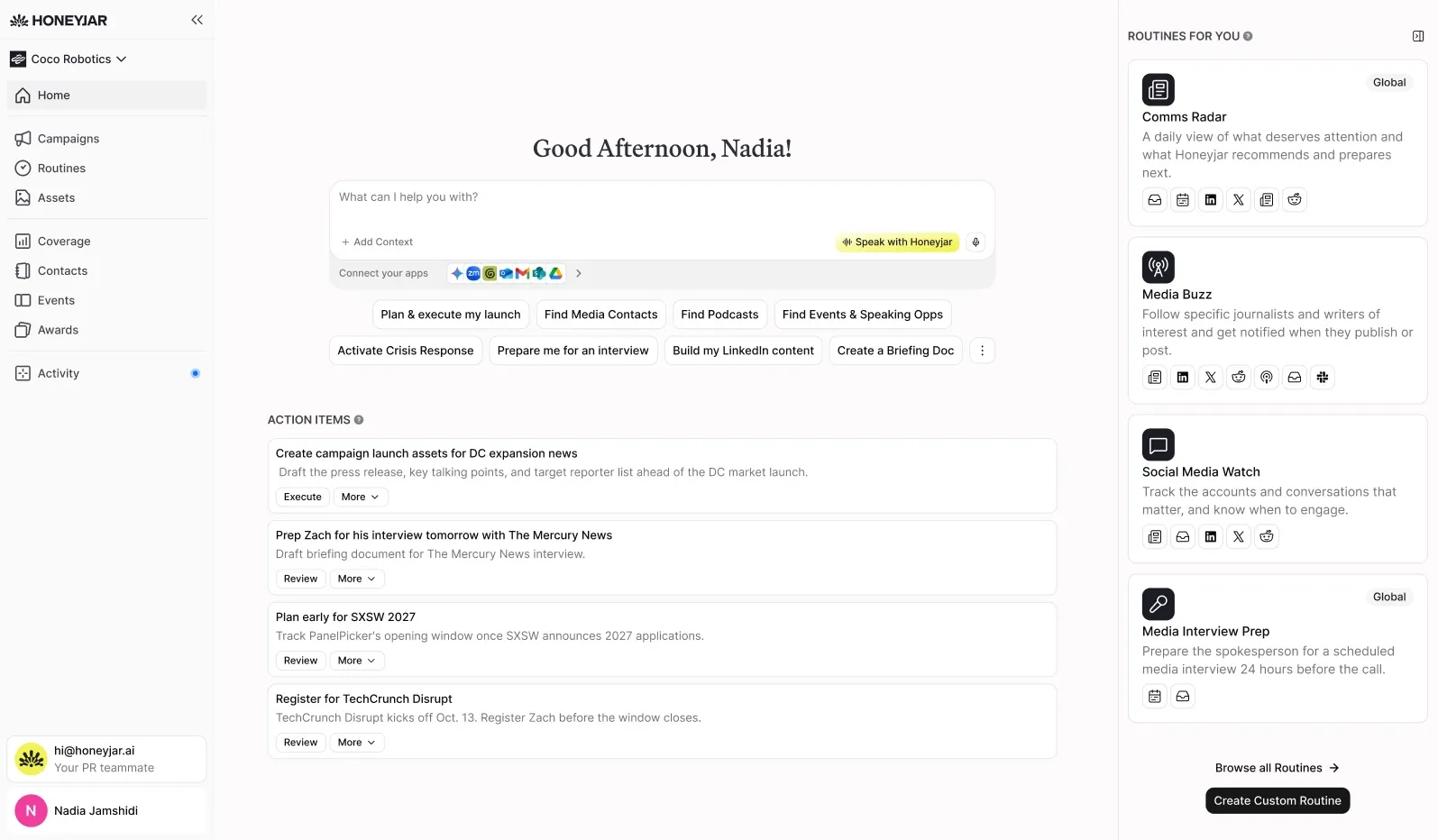
Honeyjar 正是她对这个问题的回答。它能够自动化诸如撰写公告、寻找最合适的记者进行推介以及识别最具前景的演讲机会等流程。但 Jamshidi 在一封跟进邮件中告诉我,Honeyjar 的愿景远不止于获得媒体报道和特定的人工智能工具。
Honeyjar is her answer to that question. It automates processes like writing announcements, finding the best journalists to pitch, and identifying the most promising speaking opportunities. But Jamshidi told me in a follow-up email that Honeyjar’s vision goes beyond getting press coverage and beyond specific AI tools.
“Honeyjar 可以帮助寻找记者、建立媒体名单、扫描新闻和社交媒体、跟踪报道,并发现机会,”她说。“这些功能很重要,但它们只是我们正在构建的内容的一部分。更大的想法是将整个传播工作流程整合在一起:信号、背景、策略、判断、时机和执行。”
“Honeyjar can find reporters, build media lists, scan news and social, track coverage, and surface opportunities,” she said. “Those capabilities are important, but they’re just one piece of what we’re building. The bigger idea is bringing the whole communications workflow together: signals, context, strategy, judgment, timing, and execution.”
而且这不仅仅针对创始人。Masek 说,她已经意识到有“数以百万计的未被指派的传播者负责传播工作”。
And it’s not just for founders. Masek said she’s come to realize there are “millions and millions of unassigned communicators responsible for the work of comms.”
“他们没有传播的头衔,但他们是营销人员、投资者、作者、创作者、学校校长、体育团队领袖,”她补充道。“这对战略传播的需求是极其横向的。它总是被传递,但问题往往没有得到解决。”
“They don’t have the title of comms, but they’re marketers, investors, authors, creators, school superintendents, sports team leaders,” she added. “It’s incredibly horizontal, this need to nail strategic communications. It’s always passed around, but the problems are very often not solved.”
Honeyjar 也并非要取代公关专业人士。Masek 说,她和 Jamshidi 构建了他们自己想使用的工具。她认为,Honeyjar 能让公关公司和内部传播团队更高效,同时让个人公关从业者能够“在没有任何规模成本的情况下接手第三个客户”。当 Honeyjar 开放等待名单时,Masek 说,在首个 24 小时内就收到了 10,000 份报名。Beta 测试者包括 Nextdoor、科技初创公司 Coco Robotics、投资机构 Bloomberg Beta,以及机构 Mission North 和 Full Picture。
Nor is Honeyjar trying to replace PR professionals. Masek said she and Jamshidi built the tool they wanted to use themselves. She argued that Honeyjar can make PR firms and in-house comms teams more effective, while allowing individual PR practitioners to “take on that third client without any scaling cost.”When Honeyjar opened its waitlist, it received 10,000 signups in the first 24 hours, said Masek. Beta testers include Nextdoor, tech startup Coco Robotics, investor Bloomberg Beta, and agencies Mission North and Full Picture.
这对希望获得更多关注的公司来说听起来很有前景,但对记者而言可能是噩梦。我们收到的提案比能够回复的多得多,其中许多已经由 AI 聊天机器人撰写。
That sounds promising for companies looking to get more attention, but it could be a nightmare for journalists. We receive more pitches than we can respond to, many of them already written by AI chatbots.
当我表达对被更多公关垃圾信息淹没的担忧时,Masek 指出,虽然 Honeyjar 可以用客户的语气起草推介邮件或社交媒体帖子,但实际发送或发布仍需客户本人操作。“我们绝不希望出现人类被从环节中剔除的世界,”她说。
When I raised my fears about getting inundated with even more PR slop, Masek noted that while Honeyjar can draft a pitch email or a social media post in the customer’s voice, the customer actually has to hit send or publish. “We never want a world where the human is removed from the loop,” she said.
这也是判断力关键所在。梅塞克说,她和贾姆希迪试图“用我们的智慧灌输并编码到Honeyjar中”。通过一个名为Comms Lab的更广泛的倡议,他们现在也在用其他公关专业人士的判断来训练该产品。
And that’s also where judgment is key. Masek said she and Jamshidi tried to “infuse and encode Honeyjar with our wisdom.”Through a broader initiative called the Comms Lab, they’re now training the product on the judgment of other PR pros as well.
“对我们来说,判断力就是知道该做什么、不该做什么、何时行动以及如何适应情况,”贾姆希迪补充道。“这来自于理解公司的目标和优先事项、组织内外发生的事情,以及知道该说什么、对谁说、在哪里说以及何时说。”梅塞克表示,在某些情况下,Honeyjar甚至可能告诉创始人他们目前还不适合接受媒体报道。
“For us, judgment is knowing what to do, what not to do, when to act, and how to adapt to the situation,” Jamshidi added. “That comes from understanding a company’s goals and priorities, what’s happening inside and outside the organization, and knowing what to say, to whom, where, and when.”In some cases, Masek said Honeyjar might even tell a founder that they’re simply not ready for coverage.
“我们经常听到记者说,他们希望看到更好的提案,希望直接听到专家的声音,”她说。“我们实际上看到一个未来:你的收件箱里会有更多来自你真正想听取意见的来源的可信提案。”
“We hear from reporters all the time who want better pitches, who want to hear from experts directly,” she said. “We actually see a future where there are more credible pitches in your inbox from sources who you actually want to hear from.”