
很少有人怀疑人工智能是上个世纪以来最具变革性的技术之一。从许多标准来看,它的传播速度和范围都超过了工业革命发端以来的任何创新。蒸汽机在十九世纪开始普遍使用,电力则在二十世纪初普及,但直到几十年后铁路、公路和电网建成,它们的全部潜力才得以实现。商用计算机出现于20世纪50年代,但在20世纪90年代互联网将其连接起来之前,它们并未对经济带来显而易见的推动作用。
Few people doubt that AI is among the most transformative technologies to emerge in the past century. By many measures, it is spreading faster and more widely than any innovation since the dawn of the Industrial Revolution. Steam engines came into common use in the nineteenth century and electricity in the early twentieth, but their full potential was not realized before the completion of railways, highways, and power grids decades later. Computers for business use emerged in the 1950s, but they gave no visible lift to the economy before the Internet connected them in the 1990s.
相比之下,商业人工智能几乎在一夜之间出现在全球的屏幕上,而此时绝大多数人已经拥有了电脑或智能手机。在ChatGPT发布不到四年的时间里,大约百分之三十的美国人现在正在使用人工智能,这一比例是美国人在同等发展阶段使用智能手机、互联网或电力的人口比例的五倍。人工智能公司的营收是此前包括互联网、云计算和早期移动应用在内的数字技术在其发展初期所产生营收的三倍。
Commercial artificial intelligence, by contrast, appeared almost overnight on screens worldwide, at a moment when the overwhelming majority of humans already had access to a computer or smartphone. Less than four years after the release of ChatGPT, roughly 30 percent of Americans are now using AI, five times the share of Americans who were using smartphones, the Internet, or electricity at comparable stages of development. Revenue for AI companies is three times what previous digital technologies, including the Internet, cloud computing, and early mobile apps, generated in their early years.
政策制定者、投资者和商界领袖都指望人工智能能成为包治百病的灵丹妙药,从失控的公共债务到老龄化人口带来的成本,它都能应对。在投资者当中,甚至一些全球最成功的逆向投资专家——他们通过押注反对传统智慧而发家——也在接受这样一种观点,即人工智能带来的收益可能比以往任何技术进步都更大、更迅速。
Policymakers, investors, and business leaders are counting on AI to be a miracle cure for everything from runaway public debt to the costs associated with aging populations. Among investors, even some of the world’s most successful contrarians—who make their fortunes betting against conventional wisdom—are embracing the idea that AI could yield bigger benefits more rapidly than any past technological advance.
然而,这种欣喜若狂的情绪并非普遍存在。一群日益孤立的怀疑论者认为,人工智能的崛起虽然看起来异常迅速,但实际上正在遵循一套已有数百年历史的剧本。重大技术革命总是会引发戏剧化的繁荣-萧条周期。人们会对最新突破产生过度兴奋,并开始无差别地投资于推动创新的公司。正如得克萨斯理工大学、得克萨斯农工大学以及比利时弗莱里克商学院的一支研究团队在2018年所发现的,过去两个世纪中所有最具革命性的技术创新都引发了重大市场泡沫——股价快速上涨,随后出现急剧下跌。
The euphoria is not universal, however. An ever-lonelier minority of skeptics argue that AI’s rise may seem unusually fast but is in fact following a centuries-old script. Major technology revolutions have always triggered dramatic boom-bust cycles. People get overexcited about the latest breakthrough and begin investing indiscriminately in the companies driving the innovation. As a team of researchers from Texas Tech University, Texas A&M University, and the Vlerick Business School in Belgium found in 2018, all of the most revolutionary technological innovations of the last two centuries inflated a major market bubble—a rapid increase in stock prices, followed by a precipitous decline.
“泡沫”这个词往往会让人联想到像空气一样脆弱的东西。但就像之前所有的科技泡沫一样,当前人工智能热潮背后的创新是真实存在的,这种炒作源于真正的前景。然而,正是这种前景正在推动泡沫的膨胀。一旦狂热开始出现裂痕——正如它必然会发生的那样——冲击将在金融市场中荡漾开来,并波及全球经济,而全球经济正日益依赖人工智能实现增长。
The word “bubble” tends to conjure an idea as thin as air. But as with all previous tech bubbles, the innovations of the current AI boom are real, the hype born of genuine promise. That promise, however, is exactly what is inflating the bubble. Once the mania begins to crack, as it inevitably will, the shock will ripple back through financial markets into a global economy increasingly dependent on AI for growth.
这种损害将遍及全球,不仅体现在引领人工智能发展的国家,还体现在许多正努力为这些国家提供输入要素的国家中。最脆弱的参与者将被淘汰出局,而幸存者将巩固其领先地位。从废墟中,一个更加稳定的人工智能生态系统将会浮现出来。
The damage will be felt worldwide, not only in the countries leading AI’s development but in the many now battling to supply them with inputs, as well. The weakest players will be wiped out, and the survivors will consolidate their lead. And from the rubble, a more stable AI ecosystem will emerge.
全力以赴 AI竞争已在重塑经济世界秩序。这一秩序的顶端是美国——基础AI模型ChatGPT于2022年底面向消费者推出,以及中国——DeepSeek约一年后首次亮相。从那时起,争夺霸主地位的竞赛已开始驱动两国经济。
ALL IN The AI competition is already reshaping the economic world order. At the top of this order stand the United States, where the foundational AI model, ChatGPT, reached consumers in late 2022, and China, where DeepSeek made its debut around a year later. Since then, the race for supremacy has come to drive both countries’ economies.
在美国,增长主要由大型科技公司在AI项目上投入的数千亿美元资金,以及由AI主导的股市上涨所激发的消费支出所推动。基准指数标普500指数的前十大股票全是AI巨头,合计占指数近40%的权重,并贡献了今年指数回报的约一半。
In the United States, growth has been fueled primarily by the hundreds of billions of dollars of Big Tech investment in AI projects and by consumer spending energized by gains in a stock market dominated by AI. The top ten stocks in the benchmark S&P 500 are all big AI players and together account for nearly 40 percent of the index and around half of its returns this year.
中国在AI上的投入少得多,但离不开AI。在过去十年下滑后,净出口——主要是AI相关商品——如今占中国增长的三分之一。国内经济除此之外陷于停滞,受困于坏账和劳动力萎缩。北京也在大力支持国产AI模型出口,这些模型因比美国前沿模型更便宜、性能却近乎相当而逐渐走俏。
China is spending far less on AI but would be lost without it. After falling in the last decade, net exports—mainly of AI-related goods—now account for a third of China’s growth. The domestic economy is otherwise moribund, hampered by bad debts and a shrinking labor force. Beijing is also heavily supporting the export of its homegrown AI models, which are catching on because they are cheaper than American frontier models but perform nearly as well.
人工智能的热潮如今已超越华盛顿和北京。投资者正向为美国科技巨头提供算力、半导体及其他所需基础组件的公司注入资金,推动全球股市掀起涨势。以亚洲为例,三家主要半导体公司已从中获益:台湾的台积电以及韩国的SK海力士和三星,它们在各自本地股指中的占比甚至超过美国科技巨头在美国股指中的占比。
The AI rage now extends beyond Washington and Beijing. Investors are plowing funds into companies that supply American tech giants with the computing power, semiconductors, and other building blocks they need, fueling stock market booms worldwide. In Asia, for example, three major semiconductor companies have reaped the benefits: TSMC in Taiwan and SK Hynix and Samsung in South Korea, which comprise an even larger share of their local stock indexes than big American tech firms account for in the U.S. index.
在这些相对较小的经济体中,全球人工智能热潮所引发的冲击甚至超过美国。韩国市场总值从2025年初的1.5万亿美元激增至今夏超过5万亿美元。散户投资者在18个月内获得的股票财富增长超过了他们一生的总和。芯片出口推动台湾在某些最近季度的实际增长率逼近两位数,这一增速在任何经济体中都鲜见。
In these relatively small economies, the global frenzy for AI has generated even greater shocks than in the United States. The total value of South Korea’s market exploded from $1.5 trillion at the start of 2025 to over $5 trillion this summer. Individual investors saw bigger gains in stock wealth over 18 months than they had in a lifetime. Chip exports have driven real growth in Taiwan toward double digits in some recent quarters, a pace rarely approached in any economy.
在此所谓人工智能基础设施“堆栈”这一层级的其他国家,也因全球市场向人工智能硬件制造商——即“铲子和镐”——倾斜而同样受益。高科技如今占以色列全部经济增长的一半以上,这得益于该国在训练人工智能所需的高速网络方面的专长。在日本,专注于人工智能相关设备、材料、机器人和半导体的公司已成为市场宠儿;作为存储芯片先驱的铠侠在成为美国科技公司的主要供应商后,其股价飙升至一年前的45倍以上,短暂成为日本市值最高的股票。
Other countries at this level of the so-called AI stack of computing infrastructure have benefited similarly from the global market tilt toward builders of AI hardware, or “picks and shovels.”High tech now accounts for as much as half of all economic growth in Israel, owing in part to the country’s expertise in the high-speed networks needed to train AI. In Japan, firms that specialize in AI-related equipment, materials, robots, and semiconductors have become market darlings; after Kioxia, a pioneer in memory chips, became a major supplier to U.S. tech companies, its share price spiked to more than 45 times what it had been a year earlier, briefly becoming Japan’s most valuable stock.
中国、日本、韩国、台湾和美国这五大科技强国在研发和技术上的平均支出占GDP的比例,远高于其他国家。但它们远不是唯一争夺人工智能“堆栈”立足点的国家。
All five of these leading tech powers—China, Japan, South Korea, Taiwan, and the United States—spend, on average, much more than other countries on R & D and technology as a percentage of GDP. But they are far from the only countries racing to secure footholds in the AI stack.
在它们下方,二级供应商正在与行业龙头建立联系。美国和中国的AI巨头正在新加坡和马来西亚的数据中心上投入数十亿美元。各公司正在墨西哥大力投资AI服务器生产,墨西哥也正在崛起成为AI相关硬件的重要出口商。至少有六家科技公司在越南启动了AI项目,其中包括一个大型研发中心以及旨在开发该国人才库的培训设施。
Below them, secondary suppliers are forging ties to the leaders. U.S. and Chinese AI giants are spending billions on data centers in Singapore and Malaysia. Firms are investing heavily in AI server production in Mexico, which is emerging as an important exporter of AI-related hardware, as well. At least half a dozen tech companies have launched AI projects in Vietnam, including a major R & D center and training facilities to develop the country’s talent pool.
反过来,这场全球性的AI基础建设工程预计将为数据中心铺设线路和储存能源所需的原材料提供多年源源不断的需求:来自印度尼西亚的镍、来自澳大利亚的锂、来自智利、秘鲁和刚果民主共和国的铜。被称为超大规模数据中心运营商的大型云服务商正在四处寻找这些能源。2025年,亚马逊、谷歌、Meta和微软占全球签署的所有清洁能源交易的一半。数据中心建设的私人支出比一年前大约增加了50%。
In turn, the worldwide AI construction project is expected to provide years of steady demand for the raw materials required to wire and store energy for data centers: nickel from Indonesia, lithium from Australia, copper from Chile, Peru, and the Democratic Republic of Congo. And the large cloud-service providers known as hyperscalers are looking far and wide for that energy. Amazon, Google, Meta, and Microsoft accounted for half of all clean energy deals signed across the globe in 2025. Private spending on data center construction is up by roughly 50 percent from a year ago.
并非所有国家都加入了这场财富热潮。由于对AI的压倒性关注抽走了流向其他行业的资金,身处产业链之外的国家在吸引投资和信贷方面举步维艰。欧洲大部分地区发现自己被排除在外。印度和菲律宾等新兴经济体也是如此,它们遭到了双重冷落,因为它们蓬勃发展的后台服务行业特别面临被人工智能取代的风险。
Not all countries have joined the bonanza. Those outside the stack struggle to attract investment and credit as the overwhelming focus on AI sucks money away from their industries. Much of Europe finds itself excluded. So do countries with emerging economies such as India and the Philippines, doubly shunned because their thriving back-office service sectors are particularly at risk of displacement by artificial intelligence.
很难想起历史上有什么时期,市场曾如此痴迷于单一行业,并如此依赖其成功。互联网时代曾见证资金从蓬勃发展的行业溢出并流向其他产业。如今,除了AI,几乎没有什么领域是热门的。数据中心建设的私人支出比一年前大约增加了50%,而美国所有其他建筑项目的支出则下降了5%。
It’s hard to think of any period in history when the markets were so obsessed with—and so dependent on the success of—a single sector. The Internet era saw money spill out of the booming sector and into other industries. Today, AI, and little else, is hot. Private spending on data center construction is up by roughly 50 percent from a year ago, while spending on all other building projects in the United States is down by five percent.
到目前为止,人工智能带来的提振效应已经足够强大,足以保护全球经济免受过去两年地缘政治冲击的影响,其中包括美国总统唐纳德·特朗普的关税以及美以针对伊朗的战争。先进制造业的收益和股市驱动的消费者支出继续推动美国经济增长,与人工智能相关的出口则在支撑处于产业链下游的国家。例如,墨西哥和泰国的科技出口增长速度之快,足以抵消两国疲软的国内需求。问题在于人工智能能否维持世界经济,还是一个等待破裂的泡沫。
So far, the lift from AI has been strong enough to shield the global economy from the geopolitical shocks of the last two years, including U.S. President Donald Trump’s tariffs and the U.S.-Israeli war against Iran. Gains in advanced manufacturing and stock market–driven consumer spending continue to power growth in the United States, and AI-related exports are propping up countries further down the stack. Tech exports from Mexico and Thailand, for example, are rising fast enough to offset slack domestic demand in both economies. The question is whether AI can sustain the world economy or is a bubble waiting to pop.
泡沫的特点可以是一个被推得太远的绝佳构想。越来越多的证据表明,市场已经开始将人工智能这个诱人的构想推向极限。
A bubble can be characterized as a good idea taken too far. And there is mounting evidence that markets have begun to push the tantalizing idea of AI beyond its limits.
四个“O”字 回溯几个世纪,开创性的创新催生了出奇一致的人类行为模式。企业斥巨资开发新技术,以期主导一个新兴行业。投资者紧随其后,专业人士率先入场,业余投资者随后跟进。企业借贷以进行建设;投资者借贷以购买这些企业的更多股票。交易达到了狂热的程度。价格上涨超越了创新所能支撑的潜在利润所对应的点。随着顶峰临近,价格上涨不仅加速,而且变得更加动荡,因为怀疑开始侵蚀狂热的边缘。
THE FOUR O’s Going back centuries, pioneering innovations have spawned remarkably consistent patterns of human behavior. Firms spend heavily on developing a new technology in the hope of dominating a burgeoning industry. Investors follow, with professionals leading the way and amateurs jumping in later. The firms borrow to build; investors borrow to buy more stock in those firms. Trading reaches manic intensity. Prices rise beyond a point that potential profits from the innovation can support. As the peak nears, price increases both accelerate and become more volatile as doubt begins to gnaw at the edges of the frenzy.
自至少17世纪以来,这种基本动态一直推动着从郁金香到住房等各个领域的泡沫。简而言之,渴望的对象变得被过度估值、被过度持有、被过度投资以及被过度杠杆化——我在其他地方称之为泡沫的“四个‘O’字”。
This basic dynamic has driven bubbles in everything from tulips to housing since at least the 1600s. In short, the object of desire becomes overvalued, overowned, overinvested, and overleveraged—what I have elsewhere called the “Four O’s” of a bubble.
历史证据表明,最具影响力的创新会产生最大的泡沫。泡沫的规模还取决于关于这个热门新事物的消息传播得有多远、多快。19世纪70年代,通过新建的跨大西洋电报,一系列泡沫(包括铁路股票泡沫)在欧洲和美国之间迅速蔓延。20世纪20年代,电力和电子小玩意通过其中一种小玩意——收音机——在电波中得到宣传。
Historical evidence suggests that the most impressive innovations generate the biggest bubbles. The scale of the bubble also depends on how far and fast word of the hot new thing travels. In the 1870s, a series of bubbles, including one in railroad stocks, moved quickly between Europe and the United States via the new transatlantic telegraph. In the 1920s, electricity and electric gadgets were promoted over the airwaves on one of those gadgets, the radio.
如今,对人工智能的炒作正在智能手机和社交媒体上蔓延,这些数字产品在2000年互联网泡沫破裂时甚至还不存在。综合来看,这些现象应该引发人们对这场狂热将会走多远的担忧。
Today, hype for AI is spreading on smartphones and social media, digital products that did not yet exist when the Internet bubble popped, in 2000. Taken together, these phenomena should raise concerns over just how far the mania will go.
如果人工智能确实是有史以来最具变革性、普及速度最快的新技术,它所制造的泡沫可能会成为迄今为止最戏剧性的泡沫。
If AI is indeed the most transformative and most rapidly diffused new technology ever, the bubble it creates could be the most dramatic yet.
价格大错特错 在过去半个世纪的主要泡沫中,经通胀调整后的价格通常在15年内上涨了十倍。美国科技股在2025年越过了这一门槛。人工智能多头辩称,与互联网繁荣时期的网络公司不同,如今的明星科技公司正在产生强劲的盈利,并将继续保持下去,因此它们不断攀升的股价是合乎情理的。
THE PRICE IS WRONG In the major bubbles of the past half century, prices have typically risen tenfold, adjusted for inflation, over a period of 15 years. U.S. tech stocks crossed that threshold in 2025. The AI bulls argue that unlike the dot-coms of the Internet boom, today’s marquee tech firms are generating strong earnings and will continue to do so, and their escalating stock prices are therefore justified.
但对科技泡沫的兴奋总是由真正的进步而非单纯的市场营销所激发。例如,尽管在公众的想象中,互联网时代与 Pets.com 这样没有利润的初创公司联系在一起,但这些只是小角色。20世纪90年代末的巨头(包括高通、甲骨文和思科)的盈利水平与今天的亚马逊、谷歌和微软不相上下。20世纪90年代末,科技行业的年度盈利增长率与当前十年相同,均为22%。
But the excitement about tech bubbles is always stirred by genuine progress, not mere marketing. Although the dot-com era, for instance, is linked in the popular imagination with profitless startups such as Pets.com, these were minor players. The giants of the late 1990s, including Qualcomm, Oracle, and Cisco, logged earnings on par with Amazon, Google, and Microsoft today. The tech sector posted the same annual rate of earnings growth in the late 1990s as it has in the current decade: 22 percent.
认为只要企业盈利强劲,股市繁荣就不会是泡沫的观点,为历史所否认。事实上,在泡沫中,盈利也被人为夸大并不罕见。这种双重风险在互联网泡沫时期仅部分显现,但在2000年代初期房地产和大宗商品狂热爆发时却清晰可见。
The assumption that a boom can’t be a bubble if corporate earnings are strong is belied by history. It is in fact not uncommon in a bubble for earnings to be artificially inflated as well. This twin risk was only partly evident in the dot-com period, but it was clear when the craze for housing and commodities took off in the early 2000s.
更何况,盈利或许并没有表面上看起来那么稳健。它们在一定程度上是由“循环资金”支撑的,在这种模式下,超大规模云服务商投资于诸如OpenAI或Anthropic等前沿人工智能实验室。随后,该实验室将部分资金用于向该云服务商购买服务,从而推高了后者的盈利。超大规模云服务商还重新评估其在人工智能实验室中的持股价值,并将增值部分记为“其他收入”,这一类别占了今年其盈利增长的四分之一。
What is more, earnings may not be as solid as they appear. They are propped up in part by “circular funding,” in which a hyperscaler invests in a frontier AI lab such as OpenAI or Anthropic. The lab then uses the money in part to buy services from—and thus pump up the earnings of—the hyperscaler. Hyperscalers also revalue their stake in an AI lab and report the increase as “other income,” a category that has accounted for a quarter of their earnings growth this year.
人工智能实验室是众多选择尽可能长时间保持非上市状态以避免公众对其盈利进行审视的美国公司之一。如今,其中许多公司正计划上市,但它们的盈利能力远不及20世纪90年代末的前辈。筹备首次公开募股的两个最大名字是Anthropic和OpenAI。为了获取客户和市场份额,这两家公司向客户收取的费用都低于训练和运行其人工智能模型的成本。分析师甚至在毫无利润的情况下,仅凭快速的营收增长,就已经估计每家公司的价值远超1万亿美元。
AI labs are among the many U.S. companies that have been choosing to remain private for as long as possible to avoid public scrutiny of their earnings. Now, many of these firms are planning to go public, but they are far less profitable than their predecessors in the late 1990s were. The two biggest names in the pipeline for an initial public offering of stock are Anthropic and OpenAI. To gain customers and market share, both companies are charging theirrs less than it costs to train and run their AI models. Analysts have already estimated each company’s value at well over a trillion dollars, even with no profits, based on rapid revenue growth alone.
所有权社会 与此同时,美国人正以前所未有的方式投资股票。美国是唯一一个家庭在股票中持有的财富超过房产的国度。典型的美国家庭将其30%以上的财富持于股票中,超过了2000年27%先前峰值。由于这些资金很大一部分持于仅仅追踪标普500指数的“被动型”基金中,因此绝大部分资金都流向了主导该指数的人工智能股票。
OWNERSHIP SOCIETY Americans, meanwhile, are investing in stocks as they never have before. The United States is the only country in which families hold more wealth in stocks than in their homes. The typical U.S. household holds more than 30 percent of its wealth in stocks, surpassing the prior peak of 27 percent in 2000. Since much of this money is held in “passive” funds that simply track the S&P 500 index, the bulk of it goes into the AI stocks that dominate the index.
专业资金管理者旨在通过与众不同来战胜市场,但他们发现很难逆潮流而动。他们的持仓越来越像那些曾被他们斥为“笨钱”的散户投资者。业余交易者持有的股票中,近三分之一也被对冲基金和其他典型激进的专业人士持有,创下纪录。在过去五年里,美国每天交易的股票数量激增了50%,达到约180亿股。散户投资者已经超越专业人士,成为最活跃的交易者,并积极“逢低买入”;到2026年,在股市下跌日的交易量已飙升至所有交易日平均水平的三倍以上。
Professional money managers aim to beat the market by being different, but they are finding it difficult to buck the crowd. Their holdings look increasingly like those of the retail investors they once dismissed as “dumb money.”Nearly a third of the stocks held by amateur traders are also held by hedge funds and other quintessentially aggressive pros, a record Over the last five years, the number of shares traded each day in the United States has surged by 50 percent to around 18 billion. Retail investors have surpassed the pros as the most active traders and are aggressively “buying the dips”; in 2026, trading on down days has surged to more than three times the average for all days.
外国投资者也在大力押注美国人工智能,自互联网泡沫破裂以来,他们持有的美国股票从不足2万亿美元激增至超过20万亿美元,其中大部分增幅出现在2022年11月ChatGPT推出之后。
Foreigners are betting big on American AI, too; their holdings of U.S. stocks have mushroomed from under $2 trillion to more than $20 trillion since the dot-com bust, with most of that increase coming since the launch of ChatGPT, in November 2022.
因此,人工智能已经被市场上的所有参与者过度持有。散户投资者的热情已经蔓延至其他人工智能驱动的市场,包括韩国,该国过去一直是全球股市走势的风向标。今年夏天,大型半导体股票的大幅下跌将韩国股指拉低,随后当地投资者再次开始“逢低买入”。这种走走停停的波动往往预示着一轮股市上涨行情已进入最后阶段。
AI is thus already overowned by all players in the market. The zeal among retail investors has spread to other AI-driven markets, including South Korea, which in the past has been a bellwether of global stock market movements. Sharp drops in big semiconductor stocks pushed the Korean index down this summer, before locals once again started “buying the dips.”This kind of stop-and-go volatility often signals that a market rally is in its last stages.
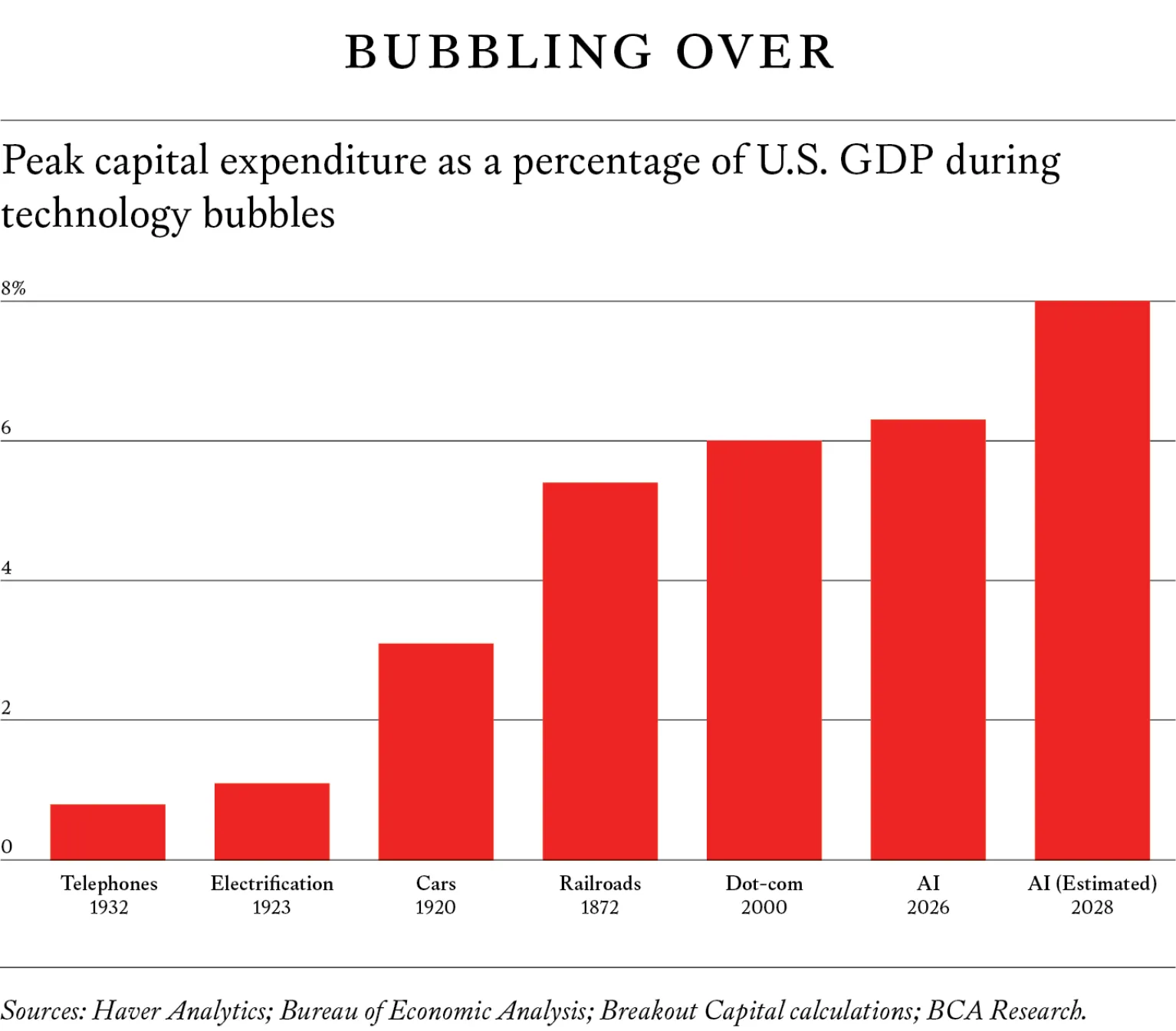
大笔支出 关于人工智能经济学的许多争论都集中在,科技公司为建设基础设施而投入的巨额资金是否能在可预见的未来产生相称的回报。在过去三年中,科技投资增加了一倍以上的多倍,其规模和速度是铁路、运河或互联网的兴起都无法比拟的。在互联网泡沫鼎盛时期,科技领域用于新建厂房和设备的支出创下了占GDP 6.0%的纪录。如今这一比例已达到6.3%,并预计将继续增加。
BIG SPENDERS Much of the debate about the economics of AI focuses on whether the enormous sums that technology firms are investing in building infrastructure can generate commensurate returns in the foreseeable future. Tech investment has more than quadrupled in the last three years, a boom unmatched in scale or speed by the rise of railways, canals, or the Internet. Tech spending on new plants and equipment hit a record 6.0 percent of GDP at the height of the Internet bubble. Today, it stands at 6.3 percent and is projected to keep increasing.
这种挥霍实现自我回本的一个途径是提高生产率(即每个工人的产出),并为整个经济注入活力。但在互联网泡沫的相似发展阶段,“全要素生产率”这一旨在衡量工人从机器中产出多少的关键指标的增长当时正呈飙升之势。如今,这一指标几乎没有上升。
One way this splurge could pay for itself is by raising productivity, or output per worker, and energizing the entire economy. But at a similar stage of the Internet boom, growth in the key measure of “total factor productivity,” which aims to capture how much output workers are generating from machines, was surging. Now it is barely rising.
即使生产率最终确实上升,大多数人工智能公司也可能无法收获回报。经济学家威廉·诺德豪斯已经证明,铁路、航空公司和互联网等过去创新所创造的价值中,只有百分之二归属于构建这些网络的公司。其余的则归属于使用这些发明的消费者和企业。网络泡沫时期涌现的5万家初创公司中,大多数在随后的破产潮中消亡,给它们的投资者造成了财富毁灭;如今大约有10家存活下来并成为了科技巨头。
Even if productivity does ultimately rise, most AI firms may not reap the rewards. The economist William Nordhaus has shown that only two percent of the value created by innovations of the past, including railroads, airlines, and the Internet, went to the companies that built these networks. The rest went to the consumers and businesses that used the inventions. Most of the 50,000 startups of the dot-com boom were wiped out in the eventual bust, destroying wealth for their investors; around ten survive today as tech giants.
人工智能正面临着在更广阔领域出现类似严重危机的可能。正如科技战略家杰夫·麦克米伦最近所言,随着美国国内外的相关人工智能初创公司达到7万家,“即将到来的人工智能公司大屠杀与即将到来的人工智能经济增长是同一场事件。”但在泡沫达到顶峰之前,谨慎情绪会逐渐消退。人工智能支出正在全球范围内蔓延,美国超大规模数据中心运营商的所有支出中,大约有百分之四十用于海外项目。到2030年,全球累计的人工智能相关投资预计将再次翻一番以上,达到6万亿美元。
AI faces the prospect of a similar crunch in a wider field. With 70,000 AI-related startups in the United States and abroad, as the tech strategist Jeff McMillan recently put it, “the coming massacre of AI companies and the coming growth of the AI economy are the same event.”But caution fades before a bubble reaches peak size. AI spending is spreading worldwide, with roughly 40 percent of all outlays by U.S. hyperscalers going into projects abroad. Cumulative global AI-related investment is expected to more than double again, to $6 trillion by 2030.
在最大的泡沫中,投资会达到一个临界点,在此之后,失败企业、坏账和失业所带来的泡沫破裂成本将超过繁荣所带来的收益。甚至连新技术的先锋企业,最终也会过度投资而无法获得回报。由全球主要央行组成的国际清算银行在7月警告称,超大规模数据中心运营商的支出竞赛正沿着超越这一投资“社会最优水平”的方向发展。
In the biggest bubbles, investment reaches a tipping point after which the cost of the bust in failed businesses, bad debts, and job losses outweighs the benefits of the boom. Even companies at the vanguard of the new technology end up investing too heavily to earn a return. The Bank for International Settlements, a consortium of the world’s major central banks, warned in July that the hyperscalers’ spending race was on track to blow past this “socially optimal level” of investment.
债务催收人 人工智能投资热潮依赖于隐藏的补贴和债务,这使其更具脆弱性且更难衡量。几年前,前五大超大规模云服务商仍在产生大量盈余现金流;如今,只有微软一家依然如此。其中四家公司的净债务有所增加,它们在现金短缺时发行债券,不得不通过借贷来资助其基建扩张。
DEBT COLLECTORS The AI investment boom rests on hidden subsidies and debts, which makes it more fragile and harder to measure. A few years ago, the top five hyperscalers were still generating large piles of surplus cash flow; today, only Microsoft does. Four of them have seen an increase in net debt, issuing bonds as they run low on cash and have to borrow to fund their buildouts.
截至7月,美国科技公司报告的净债务负担相对较小,为2500亿美元。但这些表面数字并未包括超大规模云服务商通过复杂租赁和其他账外交易为其融资的项目,这些交易在未来十年内可能会为其借贷增加约3万亿美元。
As of July, U.S. tech firms still had a relatively small reported net debt burden of $250 billion. But these visible figures do not include projects the hyperscalers are financing through complex leases and other off-the-books deals, which could add around $3 trillion to their borrowing over the next decade.
更多的支持来自公共部门。在20世纪90年代末,美国联邦储备委员会维持的货币政策比现在更为紧缩,且美国政府实现了财政盈余。为互联网泡沫提供资金的资金几乎完全来自私营部门。即使企业盈利强劲,繁荣也可能是泡沫。
More support is coming from the public sector. During the late 1990s, the U.S. Federal Reserve kept monetary policy tighter than it does now, and the U.S. government ran a surplus. The money that financed the Internet boom came almost exclusively from the private sector. A boom can be a bubble even if corporate earnings are strong.
在接下来的十年里,一切都发生了变化,特别是2008年全球金融危机之后。为了复苏和维持增长,美联储显着放松了货币政策——并且即使在好日子回归时也一直保持宽松。鉴于如今较低的失业率和稳健的增长,美联储目前的基础贷款利率比标准学术指南建议的水平整整低了一个百分点。通货膨胀率已经连续五年多超过美联储百分之二的目标。
Everything changed over the next decade, particularly after the 2008 global financial crisis. To revive and sustain growth, the Fed markedly loosened monetary policy—and kept it loose even when good times returned. Today, the Fed is holding its basic lending rate a full point below what standard academic guidelines would advise, given today’s low unemployment and solid growth. Inflation has exceeded the Fed target of two percent for more than five years running.
与此同时,在过去十年里,美国政府赤字翻了一番,达到占GDP百分之六以上的水平,这实际上将数十亿美元的借入资金转移给了家庭和企业。根据追踪政府慷慨资金流入企业利润流向的卡莱茨基-利维方程(Kalecki Levy equation),本十年中,预算赤字占美国企业利润的一半以上——是互联网泡沫时期的两倍。如果没有高耸入云的赤字,人工智能的收益看起来就不会像现在这样强劲。如果人工智能的收益并不像表面看起来那样,那么该行业应对快速上升的债务负担的能力也可能会摇摇欲坠。
Meanwhile, the U.S. government deficit has doubled over the last decade to more than six percent of GDP, in effect transferring billions in borrowed money to households and corporations. According to the Kalecki Levy equation, which tracks the flow of government largess into corporate profits, the budget deficit has accounted for more than half of U.S. corporate profits this decade—twice the level of the dot-com era. Without sky-high deficits, AI earnings would not look nearly as strong as they do. And if AI earnings are not what they appear, the industry’s ability to manage a fast-rising debt burden is likely to be shaky, as well.
泡沫隐藏在模糊的会计手段背后并不罕见,但这些隐性补贴的规模是前所未有的。资金来源也是如此。源源不断地从政府、央行和私营部门涌出的资金,将使人工智能泡沫比以往任何前辈泡沫都要大得多。
It’s not unusual for bubbles to hide behind murky accounting, but the scope of these hidden subsidies is new. So are the sources. The torrent of money pouring out of the government, the central bank, and the private sector will make the AI bubble much bigger than any of its predecessors.
泡沫麻烦 关于当前人工智能狂热可能如何结束的辩论,往往集中在人工智能公司削减投资、报告令人惊讶的疲软收益,或者以这样或那样的方式承认人工智能不会带来丰厚回报、或者回报来得不够快而无法证明当前股价合理的情景上。然而,泡沫并非完全自行破裂;投资狂热不会因为基本面突然改变而消退。在泡沫膨胀期间,收益可以保持强劲,而在经济低迷时期,股价通常在收益开始下跌的几个月前就已开始下跌。
BUBBLE TROUBLE Debates over how the current AI mania might end tend to focus on scenarios in which AI firms cut back on investment, report surprisingly weak earnings, or appear to concede one way or another that AI is not going to pay off richly or soon enough to justify current stock prices. Yet bubbles do not burst entirely of their own accord; investment crazes don’t wane because fundamentals suddenly change. Earnings can remain strong as bubbles inflate, and in a downturn, stock prices typically begin to fall several months before earnings do.
唯一一致的信号来自金融家。当流动性收紧时泡沫就会破裂,这意味着更高的利率或更严格的监管使得资金更难借到,而私人债权人则越来越不愿意以任何利率放贷。随着资金枯竭,企业和投资者可用于投资的资金就会减少。这种情况可以通过无数种方式发生。
The one consistent signal comes from the financiers. Bubbles pop when liquidity tightens, meaning higher rates or stiffer regulation make money harder to borrow, and private creditors grow less willing to lend at any rate. As money dries up, firms and investors are left with less money to invest. This can happen in myriad ways.
在过去的一个世纪里,央行加息往往先于每一次重大泡沫的破裂。然而如今,承担债务上升最大负担的不再是企业,而是政府;而最需要关注的关键角色也不再是央行行长。他们是“债券警戒者”——即那些通过抛售政府债券、将长期利率推升至痛苦高位,以此惩罚挥霍无度政府的投资者。最近,这类警戒者在美国、欧洲和日本纷纷抬头。如果他们卷土重来,利率上升及由此导致的流动性紧张将使人工智能公司通过更高负债来维持扩张计划的融资变得更加困难,甚至可能导致股市暴跌。
Over the past century, central bank rate hikes have preceded the popping of every significant bubble. Now, however, it is governments, not corporations, who shoulder the largest burden of rising debt, and the most important players to watch are no longer central bankers. They are the “bond vigilantes,” investors who periodically punish free-spending governments by selling their bonds, pushing long-term interest rates to painfully high levels. Of late, vigilantes have been rearing their heads in the United States, Europe, and Japan. If they return in force, rising rates and the resulting liquidity squeeze will make it much harder for AI firms to keep funding their expansion plans through heavier borrowing, and could send the stock market plummeting.
这就是终局的展开方式。问题首先在债务市场浮现,随后蔓延至其他金融市场。今年夏天,美国和亚洲市场的半导体股出现震荡,症状便已初现;其他人工智能股票也可能面临迫在眉睫的风险。因此,美国银行最近发布的一份研究报告警告称,“类似泡沫的不稳定”正在全球蔓延,这也毫不令人意外。
This is how the endgame unfolds. Problems surface first in the debt markets, then spill over into other financial markets. Symptoms started to appear this summer in the U.S. and Asian markets with tremors in semiconductor shares, but other AI stocks may be at imminent risk. It’s hardly a surprise, then, that a research note from Bank of America recently warned that “bubble-like instability” was spreading worldwide.
崩盘之后 每一场繁荣都埋下了自身消亡的种子。大型科技股自2009年以来一直在上涨,但在四年前开始走弱,当时美联储大幅加息。随后,ChatGPT的发布和美联储紧缩政策的结束,让科技股牛市迎来了第二春。正如国际清算银行所指出的那样,“繁荣越大,最终的萧条也就越大。”自1929年崩盘以来的每一个泡沫都比过去的泡沫更大。
AFTER THE CRASH Every boom sows the seeds of its own demise. Big tech stocks had been rising since 2009, but began to falter four years ago, as the Fed aggressively hiked rates. The release of ChatGPT and the end of Fed tightening then gave the tech bull a second wind. As the Bank for International Settlements noted, “The larger the boom, the larger the eventual bust.”Each bubble since the crash of 1929 has been larger than those of the past.
原因之一是经济的金融化。1980年,金融市场规模大致相当于全球GDP,但在2000年互联网泡沫破裂时,其规模已近全球GDP的三倍。如今,这一规模是当年的五倍。随着市场规模不断膨胀,最终令经济相形见绌,市场崩盘的潜在余波也随之增大。例如,标普500指数下跌25%,其跌幅大约是2001年或2008年跌幅的一半,但会给美国家庭带来同样巨大的损失。
One reason is the financialization of the economy. Financial markets were roughly equal to global GDP in 1980, but nearly three times as large in 2000, when the Internet boom went bust. Today, they are five times larger. As markets have grown to dwarf the economy, the potential fallout of market crashes has grown with them. A 25 percent drop in the S&P 500 index, for example, would be about half the decline of 2001 or 2008 but would generate equally large losses for American households.
当科技泡沫破裂时,其余波往往会遵循一条标准的轨迹。贷款机构收缩信贷,处于繁荣核心的企业削减成本或倒闭,破产潮抬头,建设项目被搁置。被裁员工在其他地方竞争工作岗位,压低了其他行业的工资。部分经济体增速放缓;少数经济体可能会陷入衰退。在人工智能狂热巅峰时期获益最多的经济体,将首当其冲地遭受这些影响的某种组合。
When a tech bubble deflates, the fallout tends to follow a standard trajectory. Lenders pull back, firms at the heart of the boom cut costs or close, bankruptcies pick up, building projects are shelved. Laid-off workers compete for jobs elsewhere, depressing wages in other industries. Some economies slow; a few may tip into recession. The economies that gained most at the height of the AI frenzy would be the first to suffer some combination of these effects.
冲击将从美国蔓延至日本、韩国和台湾,然后通过小型供应商向下传导至人工智能产业链底层,并最终波及矿业公司和电力生产商。每一个破裂的泡沫都会造成经济损失。这一次的损失将波及全球。
The shock would radiate from the United States to Japan, South Korea, and Taiwan, then down the AI stack through smaller suppliers, and eventually to the miners and power producers. Every burst bubble causes economic damage. This one would be felt around the world.
人工智能时代的独有特征可能会放大这种余波。在罕见的程度上,人工智能产业链上下两端经济体的增长都是由投资和市场双重繁荣驱动的。随着投资价值上升,家庭感到自己更富裕并增加消费,不断上涨的股价反过来对消费者支出产生了鼓舞人心的“财富效应”。这种对人工智能的狭隘依赖可能会在泡沫破裂时放大冲击。
And the fallout could be magnified by distinguishing features of the AI era. To an unusual degree, growth in economies up and down the AI stack is driven by the twin investment and market booms. Rising stock prices are in turn having an inspiring “wealth effect” on consumer spending, as households feel richer and spend more when the value of their investments rises. This narrow dependence on AI could amplify the shock when the bubble deflates.
另一个新变数是债务背景。世界从未在背负如此沉重债务负担的情况下陷入任何形式的危机。在政府借贷的主导下,全球债务总额在过去一年里创下了自新冠疫情以来最快的增长速度,飙升至超过350万亿美元。这相当于世界经济规模的三倍以上。一旦人工智能泡沫破裂,几乎没有哪个政府会有资金来刺激遭受打击的经济或救助受影响的企业。
Another new twist is the debt backdrop. Never has the world entered a crisis of any kind carrying a debt burden this large. Driven mainly by government borrowing, total global debt spiked over the last year at the fastest pace since the COVID-19 pandemic, to more than $350 trillion. That is more than three times the size of the world economy. Once the AI boom ends, few governments will have the money to stimulate battered economies or bail out affected businesses.
任何拯救人工智能公司的尝试都将遭遇严重的阻力。大多数美国人表示,他们对人工智能感到担忧多于兴奋。十分之七的人预计人工智能会给人类留下更少的工作岗位。全美各地的数据中心项目现在都面临着坚决的社区反对。仅在今年第一季度,地方上的抵制就阻碍或延迟了价值约1300亿美元的项目。政治人物在看到这些数据后,在出手拯救摇摇欲坠的人工智能公司之前可能会三思。自1929年股灾以来的每一个泡沫,都比以往的泡沫更大。
Any attempt to rescue AI companies would meet serious resistance. Most Americans say they are more concerned than excited about AI. Seven in ten expect it to leave fewer jobs for humans. Data center projects across the United States now face determined community opposition. Local revolts blocked or delayed projects worth some $130 billion in the first quarter of this year alone. Politicians may read those numbers and think twice before stepping in to rescue faltering AI firms. Each bubble since the crash of 1929 has been larger than those of the past.
最糟糕的泡沫往往出现在创新性很低、主要靠债务融资的行业。2000 年代的房地产泡沫就是一个典型例子。它破裂后,导致了 2008–9 年那场漫长而痛苦的大衰退。过度扩张的贷款人和借款人花了数年时间才摆脱困境,而崩盘后几乎一无所有——没有新发明、没有新兴产业,只有房价暴跌。相比之下,互联网泡沫是生产性行业中的典型“良性泡沫”,主要靠股权而非债务融资。
The worst bubbles form in industries that offer little in the way of innovation and are financed mainly by debt. The real estate bubble of the 2000s is a classic example. When it burst, the result was the long and painful Great Recession of 2008–9. Overextended lenders and borrowers took years to dig their way out of trouble, and the crash left behind nothing of value—no new inventions, no new industries, just deflated home prices. By contrast, the dot-com boom was a classic “good bubble” in a productive industry, financed by equity rather than debt.
2001 年泡沫破裂后,股价下跌虽然痛苦但很快过去。由于债务水平低,借款人没有长期挣扎,因而衰退时间短且影响轻。而此次崩盘留下了巨大价值:互联网。
After it popped in 2001, the drop in stock prices was painful but fleeting. With debts low, borrowers did not struggle for long, and the resulting recession was short and mild. And this time, the crash left behind something of tremendous value: the Internet. AI is a hybrid.
人工智能是一种混合形式。它是一项创新技术中的“良性泡沫”,融资来源包括巨额股权和债务流入。最近几次大规模泡沫的后果并未提供一个清晰的框架来估算此类崩盘的直接经济损失。这是未探索的领域,其复杂性在于过度扩张的政府难以轻易介入以遏制损失。
It is a “good bubble” in an innovative technology financed by huge flows of both equity and debt. The fallout from the most recent big bubbles offers no clear framework for estimating the immediate economic losses of such a crash. This is uncharted territory, complicated by the fact that overextended governments cannot easily step in to stem the losses.
当良性泡沫破裂时,它们会留下一个精简的、由更强幸存者组成的网络,就像互联网以及之前的铁路、运河、汽车和电视行业所经历的那样。人工智能崩盘的幸存者将推动技术向前发展,惠及全球用户;在最乐观的情况下,它们还将带来人们所期待的生产力增长提振。
When good bubbles burst, they leave behind a streamlined network of stronger survivors, as was the case with the Internet and the railroad, canal, automobile, and television industries before it. Survivors of the AI crash will push the technology forward to the benefit of users worldwide and, in the rosiest scenario, provide the hoped-for boost to productivity growth.
问题在于这种提升可能有多大——以及何时会实现。通常,新技术只有在商业化出现后数十年才会提升生产率增长。汽车在1910年代取代了纽约街头的马车,但其对生产率的最大影响只有在1950年代国家高速公路体系建成后才显现——这已经是1929年股市崩盘导致数百家汽车制造商倒闭,仅剩克莱斯勒、福特和通用汽车存活后的数十年。
The question is how big this boost might be—and when it will materialize. Often, new technologies raise productivity growth only decades after they appear in commercial form. Cars replaced horse carriages on the streets of New York in the 1910s but made their maximum impact on productivity only after the construction of the national highway system in the 1950s—decades after the market crash of 1929 wiped out hundreds of automakers, leaving only Chrysler, Ford, and General Motors standing.
在人工智能留下痕迹之前,也可能出现类似的洗牌和延迟。对人工智能对年度生产率增长潜在提升的最新预测范围从0.1个百分点——几乎不易察觉——到接近2.0个百分点——将是非凡的。如此大的提升大约会使全球可持续经济增长率翻倍,带来以惊人速度到来的繁荣黄金时代。
A similar shakeout and delay could occur before artificial intelligence makes its mark. The most recent forecasts for AI’s potential boost to annual productivity growth range from 0.1 percentage points, which would barely be noticeable, to nearly 2.0 percentage points, which would be extraordinary. An increase that large would roughly double the sustainable economic growth rate worldwide, ushering in a golden age of prosperity at astonishing speed.
数字革命的早期阶段提供了抑制这些预期的理由。互联网也曾被预期会引发生产率繁荣,并在1990年代后期短暂实现。但那波繁荣最终消退,被包括监管国家崛起和政府救助日益慷慨在内的更大力量所压倒。由人工智能驱动的生产率繁荣也将面临类似的逆风。
Earlier stages of the digital revolution offer reasons to temper those expectations. The Internet was also expected to spark a productivity boom and did so, briefly, in the late 1990s. But that boom eventually faded, overwhelmed by larger forces including the rise of the regulatory state and increasingly generous government bailouts. An AI-driven productivity boom would face similar headwinds.
人工智能以惊人速度发展,并不意味着它脱离了历史或人类行为的常规。狂热会产生过大而难以持久的失衡。当崩溃来临时,损害将是严重的,但不会是永久性的。借用化学中的一句话,既不创造,也不毁灭,一切都在转化。技术将继续前进,即使围绕它的投机狂热消退,留下更为平衡的全球市场、更理性的企业支出,以及对当下疯狂的人工智能世界的重新排序。
That AI is advancing at a dizzying pace does not mean it is advancing outside history or the norms of human behavior. Manias create imbalances too large to last. When the crash comes, the damage will be severe but not permanent. To borrow a line from chemistry, nothing is created, nothing is destroyed, everything is transformed. The technology will keep moving forward even as the speculative frenzy around it fades, leaving behind a more balanced global marketplace, more rational spending by companies, and a reordering of the crazed AI world that exists today.