皇家瑞典科学院 这篇文章首次出现在《Planet Money》通讯中。
Royal Swedish Academy of Sciences This article first appeared in the Planet Money newsletter.
您可以在此处订阅 周一上午,全球的经济学爱好者们收看了来自瑞典的公告,以了解今年诺贝尔经济学奖的得主是谁。而我们也上了一堂涉及……冰淇淋的课。
You can sign up here On Monday morning, the world's econ nerds tuned in to an announcement from Sweden to learn who won this year's Nobel Prize in economics. And we got a lesson involving … ice cream.
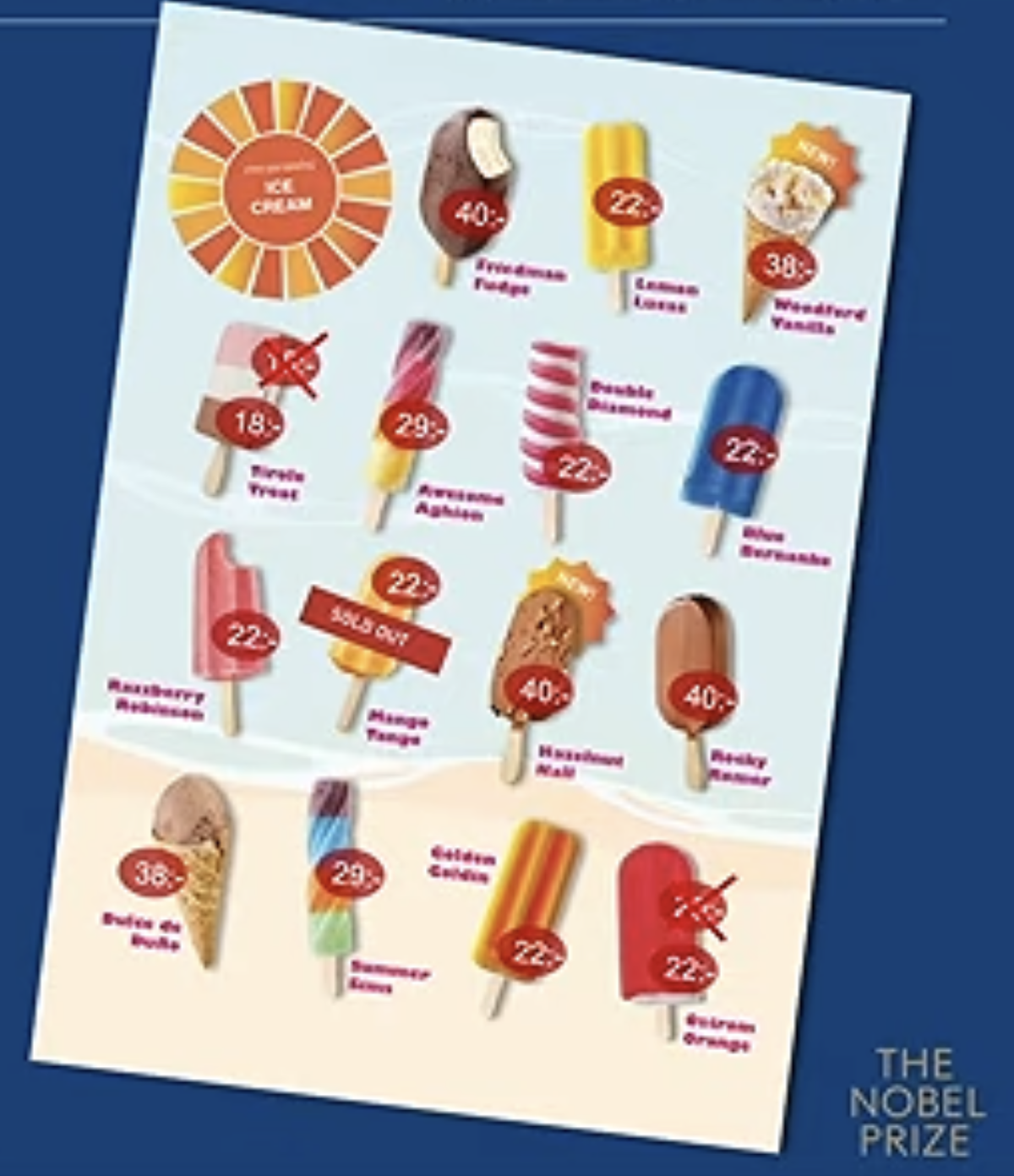
获奖者是斯坦福大学的罗伯特·霍尔和哥伦比亚大学的迈克尔·伍德福德。奖项委员会授予他们这一荣誉,是因为他们“为宏观经济稳定提供了微观经济学基础”。为了解释这句话到底是什么意思——正如我们将在本通讯中尝试做的那样——斯德哥尔摩大学的经济学家、奖项委员会成员蒂莫·博帕特站了起来,四处走动,仿佛在做一场TED演讲。就在某个时刻,他调出了身后屏幕上的一个图片:一份冰淇淋菜单。博帕特利用这份冰淇淋菜单上了一堂甜蜜的经济学课。
The winners were Robert Hall of Stanford University and Michael Woodford of Columbia University. The prize committee honored them "for microeconomic foundations of macroeconomic stabilization." To explain what the heck that means — as we will try to do in this newsletter — Timo Boppart, an economist at Stockholm University and member of the prize committee, stood up and walked around like he was giving a TED Talk. At one point, he brought up an image on the screen behind him: an ice cream menu. Boppart used the ice cream menu to serve up a sweet lesson in economics.
“企业实际上是如何定价的?”博帕特问道。“这一点就在冰淇淋菜单中得到了说明。价格并不是连续不断地调整的。企业相反地,会为整个季节设定这种冰淇淋的价格。”冰淇淋是一个富有诗意的例子。因为价格就像冰淇淋一样,可能会变得“粘滞”。事实上,经济学家使用“粘滞价格”这一术语来描述价格即使在经济条件变化时也可能顽固地保持不变。
"How do firms actually set prices?" Boppart asked. " This is illustrated here with this ice cream menu. Prices do not adjust [on] a continuous basis. Firms instead set the price of this ice cream for a whole season." Ice cream was a poetic example. Because prices, like ice cream, can get sticky. In fact, economists use the term "sticky prices" to describe how prices can stubbornly stay put even as economic conditions change.
这一看似微小的细节可能对整个经济产生巨大影响。粘滞价格是所谓“新凯恩斯经济学”的基石——这一框架有助于重塑宏观经济理论,以及政策制定者如何思考应对衰退和控制通胀。
That seemingly minor detail can have huge consequences for the entire economy. Sticky prices are a cornerstone of what's known as "New Keynesian economics" — a framework that has helped reshape macroeconomic theory and how policymakers think about fighting recessions and controlling inflation.
今年的奖项表彰了那些为新凯恩斯经济学奠定基础的工作。在此过程中,霍尔、伍德福德以及其他学者帮助赋予了经济学巨擘约翰·梅纳德·凯恩斯思想新的生命。他的思想遗产曾一度似乎面临消逝的危险。
This year's prize honored work that helped lay the foundations for New Keynesian economics. In the process, Hall, Woodford, and other scholars helped breathe new life into the ideas of economics giant John Maynard Keynes, whose intellectual legacy, for a time, seemed in danger of melting away.
要理解原因,我们需要回到1970年代,当时经济经历了一些事情,对某些人来说,这似乎推翻了凯恩斯经济学。
To understand why, we need to go back to the 1970s, when the economy experienced something that, for some, seemed to invalidate Keynesian economics.
凯恩斯主义遭遇“脑冻”约翰·梅纳德·凯恩斯基本上是宏观经济学之父,即研究整个经济如何运作的学科,包括政府可以做些什么来对抗衰退、提升就业和控制通胀。
Keynesianism gets a brain freeze John Maynard Keynes is basically the father of macroeconomics, the study of how the entire economy works, including what the government can do to fight recessions, boost employment, and control inflation.
凯恩斯的突破发生在大萧条的最深处,当时他出版了《就业、利息和货币通论》他阐述了一种今天看来可能显而易见的观点,但在当时挑战了经济学正统思想:经济可能陷入长期低迷,而自由市场不一定能自行让所有人重新就业。相反,凯恩斯写道,我们需要政府来帮助提升支出、让人们重返岗位,并使经济恢复健康。
Keynes' breakthrough came in the depths of the Great Depression, when he published The General Theory of Employment, Interest, and Money He articulated an idea that may seem obvious today but challenged the economic orthodoxy of his time: an economy can get stuck in a prolonged slump, and the free market won't necessarily get everyone back to work on its own. Instead, Keynes wrote, we needed the government to help boost spending, put people back to work, and return the economy to health.
如果你曾经上过经济学101课,你可能听说过“看不见的手”这一自由市场概念。它的意思是,人们和企业在竞争性市场中追求自身利益,可以在政府不必介入的情况下帮助经济充分发挥潜力。凯恩斯基本上认为,我们不能依赖看不见的手来让经济摆脱低迷。我们需要政府的可见之手。
If you've ever taken an Econ 101 class, you've probably heard about the "invisible hand" of the free market. It's the idea that people and businesses pursuing their own interests in competitive markets can help the economy reach its full potential without the government having to step in. Keynes basically argued we couldn't count on the invisible hand to pull the economy out of a slump. We needed the visible hand of the government.
凯恩斯影响了一整代经济学家和政策制定者。即便是自由市场的坚定倡导者米尔顿·弗里德曼,也曾在1965年被引用说:“我们如今都是凯恩斯主义者。”(后来他说这句话被断章取义了。)然而,在1970年代,主导的凯恩斯模型——以及它们所帮助指引的政策——遇到了麻烦。通胀和失业率同时上升——这种痛苦的组合被称为“滞胀”。当时的凯恩斯模型难以解释这一现象。
Keynes influenced an entire generation of economists and policymakers. Even Milton Friedman, a strong advocate for the free market, was quoted in 1965 as saying, "We are all Keynesians now." (He later said the quote was taken out of context.) In the 1970s, however, the dominant Keynesian models — and the policies they helped guide — ran into trouble. Inflation and unemployment rose together — a painful combination known as "stagflation." The existing Keynesian models struggled to explain it.
“凯恩斯的配方长期以来似乎很有效,但随后在1970年代的石油危机期间失效,当时高失业率和高通胀同时出现,”诺贝尔委员会主席约翰·哈斯勒在宣布奖项时说。
"For a long time, the recipes of Keynes seemed to work, but they then failed during the oil crisis in the 1970s when high unemployment and high inflation took over simultaneously," said John Hassler, the chair of the Nobel committee, when they announced the prize.
当传统模型失效时,一些经济学家想要彻底否定凯恩斯。像罗伯特·卢卡斯和爱德华·普雷斯科特这样的经济学家——他们各自获得了诺贝尔奖——挑战了凯恩斯经济学及其对政府政策能够有效平滑经济波动的信心。这被称为“看不见的手的复仇”。
When the old-school models faltered, some economists wanted to reject Keynes wholesale. Economists like Robert Lucas and Edward Prescott — who each won Nobel Prizes — challenged Keynesian economics and its confidence that government policy could effectively smooth out the economy's ups and downs. Call it the revenge of the invisible hand.
一个核心批评是:凯恩斯模型过度依赖过去经济数据中的模式,却没有充分解释其背后的个体决策。回应这一批评意味着赋予模型“微观基础”:从个体人和企业的决策出发,来解释整个经济如何运作。经济由人构成,而人会提前思考。他们会预测政策制定者将采取什么行动,而这些预期又会影响他们的消费、储蓄和投资行为。如果政策制定者改变方向,人们的行为也可能随之改变——这使得旧的模式成为判断新政策是否有效的不可靠指南。
A central criticism: The Keynesian models relied too heavily on patterns found in past economic data without adequately explaining the individual decisions behind them. Addressing that criticism meant giving models "microfoundations": starting with the decisions of individual people and businesses to explain how the whole economy works. The economy is made of people, and people think ahead. They anticipate what policymakers will do, and those expectations shape how they spend, save, and invest. If policymakers change direction, people's behavior might too — making old patterns an unreliable guide to whether a new policy will work.
由普雷斯科特和其他经济学家发展出的凯恩斯主义的一个有影响力的替代理论被称为“实际商业周期”理论。这些模型假设价格和工资完全灵活,能够随着经济条件的变化自由调整。如果对劳动力的需求下降,工资也可能下降,使得雇佣工人变得更便宜,从而使劳动力市场能够平衡供需。这几乎没有留给衰退的一个熟悉特征的空间:即想工作却找不到工作的人。
One influential alternative to Keynesianism, developed by Prescott and other economists, became known as "real business cycle" theory. These models assumed that prices and wages were completely flexible, adjusting freely as economic conditions changed. If demand for workers fell, wages could fall too, making workers cheaper to hire and allowing the labor market to balance supply and demand. That left little room for a familiar feature of recessions: people who want to work but can't find jobs.
如今哈佛大学经济学家格雷戈里·曼昆在1980年与迈克尔·伍德福德一起进入麻省理工学院攻读研究生。他们正在学习宏观经济学,而当时经济学家们正就如何重建这一学科展开激烈争论。
Gregory Mankiw, now an economist at Harvard University, entered graduate school at MIT alongside Michael Woodford in 1980. They were learning macroeconomics just as economists were fighting over how to rebuild it.
卢卡斯和普雷斯科特当时正处于上升期,但我们很多人对他们的结论持怀疑态度。曼昆告诉《……》这就是伍德福德和霍尔等人开始登场的时候。人们觉得那些拒绝凯恩斯模型的人是在把婴儿和洗澡水一起倒掉。于是他们并不想直接否定它,而是想要解决其中的问题。霍尔和伍德福德的新观点帮助重建了宏观经济学,使其围绕个人和企业的决策展开。
"Lucas and Prescott were ascendant, but a lot of us were skeptical of their conclusions," Mankiw tells " And that's when people like Woodford and Hall sort of entered the stage. The sense was that the people who were rejecting the Keynesian model were throwing out the baby with the bathwater. And so rather than throwing it out, they wanted to sort of fix the problems." A fresh scoop of Keynes Hall and Woodford helped rebuild macroeconomics around the decisions of individual people and businesses.
霍尔在理解人们对未来的预期如何塑造当下的消费方面开创了新局面。伍德福德在此基础上深化了研究,构建了一个将前瞻性消费决策与粘性价格相结合的框架。
Hall broke new ground in understanding how people's expectations about the future shape their spending today. Woodford built on that work, developing a framework that combined forward-looking spending decisions with sticky prices.
要理解粘性价格为何重要,我们可以回到冰淇淋的例子。假设发生衰退,冰淇淋的需求骤降。店铺可能不会很快降价来吸引顾客。也许更换菜单和招牌需要时间和金钱。或者店铺尚未确定需求下降是暂时的还是长期的。于是他们选择保持价格不变,卖出的冰淇淋变少,最终可能不得不削减工时或裁员。当价格无法调整时,就业和企业就会受到冲击。
To see why sticky prices matter, let's return to the ice cream example. Say there's a recession and demand for ice cream plummets. Shops might not quickly reduce ice cream prices to entice customers back. Maybe changing menus and signs costs time and money. Or maybe shops aren't yet sure whether the drop in demand is temporary or here to stay. Instead, they keep prices frozen, sell fewer scoops, and ultimately may end up having to cut worker hours or lay people off. When prices don't adjust, jobs and businesses take a hit.
同样的逻辑也适用于工资,我们认为工资在经济中的作用甚至比冰淇淋价格更大。
The same story goes for wages, which we guess are a bigger factor in the economy than ice cream prices.
曼昆说:“当经济学家谈论粘性价格时,他们也在指粘性工资——即劳动力的价格。大多数人并不是每月都能调整工资。”在整个经济中,这种粘性或称“价格刚性”可能带来重大后果。当支出下降时,价格和工资不会快速灵活地调整,以维持人们的消费和企业的雇佣。与其让价格下降以使供需达到平衡,在这些模型中,价格粘性反而导致产出和就业下降。这有助于解释为什么在衰退期间,想要工作的人可能会长时间失业。
" When economists talk about sticky prices, they're also including sticky wages — the price of labor," Mankiw says. "Most people don't get their wages adjusted every month." Across the economy, that stickiness or "price rigidity" can have big consequences. When spending drops, prices and wages don't quickly and flexibly adjust to keep people buying and businesses hiring. Instead of prices falling to bring supply and demand together, in these models, price stickiness causes production and employment to fall. It helps explain why, during recessions, people who want to work can remain out of a job for long stretches.
“将这些价格刚性纳入框架是绝对关键的,因为这正是看不见的手无法发挥作用、政策干预有空间的原因,”博普帕特在诺贝尔奖公布时说道。
" Bringing in those price rigidities into the framework was absolutely key because this is the reason why the invisible hand cannot do its magic and there is room for policy intervention," said Boppart at the Nobel Prize announcement.
换句话说,即使人们和企业能够提前思考并按照自身利益行事,粘性价格仍可能使经济陷入低迷。可以说这是凯恩斯的回归。在这些模型中,政府和中央银行仍有责任让经济重回正轨。
In other words, even when people and businesses think ahead and act in their own interests, sticky prices can keep the economy stuck in a slump. Call it Keynes' comeback. In these models, governments and central banks still have a role to play in getting the economy back on track.
这就是新凯恩斯经济学的承诺:认真对待旧模型的批评,围绕个体决策重建模型,并保留凯恩斯的核心洞察——自由市场并不总能自行复苏。
This was the promise of New Keynesian economics: take the criticisms of the old models seriously, rebuild models around individual decisions, and preserve Keynes' central insight that the free market won't always bounce back on its own.
“区分凯恩斯模型与实际商业周期模型的一个明显区别是价格的灵活性或粘性,”曼昆说。“如今的大多数经济学家——虽然不是全部——但我认为大多数经济学家如今接受了粘性价格的假设。”这些新凯恩斯模型成为政府和中央银行思考如何应对衰退和控制通胀的重要组成部分。
"One thing that clearly differentiates Keynesian models from Real Business Cycle models was the flexibility or stickiness of prices," Mankiw says. "Most economists today — not all — but I think most economists today buy into the sticky price assumption." These New Keynesian models became integral to how governments and central banks think about fighting recessions and controlling inflation.
例如,伍德福德的工作为“前瞻性指引”奠定了理论基础,这是美联储在大衰退期间采用的一种策略。美联储将基准利率降至近零,但经济仍需刺激。因此,在时任主席本·伯南克的领导下,美联储表明预计将在较长时期内维持低利率。通过塑造对未来利率的预期,美联储试图降低长期借贷成本并刺激当下的消费。
Woodford's work, for example, helped lay the theoretical groundwork for "forward guidance," a strategy the Federal Reserve used during the Great Recession. The Fed slashed its benchmark interest rate to near zero, but the economy still needed stimulus. So under then-chair Ben Bernanke, the Fed signaled that it expected to keep interest rates low for an extended period. By shaping expectations about future rates, the Fed tried to help lower longer-term borrowing costs and encourage spending today.
凯恩斯的思想在新的基础上得以延续。曼昆还对米尔顿·弗里德曼的名言提出了更新:“我们如今都是新凯恩斯主义者了,”他说。
Keynes' ideas survived with new foundations. And Mankiw offers an update to Milton Friedman's famous line: "We're all New Keynesians now," he says.
注:在整篇文章中,我们将该奖项称为“诺贝尔经济学奖”。但这么称呼颇具争议。严格来说,它的名字要拗口得多。经济学并非阿尔弗雷德·诺贝尔设立的奖项之一。那么它是如何加入这一行列的?Ricky和我在《Planet Money》旗下节目《The Indicator》最新一期中讲述了这个故事。敬请在周二发布时收听。
P.S. Throughout this piece, we've called this award the "Nobel Prize in economics." But calling it that is surprisingly controversial. Technically, it has a much clunkier name. Economics wasn't one of the prizes Alfred Nobel created. So how did it join the club? Ricky and I tell that story in the latest episode of The Indicator from Planet Money. Check it out when it's released Tuesday.