公司正在赋予人工智能系统更多自主权,以提高生产力和效率。但随着机器人承担更多责任,高管、经理和员工仍不清楚当出现问题时谁应承担责任。
Companies are giving artificial-intelligence systems more autonomy to boost productivity and efficiency. But as bots take on more responsibility, executives, managers and employees remain unclear on who should be held accountable when something goes wrong.
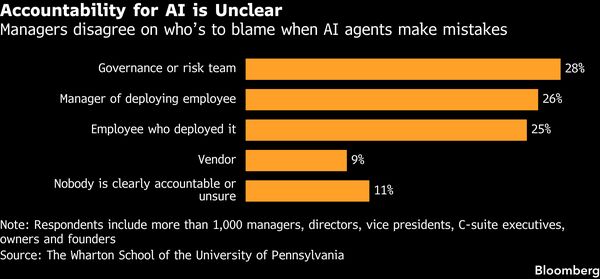
宾夕法尼亚大学沃顿商学院周二发布的一份新报告发现,管理层对此几乎没有达成一致。当被问及当机器人“犯下重大错误”时谁应承担责任时,受访者在部署AI代理的员工、该员工的经理以及公司的风险团队之间大致平均分配,每类人选各占约四分之一。大约10%的人将责任归咎于供应商,而类似比例的人表示他们不确定谁应承担责任。
A new report published Tuesday by the Wharton School of the University of Pennsylvania found little agreement among managers. When asked who should be held responsible when a bot “makes a consequential error,” respondents were split roughly evenly between the employee deploying the AI agent, the employee’s manager and the company’s risk team, with about a quarter choosing each. Roughly 10% blamed the vendor, while a similar share said they weren’t sure who should be held accountable.
随着OpenAI、Alphabet Inc.旗下的Google和Meta Platforms Inc.等公司将越来越强大的AI代理交到员工手中,这一责任问题变得更加紧迫。这些机器人拥有自己的企业身份,能够独立朝着目标工作,在某些情况下甚至可以持续数天。
That question of accountability is becoming even more pressing as companies including OpenAI, Alphabet Inc.’s Google and Meta Platforms Inc. push increasingly powerful AI agents into the hands of employees. The bots are equipped with their own corporate identities and are able to independently work toward goals, in some cases over the course of several days.
尽管近几个月来,失控AI代理的担忧主导了头条新闻,但对公司而言更为紧迫的风险可能远比这更普通和平凡。员工监控软件公司Teramind的副总裁Leeron Walter表示,当机器人能够访问电子邮件账户或客户数据库等实时系统时,一个微小的提示错误或不明确的指令可能很快演变成更大的危机。
While concerns of rogue AI agents have dominated headlines in recent months, the more immediate risk to companies may be far more ordinary and mundane. A minor prompt error or unclear instructions can quickly snowball into a larger crisis when agents have access to live systems such as email accounts or customer databases, said Leeron Walter, vice president at employee-monitoring software company Teramind.
公司已经面临此类错误。Walter指出,一家美国全国性零售商曾有一名员工构建了一个AI系统以自动化客户邮件。一个提示错误导致机器人在不到六小时内向超过18,000名客户发送了错误的退款和取消通知,引发了数千起客户服务咨询。Walter表示,在这类令人尴尬的错误之后,客户对员工监控系统的需求有所增加。
Companies are already facing those kinds of mistakes. Walter pointed to one national US retailer where an employee built an AI system to automate customer emails. A prompt error caused the bot to send incorrect refund and cancellation notifications to more than 18,000 customers in less than six hours, triggering thousands of customer-service inquiries. Walter said customer demand for employee-monitoring systems has ticked up in the wake of embarrassing mistakes like these.
在另一家美国消费电子企业,沃尔特称有一名市场部员工利用人工智能自动生成并发布产品定价。由于提示词设置出现失误,一款旗舰产品被标上了85%的折扣价,这一错误持续了三个小时。在问题被发现前,共有700多份订单被成功下单;由此引发的客户投诉及后续处理工作则耗费了数周时间才得以解决。
At another US-based consumer electronics company, Walter said a marketing employee used AI to automatically generate and publish product prices. A prompt error caused a flagship device to be listed at an 85% discount for three hours. More than 700 orders were placed before the mistake was caught, and the resulting customer-service fallout took weeks to resolve.
此类失误不仅会导致巨额经济损失,还可能损害企业声誉。它们引发了一个令员工和管理者都颇为困扰的问题:既然企业被鼓励尝试使用人工智能技术,那么一旦出现问题,责任又该由谁来承担呢?
Mishaps like those, which can result in large losses and long-term reputational damage, are raising an uncomfortable question for workers and their managers: If employers are being encouraged to experiment with AI, who takes the blame when something goes wrong?
“各企业正在实时摸索经验,”咨询公司GBK Collective的合伙人、沃顿商学院该项研究的合著者杰里米·科斯特说道。“当我向企业高层提出这个问题时,他们最常给出的回答就是‘尚未考虑过此事’。”
“Organizations are learning in real time,” said Jeremy Korst, a partner at the consulting firm GBK Collective and co-author of the Wharton study. “When I ask this question of a senior executive, the most frequent answer I get is that they hadn’t thought about it yet.”