重量轻于一根黄油棒的超紧凑型无人机,其计算能力和功率容量不如大型机型,这限制了其传感器的性能。这意味着如果建筑物内充满烟雾或灾难发生在夜间,无人机的摄像头和激光雷达将无法工作。即使是一块透明的玻璃板,也可能成为无人机无法感知的障碍。
Weighing less than a stick of butter, ultra-compact drones don’t have as much compute or power capacity as larger models, and this restricts the power of their sensors. That means if a building is filled with smoke or the disaster happens at night, the drone’s cameras and lidar will cease to function. Even a clear pane of glass can be an obstacle the drone might not sense.
现在,荷兰代尔夫特理工大学的一个研究团队——从夜行动物的胡须中获得灵感——开发出一种轻量级触觉传感器,使无人机即使在无法“看见”的情况下也能导航。一些夜行动物,如老鼠,以及某种程度上猫,可以仅通过胡须感知周围环境的感觉来探索周围环境,从而在没有视觉的情况下移动。研究团队想知道无人机是否也能做到这一点。
Now, a research team at Delft University of Technology in the Netherlands—drawing inspiration from the whiskers of nocturnal animals—has developed a lightweight, tactile sensor for drones to navigate even when they can’t “see.”Some nocturnal animals, like mice and to some extent cats, can explore their surroundings using just the sensations of the environment around them on their whiskers, enabling them to move without vision. The research team wondered whether drones could do the same.
在无人机开发领域,触觉导航是一个全新的概念,伴随着自身的挑战。“要让触觉感知在无人机上发挥作用,它需要轻量、低延迟和低功耗,”代尔夫特理工大学教授萨尔瓦·哈马扎在新闻稿中解释道。幸运的是,自然已经完成了部分创新。
In the world of drone development, tactile navigation is a novel concept that comes with its own challenges. “For tactile sensing to work on drones, it needs to be lightweight, low-latency, and low-power,” Salwa Hamaza, a professor at Delft University of Technology, explained in a press release. Luckily, nature already did some of that innovating.
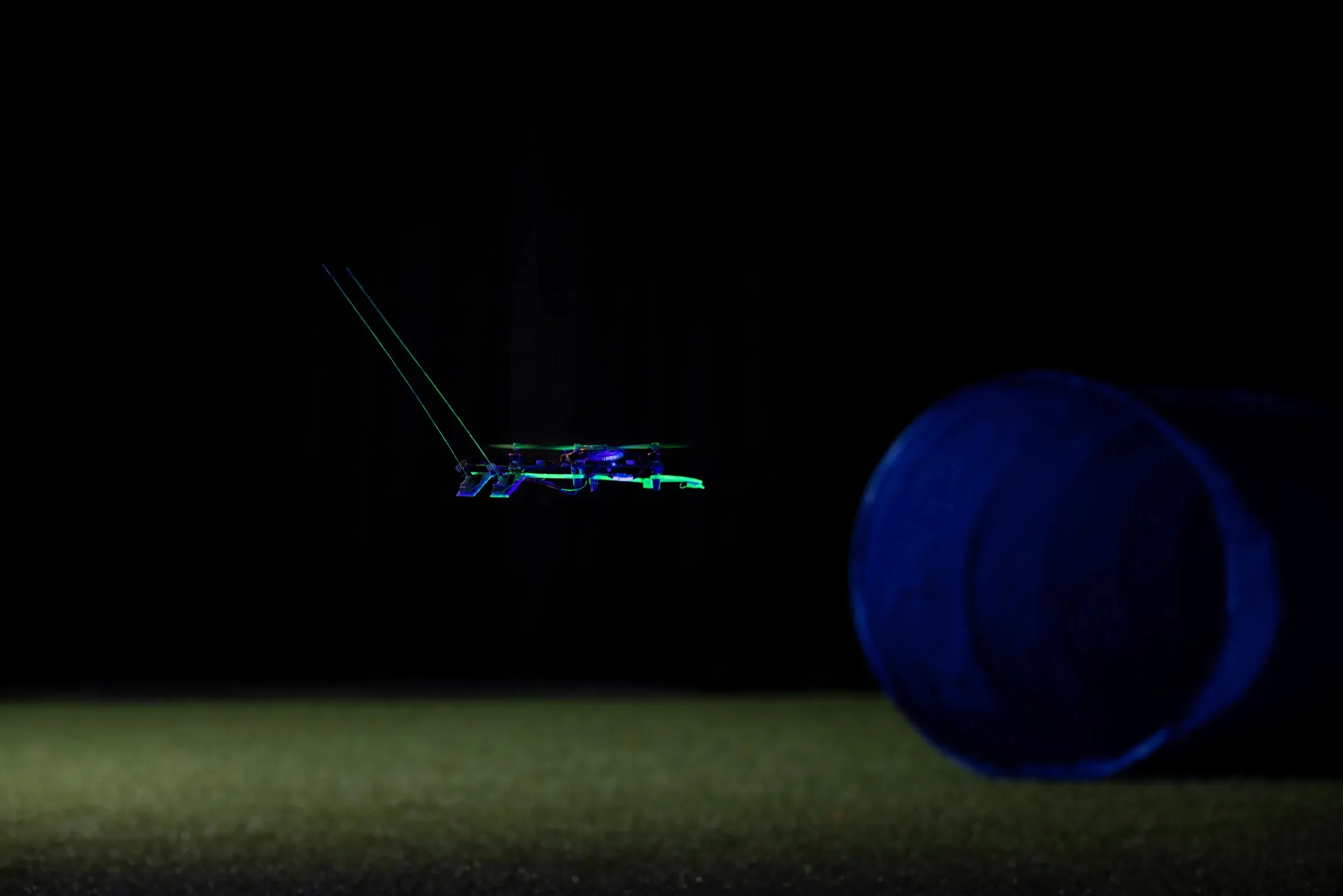
哈马扎及其团队为无人机制作的“胡须”由镍钛合金制成的细丝组成,每根直径为0.4毫米——大约相当于四张纸的厚度。然而,这些触须的长度却超过了无人机本身。研究人员在一只巴掌大小的无人机上安装了两根胡须,每根长近8英寸(约20.3厘米),并在底部各安装了三个小型压力传感器。这些传感器可以评估导线的弯曲程度,无人机据此估算其与附近障碍物的距离和相对位置。所有此类导航所需的计算均由无人机内置的微控制器处理完成,无需依赖外部计算机。
The “whiskers” Hamaza and her team crafted for the drone consist of delicate wires made of nickel-titanium, each measuring 0.4 millimeters in diameter—about the thickness of four sheets of paper. The antennae, however, were longer than the drone itself. To a palm-sized drone, the researchers attached two whiskers, each nearly 8 inches long with three small pressure sensors at the base. These can assess the bending of the wires, from which the drone estimates its distance from and position in relation to nearby barriers. All calculations necessary for this navigation are processed by a microcontroller onboard the drone, without relying on an external computer.
这听起来可能并不复杂,但即使确定安装导线的角度也面临挑战。通过胡须导航的动物通常不会飞行。即使是非常轻盈和精细的长突起物,也可能导致无人机不稳定。研究人员在沿墙移动时观察到,胡须的阻力可能导致无人机旋转并坠毁。
It may not sound too complicated, but even determining the angle at which to mount the wires was a challenge. Animals that navigate via whisker generally do not fly. Having a long protrusion, even if very light and delicate, can make the drone unstable. When moving along a wall, the researchers saw that resistance from the whisker could cause the drone to rotate and crash.
研究人员在三种不同速度下测试了六种不同角度,共进行了72次飞行。当胡须安装在30度、45度和60度角时,无人机飞行过程中未出现重大事故。在这些角度中,他们选择了45度角,因为它导致无人机姿态偏差最小。他们还考虑到60度角会减少前向感知范围。
The researchers compared a total of 72 flights, testing six different angles at three different speeds. The drone flew without major incident when the whiskers were mounted at 30 degrees, 45 degrees, and 60 degrees. Of these, the 45-degree angle was adopted because it resulted in the least deviation in the drone’s orientation. They also took into account the fact that a 60-degree angle reduces the forward sensing range.
研究人员在处理胡须采集的信息时也遇到了若干障碍。其中之一是区分实际接触信号和由无人机自身引起的干扰,例如螺旋桨的振动。即使过滤掉这些噪声,无人机的检测中仍有大约38%是误报。
The researchers also encountered several hurdles in processing the information taken in by the whiskers. One was distinguishing between actual contact signals and disturbances caused by the drone itself, such as vibrations from the propellers. Even when filtering this noise out, about 38 percent of the drone’s detections were false positives.
问题似乎在于漂移——一种传感器读数随时间逐渐偏移的现象。因此,研究团队开发了一种校正算法,该算法能够基于无人机未接触任何物体时的传感器读数,持续估算漂移随时间的趋势。当该算法与过滤器结合使用时,误报据报道降至0%。
The issue seemed to be drift, a phenomenon where sensor readings gradually shift over time. The research team, therefore, developed a correction algorithm that continuously estimates the trend of drifts over time—based on sensor readings when the drone is not touching anything—while in flight. When combined with the filter, false positives reportedly dropped to 0 percent.
这些测试主要在一个由三面透明墙依次排列的环境中进行。每当触觉传感器接触到墙面时,无人机会沿墙平行飞行,保持距离墙面60至100毫米,直至到达边缘。即使墙相对于无人机呈一定角度,无人机仍能够导航——而配备激光传感器的无人机则无法做到这一点。
These tests were largely done in an environment with three transparent walls arranged in a row. Whenever the tactile sensor touched a wall surface, the drone flew parallel to the wall, maintaining a distance of 60 to 100 millimeters from the surface until it reached the edge. The drone was even able to navigate when the wall was at an angle to it, something a drone with laser sensors would not be able to do.
然而,在真实世界的情境中——比如灾难现场的废墟——障碍物并不会如此整齐地排列。即使在普通房间里,沿墙飞行的无人机也很容易卡在角落里,或者忽略侧面的障碍物。因此,研究人员编码了一种探索方法,该方法通过概率估计墙壁的形状,优先让无人机穿越未探索的区域。使用这种方法,无人机在90%的测试中成功在一间玻璃墙的小房间里找到了一个宽2.5英尺的出口。
However, in a real-world situation—like the rubble of a disaster—obstacles are not so neatly arranged. Even in your average room, a drone following a wall could easily get stuck in a corner or overlook barriers to the side. The researchers, therefore, encoded an exploration method that prioritizes moving through unexplored areas by probabilistically estimating the shape of walls. Using this method, the drone successfully found a 2.5-foot-wide exit in a small room with glass walls in 90 percent of tests.
而且,从比喻意义上和字面意义上来说,仍有改进的空间,因为这个触觉系统仅使用了无人机192 KB内存的一小部分。“我们想表明,触觉感知不必以体积或计算能力为代价,”代尔夫特理工大学博士生Chao-Shan Ye在新闻稿中补充道。“我们的整个触觉感知流水线仅使用34 KB内存就在机载设备上运行,使得微型无人机能够实时感知并响应其环境。”该报道最初发表于《WIRED Japan》,并从日文翻译而来。
And there is room for improvement, figuratively and literally, given that this touch system only uses a small fraction of the drone’s 192 KB of memory. “We wanted to show that touch does not have to come at the cost of size or computational power,” Chao-Shan Ye, a doctoral student at Delft University of Technology, added in the press release. “Our entire tactile perception pipeline runs onboard using just 34 KB of memory, allowing a tiny drone to sense and respond to its environment in real time.”This story originally appeared on WIRED Japan and has been translated from Japanese.