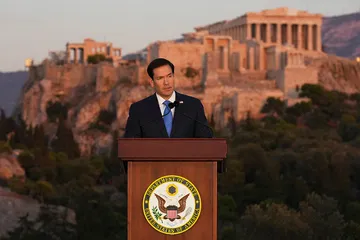
上周,美国国务卿马尔科·卢比奥站在帕特农神庙前宣称,特朗普政府寻求与欧洲合作,捍卫西方文明的“独特性格”。这或许本意是一种鼓励。
Last week, US Secretary of State Marco Rubio, standing in front of the Parthenon, declared that the Trump administration sought to partner with Europe in defending the “distinct character” of Western civilization. It was meant, perhaps, as an exhortation.
但对欧洲而言,这听起来像是一种威胁。卢比奥表示,美国已选择“不带歉意地追求国家权力。”其暗示是,欧洲国家并未如此选择,因而只能自甘“陷入萎缩、奴役和衰落的未来。”然而,欧洲大陆上鲜少有人会认为,以卢比奥及其上司所期望的那种顺从为特征的美欧伙伴关系,会比奴役好多少。
But to Europe, it sounded like a threat. The US, said Rubio, had chosen “the unapologetic pursuit of national power.”The implication was that European nations had not and thus resigned themselves “to a future of atrophy and servitude and decline.”Yet few on the continent will think that a partnership with the US defined by the kind of the obedience Rubio and his boss expect would be much better than servitude.
特朗普的白宫并未掩饰其控制欧洲选择的意愿。其去年底发布的国家安全战略将“在欧洲国家内部培育对欧洲当前轨迹的抵抗”列为优先事项。
Donald Trump’s White House has not concealed its desire to control Europe’s choices. The national security strategy it released at the end of last year identified “cultivating resistance to Europe’s current trajectory within European nations” as a priority.
该政府还表明,若其决定将这些国家推向其公民可能自行选择之外的方向,它拥有实现这一目标的杠杆。
The administration has also shown that, if it decides to push these countries in a direction other than the one their citizens might choose for themselves, it has the levers to do so.
特朗普本月早些时候就动用了其中一个杠杆,当时他威胁称,除非欧洲释放部分战略柴油储备,否则将暂停化石燃料出口。此次,总统的担忧是,高昂的油价可能让他失去中期选举。但当此类威胁奏效时,它们往往会被反复使用。
Trump pulled one of them earlier this month, when he threatened to withhold fossil-fuel exports unless Europe released some of its strategic diesel reserves. On this occasion, the president’s concern was that high prices at the pump might cost him the midterms. But when such threats prove effective, they tend to be used again and again.
自普京总统2022年入侵乌克兰以来,欧洲领导人一直试图摆脱对俄罗斯天然气的依赖。如今,他们必须面对一个事实:这一努力只是让他们对华盛顿的依赖加深了——而华盛顿谈论干涉其政治的热情,与克里姆林宫如出一辙。
Europe’s leaders have, since President Vladimir Putin’s 2022 invasion of Ukraine, tried to break free of Russian gas. Now they must confront the fact that this effort has just increased their dependence on a Washington that talks about intervention in their politics with the same hunger as the Kremlin.
近年来,欧洲领导人经常谈论他们寻求战略自主的努力。但在关系到欧洲独立的每个关键领域——国防、技术、能源——过去十年里,欧洲对美国的依赖反而增加了,而不是减少了。
In recent years, Europe’s leaders have spoken often about their search for strategic autonomy. But in every field that matters to European independence — defense, tech, energy — the continent has become more reliant on the US over the past decade, not less.
以欧洲备受讨论的重新武装为例。也许十年后,其军工复合体将得到复苏。然而我们可以确定的是,根据官方项目记录,美国向北约欧洲成员国出售装备的价值仅占这些国家2019年至2021年军事装备支出的28%;而在2022年至2024年期间,这一比例上升至超过一半。
Consider Europe’s much-discussed rearmament. Perhaps, a decade from now, its military-industrial complex will have been revived. What we know for sure, however, is that the value of proposed sales of US equipment to European NATO members, as recorded under official programs, was only 28% of those countries’ spending on military equipment between 2019 and 2021; between 2022 and 2024, that proportion rose to more than half.
欧洲军队在所谓的“战略推动系统”上尤其依赖美国——这些系统如运输、指挥与控制以及通信系统,是现代战争作战所必需的。上个月,欧洲委员会主席乌尔苏拉·冯德莱恩在其年度政策演讲中宣布提出一项新的“欧洲战略推动系统工具”提案,公众才认识到这种状况不能继续下去。
European militaries are particularly dependent on the US for so-called strategic enablers — the systems, such as those for transport, command and control and communication, that are essential for modern war-fighting. Public recognition that this couldn’t be allowed to continue came last month, when European Commission President Ursula von der Leyen used her annual policy address to announce a proposal for a new “European instrument for strategic enablers.”
然后是技术领域,众所周知欧洲在此方面落后。马里奥·德拉吉2024年关于欧洲竞争力的报告指出,如果排除技术部门,欧盟过去20年的生产力增长与美国相同。而在同一时期,美国技术对欧洲的增长、安全和生存变得更加关键——根据官方统计,欧盟有41%的企业高度依赖云服务,而这些云服务中有70%由美国公司控制。
Then there’s tech, where everyone knows the continent is a laggard. Mario Draghi’s 2024 report on European competitiveness pointed out that, if you exclude the technology sector, European Union productivity growth over the past 20 years was the same as that of the US. Over the same period, American tech has become more essential for European growth, security and survival — 41% of EU enterprises are, according to official statistics, “highly dependent” on cloud services, 70% of which are controlled by US companies.
这使得欧洲的政治日益紧张,容易被操纵。领导人经常谈论俄罗斯渗透到该大陆的信息经济,但埃隆·马斯克和其他美国科技亿万富翁却被允许更公开地塑造它。英国首相可能会抱怨莫斯科曾试图干预2016年英国脱欧公投;然而在这些年里,真正干预支持匈牙利和罗马尼亚亲俄右翼势力的,是美国副总统,而且他公开支持德国的AfD。
That’s left Europe’s politics increasingly febrile and open to manipulation. Leaders talk often about Russian infiltration into the continent’s information economy, but Elon Musk and other US tech billionaires are allowed to shape it far more openly. The British prime minister might complain that Moscow tried to interfere in the 2016 Brexit referendum; yet in the years since, it’s the US vice president who has intervened in support of pro-Russian right-wingers in Hungary and Romania, and openly backed the AfD in Germany.
本周,欧盟宣布与北京达成一项协议,希望这能为其汽车工业提供一些喘息空间。这只是欧盟在规划对华和对俄反制措施上投入巨大时间和精力的最新例子。也许其中一些精力应该用于思考如何应对美国。欧洲不需要美国告诉它如何捍卫自己的文明。它需要找到一种方式,确保华盛顿不会决定这个文明应该是什么样子。
This week, the EU announced an agreement with Beijing that it hoped would give its car industry some breathing space. It’s just the latest example of the massive time and effort the bloc has devoted to planning countermeasures against China and Russia. Perhaps some of that energy should go to figuring out what to do about the US. Europe doesn’t need America to tell it how to defend its civilization. It needs to find a way to ensure Washington doesn’t get to decide what that civilization should be.