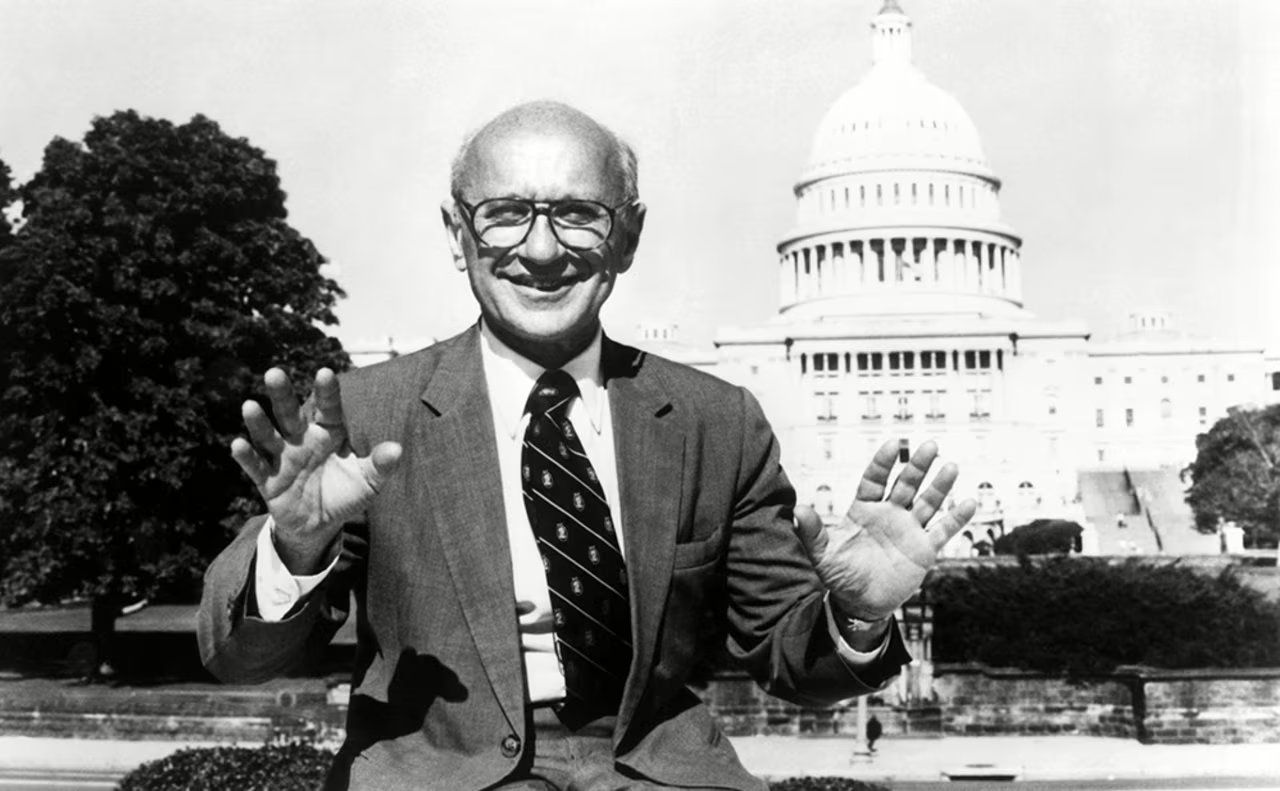
自由市场的支持者们感到遗憾:我们迫切需要能够反驳那些日益嚣张的社会主义者的新思想家,但却始终找不到这样的人。其实,如果我们能清楚地记住自己真正需要寻找的是什么,或许会更容易找到答案。
Friends of free markets lament that we need, but can’t find, new Milton Friedmans to refute emboldened socialists. We might have better luck if we remembered what we are trying to find.
五十年前的这个星期三,米尔顿·弗里德曼被授予诺贝尔经济学奖。据美联社报道,诺贝尔奖评审委员会对他的提名进行了异常漫长且激烈的讨论;有传言称,一些评委对弗里德曼在杂志专栏中发表的“轻率”评论中的政策主张表示反对。在《新闻周刊》等媒体上,弗里德曼提出了一个充满进步与自由的理想世界蓝图。他的论点极具说服力,而且他总是以勇气、清晰的表达方式以及一种令人放松的幽默感来阐述自己的观点——这种幽默感尤其体现在他总是针对抽象的思想而非具体的人进行批评上。
Fifty years ago Wednesday, Friedman was awarded the Nobel Prize in economics. The Associated Press reported that the Nobel committee had an unusually long and heated discussion of his nomination. Some members were rumored to have objected to Friedman’s policy proposals in his “ ‘careless’ commentaries in his magazine columns.”In Newsweek and elsewhere, Friedman proposed a better world of progress and freedom. His arguments were strong, and he delivered them with courage, clarity and a disarming good humor that was magnified by his directing them at ideas, not people.
弗里德曼的昔日学生加里·贝克尔(后来也获得了诺贝尔奖)曾这样评价他:“弗里德曼是我认识的人中最具思想勇气的人;只要他认为某件事是对的,无论后果如何,他都会毫不犹豫地说出来。”正因为如此,弗里德曼有时不得不承受那些不愿听他观点的人的敌意。
Gary Becker, Friedman’s former student and an eventual Nobel winner himself, said Friedman “was the most intellectually courageous person I have ever known, willing to say something if he believed it was right, damn the consequences.”The consequence was that Friedman sometimes had to take ill will from those who didn’t want to hear what he said.
弗里德曼曾因主张“医生执照制度会限制医生数量、从而减少患者获得医疗服务的机会”而遭到美国医学协会的反对;他还因主张“应该废除国家科学基金会(NSF),因为该机构给纳税人带来了负担并阻碍了科技创新”而遭到其他经济学家的反对;更糟糕的是,他因主张“马克思主义的社会主义制度会终结进步与自由”而遭到马克思主义青年组织的抵制——这些组织多年来一直干扰他的演讲活动。
Friedman took ill will from the American Medical Association when he argued that licensing physicians limited their supply and thereby reduced patient access to healthcare. He took ill will from his fellow economists who were receiving National Science Foundation funding when he argued that the NSF should be abolished because it burdened taxpayers and reduced innovation. And he took ill will from the Marxist Spartacus Youth League (who for years disrupted his speeches) when he argued that their socialism would bring the end of progress and freedom.
弗里德曼早年曾因社会主义倾向且高度数学化的考尔斯委员会而受到不待见。该委员会是芝加哥大学经济系的重要组成部分,成员中有几位后来获得了诺贝尔奖。在考尔斯委员会的研讨会上,弗里德曼坚持认为他们的建模选择是武断的,而他们复杂的一般均衡多元回归模型并未产生有证据支持的预测。
Early in his career Friedman took ill will from the socialist-oriented and highly mathematical Cowles Commission. The commission was an important part of the University of Chicago economics department and included a couple of members who went on to receive Nobel Prizes. At Cowles Commission seminars, Friedman persistently argued that their modeling choices were arbitrary and their complex general equilibrium multiple regression models didn’t generate predictions supported by the evidence.
弗里德曼的经历进一步强化了他的论点。二战期间,他在政府工作时曾使用多元回归分析——一种统计预测方法——试图研发两种更坚固的合金用于军用飞机。当他将提出的合金配方送到麻省理工学院实验室进行制作和测试时,两种合金在几小时内就燃烧殆尽,这使他对多元回归分析产生了终生的怀疑。
Friedman’s experiences strengthened his argument. During World War II, while working for the government, he had used multiple regression analysis—a means of statistical prediction—to try to devise two stronger alloys for use in military airplanes. When he sent his proposed alloy mixtures to be created and tested at an MIT lab, both alloys burned up in a few hours, leading him to a lifelong skepticism of multiple regression analysis.
詹妮弗·伯恩斯在她对弗里德曼的传记中写道,考尔斯委员会的成员选择离开芝加哥前往耶鲁,而不是留下来面对他的有说服力的论点。这为弗里德曼提供了机会,使他得以建立一个采用不同方法、追求不同目标的主要经济学部门。
Jennifer Burns tells in her biography of Friedman how the members of the Cowles Commission decamped for Yale rather than stay in Chicago and face his persuasive arguments. This gave Friedman the opportunity to build a major economics department that practiced methods and pursued goals different from others.
经济学家阿约·克拉默和大卫·科兰德在其1990年出版的《经济学家的成长》一书中报道,当他们对四个主要经济学系的研究生进行调查时,麻省理工、哈佛和哥伦比亚的学生认为自己在做数学谜题求解;而芝加哥的学生则认为自己在运用价格理论来理解世界如何运作并使其运作得更好。许多人称之为“芝加哥学派”;弗里德曼则称之为“好经济学”。
Economists Arjo Klamer and David Colander reported in their 1990 book, “The Making of an Economist,” that when they surveyed graduate students at four major economics departments, those at MIT, Harvard and Columbia thought they were doing mathematical puzzle-solving. Those at Chicago thought they were applying price theory to understand how the world worked and make it work better. Many called this the Chicago School; Friedman called it good economics.
弗里德曼认为良好的经济学需要言论自由,有时他会根据新证据和论点迅速改变自己的想法。当英国经济学家罗纳德·科斯提出一些想法时,弗里德曼最初持怀疑态度,但在一次热烈的讨论之后,他同意了科斯的观点。弗里德曼的亲密朋友、芝加哥学派的共同创始人乔治·斯蒂格勒说:“这是一次令人振奋的事件!”在其他一些议题上,弗里德曼的观点演变得更慢一些。
Friedman believed that good economics required free speech, and sometimes he quickly changed his mind in response to new evidence and arguments. When British economist Ronald Coase presented some of his ideas, Friedman was at first skeptical but came to agree with Coase after a lively discussion one evening. George Stigler, Friedman’s close friend and co-founder of the Chicago School, said, “What an exhilarating event!”On some other issues, Friedman’s views evolved more slowly.
他部分地后悔自己早期致力于使所得税预扣更高效的努力,认为这刺激了政府的增长。他后来提出的所得税政策被称为“负所得税”,这是如今所谓的普遍基本收入的一种形式。我推测,如果他今天还活着,他可能会认为这也是一个令人遗憾的提议,同样可能刺激政府的增长。
He partly regretted his early effort to make income-tax withholding more efficient, seeing it as a stimulant to the growth of government. His later proposal for income tax policy was called the “negative income tax,” a form of what today is called universal basic income. I speculate that if he were alive today, he might see it as another regrettable proposal that is also likely to stimulate government growth.
乐观的性格并没有阻止弗里德曼看到“现状的暴政”——他与妻子罗斯合著的一本书的标题——常常阻碍良好政策的采纳。但他也看到,在危机时期,官员们会寻求经济学家们发展并保持活跃的替代政策。如今我们正面临医疗危机。当我大约在1973年首次见到弗里德曼时,我记得他支持废除食品和药物管理局。当我最后一次听到他演讲时,那是在他2006年去世前大约一年(超过30年后),他仍在坚持这一政策,仍在解释FDA使医疗变得非常昂贵,最重要的是减少了药物创新。
A cheery disposition didn’t keep Friedman from seeing that a “tyranny of the status quo”—the title of one of the books he wrote with his wife, Rose—often blocked the adoption of good policies. But he also saw that in times of crisis, officials would seek out alternative policies that economists had developed and kept alive. Today we have a healthcare crisis. When I first met Friedman in about 1973, I remember his supporting the abolition of the Food and Drug Administration. When I last heard him speak, more than 30 years later (about a year before his death in 2006), he was still keeping this policy alive, still explaining that the FDA made healthcare very expensive and most importantly reduced drug innovation.
弗里德曼身高只有五英尺,身材并不高大。他个子矮,但毅力、善意、清晰和勇气绝不逊色。
At 5 feet tall, Milton Friedman wasn’t physically imposing. He was short, but not short on perseverance, goodwill, clarity and courage.
戴蒙德先生是美国经济研究所的高级研究员,《开放式创造性毁灭:维持创新活力》一书的作者。
Mr. Diamond is a senior fellow at the American Institute for Economic Research and author of “Openness to Creative Destruction: Sustaining Innovative Dynamism.”