今年5月,约两吨死鱼漂浮在柬埔寨一处湖泊的湖面上。上个月,印度尼西亚另一处湖泊的水位下降,露出了长期被水淹没的索芒村遗址。在菲律宾,当局则警告首都马尼拉的居民,当地的供水可能很快会出现短缺。这些事件虽看似彼此独立,但都是由天气变热、变干燥所引发,它们共同预示着厄尔尼诺现象可能给亚洲带来的巨大影响。
BACK IN MAY about two tonnes of dead fish floated to the surface of a lake in Cambodia. Last month in Indonesia receding water levels in another lake exposed the ruins of Somang, a long-submerged village. In the Philippines officials have warned residents of Manila, the capital, that their water supply may soon be reduced. These events—all caused by hotter, drier conditions—may seem isolated, but taken together they point to the havoc that El Niño could bring in Asia.
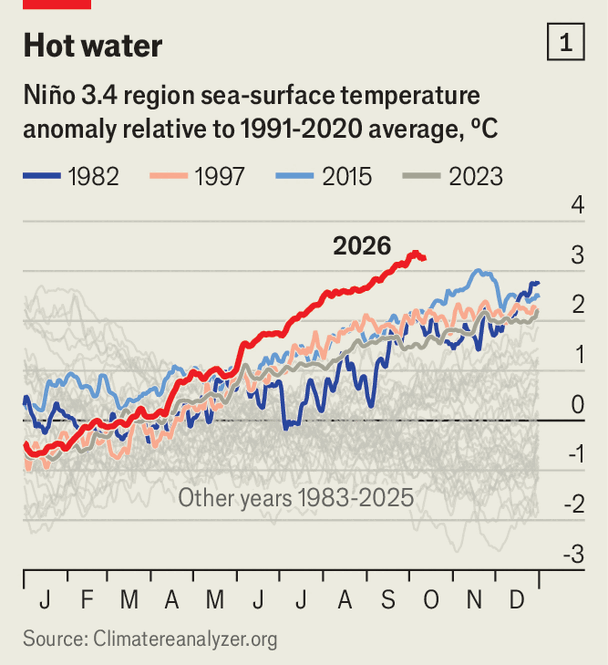
厄尔尼诺是一种自然周期性出现的气候现象。每隔数年,东太平洋上空的风向发生变化,便会导致南亚与东南亚大部分地区出现高温少雨的天气。今年的厄尔尼诺现象始于5月,预计下个月达到峰值,其强度异常强烈。根据一项每日监测指标显示,太平洋海面温度异常值已超过了有记录以来历次厄尔尼诺事件的最高值(见图表1)。世界气象组织预计,此次厄尔尼诺现象将持续到2月份。
The climate pattern is a naturally recurring phenomenon. Every few years a shift in the winds above the eastern Pacific causes hotter and drier conditions in much of South and South-East Asia. This year’s episode, which began in May and is due to peak next month, is unusually fierce. On one daily measure, sea-surface temperature anomalies in the Pacific have already exceeded the peak of every previous event on record (see chart 1). The World Meteorological Organisation expects this El Niño to last into February.
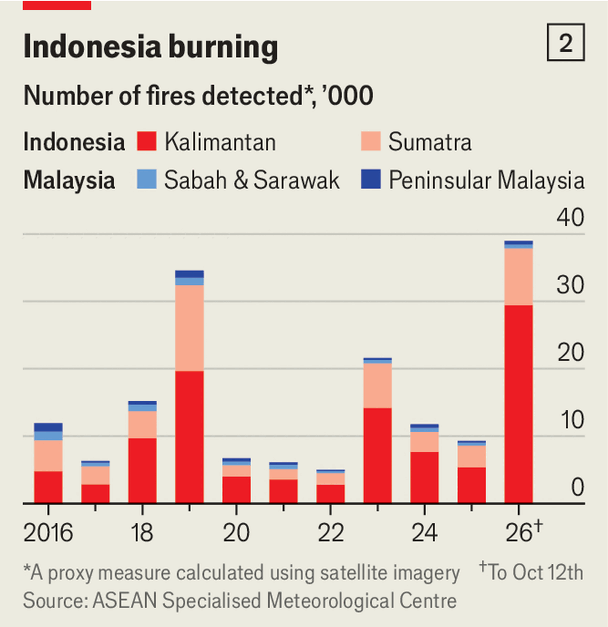
其影响波及全球,但亚洲尤为脆弱:数亿民众的生计依赖于农业,各国政府也仍在努力应对伊朗战争引发的能源危机。目前,该地区的许多地方已受到厄尔尼诺的负面影响。为印度提供全年近70%降雨量的季风降水量比正常水平低了约13%,是近十年来最干旱的年份。卫星数据显示,印度尼西亚正经历11年来最为严重的火灾季(见图表2)。在菲律宾,官方称已有7个省份出现旱情,预计明年年初全国都将面临干旱。
The effects will be global, but Asia is especially exposed: hundreds of millions of its people depend on farms for their livelihoods, and its governments are still grappling with the energy shock from the war in Iran. In many parts of the region, El Niño is already causing damage. India’s monsoon, which supplies nearly 70% of annual rainfall, ended about 13% below normal levels—the driest in a decade. Satellite data suggest that Indonesia is enduring its worst fire season for 11 years (see chart 2). In the Philippines officials say that seven provinces are already experiencing drought, and that the entire country could be in drought by early next year.
最直接的影响将体现在食品领域。那些依赖降雨耕作的农民受到的冲击最为严重,尤其是在印度尼西亚——该国的主要水稻种植期正值10月至12月,恰好是厄尔尼诺现象最为强烈的时期。即便是有灌溉设施的农场也难逃影响,因为缺雨导致水库水量锐减。在泰国中部,这一情况促使政府呼吁农民今年不再种植第二季水稻。
The most direct impact will be on food. Farmers who depend on rainfall will be hit hardest, especially in Indonesia, where the main rice crop is planted between October and December, just as El Niño peaks. But irrigated farms are not immune, because the lack of rain is draining reservoirs. In central Thailand that prompted the government to ask farmers not to plant a second rice crop this year.
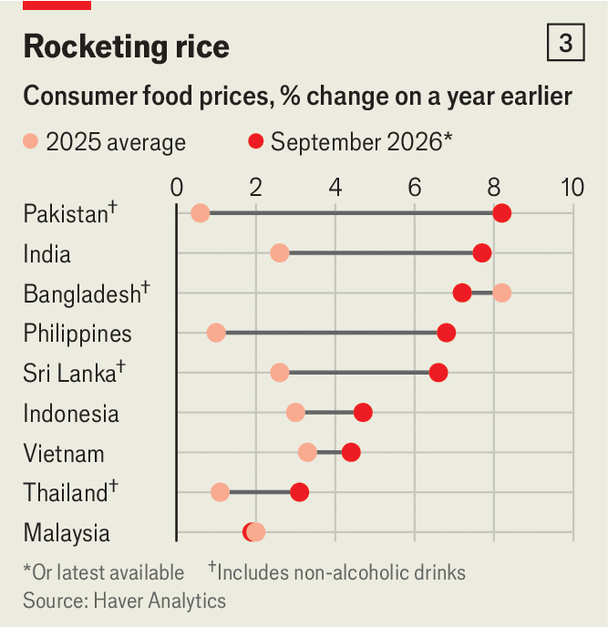
除此之外,伊朗战争还扰乱了燃料与化肥的供应。世界银行预计,今年化肥价格平均将比去年上涨38%。不断攀升的生产成本与极端天气不仅压缩了农民的收入,还推高了食品价格(见图表3)。印度的年度食品通胀率从1月的2.1%升至8月的6%;斯里兰卡的食品通胀率在9月更是达到9%。不过更令人担忧的是食品供应问题。
All this comes on top of the Iran war’s disruption to fuel and fertiliser supplies. The World Bank expects fertiliser prices this year to average 38% more than last year. Higher input costs and extreme weather are squeezing farmers’ incomes, but also contributing to food inflation (see chart 3). India’s annual food inflation rate rose from 2.1% in January to 6% in August; in Sri Lanka it reached 9% in September. Yet the bigger worry is supply.
泰国 Krungthai 银行估计,从现在起至明年年中,泰国的稻米产量可能减少18%。虽然泰国拥有充足的粮食储备,但其他国家却几乎没有可依赖的后备资源。根据美国农业部的数据,孟加拉国的稻米库存量仅相当于其年消费量的4%不到。
Krungthai, a Thai bank, reckons Thailand’s rice output could fall by 18% between now and the middle of next year. Thailand has plenty of reserves, but other countries have little to fall back on. Bangladesh’s rice stocks amount to less than 4% of its annual consumption, according to data from America’s Agriculture Department.
为评估哪些国家受冲击最大,《经济学人》为亚洲11个新兴经济体编制了一份“脆弱性指数”。该指数综合考量两方面因素:厄尔尼诺现象对各国经济的潜在影响程度(以农业在国民经济中的比重为依据),以及各国政府缓解冲击的能力(以粮食储备量、公共债务水平及福利体系覆盖范围为依据)。斯里兰卡、孟加拉国和柬埔寨的得分最低(饱受战争蹂躏的缅甸相关数据较为匮乏,否则很可能位居榜首)。
To gauge which country is most exposed The Economist has built a “vulnerability index” for 11 of Asia’s emerging economies. It combines two sets of measures: how much El Niño could hurt their economies (based on the importance of agriculture to them), and how well governments could cushion the blow (based on grain stocks, public debt and the reach of welfare systems). Sri Lanka, Bangladesh and Cambodia come out worst (data for war-torn Myanmar are patchy, otherwise it would probably top the list).
不出所料,经济较发达的泰国与马来西亚表现最好。受冲击的形式则因国而异:在印度,受影响的主要是农民;而在菲律宾与孟加拉国,普通消费者则首当其冲。
Unsurprisingly, richer countries—Thailand and Malaysia—fare best. The pain takes different forms. In India the risk falls mainly on farmers; in the Philippines and Bangladesh it falls on consumers.
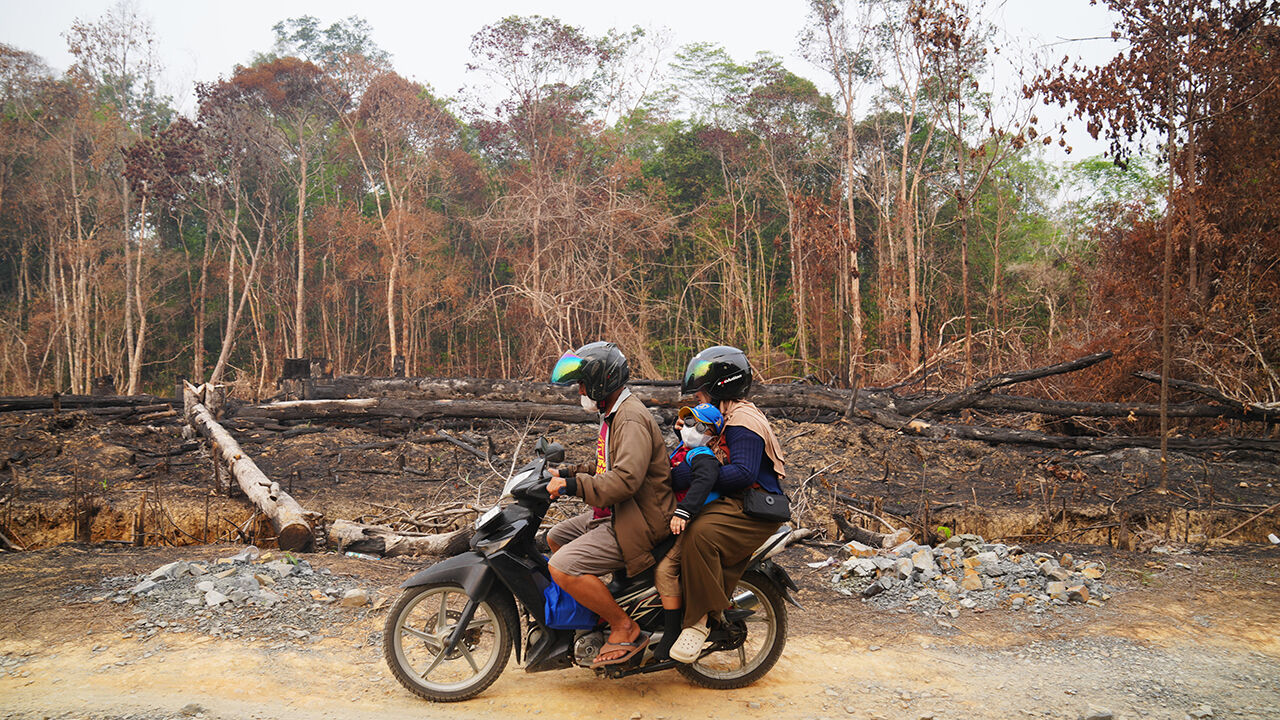
厄尔尼诺现象将产生超出粮食和农业范围的影响。亚洲开发银行(ADB)警告称,它可能加剧能源冲击:河流干涸导致水力发电减少,与此同时高温推升空调需求,迫使各国燃烧更多煤炭。公共卫生也面临风险。印度尼西亚的火灾产生的烟雾笼罩了东南亚部分地区;10月12日,新加坡的空气质量被评为全球最差,甚至比德里还要糟糕。
El Niño will generate effects beyond food and agriculture. The Asian Development Bank (ADB) warns it could worsen the energy shock: drying rivers cut hydropower output just as heat raises demand for air-conditioning, pushing countries to burn more coal. Public health is at risk, too. Smoke from Indonesia’s fires has shrouded parts of South-East Asia; on October 12th Singapore’s air was rated the unhealthiest in the world, worse even than Delhi’s.
经济损失可能十分巨大,尤其是因为各国政府的承受能力有限。对1997年厄尔尼诺现象的研究发现,它在接下来的五年里使全球经济损失近6万亿美元——其中亚洲承担了大部分损失。联合国估计,如果今年的粮食和能源价格冲击完全转嫁给家庭(即取消补贴和其他有利措施),全球将有约1.32亿人陷入贫困,其中9100万人位于亚洲。随着政府债务激增,避免这种情况将变得更加困难。
The economic toll could be enormous, especially because governments are poorly placed to absorb it. A study of the 1997 El Niño found that it cost the global economy nearly $6trn over the next five years—with Asia bearing much of the cost. The United Nations estimates that if this year’s food-and-energy price shock were passed fully onto households (ie, if subsidies and other helpful measures were removed), about 132m more people worldwide would fall into poverty, of whom 91m would be in Asia. As government debts balloon, avoiding this scenario will become harder.
好消息是,各国政府能够提前看到这场危机的到来。亚洲开发银行的罗森·费尔南多表示,更好的数据和预报意味着政策制定者比以前的厄尔尼诺时期更有准备。除了建立大米储备,各国政府也在尝试直接帮助农民。印度正在引导旱区种植者转向种植豆类和其他作物;与此同时,菲律宾则在发放抗旱种子。
The good news is that governments can see the crisis coming. Better data and forecasting mean policymakers are more prepared than in previous El Niño episodes, says Roshen Fernando of the Asian Development Bank. Alongside building up rice buffers, governments are also trying to help farmers directly. India is nudging growers in parched districts to shift towards planting pulses and other crops; the Philippines, meanwhile, is handing out drought-resistant seeds.
提前筹集资金也很重要。救灾资金往往只在灾害发生后才发放。费尔南多先生表示,政府应专门预留资金用于应对厄尔尼诺。这可以通过在高峰到来前协商紧急信贷额度和灾害保险来实现。
Money needs to be arranged in advance, too. Disaster funds are often released only after disaster strikes. Governments should instead set aside money specifically for El Niño, says Mr Fernando. That could be done by negotiating emergency credit lines and disaster insurance before the peak arrives.
特别有价值的是“预防性行动”,即在预测超过预设阈值时(例如水库水位)释放现金或其他援助。联合国认为,以这种方式花费的每一美元可以节省高达7美元的损失和后续援助。此类方案曾在非洲和中美洲试点。但在亚洲,其覆盖范围有限——部分原因是缺乏资金。6月,联合国世界粮食计划署及其粮食及农业组织寻求2.02亿美元,以保护22个国家的880万人,包括阿富汗、巴基斯坦和菲律宾。目前仅筹集到4000万美元。随着富国捐助者紧缩预算,预防工作成为首当其冲被削减的项目之一。
Particularly valuable is “anticipatory action”, which releases cash or other help when forecasts cross predetermined thresholds (such as water levels in a reservoir). The UN thinks every dollar spent in this way can save up to $7 in losses and later aid. Such schemes have been tried in Africa and Central America. But in Asia their coverage has been limited—in part due to a lack of financing. In June the UN’s World Food Programme and its Food and Agriculture Organisation sought $202m to protect 8.8m people in 22 countries, including Afghanistan, Pakistan and the Philippines. So far only $40m has been raised. As rich-country donors tighten their purse strings, prevention has among the first things to be cut.
一个多世纪前,一次特别强烈的厄尔尼诺现象导致印度、中国及其他地区发生饥荒,造成数千万人死亡。这主要是因为当时没有人预见到它的到来或知道应对措施。如今,亚洲更为富裕,也知道未来可能面临什么。但预报只有在政府和捐助者基于其采取行动时才有用。■
More than a century ago a particularly intense El Niño caused famines that killed tens of millions of people across India, China and elsewhere. That was largely because nobody saw it coming or knew what to do. Today a far richer Asia knows what lies in store. But forecasts are only useful if governments and donors act on them. ■