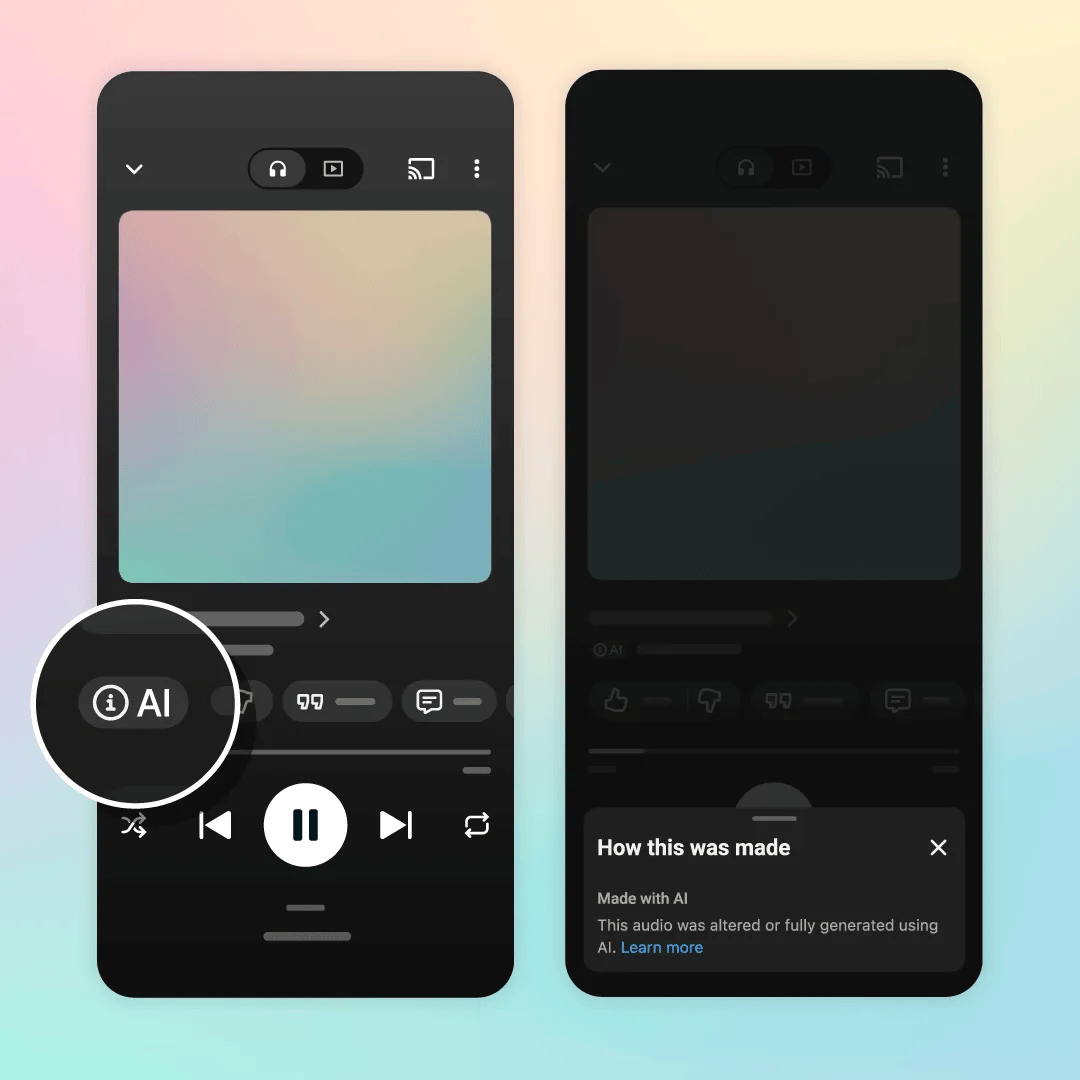
YouTube Music于周三宣布推出了一项新的标签系统,旨在提高使用生成式人工智能(AI)创作的歌曲的透明度。现在,听众可以轻松识别出那些通过AI技术制作的歌曲,包括那些在创作或演唱过程中使用了AI技术的作品。
YouTube Music announced Wednesday the rollout of a new labeling system aimed at improving transparency around songs created with the help of generative AI. Now, listeners will be able to easily identify tracks created using AI, including those involved in composition and vocals.
这些标签会显示在歌曲的播放页面上;用户点击这些标签后,可以获取有关AI在该歌曲创作中所起作用的详细信息。
The label will appear on the player page. Clicking on this label provides additional information about the specific role of AI in the track’s creation.
值得注意的是,这项新标签系统也将应用于YouTube的应用程序本身。
Notably, these labels will also extend to the main YouTube app.
YouTube表示,他们与多家音乐合作伙伴进行了合作,并自主研发了用于识别AI生成音乐的检测工具。根据其帮助文档,使用YouTube平台的音乐合作伙伴可以通过三种方式来标注他们的作品是否使用了AI技术:“完全由AI生成”(Fully Gen AI)、“部分使用AI生成”(Partially Gen AI)或“未使用AI生成”(No Gen AI)。
YouTube said it collaborated with various music partners and deployed its own detection tools to identify AI-generated music. According to its help page, partners using YouTube can declare their work’s use of generative AI through one of three designations: “Fully Gen AI,” “Partly Gen AI,” or “No Gen AI.”
其中,“完全由AI生成”的歌曲是指完全由AI技术创作的歌曲;“部分使用AI生成”的歌曲则是指艺术家在创作过程中融入了AI生成的元素,但同时添加了自己的原创内容;而那些使用自动调音(Auto-Tune)等音高校正工具编辑过的歌曲则被归类为“未使用AI生成”的歌曲。
“Fully Gen AI” applies to tracks that are entirely generated by AI, while “Partly Gen AI” refers to works where artists may have incorporated AI-generated components but added their own live elements. Tracks edited using pitch-correction tools such as Auto-Tune fall under the “No Gen AI” category.
这一举措的背景是:AI生成的音乐正在各大流媒体平台上迅速普及,许多平台都在采取相应的措施来明确标注这类音乐。例如,Apple Music计划在今年晚些时候推出“Made With AI”标签作为其AI透明度标签系统的一部分;Spotify同样提供了类似的AI标签功能,并配备了音乐内容过滤机制。Deezer则采取了更为严格的措施:据其报告,每天有近90,000首完全由AI生成的歌曲被检测到;该平台会将这些歌曲从算法推荐和编辑推荐的播放列表中剔除,并拒绝向这些歌曲的版权所有者支付报酬;同时,Deezer还在开发让用户能够自行过滤掉AI生成音乐的选项。
The move comes as AI-generated music rapidly expands across streaming services, and many platforms are adopting their own approaches. For instance, Apple Music has plans to introduce “Made With AI” labels as part of its AI Transparency Tags later this year. Spotify also has AI labels, as well as a music spam filter. Deezer has taken one of the stricter stances, reporting in July that it was receiving nearly 90,000 fully AI-generated tracks daily. The platform labels detected AI-generated music and excludes it from algorithmic recommendations and editorial playlists, while also withholding royalties from fraudulent streams.
TIDAL也会对那些被识别为完全由AI生成的歌曲进行标注,允许用户选择是否播放这些歌曲,并且不会向这些歌曲的版权所有者支付报酬。
The company is also working on an option to let users filter out AI-generated music. TIDAL also labels recordings it identifies as entirely AI-generated, allows listeners to disable them, and excludes these recordings from royalty attribution.
相比之下,YouTube更注重信息的透明度(即向用户公开相关事实),而非采取全面的限制措施。它新推出的标签系统旨在向听众说明人工智能在音乐创作中的作用;不过,仅仅因为音乐作品使用了人工智能技术,并不意味着该作品就不能被用于盈利目的。YouTube甚至还在探索基于人工智能的音乐创作工具——例如“Dream Track”这款工具,它允许部分创作者使用人工智能技术来生成参与者的声音样本,并据此制作音乐配乐。
YouTube, by contrast, is focusing on disclosure rather than blanket restrictions. Its new labels are intended to inform listeners about AI’s role in music creation, but AI involvement alone doesn’t make a track ineligible for monetization. YouTube even experiments with AI-powered music creation, including its tool Dream Track, which lets select creators generate soundtracks featuring AI-generated versions of participating artists’ voices.