到访日本的游客都深谙这种简单的乐趣:喝上一杯当地啤酒——无论标签上印着哪个品牌,这些拉格啤酒的口感始终令人满意且熟悉。
Visitors to Japan know the simple joys of a local beer — a mug of lager that, regardless of the brand on the label, is consistently tasty and familiar.
不过,日本公平交易委员会却认为这种一致性或许是个问题。据彭博社报道,该委员会已对日本四大啤酒厂商展开调查,怀疑它们合谋商定向批发商提价的时间与幅度。另有消息称,该监管机构其实数十年来一直在关注此类行为。
That consistency might be a problem, says the Fair Trade Commission, which has launched an investigation into the four major brewers. The regulator suspects they colluded to fix the timing and level of price hikes for wholesalers, according to Bloomberg News. Further reports suggest the regulator has been looking at the practice for decades.
这种合谋行为显然不妥:倘若指控属实,那么多年来消费者一直都在支付高于实际价值的费用。
The collusion is problematic; if the allegations are true, customers have been paying more than needed for years.
但更严峻的问题或许在于,这些企业未能进一步整合壮大,从而具备在全球市场上竞争的实力。自上世纪90年代中期达到顶峰以来,日本国内啤酒市场规模已缩水约40%,而四大啤酒厂商仍在为争夺这一不断萎缩的市场份额相互竞争。与此同时,海外的啤酒企业则通过并购整合实现了规模扩张。倘若日本始终无法培育出能与安海斯-布希英博、喜力等国际巨头相抗衡的本土龙头企业,日后恐怕会为此后悔不已。
But the bigger problem might be that they didn’t get even closer — and build the scale to compete globally. The four have been fighting over a shrinking domestic beer sector that is some 40% smaller since its mid-90s peak while overseas rivals, riding a wave of consolidation, have become substantially larger. A failure to form national champions big enough to take on the likes of Anheuser-Busch InBev and Heineken NV is something Japan might come to regret.
这四大企业——朝日啤酒、麒麟啤酒、札幌啤酒以及三得利酒业——构成了寡头垄断格局,掌控着日本90%的啤酒销量。它们的产品与定价大体相近,各自都推出一款或数款酒精度约为5%的拉格啤酒以满足本地消费者的口味偏好。近年来,随着能源与原材料成本持续上涨,这些企业也几乎在同一时期上调了产品价格。
The companies, Asahi Breweries, Kirin Brewery, Sapporo Breweries and Suntory Spirits, make up an oligopoly that controls 90% of the country’s beer sales. Prices and products are largely similar, each shipping one or more flagship variations of the 5% or so ABV lager favored by local palates. The firms have, in recent years, raised prices at similar times as energy and input costs have climbed.
四家公司并非始终步调一致,而是倾向于由一家创新、其他家迅速跟进。(四家均表示正全力配合公平交易委员会的调查;朝日集团控股社长为涨价辩护,称过去几年其业务累计成本增加达1000亿日元(约合6.32亿美元)。)麒麟长期占据主导地位,直到1987年朝日Super Dry问世。这款创新型拉格啤酒不仅改变了日本啤酒的口味特征,更让其制造商跃居行业龙头。
Rather than consistently moving in lockstep, there is a tendency for an innovation by one to be quickly copied by the others. (All four have said they are fully cooperating with the FTC investigation; the president of Asahi Group Holdings Ltd. defended the need for price rises citing ¥100 billion ($632 million) in cumulative cost increases in its business over the past several years.) Kirin dominated for decades until Asahi Super Dry came along in 1987. The innovative lager not only changed the taste profile of Japanese beer, but turned its maker into the industry leader.
此后竞争对手一直在追赶这一高峰,推出数十款新产品和季节限定款,试图夺取或仅仅是维持市场份额。确实,这种无穷无尽的多样性是此地生活的一大乐趣,从高麦芽的秋味啤酒到使用产地啤酒花酿造的精酿,应有尽有。我不希望看到这些消失。但我们也应考虑另一种可能。
Rivals have been chasing that high ever since, launching dozens of new products and seasonal variations in an attempt to capture, or just maintain, market share. It’s true that this endless variety is one of the joys of life here, from the high-malt Aki Aji autumn beer to brews using regional hops. I don’t want to see that go. But we should also consider the alternative.
随着朝日在世纪之交超越麒麟,这些啤酒厂曾是世界较大规模的酿酒商。如今,它们远远落后于海外竞争对手,后者规模已大幅扩大,运营规模截然不同。四大啤酒企业合计产量仅为百威英博的20%,后者现旗下拥有百威、科罗娜和斯特拉·阿图瓦等品牌。
When Asahi overtook Kirin around the turn of the century, the breweries were among the world’s larger makers. Now, they are distant also-rans to overseas rivals that have become substantially bigger, and operate at a vastly different scale. The big four combined have just 20% of the production of AB InBev, which now controls brands such as Budweiser, Corona and Stella Artois.
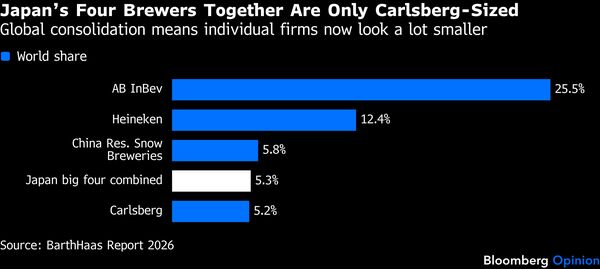
过度碎片化并非仅限于啤酒行业。日本拥有七家汽车制造商和近百家地方银行。尽管人口在减少,它们往往宁愿为争夺萎缩的受众而竞争,也不愿联手应对全球市场。
Excessive fragmentation isn’t limited to beer. The country has seven automakers and nearly 100 regional banks. Despite the declining population, they often prefer to compete for a shrinking audience rather than join forces to take on a global one.
当地银行正在加速合并。除了本田和日产那次失败的合并之外,汽车行业也逐渐开始向两大巨头集中。然而,在啤酒行业,尽管该行业面临着诸多挑战(如人口减少、年轻人饮酒习惯的改变以及更便宜的替代品的出现),关于行业整合的讨论却非常少。
Local banks are now combining in droves. And, the failed merger of Honda and Nissan aside, the auto industry is slowly starting to concentrate around two poles. But when it comes to beer, it’s remarkable how little discussion there has been of a broader consolidation despite the broader challenges the sector faces, including a declining population, shifting drinking habits among young people, and a trend for cheaper alternatives.
唯一的例外是2009年麒麟啤酒与三得利啤酒之间的合并谈判——如果这次合并成功,它们本可以成为全球食品和饮料行业的巨头之一。但与金融危机后许多日本企业的合并计划一样,这次谈判最终因控制权问题而破裂。
The one exception was the 2009 merger talks of Kirin and Suntory, a potential food-and-beverage behemoth that, at the time, would have been in the world’s top five. But, like many of the proposed combinations of Japanese firms following the financial crisis, talks broke down over control.
随着市场规模不断缩小,四大啤酒巨头各自采取了不同的策略。其中两家公司的啤酒业务已逐渐被边缘化:麒麟啤酒的酒精饮料收入占比已降至不到一半,该公司因此加快了向医疗保健领域的拓展,最近以14亿美元收购了加拿大维生素和补充剂制造商Jamieson Wellness Inc.;而三得利则通过收购Jim Beam等品牌进入了烈酒市场。
As the market has shrunk, each of the big four has attempted a different strategy. For two, beer has become something of an afterthought: Alcohol now makes up less than half of annual revenue for Kirin, which has accelerated a push into healthcare, most recently with the $1.4 billion purchase of Canadian vitamins and supplements maker Jamieson Wellness Inc., while Suntory pushed into liquor with its acquisition of brands including Jim Beam.
与此同时,札幌啤酒曾与美国的精酿啤酒制造商Anchor Brewing和Stone Brewing进行了糟糕的收购交易。后来,在激进投资者3D Investment Partners的压力下,札幌啤酒被迫出售了其持有的房地产资产。如今,札幌啤酒重新将重点放在啤酒业务上,并与嘉士伯合作在东南亚市场开展业务。只有朝日啤酒通过海外扩张取得了真正的成功,收购了Peroni和Pilsner Urquell等品牌。不过,其规模仍远低于竞争对手。
Sapporo, meanwhile, made disastrous deals for US craft beer makers Anchor Brewing and Stone Brewing. Subsequently, it was pressured by activist 3D Investment Partners, which accused the company of being “severely mismanaged,” into divesting its real estate holdings. Sapporo is now focusing again on beer, allying with Carlsberg to form a venture to sell in Southeast Asia. Only Asahi has found real success by expanding its portfolio overseas, acquiring brands including Peroni and Pilsner Urquell. Nonetheless, its scale remains well below rivals.
如果不能在日语术语的使用上达成统一(即不能统一使用日语中的专业术语),最终可能就会被迫接受由他人制定的标准。从价格、口味和包装格式来看,日本啤酒的统一性表明:无论是否存在垄断组织,日本的啤酒制造商们确实懂得如何进行协调与合作。可惜的是,他们从未将这种合作模式发展到其应有的逻辑终点(即从未将其发展为一种可持续的、全国统一的商业策略)。
Failure to consolidate on Japanese terms may eventually mean consolidation on someone else’s. In price, taste and format, the consistency of Japanese beer shows that, cartel or not, the country’s brewers knew how to coordinate. It’s just a shame they never took that to its logical conclusion.