墨尔本:想象一家公司既向你销售设备,又向你的企业投入资金,随后租回你用这些设备所建造的东西。它同时是你的供应商、投资者和客户。这种模式被称为循环融资。
MELBOURNE: Imagine a company that sells you equipment, invests money in your business, and then rents back what you build with it. It’s your supplier, your investor and your customer all at once. That’s known as circular financing.
许多人工智能(AI)公司,包括微软、亚马逊、谷歌和英伟达,都采用了这种不透明的融资方式的一种版本。
Many artificial intelligence (AI) companies, including Microsoft, Amazon, Google and Nvidia, have adopted a version of this opaque method of financing.
芯片供应商向数据中心建设者等客户投资,客户用这些资金购买供应商的芯片,双方公司均报告增长。
A chip supplier invests in a customer such as a data centre builder, the customer spends the money on the supplier’s chips, and both companies report growth.
一份央行分析发现,投向AI公司的资金中有55.2%来自其他AI公司。
One central bank analysis found that 55.2 per cent of investments into AI firms came from other AI firms.
投资者和市场尚不清楚的是,这场AI热潮究竟有多少是由真实的最终用户需求推动的,又有多少可能是泡沫。
What’s not clear to investors or the market is how much of this AI boom is being driven by real, end-user demand – and how much might be a bubble.
一切都回到了英伟达。以英伟达为例。全球领先的芯片制造商正在向ChatGPT的所有者OpenAI投资,以支持装满英伟达芯片的数据中心。
IT ALL COMES BACK TO NVIDIA Take Nvidia. The world’s leading chipmaker is investing in ChatGPT owner OpenAI to support data centres filled with Nvidia chips. Nvidia will invest US$30 billion in a private funding round in OpenAI and provide a guarantee of up to US$105 billion for an OpenAI data centre in Ohio, as well as investing in the company building it.
英伟达将在OpenAI的私募融资轮次中投资300亿美元,并为俄亥俄州的OpenAI数据中心提供最高1050亿美元的担保,同时还投资于该数据中心的建设方。
That helps OpenAI to remain Nvidia’s best customer, but it also raises the question: Is the chipmaker propping up the market?
这有助于OpenAI继续保持英伟达的最大客户身份,但也引发了一个问题:芯片制造商是在支撑市场吗?
Nvidia has invested in other AI firms as well, including up to US$10 billion in Anthropic, the developer of Claude.
英伟达还投资了其他AI公司,包括向Claude的开发商Anthropic投资最高100亿美元。
It bought US$2 billion of shares in cloud provider CoreWeave to help it speed up the build-out of AI factories that use Nvidia technology.
它以20亿美元购买了云服务提供商CoreWeave的股份,以帮助其加速使用英伟达技术的AI工厂建设。
In total, Nvidia made more than 50 different investment deals in AI companies in 2024 alone.
仅在2024年,英伟达就在AI公司中完成了超过50笔不同的投资交易。
Some of those deals are staged over years or still open-ended.
其中一些交易分阶段进行或仍处于开放状态。但这些循环交易有助于AI建设的速度快于没有英伟达融资时的情况。
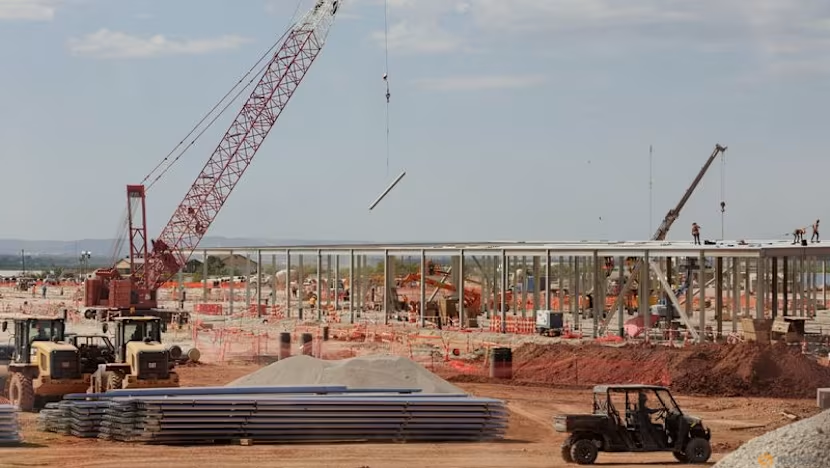
But these circular deals help the AI build-out move faster than it could without Nvidia’s financing. Australian data centre builder Firmus – which last week dramatically abandoned plans to list on the Australian Securities Exchange – provides an example.
澳大利亚数据中心建设公司Firmus(该公司上周戏剧性地放弃了在澳大利亚证券交易所上市的计划)提供了一个例子。英伟达在Firmus身上兼具三重身份,即:投资者:英伟达于2025年9月通过公司3.3亿澳元(约合2.3亿美元)的融资首次投资Firmus Technologies,用于在塔斯马尼亚州建设数据中心。随后,英伟达以现有投资者身份参与了另外两轮融资,一轮在2026年4月,另一轮是Firmus在2026年8月的20亿美元融资轮。英伟达未披露其具体投资金额。
Nvidia wears all three hats for Firmus, namely: Investor: Nvidia first invested in Firmus Technologies through the company’s A$330 million (US$230 million) capital raising in September 2025 to finance data centres in Tasmania. It then participated as an existing investor in two further funding rounds, one in April 2026 and Firmus’s US$2 billion funding round in August 2026. Nvidia did not disclose how much it invested.
供应商:Firmus计划使用英伟达的DSX AI工厂平台建设数据中心,该平台整合了芯片、网络和软件,以提供算力。
Supplier: Firmus plans to build data centres using Nvidia’s DSX AI factory platform, which combines chips, networking and software to provide computing capacity.
客户:Firmus与英伟达签署协议,将其成为巴淡岛数据中心的客户,该项目六年内价值最高可达300亿美元。与此同时,OpenAI(凭借其与英伟达的现有关系)被命名为Firmus马来西亚数据中心的锚定客户。
Customer: Firmus signed Nvidia as a customer for its data centre in Batam, Indonesia, worth up to US$30 billion over six years. Meanwhile, OpenAI (with its existing relationship with Nvidia) has been named as an anchor customer at Firmus’ Malaysian data centres.
循环交易集中风险 同样的循环会集中风险。随着英伟达在人工智能领域同时扮演投资者、供应商和融资者的角色,一家公司出现问题可能会迅速蔓延到其他公司。这也使估值变得复杂。
CIRCULAR DEALS CONCENTRATE RISK The same loop concentrates risk. With Nvidia acting as investor, supplier and financier across the AI sector, trouble at one firm can spread quickly to the others. It also complicates valuations.
例如,OpenAI的收入报告方式受到质疑。上周,《金融时报》报道其年化收入比公司此前所称的少200亿美元,导致其股价受挫。
For instance, OpenAI’s method of reporting revenues has been queried. Its shares were hit last week when the Financial Times reported its annualised revenues were US$20 billion less than the company had suggested.
澳大利亚储备银行在其最近的金融稳定报告中警告称,存在一些“高风险公司的集中区域”,包括那些采用不透明或循环融资安排的公司,在这些公司中,芯片制造商向购买其产品的公司提供融资。
The Reserve Bank of Australia warned in its recent Financial Stability Review that there are “pockets” of higher-risk companies, including those using opaque or circular funding arrangements, where chipmakers provide financing to the companies that purchase their products.
警告称AI泡沫可能破裂,澳大利亚储备银行表示:“一个可能的触发因素可能是对AI投资热潮的情绪转变,这种热潮日益受到对持续快速盈利增长的预期推动,同时伴随着一种日益不透明且循环的债务融资周期。”担忧在于,美国股市几乎所有的涨幅都由AI公司推动。
Warning about the possibility of the AI bubble bursting, the RBA said: “One possible trigger could be a shift in sentiment towards the AI investment boom, which is increasingly fuelled by expectations of sustained rapid earnings growth and a debt-financing cycle that is becoming more opaque and circular.”The concern is that nearly all the gains in the US stock market have been driven by AI companies.
在华尔街,芯片制造商贡献了2026年标普500指数总涨幅的约70%,而英伟达目前是该指数中最大的单一公司,占指数的约8%。
On Wall Street, chipmakers have contributed around 70 per cent of the total gains in 2026 for the S&P 500, and Nvidia is now the index’s largest single company at about 8 per cent of the index.
这使得市场变得脆弱。如果投资者开始怀疑OpenAI及类似客户能否从客户那里赚取足够的收入以履行其承诺,英伟达将面临双重打击。首先是预期销售下降;其次是其对这些同一公司的融资敞口。这将拖累整个市场,因为英伟达在关键指数中的权重很大。
This makes the market fragile. If investors begin doubting that OpenAI and similar customers can earn enough in revenue from customers to meet their commitments, Nvidia would be hit on two fronts. First, via lower expected sales and second via its financing exposure to those same companies. That would drag down the whole market, due to its heavy weighting in the key index.
澳大利亚人也会感受到影响。近90%的家庭面临AI股票敞口,这是因为他们通过养老金基金持有的美国股票。
Australians would feel it too. Nearly 90 per cent of households are exposed to AI stocks, due to the US shares held through their superannuation funds.
时机问题 以上情况并不意味着AI热潮是虚假的。问题在于时机。
A QUESTION OF TIMING None of this means the AI boom is fake. The issue is timing.
英伟达、OpenAI和Firmus正在赌注:来自用户和企业的未来收入将增长得足够快,以支付当前的大规模数据中心建设。在此之前,投资者、贷款人以及彼此的公司将填补融资缺口。
Nvidia, OpenAI and Firmus are betting that future revenue from users and businesses will grow fast enough to pay for today’s massive data centre build-out. Until then, investors, lenders and each other’s companies fill the financing gap.
这与1990年代的电信热潮有历史类比。当时被称为“新经济”的时期,设备制造商如思科系统为客户融资以购买其设备。光纤铺设过快过早,当股市泡沫破裂时,投资者遭受重大损失。
There is a historical comparison with the 1990s telecom boom. In what was then called the “New Economy”, equipment makers such as Cisco Systems financed customers to buy their equipment. Too much fibre was laid too soon, and investors lost heavily when the stock market bubble burst.
但那些光纤使用了数十年。最新的AI芯片寿命仅为几年。如果来自企业和消费者的预期收入和需求延迟或低于预测,股东和养老金基金将承担损失。
But that fibre lasted decades. The newest AI chips have a shelf life of only a few years. If the expected revenue and demand from business and consumers arrives late or below forecasts, shareholders and super funds will bear the losses.
瑞鹏·刘(Ruipeng Liu)是迪肯大学金融学高级讲师,萨加里卡·米什拉(Sagarika Mishra)是迪肯大学副教授。此评论首发于《对话》(The Conversation)。
Ruipeng Liu is Senior Lecturer in Finance and Sagarika Mishra is Associate Professor at Deakin University. This commentary first appeared on The Conversation.