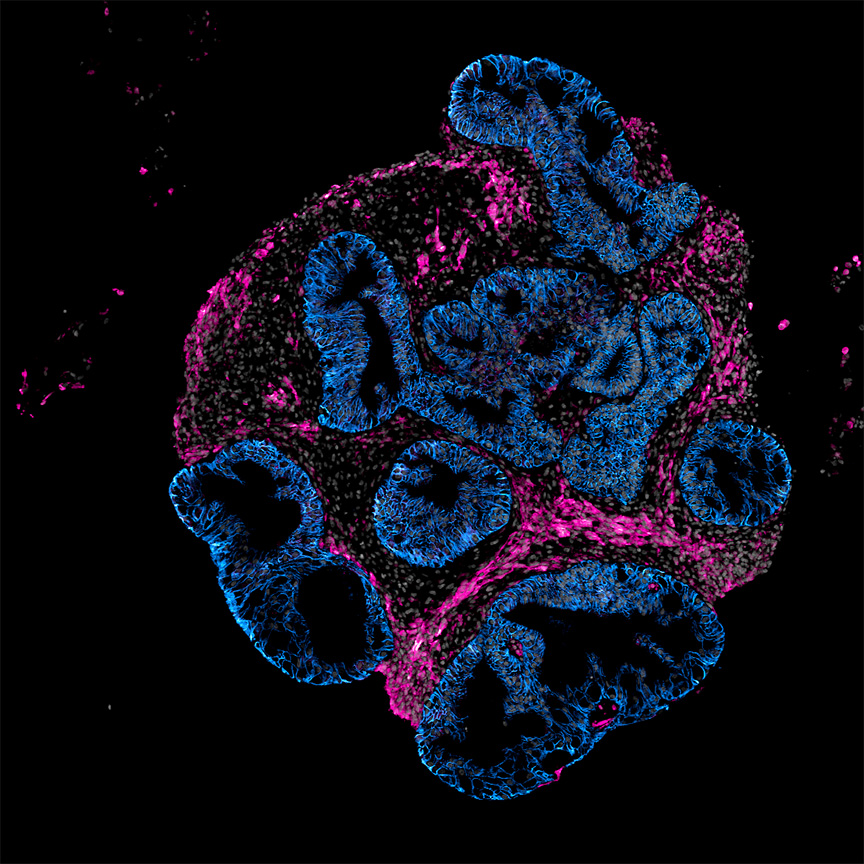
长期以来,药物研发一直依赖动物模型,但由于不同物种间的生理差异,在动物身上有效的药物未必能在人体中产生相同效果,因此大多数药物在研发过程中仍会以失败告终。总部位于丹佛的初创企业Intero Biosystems正在研发一种名为“人类肠道类器官”的技术——即在实验室中培育出能够模拟人体肠道结构的组织,以此作为另一种研究手段,以便在药物进入人体试验阶段前,先观察它们对人体的潜在影响。
Drug development has long relied on animal models, but differences between species mean what works in animals doesn’t always translate to humans, and most drugs still fail during development. Intero Biosystems, a Denver-based startup, is developing human intestinal organoids, lab-grown tissue that mimics the gut, as another way to study how drugs and other compounds might affect the human body before they are tested in people.
如今,众多研究人员及制药企业都在积极寻求能更真实反映人体生理特征的实验模型,以此补充甚至逐步替代动物实验。
Researchers and pharmaceutical companies are increasingly looking for models that better reflect human biology to supplement animal testing and reduce their reliance on it.
这家从密歇根大学衍生出来的企业表示,其研发的肠道类器官与那些仅能模拟肠道部分结构的简易模型有所不同。联合创始人兼首席技术官玛德琳·艾肯向TechCrunch介绍称,这些类器官包含了人体肠道中存在的多种细胞与组织类型,因此有望成为更贴近人体生理特征的药物测试模型。
Intero, which spun out of the University of Michigan, says its organoids differ from simpler models that replicate only part of the gut. They contain multiple cell and tissue types found in the human intestine, which the company believes makes them a more human-relevant model for testing drugs and other compounds, co-founder and CTO Madeline Eiken told TechCrunch.
“绝大多数药物在临床试验阶段都会失败,其实不难理解:我们既不是老鼠,也不是单层扁平细胞而已。”艾肯说道。
“Most drugs fail clinical trials, and I think it’s pretty easy to appreciate that we are neither mice nor flat layers of cells,” Eiken said.
这家公司的核心产品名为GastroScreen,是一种供制药、生物技术、食品及化工企业使用的肠道类器官模型。联合创始人兼首席执行官查理·蔡尔兹介绍称,每个类器官的直径约为1毫米,公司每次会以试管包装的形式向客户寄送约100个。客户既可将它们作为健康的肠道模型使用,也可人为诱发类似疾病的状态,进而测试不同化合物对这类组织的作用效果。
The startup’s flagship product, GastroScreen, is a human intestinal organoid model that it sells to pharmaceutical, biotech, food, and chemical companies for testing drugs and other compounds. Each organoid is about one millimeter across, and the company ships roughly 100 at a time in a tube, co-founder and CEO Charlie Childs said. Customers can use them as healthy intestinal models or induce disease-like conditions to test how the tissue responds to different compounds.
“我们实际上就是在通过快递向客户寄送‘微型活体器官’。”蔡尔兹说道。
“We’re literally shipping mini living organs in the mail to people,” Childs said.
除了提供类器官本身外,Intero还销售培育及研究类器官所需的各类耗材,比如用于滋养细胞的营养液以及实验中使用的化学试剂。该公司还为客户开展相关研究服务,包括设计定制化实验方案、执行实验室测试并交付实验结果数据。这些研究大多围绕药物安全性及疾病机理展开。例如,客户可让类器官接触候选药物,以观察其是否会对肠道造成损害;也可利用模拟特定肠道疾病的类器官来研究组织对该化合物的反应情况。
Beyond the organoids themselves, Intero sells the supplies needed to grow and work with them, such as the nutrient mixes that feed the cells and the chemicals used in experiments. It also runs studies for customers, including designing custom experiments, performing lab tests, and delivering the resulting data. Much of this work focuses on drug safety and disease research. For example, a customer can expose the organoids to a drug candidate to see whether it could harm the gut, or use organoids modeling a gut condition to see how the tissue responds to a compound.
这家初创企业创立于2024年,去年完成了230万美元的种子前轮融资。目前公司拥有7名员工,客户数量接近10家。据首席执行官介绍,从去年第四季度至今年第三季度,公司营收已突破40万美元。
Founded in 2024, the startup now has seven employees and just under 10 customers after raising a $2.3 million pre-seed round last year. It generated more than $400,000 in revenue from the fourth quarter of last year through the third quarter of this year, the CEO noted.
监管政策的变化也推动了市场对动物实验替代方案的关注度。去年4月,美国食品药品监督管理局(FDA)公布了减少药物研发过程中对动物实验依赖的计划,并提倡将类器官、器官芯片(可模拟器官功能的小型装置)以及基于人工智能的计算模型等作为潜在替代方案。
Regulatory changes have also helped drive interest in alternatives to animal testing. In April of last year, the U.S. Food and Drug Administration (FDA) laid out plans to reduce its reliance on animal testing in drug development, promoting alternatives including organoids, organs-on-chips (small devices that mimic organ functions) and AI-based computational models as potential alternatives.
今年3月,FDA发布了指导性草案,详细说明了药物研发机构在使用非动物实验方法作为监管申报依据时,应如何对这些方法的有效性进行验证。该指南虽提供了验证框架,但并未指定任何特定实验方法。某种非动物实验方法能否被用作申报依据,取决于该方法本身、实际应用方式以及所提供的数据质量等多重因素。
In March of this year, the FDA issued draft guidance outlining how drug developers should validate new approach methodologies, or NAMs, a term of non-animal testing methods, when using them to support regulatory submissions. The guidance provides a framework for validation but doesn’t endorse any specific method. Whether a NAM can support a submission depends on factors including the method, how it is used, and the data provided.
Eiken向TechCrunch表示,美国法律的相关调整允许药物研发机构在特定情况下采用非动物实验方法,这促使制药企业更愿意探索类器官这类技术。她补充道,此前对这类技术持观望态度的企业如今也纷纷计划将类器官技术引入内部研发流程。
Changes in U.S. law that allow drug developers to use non-animal testing methods in some cases have made pharmaceutical companies more willing to explore technologies such as organoids, Eiken told TechCrunch. Companies once hesitant about the technology are now looking to bring organoids in-house, she added.
Intero 并非唯一一家致力于构建更符合人体肠道特征模型的公司。Altis Biosystems 开发了来源于干细胞的肠道模型,而 InSphero 提供了用于胃肠毒性测试的患者来源肠道类器官。其他同行如 MIMETAS 采取了不同的方法,利用器官芯片技术,通过微流体系统重建人体组织内部环境的某些方面。
Intero isn’t alone in trying to build more human-relevant models of the gut. Altis Biosystems develops stem cell-derived intestinal models, while InSphero offers patient-derived intestinal organoids for gastrointestinal toxicity testing. Other peers like MIMETAS take a different approach with organ-on-chip technology, using microfluidic systems to recreate aspects of the environment inside human tissues.
Intero 表示,其模型在复杂性和可扩展性方面区别于竞争对手。与通过结肠镜检查等程序采集组织培养的肠道模型不同,GastroScreen 来源于诱导多能干细胞,这些细胞是被重编程的成体细胞,能够分化为几乎任何细胞类型,并且可以从血液样本中获得,Eiken 解释道。这种方法使初创公司有可能根据不同患者个性化其模型,并更轻松地扩大生产规模,她补充道。
Intero says it sets itself apart from competitors in the complexity and scalability of its model. Unlike intestinal models grown from tissue collected through procedures such as colonoscopies, GastroScreen is derived from induced pluripotent stem cells, which are adult cells reprogrammed to become almost any cell type and can be generated from a blood sample, Eiken explained. That approach gives the startup the potential to personalize its models to different patients and scale production more easily, she added.
当被问及有什么证据表明 GastroScreen 能比现有动物或细胞模型更准确地预测人体对药物的反应时,Childs 表示公司仍在构建该证据,目前正处于三阶段验证过程的第二阶段。在首先证明 GastroScreen 包含人体肠道的关键组织后,Intero 现在正在对具有已知人体影响的知名药物进行测试。Childs 对 TechCrunch 表示,GastroScreen 已显示出对减少肠道炎症的药物以及已知会损伤肠道的化合物的预期反应。
When asked what evidence shows GastroScreen can predict human drug responses more accurately than existing animal or cell-based models, Childs said the company is still building that evidence and is now in the second stage of a three-stage validation process. Having first shown that GastroScreen contains the key tissues of the human gut, Intero is now testing well-known drugs with documented effects in humans. GastroScreen has shown expected responses to drugs that reduce intestinal inflammation and to compounds known to damage the gut, Childs told TechCrunch.
在最终阶段,公司将直接将 GastroScreen 的结果与制药公司现有的动物和临床数据进行比较。这些研究正在与多家制药公司开展,既使用现有化合物,也使用新药候选物,Childs 说。
In the final stage, the company will compare GastroScreen’s results directly with pharmaceutical companies’ existing animal and clinical data. Those studies are underway with several pharmaceutical companies, using both existing compounds and new drug candidates, Childs said.
Intero 不使用人工智能来构建其器官芯片。相反,Childs 看到了利用器官芯片生成人工智能模型所需生物数据的机会,公司计划向制药公司和人工智能公司授权此类数据集。
Intero doesn’t use AI to build its organoids. Instead, Childs sees an opportunity to use the organoids to generate the biological data AI models need, and the company plans to license such datasets to pharmaceutical and AI companies.
在短期内,Intero 专注于扩大生产规模。Childs 表示,公司目前一次可以生产几千个器官芯片,并正在努力实现制造自动化,目标是每批生产数十万个。长期来看,公司希望进入个性化医疗领域,利用患者自身的细胞制造器官芯片,以便在治疗前测试不同药物。其最雄心勃勃的目标是构建人工肠道,Childs 表示这一愿景将建立在其器官芯片技术所实现的生产规模和患者特异性数据之上。
In the near term, Intero is focused on scaling production. It can currently make a few thousand organoids at a time and is working to automate manufacturing, with the goal of producing hundreds of thousands per batch, Childs said. Longer term, it wants to move into personalized medicine, using a patient’s cells to create organoids that could test different drugs before treatment. Its most ambitious goal is an artificial intestine, a vision that Childs said would build on the manufacturing scale and patient-specific data generated through its organoid technology.
Intero 于本周三早些时候在 TechCrunch Disrupt 大会上亮相,这是 20 家争夺今年创业大赛冠军头衔的初创公司之一。欢迎继续关注后续活动:Disrupt 将于 10 月 13 日至 15 日在旧金山市中心举行。
Intero took the stage earlier Wednesday at TechCrunch Disrupt, where it’s one of 20 startups vying for this year’s Startup Battlefield title. Join us for the rest of the action: Disrupt runs October 13 to 15 in downtown San Francisco.