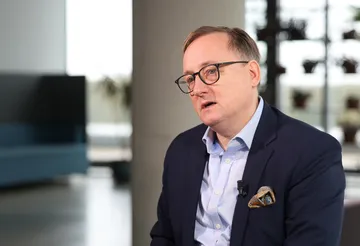
欧洲央行管理委员会委员马丁斯·卡扎克斯表示,欧洲央行有时间分析由全球经济中相反力量形成的通胀动态。
The European Central Bank can afford to take some time in analyzing inflation dynamics that are shaped by opposing forces in the global economy, Governing Council member Martins Kazaks said.
这位拉脱维亚央行行长在一次采访中表示,尽管石油和天然气价格的持续上涨将使消费物价增长保持高位,但最近几周政府债务的抛售可能开始对经济活动造成压力。
While the persistent rise in oil and gas prices is set to keep consumer-price growth elevated, the selloff in government debt in recent weeks might start to weigh on economic activity, the Latvian central-bank chief said in an interview.
卡扎克斯在曼谷出席国际货币基金组织年会期间表示:“我的感觉是,在不久的将来通胀力量仍将更强。”他指出:“因此,政策方向是明确的,尽管在利率问题上没有任何立即采取行动的迫切需要。我们并没有落后于形势,从这个意义上说,我们处于有利地位。”欧洲央行官员正在讨论今年自伊朗战争爆发以来两次加息后的下一步举措。随着通胀率接近4%,一些人表示,可能需要进一步收紧政策才能回到2%的目标。
“My feeling is that the inflationary forces will still be stronger in the immediate future,” Kazaks said in Bangkok, where he’s attending the IMF’s Annual Meetings. “So the direction of policy is clear, even if there isn’t any immediate need to rush on rates. We’re not behind the curve, so in that sense, we’re well positioned.”ECB officials are debating what to do next after raising rates twice since the start of the Iran war this year. With inflation approaching 4%, some have said that more tightening might be necessary to return to the 2% target.
比利时央行行长皮埃尔·温施本周对彭博电视表示,“我们可能不得不再次加息”,尽管不确定性很高。他的立陶宛同僚格迪米纳斯·希姆库斯对此表示赞同,称最近的证据表明有必要提高借贷成本。
Belgian central-bank chief Pierre Wunsch told Bloomberg Television this week that “we are probably going to have to hike again,” even if uncertainty is elevated. His Lithuanian colleague Gediminas Simkus agreed, saying that recent evidence suggests a need for higher borrowing costs.
卡扎克斯强调,通胀的上行风险“仍然大于增长的下行风险”。然而,他表示,经济扩张面临的威胁“更有可能呈现非线性特征”。
Kazaks highlighted that risks to inflation on the upside are “still bigger than the risks to growth on the downside.”However, the threats to economic expansion “are at risk of being more nonlinear,” he said.
卡扎克斯认为,在如此复杂的背景下,这家总部位于法兰克福的机构在利率突破被估计为会限制经济增长的水平之后,决策可能会变得更加复杂。
Against such a complex backdrop, decision-making at the Frankfurt-based institution could become more complicated as rates breach a level above which they’re estimated to restrict the economy, according to Kazaks.
他说:“货币政策的权衡将变得更加棘手。到目前为止,决策相对容易。但存在很大的不确定性和非常低的能见度。”法国加剧了这一挑战,由于该国政府艰难削减预算赤字,法国引发了近期的债券抛售。其他负债累累的欧元区国家的收益率也有所上升,这引发了人们的担忧,即市场走动会阻碍货币政策的传导并迫使欧洲央行进行干预。
“The tradeoffs for monetary policy are going to get more tricky,” he said. “So far, the decisions have been relatively easy. But there’s a lot of uncertainty and very low visibility.”Adding to the challenge is France, which has led the recent bond selloff as the government struggles to reduce its budget deficit. Yields in other highly indebted euro nations have risen as well, raising concerns that market moves hamper the transmission of monetary policy and force the ECB to intervene.
卡扎克斯说:“金融市场的无序波动将是一个令人担忧的问题,但这并不意味着金融市场中的任何压力都成为我们的问题。仍有时间解决财政问题,我敦促将其解决。”法国政府已经提出了缩小赤字的计划,现在需要向紧张的金融市场证明它能够实施这些计划。在投资者对法国债务要求的收益率溢价升至欧元区危机以来的最高水平之后,关于欧洲央行可能进行干预的猜测有所增加。
“Unwarranted volatility in financial markets would be a worry, but it doesn’t mean that any stress in financial markets becomes our problem,” Kazaks said. “There’s still time to fix the fiscal issue, and I would urge it to be done.”The French government has presented plans to narrow its deficit and now needs to prove to nervous financial markets that it can implement them. Speculation about possible ECB intervention has grown after the premium investors demand over equivalent German debt rose to the highest level since the euro-area crisis.
但卡扎克斯表示,货币政策不应通过帮助降低法国借贷成本来介入。
But monetary policy shouldn’t get involved by helping lower French borrowing costs, Kazaks said.
他说:“使其成为解决所有问题的方案将是非常短视和适得其反的。”
“It’d be very shortsighted and counterproductive to make it the solution to all the problems,” he said.
他补充说:“当然,货币政策的传导是我们关心的事,我们将对此进行关注。如果情况变得无序,我们将做必要的事情。但我们不应该试图解决每一个可能的问题。”
“Of course, transmission of monetary policy is of interest to us and we will follow that,” he added. “If things become disorderly, we will do what is necessary. But we shouldn’t try to solve every possible problem.”
卡扎克斯还谈到了最低准备金要求,这是一个徘徊了一段时间的话题。
Kazaks also touched on minimum reserve requirements, a topic that’s lingered for a while.
增加准备金将从流通中撤出流动性,并促进量化紧缩。这也将降低央行的利息支付,帮助其应对因量化宽松而产生的亏损。
An increase would remove liquidity from circulation and contribute to quantitative tightening. It would also lower central banks’ interest payments, helping them address losses accrued as a result of quantitative easing.
卡扎克斯说:“如果我们有使用它的政策理由,我们就应该使用。我们向市场进行解释,以便我们的反应机制是可以理解的,然后就会没事的。”
“If we have a policy case to use it, then we should,” Kazaks said. “We explain it to the market so that our reaction function is understandable, and then it’s going to be alright.”
立陶宛的希姆库斯周三表示,“讨论这个问题并没有什么不对”,目前的水平并非“一成不变”。
Lithuania’s Simkus said Wednesday that “there’s nothing wrong with discussing it” and that the current level isn’t “carved in stone.”