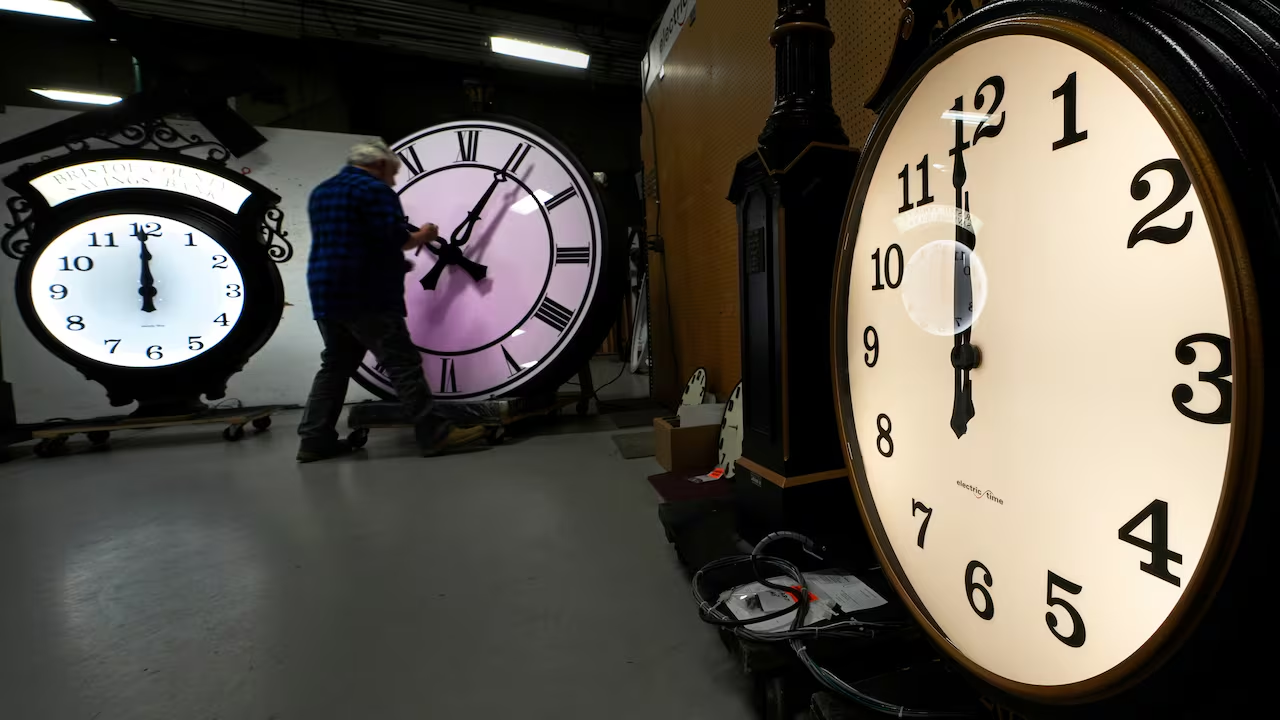
在过去的50多年里,人类一直利用“闰秒”来保持我们的时钟与地球自转同步。
For more than 50 years, humanity has used "leap seconds" to keep our clocks aligned with the rotation of the Earth.
周四,法国的一个国际授时机构预计将取消闰秒,并允许时钟出现偏差,直到其与标准时间相差整整一小时,这一过程可能需要几个世纪甚至几千年。
On Thursday, an international timekeeping body in France is expected to do away with leap seconds and let the clocks slip until they're out of alignment by a full hour, which could take centuries or even millennia.
我们用来记录日子的精确原子时——开发于20世纪50年代,通过追踪原子的自然振动来测量——与基于太阳在空中相对于地球特定位置的太阳时略有不同,因为地球的自转一直在逐渐放缓。
The precise atomic time we use to track our days — developed in the 1950s and measured by tracking the natural vibrations of atoms — is slightly out of sync with solar time, which is based on the position of the sun in the sky relative to a specific location on Earth, because the planet's rotation has been gradually slowing.
闰秒于1972年被引入,作为纠正这种差异的一种方法。加拿大国家研究委员会计量研究中心频率与时间团队负责人斯科特·比蒂(Scott Beatti)表示,当时立即增加了10秒。
The leap second was introduced in 1972 as a way to correct the discrepancy. Ten seconds were added immediately, says Scott Beattie, lead of the frequency and time team at the National Research Council of Canada's Metrology Research Centre.
从那时起,负责追踪太阳日与原子时之间差异的国际地球自转服务局一直在监测这种差异,以确定何时需要增加额外的一秒。
Since then, the International Earth Rotation and Reference Systems Service, which tracks the difference between the solar day and atomic time, has monitored the discrepancy to determine when an extra second is needed.
当达到这一阈值时,国际计量局将在12月底或6月底增加一秒。闰秒已被添加了27次,最近一次是在2016年。
When that threshold is reached, the International Bureau of Weights and Measures adds a second at either the end of December or the end of June. Leap seconds have been added 27 times, most recently in 2016.
如果我们不进行这些微小的调整,在我们有生之年,任何事情都不会有明显的改变。但比蒂说,最终“你可能会在午夜迎来一天中最亮的时候,而在中午迎来一天中最暗的时候”。这一概念类似于闰年,即每四年在2月底增加一天,以保持格里历与季节同步,因为地球绕太阳公转一周大约需要365又四分之一天。
If we didn't make those tiny adjustments, nothing would perceptibly change in our lifetimes. But eventually, Beattie says, "you might get the brightest part of the day at midnight and the darkest part of day at noon." The concept is similar to leap years, whereby a day is added to the end of February every four years to keep the Gregorian calendar aligned with the seasons because the Earth's orbit around the sun takes about 365¼ days.
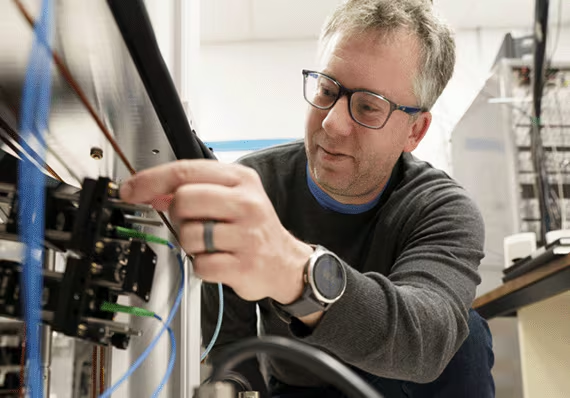
比蒂表示,如果没有闰年,我们最热的月份最终会落在了现在的冬季,而较冷的月份则会落在了夏季。问题出在哪里?然而,闰秒似乎带来的麻烦多于价值的时刻已经到来。比蒂说:“基本的全球共识是,我们希望废除这些突然的闰秒。”
Without leap years, our hottest months would eventually fall during what is now winter, and the colder months during summer, Beattie says. What's the problem? But the time has come when leap seconds seem to be causing more trouble than they're worth. "The basic global agreement is that we want to do away with these abrupt leap seconds," Beattie said.
这是因为,对于科技和电信公司以及依赖精确计时的基础设施来说,这种微小的调整可能会令人头疼。
That's because the small adjustment can be a headache for tech and telecommunications companies and infrastructure that relies on precise timekeeping.
各大公司也采用了不同的方式来实施闰秒,例如改变时钟速率,将额外的一秒拉长到几个小时或整整一天。比蒂说,网络之间的这种差异带来了系统故障的风险。
Companies also have different ways of implementing leap seconds, such as changing their clock rates to stretch the extra second over several hours or an entire day. Beattie says that variation among networks creates a risk of system failures.

例如,2012年Reddit和LinkedIn的崩溃,以及2016年Cloudflare的短暂中断,都被归咎于闰秒。
The leap second was blamed for Reddit and LinkedIn crashes in 2012, for example, and brief outages at Cloudflare in 2016.
比蒂说:“问题在于,对计时和网络同步的需求一直在上升,它们在不断增加。因此,风险也随之增加,因为你只需要某个系统没有正确实施它,然后就会产生连锁反应,从而导致相当大的问题。”负闰秒?还有一个复杂的转折。
"The problem is that the needs for timing and network synchronicity are just going up and up, they're ever increasing," Beattie said. "And so the risks are just increasing along with them, because all you need is for some system to not implement it properly and then you could have a cascade effect that could cause quite significant problems." Negative seconds? There's another complicating twist.
在过去六年左右的时间里,地球的自转实际上一直在加速,这提出了未来可能需要“负闰秒”——即减去一秒——的可能性。
Over the last six years or so, the Earth's rotation has actually sped up, raising the possibility that a "negative leap second" — in which a second would be taken away — could be needed in the future.
科技巨头Meta在2022年表示,负闰秒可能会对软件产生“毁灭性影响”,并补充道:“无论如何,对于管理硬件基础设施的人来说,每一个闰秒都是主要的痛苦来源。”安大略省西北部部分地区将于11月实行永久夏令时西北地区季节性时间调整将于11月1日起正式结束这项将于2027年5月生效的拟议修复方案是,让这些额外的秒数累积到3600秒——整整一小时——然后再调整时钟,从而将这个问题推迟许多代人。并非所有人都对这种方法印象深刻。
Tech giant Meta said in 2022 that a negative leap second could have a "devastating effect" on software, adding, "In any case, every leap second is a major source of pain for people who manage hardware infrastructures." Parts of northwestern Ontario moving to permanent daylight saving time in November Seasonal time changes in N.W.T. officially end as of Nov. 1 The proposed fix, which would take effect in May 2027, is instead to let those extra seconds add up to 3,600 — a full hour — before adjusting the clocks, pushing the issue many generations down the road. Not everyone is impressed by this approach.
约克大学物理和 astronomy 名誉教授保罗·德兰尼(Paul Delaney)表示,听到这一提议时他感到“很惊讶”。
Paul Delaney, a York University physics and astronomy professor emeritus, says he was "surprised" to hear the proposal.
他说:“对于一个日益计算机化、以人工智能为导向的经济体来说,这是一个问题,这显然就是我们目前的现状。但话又说回来,天哪,我们难道不还雇佣着计算机程序员来解决这些问题吗?我内心的一部分声音在说,我们这是在举手投降,并说:‘哦,这太难做了,管他呢,这只是一秒钟。’”“并非完美的系统”里贾纳大学天文学副教授萨曼莎·劳勒(Samantha Lawler)表示,有许多因素影响着地球的自转速度,但它总体上有随时间变慢的趋势,部分原因在于月球对地球潮汐的影响。
"It is a problem for an increasingly computerized, AI-oriented economy, and that's obviously what we have," he said. "But that said, gosh, don't we still hire computer programmers to sort these sorts of things out? Some part of me says that we're throwing in the towel and saying, 'Oh, it's too difficult to do, and what the heck, it is just a second.'" 'Not a perfect system' Samantha Lawler, an associate professor of astronomy at the University of Regina, says many factors affect the Earth's rotation speed, but it has tended to slow over time, in part because of the moon's effect on Earth's tides.
但气候变化和冰川融化等复杂的变量,可能会导致这种趋势发生变化。这就是被称为“欧洲水塔”的瑞士冰川融化的速度联合国称,气候变化已过不归路,最严重的影响现已不可避免她表示,没有哪个系统是完美的,能让我们的时钟来应对这些变化,而且没有闰秒“我们也会过得很好”。
But complex variables, including climate change and glacial melting, can cause changes in that trend. This is how fast Swiss glaciers, the 'water tower of Europe,' are melting away Climate change past the point of no return, UN says, as worst impacts are now unavoidable She says there is no perfect system for our clocks to account for these shifts and "we'll be fine" without leap seconds.
劳勒说:“这是一个真实的、我们一直在与之斗争的人类问题,只要我们一直在观察星星在天空中移动、追踪太阳何时升起和落下、并试图找出正确的规律,这个问题就一直存在。”“它总会有点偏差,我认为我们只能接受这一点。”
"This is a real human problem that we've been struggling with forever, as long as we've been watching the stars move across the sky and tracking when the sun rises and sets, and trying to get the patterns right," Lawler said. "It's always going to be a little bit wrong, and I think we just have to accept that."