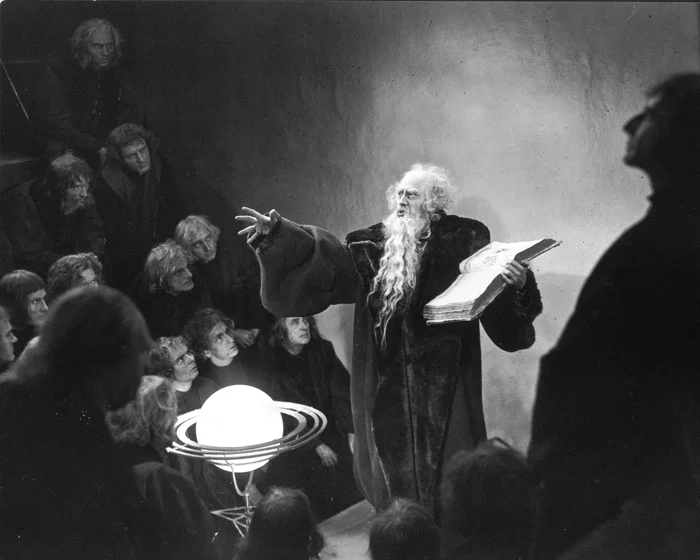
这部改编自歌德悲剧故事、讲述一个男子将灵魂卖给魔鬼的1926年电影,依然是德国表现主义的一项壮丽壮举。FW·穆瑙于1926年推出的无声奇幻情节剧迎来了百年诞辰,这也成了人们深思这部神秘电影的契机。该片改编自歌德19世纪对一位炼金术士兼自然哲学家命运的描绘,他将灵魂出卖给魔鬼,但在德国浪漫主义一种高屋建瓴的高潮中,最终被爱所救赎。
The 1926 film of Goethe’s tragic tale of a man who sells his soul to the devil remains a spectacular feat of German expressionism The centenary of FW Murnau’s silent fantasy-melodrama from 1926 is the occasion to ponder this mysterious film, taken from Goethe’s 19th-century depiction of the alchemist and natural philosopher who sells his soul to the devil but, in a very high-minded climax of German romanticism, is redeemed by love. (Not love of God precisely, but love of a good woman; the word “Liebe” finally appears at the centre of Murnau’s radiating vision of concentric circles conjured by the heavens, which annul his debt to the Evil One.)
(严格来说不是对上帝的爱,而是对一位善良女子的爱;在穆瑙构想的、由天堂召唤出的同心圆辐射状愿景的中心,最终浮现出了“爱”字,从而消除了他欠下恶魔的债务。)因此,它与克里斯托弗·马洛对浮士德博士那部更令人恐惧、更残酷无情的叙述截然不同。
It is therefore very different from Christopher Marlowe’s scarier and more unforgiving account of Doctor Faustus.
穆瑙的《浮士德》(显然)关注并受到邪恶的驱动,其中也能看到他四年前拍摄的《诺斯费拉图》的影子。在这部电影中,浮士德与梅菲斯托达成了为期24小时的试用期协议后,发现自己像吸血鬼一样害怕十字架。这也是一部深深打上魏玛德国烙印的电影,充满了疯狂的活力以及刺耳的讽刺和黑色幽默;浮士德将自己所有的巫术书籍连同《圣经》付之一炬的焚书场景,与后来的历史事件产生了共鸣。(这或许间接启发了克劳斯·曼的小说《梅菲斯托》,该书后来被伊斯特万·萨博拍成了电影。)
Murnau’s Faust is (obviously) concerned with and animated by evil, and there are echoes of his Nosferatu, made four years previously. In this film, Faust, having struck his bargain on a provisional 24-hour basis with Mephisto, finds that he is scared of a crucifix, like a vampire. It is also very much a film of Weimar Germany with its mad energy and streaks of garish satire and black comedy; the book-burning scene in which Faust immolates all his necromancy volumes, along with the Bible, is one which resonated with later events. (Perhaps it indirectly inspired Klaus Mann’s novel Mephisto, later to be filmed by István Szabó.)