中东正变得更加自由这一观点听起来可能有些反直觉。近50年前,伊朗的一场革命摧毁了该国的世俗秩序,迎来了一个以什叶派原教旨主义为基础、以“美国去死”为战斗口号的专制神权政体。此后,该地区一直是欧洲和北美多次恐怖袭击的温床,孕育了致力于独裁神权的叛乱运动,以及压迫女性、扼杀言论自由并边缘化少数族群的压迫性政权。
The idea that the Middle East is becoming more liberal may sound counterintuitive. Nearly 50 years ago, a revolution in Iran dismantled the country’s secular order and ushered in an absolutist clerical regime grounded in Shiite fundamentalism whose battle cry was “Death to America.”The region has since been an incubator for numerous terrorist attacks in Europe and North America, insurgent movements committed to authoritarian theocracy, and repressive regimes that subjugate women, crush free expression, and marginalize minorities.
到了现在,人们或许很容易得出这样的结论:中东社会对自由主义根本不感兴趣——正如哲学家米歇尔·福柯在1978年谈到伊朗起义时所宣称的那样,它们受制于一种本质上不同且更偏向宗教的“真理政体”。按照这种观点,一种原教旨主义者自称有权按其意愿定义信仰的统治系统——它将个人自由置于宗教旨意之下、宣扬男性至上、并对女性实施严格的着装要求——将永远使该地区与西方区别开来。
By now, it might seem easy to conclude that Middle Eastern societies are simply less interested in liberalism—that they are governed by a fundamentally different, more religiously oriented “regime of truth,” as the philosopher Michel Foucault declared in 1978 about the uprising in Iran. In this view, a system of rule in which fundamentalists claim authority to define the faith as they see fit—subordinating individual liberty to religious diktats, promoting male supremacy, and imposing restrictive dress codes on women—will forever distinguish the region from the West.
但这种评估把统治的后果误认为其原因。在威权主义巩固之下,另一种历史正在展开。2000年至2020年间,我在中东地区主持了一系列调查,对五个关键国家的代表性人群进行面对面访谈,以了解公民为何持有其价值观,并追踪这些价值观的变化。在这些国家——埃及、伊朗、伊拉克、沙特阿拉伯和土耳其——的受访者在不同程度上表达了对自由价值观日益增长的偏好,即使他们的统治者试图压制民众对民主变革的诉求。
But this assessment mistakes the consequences of domination for its causes. Beneath the authoritarian entrenchment, another history has been unfolding. Between 2000 and 2020, I supervised a series of surveys in the Middle East, conducting face-to-face interviews with representative samplings of people in five key countries to understand why citizens hold the values they do and to track shifts in those values. To varying degrees, respondents in these countries—Egypt, Iran, Iraq, Saudia Arabia, and Turkey—expressed an increasing preference for liberal values, even as their rulers sought to suppress popular demands for democratic change. (We focused on these countries because their size and political importance made them valuable cases for testing sociological theories.)
(我们之所以关注这些国家,是因为它们的规模和政治重要性使其成为检验社会学理论的有价值案例。)调查询问了受访者关于广泛价值观的看法,但我们试图通过15个问题来捕捉他们对自由价值观的态度,这15个问题涵盖三个维度:表达性个人主义、性别平等和世俗政治。表达性个人主义通过以下方面进行衡量:倾向于因爱情而非父母批准而结婚;认为独立和想象力比服从和宗教信仰更受孩子欢迎的品质;以及女性有权按照自己意愿穿衣。
The survey queried respondents about a broad range of values, but we sought to capture their attitudes toward liberal values with 15 questions covering three dimensions: expressive individualism, gender equality, and secular politics. Expressive individualism was measured by a preference for marrying for love rather than parental approval, independence and imagination over obedience and religious faith as desirable qualities in children, and the right of women to dress as they wish.
对性别平等的看法通过关于一夫多妻制、妻子服从以及在政治、就业市场和教育中优先考虑男性的问题来引出。对世俗政治的看法通过关于将宗教与政治分离;西方式治理;伊斯兰政府;以及伊斯兰教法(沙里亚法)的问题来评估。随后,我们将回答合并,为每次调查中每个人口生成一个“自由主义指数”得分,范围为1到4,得分越高表示对自由主义的支持越强。
Views on gender equality were elicited through questions on polygamy, wifely obedience, and giving priority to men in politics, the job market, and education. Perspectives on secular politics were assessed through queries about separating religion from politics; Western-style governance; Islamic government; and sharia law. We then combined the responses to generate a “liberalism index” score of 1 to 4 for each population in each survey, with higher scores indicating greater support for liberalism.
这些指数显示出自由主义程度的显着上升,尽管变化的幅度因领域和国家而异。该地区对伊斯兰政府和伊斯兰教法的支持普遍下降。在伊朗人中,对政教分离、性别平等以及着装自由的需求不断增长。这些价值观的转变已转化为政治行动,其中最显著的是2022年的“女性、生命、自由”运动以及2025至2026年的全国性抗议活动,据报道,有数万名抗议者被伊斯兰共和国安全部队杀害。
These indices showed significant increases in liberalism, although the magnitude of the change differed by domain and country. Support for Islamic government and sharia generally declined across the region. Among Iranians, there has been a growing demand for the separation of religion and politics, for gender equality, and for freedom of dress. These changing values have translated into political action, most notably in the Woman, Life, Freedom movement of 2022 and the nationwide protests of 2025–26, when tens of thousands of protesters were reported to have been killed by the Islamic Republic’s security forces.
在埃及,认为伊斯兰政府“非常好”的受访者比例从2011年的25%下降到2020年的16%;认为伊斯兰教法“非常重要”的比例从28%下降到18%。在伊拉克受访者中,强烈支持伊斯兰政府和伊斯兰教法的比例从2004年的30%和34%分别下降到2011年的15%和14%。
In Egypt, the proportion of respondents who considered Islamic government to be “very good” fell from 25 percent in 2011 to 16 percent in 2020; the share who felt sharia law was “very important” declined from 28 percent to 18 percent. Among Iraqi respondents, the proportion that strongly supported Islamic government and sharia law fell from 30 and 34 percent in 2004 to 15 and 14 percent in 2011.
尽管在沙特阿拉伯,由于政治敏感性,许多关于政府形式的调查问题被排除在外,但该国的调查捕捉到了显著变化:认为实施伊斯兰教法非常重要的受访者比例从2003年的73%下降到2011年的35%。与此同时,在性别平等问题上,强烈认同大学教育对男孩比对女孩更重要的比例显著下降,特别是埃及人(从2001年的15%下降到2020年的8%)和伊拉克人(从2004年的29%下降到2011年的8%——根据研究机构阿拉伯晴雨表的数据,这一水平在2021至2022年平均保持不变)。
Although many survey questions on forms of government were excluded in Saudi Arabia because of political sensitivities, surveys in that country captured significant changes: the proportion of respondents who considered it very important to implement sharia law fell from 73 percent in 2003 to 35 percent in 2011. On gender equality, meanwhile, the share who strongly agreed that university education is more important for boys than for girls declined significantly, especially among Egyptians (from 15 percent in 2001 to eight percent in 2020) and Iraqis (from 29 percent in 2004 to eight percent in 2011—a level that remained unchanged, on average, in 2021–22, according to the research group Arab Barometer).
对各个国家结果的更细致观察表明,宗教统治本身的经历可能助长了、而非排除了对回应型政治秩序的渴望。大众思想重塑一个社会的治理机构需要时间。然而中东历史表明,价值观的转变对于促成社会和政治组织形式的变化至关重要。例如,20世纪初埃及、叙利亚和伊朗自由民族主义运动的兴起,在此之前几十就已经出现了自由主义和民族主义意识形态。同样的模式也体现在20世纪60和70年代伊斯兰原教旨主义的兴起中,该浪潮最终催生了伊斯兰政权的建立以及伊斯兰主义极端主义的蔓延。
A more fine-grained look at the results in individual countries suggests that the experience of religious domination itself may have fed, rather than foreclosed, a desire for a responsive political order. It can take time for popular ideas to reshape a society’s governing institutions. Yet Middle Eastern history shows that shifts in values can be crucial in bringing about changes in social and political organization. The rise of liberal nationalist movements in Egypt, Syria, and Iran in the early twentieth century, for example, was preceded by the emergence of liberal and nationalist ideologies decades earlier. The same pattern is evident in the rise of Islamic fundamentalism in the 1960s and 1970s, which culminated in the establishment of Islamic regimes and the spread of Islamist extremism.
稳步转变 在2000年至2020年间,我们在埃及进行了五次调查,在伊朗进行了三次,在伊拉克进行了七次,在沙特阿拉伯进行了两次,在土耳其进行了三次。我们还考察了2011年后伊拉克的“阿拉伯晴雨表”(Arab Barometer)调查以及伊朗2020年“世界价值观调查”(World Values Survey)中的具体调查结果,这些调查中的问题与我们的问题相呼应。
A STEADY SHIFT Between 2000 and 2020, we conducted five surveys in Egypt, three in Iran, seven in Iraq, two in Saudi Arabia, and three in Turkey. We also considered specific findings in surveys conducted after 2011 in Iraq by Arab Barometer and in Iran by the World Values Survey in 2020, in which the questions mirrored our own.
这些数据揭示了政治发展与公众舆论之间令人瞩目的反差:正当“阿拉伯之春”在摇篮中被扼杀、圣战分子运动恐怖袭击该地区、土耳其领导人雷杰普·塔伊普·埃尔多安(Recep Tayyip Erdogan)追逐奥斯曼复兴主义梦想、伊朗最高领袖力图将该国塑造成什叶派主导的抵抗之弧中心、沙特领导人捍卫逊尼派宗派主义之际,这些中东关键国家的公众却日益倾向于自由价值观。
These data reveal a striking contrast between political developments and public opinion: even as the Arab Spring was smothered in its cradle, jihadist movements terrorized the region, Turkish leader Recep Tayyip Erdogan pursued dreams of Ottoman revivalism, Iran’s supreme leader sought to cast the country as the center of a Shiite-led axis of resistance, and Saudi leaders defended Sunni sectarianism, publics in each of these key Middle Eastern countries increasingly favored liberal values.
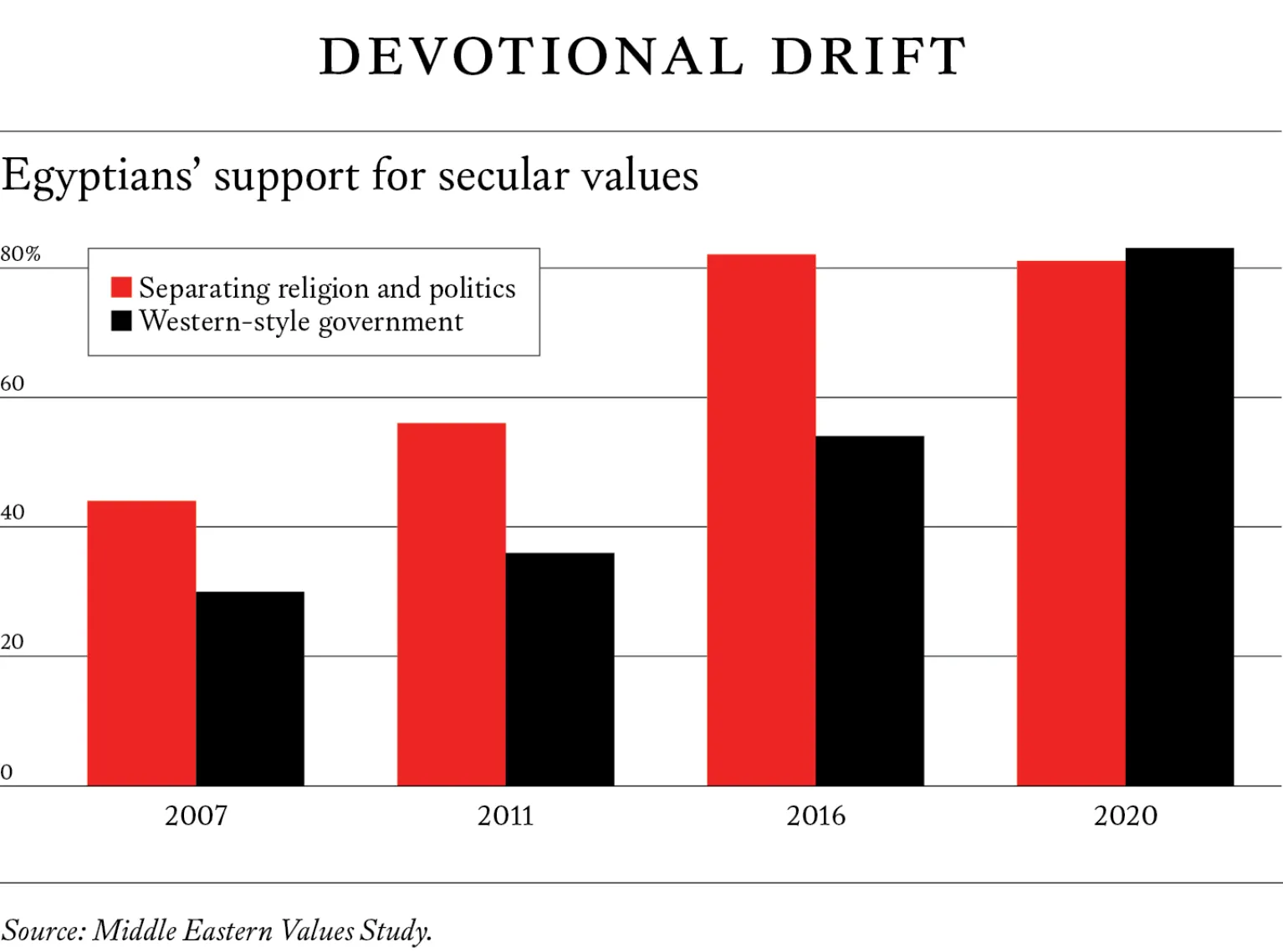
例如,埃及男性的自由主义指数评分从2.09上升到2.28,女性则从2.08上升到2.39。最显著的变化是对政教分离和采用西方体制的支持激增。受访者被问及,他们是否强烈同意、同意、不同意或强烈同意,如果政教分离且政府类似于西方国家,埃及将会是一个更好的地方。强烈同意或同意政教分离的比例从2007年我们首次提出该问题时的44%,上升到2011年的56%、2016年的82%以及2020年的81%。对西方风格政府的支持率从2007年的30%上升到2011年的37%、2016年的55%以及2020年的82%。
For instance, Egypt’s liberalism index rating rose from 2.09 to 2.28 among men and from 2.08 to 2.39 among women. The most striking change was a surge in support for separating religion and politics and for adopting a Western style of government. Respondents were asked whether they strongly agreed, agreed, disagreed, or strongly disagreed that Egypt would be a better place if religion and politics were separated and if its government resembled those of Western countries. The percentage that strongly agreed or agreed with separating religion and politics rose from 44 percent in 2007, when we first asked the question, to 56 percent in 2011, 82 percent in 2016, and 81 percent in 2020. Support for Western-style government increased from 30 percent in 2007 to 37 percent in 2011, 55 percent in 2016, and 82 percent in 2020.
为了解这些转变,我们采访了一部分在2011年至2020年间观点发生变化的追踪调查受访者。在那些还记得自己先前回答的人中,绝大多数人将他们对政教分离的新支持归因于对穆斯林兄弟会的幻想破灭,该伊斯兰主义运动的候选人赢得了埃及2012年的总统选举。那些转而赞成西方治理模式的人提到了西方国家的经济繁荣,并希望采用类似的体制能为埃及带来同等的繁荣。埃及人对性别平等和表达性个人主义的支持也有所增加,尽管幅度更为温和。
To understand these shifts, we interviewed a sampling of panel respondents whose views had changed between 2011 and 2020. Among those who remembered their earlier responses, a large majority attributed their newfound support for separating religion from politics to disillusionment with the Muslim Brotherhood, the Islamist movement whose candidate won Egypt’s 2012 presidential election. Those who had come to favor Western models of governance cited the economic prosperity of Western countries and hoped that the adoption of similar institutions would bring comparable prosperity to Egypt. Egyptians’ support for gender equality and expressive individualism also increased, albeit more modestly.
土耳其的民意也明显转向了自由主义价值观。在2013年至2020年期间,土耳其男性的自由主义指数从2.64上升至2.88,女性则从2.70上升至2.91。在埃及和土耳其两国,女性群体中自由主义价值观的普及都比男性更为广泛。但埃及的自由主义转变主要表现在对世俗政治态度的明显变化上,而在土耳其,朝向自由主义观点的最大转变则与对性别平等和表达性个人主义的看法有关。
Turkish popular opinion also shifted significantly toward liberal values. Between 2013 and 2020, Turkey’s liberalism index rose from 2.64 to 2.88 among men and from 2.70 to 2.91 among women. In both Egypt and Turkey, liberal values expanded more broadly among women than men. But whereas the liberal shift in Egypt was especially pronounced in attitudes toward secular politics, in Turkey the largest shifts toward liberal views related to views of gender equality and expressive individualism.
正当埃尔多安奉行日益专制、伊斯兰主义的政治规划时,这些自由化趋势依然展开了。2003年,在他所在的的正义与发展党在选战中获胜后,埃尔多安被任命为总理,这一任命最初被誉为伊斯兰主义的一种形式能够与民主共存的迹象。但他最终放弃了对民主治理的任何真正承诺,拆除了体制性制衡,并通过了一场2017年的修宪公投,巩固了他的权力。埃尔多安试图培植奥斯曼风格的泛伊斯兰主义,这一举动似乎加速了自由化,而不是加强了宗教的一致性。
These liberalizing trends unfolded even as Erdogan pursued an increasingly authoritarian, Islamist political project. Erdogan’s appointment as prime minister in 2003 after a ballot-box triumph by his Justice and Development Party was initially hailed as a sign that a form of Islamism could coexist with democracy. But he would eventually abandon any real commitment to democratic governance, dismantling institutional checks and balances and forcing a 2017 constitutional referendum that entrenched his power. Erdogan’s attempt to foster an Ottoman-style pan-Islamism appears to have accelerated liberalization rather than strengthened religious conformity.
这一进程的一个重要迹象是,在埃尔多安执政期间,土耳其受访者的自我认同从宗教转向了国家,同时清真寺的出席率也有所下降。2001年,64%的受访者主要认同自己是穆斯林,仅有34%的人首要认同自己是土耳其公民。到2013年,这些数字分别变为39%和44%;2016年,这一比例分别为36%和53%;到2020年,穆斯林身份认同降至24%,土耳其公民身份认同则达到63%。
An important indication of this process is the shift in Turkish respondents’ self-identification toward nation rather than religion under Erdogan, alongside a decline in mosque attendance. In 2001, 64 percent of respondents identified primarily as Muslim, and only 34 percent identified foremost as Turkish citizens. By 2013, these figures had shifted to 39 and 44 percent, respectively; in 2016, they stood at 36 and 53 percent, and by 2020, at 24 percent for Muslim identity and 63 percent for Turkish citizenship.
在此期间,清真寺的出席率也有所下降:自称每周去清真寺一次以上的受访者比例从2001年的19%降至2013年的16%,随后在2020年降至仅11%。鉴于清真寺的出席率在埃尔多安掌权之前就已经在下降,他最初的吸引力可能与其说是因为宗教保守主义,不如说是因为他担任伊斯坦布尔市长的政绩以及民众对土耳其世俗政治建制的不满。
Mosque attendance also declined over this period: the proportion of respondents who reported attending a mosque more than once a week fell from 19 percent in 2001 to 16 percent in 2013 and then to just 11 percent in 2020. Given that mosque attendance was already declining before Erdogan came to power, his initial appeal may have owed less to religious conservatism than to his record as mayor of Istanbul and widespread frustration with Turkey’s secular political establishment.
但我们的调查受访者随后向国家认同的转变,加上清真寺出席率的进一步下降,表明埃尔多安转向威尼斯式(此处按原文authoritarianism译为威权主义)的统治可能加剧了正在进行的自由化趋势。
But our survey respondents’ subsequent shift toward national identity, coupled with a further decline in mosque attendance, suggest that Erdogan’s turn toward authoritarianism may have intensified an ongoing trend toward liberalization.
宗教反弹 看似历史的讽刺,试图否定自由主义的力量反而助长了对它的支持。但强调自由主义与经济发展及中产阶级崛起关联的传统解释无法完全说明意识形态的转变。同一阶层在一种历史条件下可能拥抱自由主义,而在另一种条件下则转向非自由主义。(例如,二十世纪初埃及的自由价值观曾得到新兴中产阶级的支持,而后来,同一阶层又转而支持穆斯林兄弟会这一原教旨主义组织。)
RELIGIOUS RECOIL It may seem an irony of history that the very forces seeking to discredit liberalism have helped generate support for it. But conventional explanations emphasizing liberalism’s association with economic development and the rise of a middle class cannot fully account for ideological shifts. A given class may embrace liberalism under one set of historical conditions and illiberalism under another. (For instance, liberal values in early-twentieth-century Egypt were supported by the new middle class, the , but later, the same class came to favor the fundamentalist Muslim Brotherhood.)
相反,思想的意义是在与社会中占主导地位的其他思想相对立中形成的。这种对抗通过哲学辩论、宗教争论以及公开或秘密的公共讨论展开。当一套思想体系在社会中占据主导地位时,它同时成为争议的靶子和产生新思想的催化剂。对政治平等的渴望往往是在对抗专制权力中产生的,正如对性别平等的需求是对父权制制度的反应,表达个性的欲望是对家庭或社群束缚的回应,以及对自由穿衣的需求是对限制性着装规定的反抗。
Rather, ideas acquire meaning in opposition to other ideas that dominate society. This contestation takes place through philosophical debates, religious disputations, and public discussions, whether direct or indirect, open or clandestine. When a constellation of ideas comes to occupy a dominant position in a society, it simultaneously becomes a target of contestation and a catalyst for the production of ideas. A yearning for political equality tends to arise in opposition to authoritarian power, just as demands for gender equality emerge in reaction to patriarchal institutions, the desire to express one’s individuality in response to familial or communal constraints, and the demand for freedom of dress in defiance of restrictive sartorial regulations.
中东地区对自由价值观的兴趣——即宗教与政治分离的价值、对个人判断的赞扬,以及将个人而非集体视为政治共同体基本单位的认同——在过去几十年里似乎是在反对伊斯兰原教旨主义及其对行为的强制性规制的过程中发展起来的。例如,沙特阿拉伯对女性流动性的限制以及对伊朗女性施加的着装规定,使宗教对个人行为的控制尤为明显。对这些具体限制的抵抗有助于培育更广泛的信念,即政治权力不应随意决定应由个人判断处理的事务。
The Middle East’s interest in liberal values—that is, the value of separating religion from politics, the celebration of individual judgment, and the recognition of the individual rather than a collective as the fundamental unit of a political community—appears to have developed in recent decades in opposition to Islamic fundamentalism and its coercive regulation of conduct. Restrictions on women’s mobility in Saudi Arabia and dress regulations imposed on Iranian women, for example, made the exercise of religious control over individual conduct especially visible. Resistance to specific limits such as these can help foster a wider conviction that political power should not arbitrarily determine matters properly belonging to individual judgment.
这一过程在埃及和土耳其尤为明显,在这两个国家,清真寺出席率的下降伴随着自由价值观——尤其是世俗主义——的吸引力增强。在埃及,清真寺平均出席率(按1到4的评分范围计)从2011年的2.65下降至2020年的2.30;而在土耳其,则从2013年的1.96下降至2020年的1.82。值得注意的是,伊朗和沙特阿拉伯这两个由伊斯兰政权统治的国家,在我们于2000年代初进行的调查中,记录了所有受访国家中最低的清真寺出席率,两国平均均为1.86。在伊朗,这一数字随时间推移而下降,至2020年降至1.79。
This process is evident in Egypt and Turkey, where declining mosque attendance has accompanied the growing appeal of liberal values, particularly secularism. In Egypt, average mosque attendance (scored on a range of 1 to 4) fell from 2.65 in 2011 to 2.30 in 2020, while in Turkey, it declined from 1.96 in 2013 to 1.82 in 2020. It is striking that Iran and Saudi Arabia, both governed by Islamic regimes, recorded the lowest levels of mosque attendance among the countries we surveyed in the early 2000s, with an average of 1.86 in each country. In Iran, this figure declined over time, reaching 1.79 in 2020.
宗教强制导致伊朗人中自由主义激进化的趋势上升。伊斯兰共和国面临超过三十年的持续反对:首先是1990年代的改革运动;随后是2009年的绿色运动;最近则是2022年马赫萨·阿米尼去世后爆发的全国性抗议,这位年轻女子因据称违反强制戴头巾规定而被警方拘留,随后在警方羁押期间去世。随着时间的推移,这一反对运动的目标已从改革政权转向挑战其权威。
Religious coercion has contributed to the rise of militant liberalism among Iranians. The Islamic Republic has faced sustained opposition for more than three decades: first, the reformist movement of the 1990s; then, the Green Movement of 2009; and, more recently, the nationwide protests after the 2022 death of Mahsa Amini, a young woman who died in police custody after being arrested for allegedly violating compulsory veiling rules. Over time, the objectives of this opposition have shifted from reforming the regime to challenging its authority.
尽管政权已退出强制戴头巾的执行,但反对运动仍在继续激进化。2026年初的革命运动表达了日益增长的决心,旨在使国家摆脱伊斯兰共和国自身的专制统治。
Although the regime has retreated from enforcing compulsory veiling, the opposition movement has continued to radicalize. The revolutionary movement of early 2026 expressed a growing determination to liberate the country from the authoritarian rule of the Islamic Republic itself.
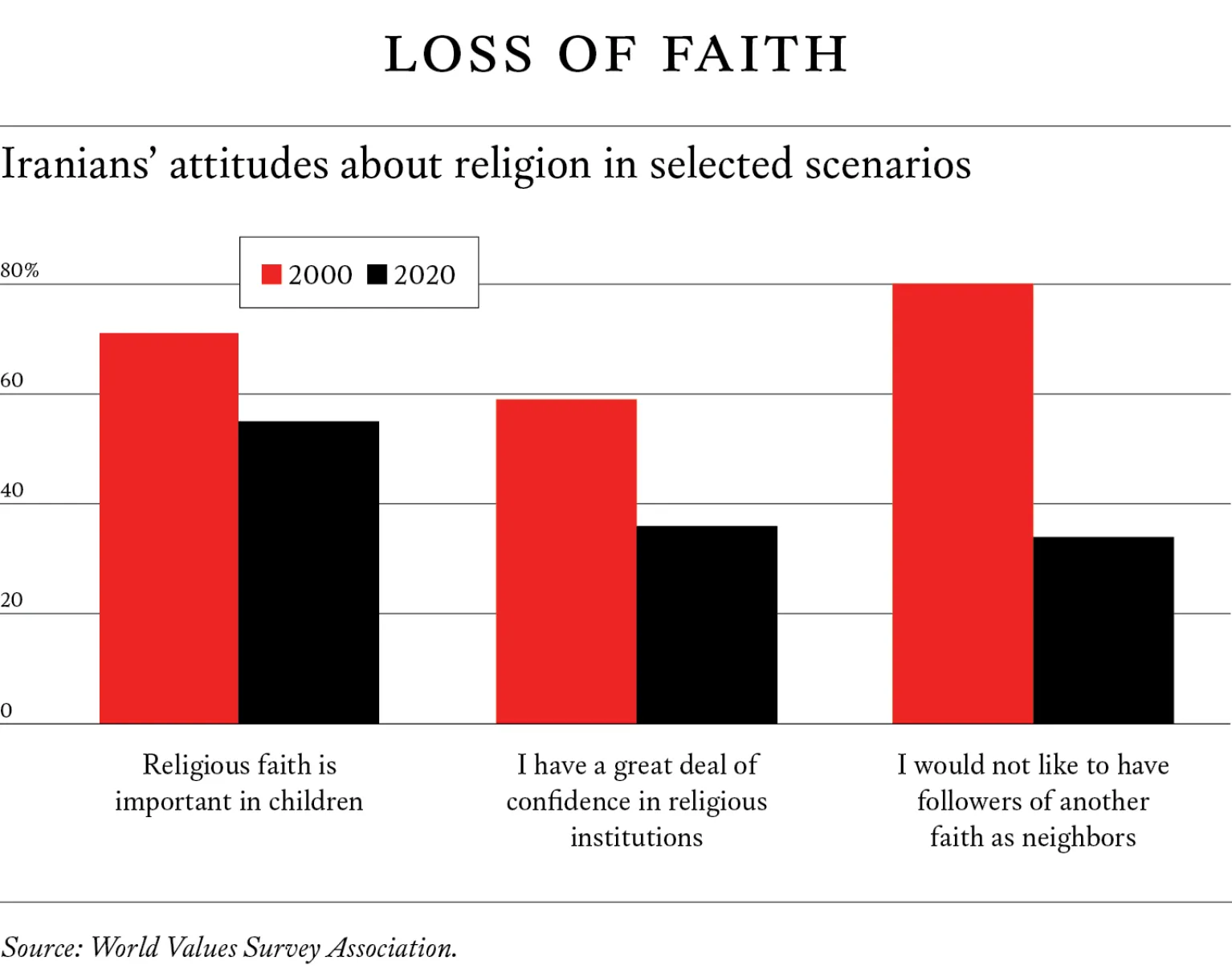
专制条件可能导致人们在调查中隐藏其真实偏好。尽管如此,数据显示,过去二十年伊朗人的宗教依恋出现显著下降。认为宗教信仰是儿童应具备的重要品质的受访者比例,从2000年的71%下降至2020年的55%。同样,表示对宗教机构“有很大信心”的伊朗人比例,从59%下降至36%。宗教不宽容也急剧下降:表示不愿与其他信仰的人作为邻居的受访者比例,从2000年的80%下降至2020年的34%。
Authoritarian conditions may lead people to conceal their true preferences in surveys. Nonetheless, the data reveal a marked decline in Iranians’ religious attachment over the past two decades. The proportion of survey respondents who considered religious faith an important quality for children to possess fell from 71 percent in 2000 to 55 percent in 2020. Similarly, the share of Iranians who expressed “a great deal of” confidence in religious institutions dropped from 59 percent to 36 percent. Religious intolerance also declined sharply: the proportion of respondents who said they would not want members of other faiths as neighbors fell from 80 percent in 2000 to 34 percent in 2020.
由总部位于荷兰、专注于伊朗研究的基金会GAMAAN于2022年对约2万名伊朗人进行的调查进一步说明了这一转变。完全88%的受访者对民主持有积极态度,而67%持有基于伊斯兰法(沙里亚法)的政府持负面看法。53%的受访者更倾向于世俗共和国或君主立宪制,而仅有22%倾向于伊斯兰政府。
A 2022 survey of approximately 20,000 Iranians conducted by GAMAAN, a research foundation based in the Netherlands that focuses on Iran, further illustrates this shift. Fully 88 percent of respondents expressed favorable attitudes toward democracy, while 67 percent held negative views of a government based on sharia. A secular republic or constitutional monarchy was preferred by 53 percent, compared with just 22 percent favoring an Islamic government.
在伊拉克,2003年美国入侵似乎促成了伊拉克民族主义的上升以及更强烈的民族认同感。受访者被问到:“以下哪项最能描述你首先是什么:(1) 我是伊拉克人;(2) 我是穆斯林;(3) 我是阿拉伯人;(4) 我是库尔德人;或(5) 其他?” 将自己主要视为伊拉克人的比例从2004年的23%上升至2020年的68%。对共同民族共同体的认同,而非仅仅是宗教或民族身份的认同,是自由公民身份的重要组成部分。
In Iraq, the 2003 U.S. invasion appears to have contributed to a rise in Iraqi nationalism and a stronger sense of national identity. Respondents were asked, “Which of the following best describes you above all: (1) I am an Iraqi; (2) I am a Muslim; (3) I am an Arab; (4) I am a Kurd; or (5) other?”The share identifying primarily as Iraqi rose from 23 percent in 2004 to 68 percent in 2020. Attachment to a shared national community, rather than to religious or ethnic identity alone, is an important component of liberal citizenship.
入侵后出现的宗派暴力似乎让伊拉克人认识到民族团结以及将宗教与政治分离的重要性。认为宗教与政治应当分离的伊拉克受访者比例从2004年的54%上升至2008年的76%,随后在2013–14年降至69%,并在2018年再次升至80%。
The sectarian violence that followed the invasion appears to have convinced Iraqis of the importance of both national solidarity and separating religion from politics. The share of Iraqi respondents who agreed that religion and politics should be separated rose from 54 percent in 2004 to 76 percent in 2008, before falling to 69 percent in 2013–14 and rising again to 80 percent in 2018.
对世俗政治的支持以及民族认同感的同步上升不太可能是偶然的。宗派暴力使得宗教动员日益缺乏吸引力,而外国占领则唤起了人们对伊拉克民族性的认识。2014年后,伊朗在伊拉克事务中的干涉扩大可能进一步推动了民族团结。准备变革即使这些中东政权的治理尚未明显体现向自由价值观的转变,但在不久的将来可能会出现这种转变。
The parallel increases in support for secular politics and a sense of national identity are unlikely to be accidental. Sectarian violence made religious mobilization increasingly unattractive, while foreign occupation provoked an awareness of Iraqi nationhood.
毕竟,思想推动历史——而且在中东地区这一点尤为明显。二十世纪初埃及、伊朗和土耳其现代世俗国家的形成,之前在十九世纪末就已经出现了自由主义、宪政主义、民族主义和世俗主义的流行。随后,1952年至1969年间在埃及、伊拉克、利比亚和叙利亚出现的阿拉伯民族主义政府,同样受到数十年前由叙利亚思想家萨蒂·阿尔-胡斯里和巴勒斯坦教育家达尔维什·阿尔-米克达迪所阐述的泛阿拉伯民族主义意识形态的深刻影响。
二十世纪末伊斯兰国家和运动的崛起,则是另一种意识形态转变的结果——世俗项目失去合法性,政治伊斯兰获得影响力。
After 2014, the expansion of Iran’s meddling in Iraq may have additionally driven national solidarity.
埃及和伊拉克说明了社会价值观的变化如何以不同方式重塑政治。在埃及,对穆斯林兄弟会的失望似乎削弱了政治伊斯兰作为威权统治替代方案的吸引力,而对世俗政治和西方式政府的支持日益增长,则指向对该国既定威权意识形态的更广泛拒绝。这种态度本身并不直接产生民主,但可能为未来的民主运动奠定基础。
READY FOR CHANGE Even if governance in these Middle Eastern regimes does not yet clearly reflect a shift toward liberal values, it may in the near future. After all, ideas drive history—and they have clearly done so in the Middle East. The formation of modern secular states in Egypt, Iran, and Turkey in the early twentieth century was preceded, in the late nineteenth century, by a rise in the popularity of liberalism, constitutionalism, nationalism, and secularism.
而且,由于自由价值观在女性中的传播程度高于男性,它们可能促使更多女性参与政治生活。相较之下,在伊拉克,世俗政治支持的增长可能会加强以领土民族主义为诉求的运动,从而成为宗派动员的替代方案。
The subsequent emergence of Arab nationalist governments in Egypt, Iraq, Libya, and Syria from 1952 to 1969 was likewise heavily influenced by the pan-Arab nationalist ideology formulated several decades earlier by Sati al-Husri, a Syrian thinker, and Darwish al-Miqdadi, a Palestinian educator. The late-twentieth-century rise of Islamic states and movements followed an earlier ideological transformation in the opposite direction, as secular projects lost legitimacy and political Islam gained influence.
自由价值在普通民众中的传播并不保证政治自由化。然而,曾经主导该地区的政治选择已失去争取大众忠诚的能力。这对外部观察中东的方式具有重要意义。数十年来,西方民主国家常将中东政治视为稳定的威权统治与政治伊斯兰之间的二选一。这种二元对立已不再代表该地区公民的偏好。
Egypt and Iraq illustrate how changing social values can reshape politics in different ways. In Egypt, disillusionment with the Muslim Brotherhood appears to have weakened the appeal of political Islam as an alternative to authoritarian rule, while growing support for secular politics and Western-style government points toward a broader rejection of the country’s established authoritarian ideologies. Such attitudes do not by themselves produce democracy, but they may create the foundations of a future democratic movement. And because liberal values have spextensively among women than men, they may encourage greater female participation in political life. In Iraq, by contrast, growing support for secular politics could strengthen movements that appeal to territorial nationalism as an alternative to sectarian mobilization.
中东自由价值的兴起也不应仅被理解为西方文化影响的结果。本文记录的自由意识源自明显的地区性经验:宗教威权暴露了在同一机构中混合神圣与政治权威的危险,宗派冲突使国家公民身份更具吸引力,父权制规制加速了对性别平等的诉求,而对言论、信仰和身体的限制提升了个人自主的吸引力。自由主义在先前政治项目失败的背景下获得了进展,最显著的是宗教政权的崛起、宗教垄断的持续以及对人体——尤其是女性——的虐待。即便在民主制度建设努力受挫的情况下,如阿拉伯之春之后,自由思想仍然持续并扩展。
The spread of liberal values among ordinary people does not guarantee political liberalization. Yet the political alternatives that once dominated the region have lost their capacity to command popular allegiance. This has important implications for how outsiders view the Middle East. For decades, Western democracies have often treated Middle Eastern politics as a choice between a stable authoritarian rule and political Islam. This binary no longer represents the preferences of the region’s citizens. And the rise of liberal values in the Middle East should not be understood simply as a result of Western cultural influence. The liberal awareness documented here has emerged from distinctly regional experiences: religious authoritarianism has exposed the dangers of mixing sacred and political authority in the same institutions, sectarian violence has made national citizenship more attractive, patriarchal regulation has accelerated demands for gender equality, and restrictions on speech, belief, and the body have boosted the appeal of individual autonomy. Liberalism has gained ground in response to the failure of the political projects that preceded it, most significantly the rise of religious regimes, the persistence of religious monopolies, and the maltreatment of the human body, particularly of women. Even where efforts to build democratic institutions have faltered, as after the Arab Spring, liberal ideas have nonetheless persisted and expanded.
尽管西方部分地区对自由民主的支持似乎正在衰退,但民主的历史远未结束。中东地区已经尝试过阿拉伯民族主义、国家社会主义、世俗威权主义、君主制、军事统治和政治伊斯兰主义。这些尝试无一提供了政治问责、合法治理或经济繁荣。自由主义的下一章或许会诞生于那些亲身经历过其他替代方案失败的社会。如今重要的问题,不是中东是否已经准备好迎接民主,而是其政治制度能否跟上日益增长的公众对个人权利与自由的诉求——以及该地区以外的民主国家是否愿意承认并支持当地人民追求民主的渴望。
Although support for liberal democracy appears to be in retreat in parts of the West, the history of democracy is far from over. The Middle East has already experimented with Arab nationalism, state socialism, secular authoritarianism, monarchy, military rule, and political Islam. None of these experiments have offered political accountability, legitimate governance, or economic prosperity. Liberalism’s next chapter may arise in societies that have experienced the failure of alternatives firsthand. The important question now is not whether the Middle East is ready for democracy but whether its political institutions can keep pace with growing public support for individual rights and freedoms—and whether democracies outside the region are willing to acknowledge and back its people’s democratic aspirations.
编者注:本文所用数据是在美国国家科学基金会和海军研究办公室多项资助的支持下收集完成的。
Editor’s Note The data used in this article were collected with support from several grants from the National Science Foundation and the Office of Naval Research.