反无人机系统可以结合雷达、摄像头、射频传感器和其他设备来检测、追踪和识别潜在威胁。霍尼韦尔航空航天公司的SAMURAI系统旨在将这些不同来源的信息整合到一个界面中。
Counter-drone systems can combine radar, cameras, radio-frequency sensors and other equipment to detect, track and identify potential threats. Honeywell Aerospace’s SAMURAI system is designed to bring information from those disparate sources into a single interface.
该系统使用霍尼韦尔航空航天公司的战场管理软件UNITAS,来整合不同制造商的传感器和效应器。
The system uses UNITAS, Honeywell Aerospace’s battle-management software, to integrate sensors and effectors from different manufacturers.
“并不存在一种能够解决所有威胁的方案,”霍尼韦尔航空航天公司业务总监、退役空军上校汤姆·科尼基说。
“There is no one solution that solves every threat out there,” said retired Air Force Col. Tom Konicki, director of business at Honeywell Aerospace.
威胁范围从进入禁飞空间的娱乐无人机,到可能被用于袭击军事设施或其他关键基础设施的无人机。科尼基表示,反无人机系统需要检测、追踪、识别、分类,并最终击败无人机,无论操作者的意图如何。“威胁是真实存在的,而且威胁就在当下,”他补充道。
The threat ranges from recreational drones flown into restricted airspace to unmanned aircraft that could be used to attack military installations or other critical infrastructure. Konicki said counter-drone systems need to detect, track, identify, classify and ultimately defeat drones, regardless of the operator’s intent. “The threat is real, and the threat is now,” he added.
虽然SAMURAI代表“固定和移动无人机系统揭示与拦截”,但UNITAS不是一个首字母缩写词。科尼基说,这个名称的灵感来源于橄榄球运动员约翰尼·尤尼塔斯。
While SAMURAI stands for Stationary and Mobile UAS Reveal and Intercept, UNITAS is not an acronym. Konicki said the name was inspired by football player Johnny Unitas.
反无人机系统可以结合多种类型的设备。雷达可以在远距离检测物体,而射频传感器可以检测与无人机或其控制器相关的信号。远程识别设备可以接收合规无人机广播的身份信息。光学和红外摄像头使操作员能够更仔细地检查物体,而声学传感器则可以通过声音帮助检测无人机。
Counter-drone systems can combine several types of equipment. Radar detects objects at a distance, while radio-frequency sensors can detect signals associated with drones or their controllers. Remote identification equipment can receive identifying information broadcast by compliant drones. Electro-optical and infrared cameras allow operators to examine objects more closely, while acoustic sensors can help detect drones by their sound.
根据威胁情况和可用设备,反无人机系统还可以使用电子战、定向能系统、常规武器或拦截无人机来击败飞机。一些系统使用网来捕捉无人机,这种方法可以设计为降低碎片掉落到人员或财产上的风险。
Depending on the threat and equipment available, counter-drone systems can also use electronic warfare, directed-energy systems, conventional weapons or interceptor drones to defeat an aircraft. Some systems use nets to capture drones, an approach that can be designed to reduce the risk of debris falling onto people or property.
科尼奇说,一些反无人机系统的操作员必须监控六、七或八个独立的屏幕,以显示雷达、摄像头、射频传感器、干扰设备和其他功能。这可能要求一名操作员同时跟踪多个信息流。UNITAS 的设计旨在整合这些信息流,使操作员能够在一个界面中查看来自多个传感器的信息。
Konicki said operators of some counter-drone systems must monitor six, seven or eight separate screens for radar, cameras, radio-frequency sensors, jamming equipment and other capabilities. That can require one operator to track multiple information streams simultaneously. UNITAS is designed to consolidate the feeds so operators can view information from multiple sensors together in one interface.
“我们称之为‘单一玻璃窗格’,”科尼奇说。“可能有七个不同的传感器已经识别出目标,并将数据馈送到我们的软件中。”科尼奇表示,该界面的设计旨在让操作员易于使用,包括可能被分配反无人机任务但缺乏操作不同系统丰富经验的年轻服役人员。他说,霍尼韦尔航空航天已向美国政府和军方代表,以及地方执法部门和州、市代表展示了该软件。
“We call it a single pane of glass,” Konicki said. “There could be seven different sensors that have identified it and are feeding that into our software.”Konicki said the interface is designed to be straightforward for operators, including younger service members who may be assigned counter-drone duties without extensive experience operating the different systems. He said Honeywell Aerospace has demonstrated the software to U.S. government and military representatives, as well as local law enforcement and state and city representatives.
该软件还采用开放架构方法,允许客户整合他们已有的设备,而不是用单一制造商的产品进行替换。
The software also uses an open-architecture approach, allowing customers to integrate equipment they already own instead of replacing it with products from a single manufacturer.
“我们不是要求他们去购买新设备,”科尼奇说。“我们可以与他们现有的设备进行集成。”客户可以根据自身需求选择合适的设备,并随着检测技术和对抗措施的发展更新组件。科尼奇说,霍尼韦尔航空航天正与其他公司合作,以整合他们的技术,而不是将客户锁定在单一供应商的产品中。他说,公司寻求足够成熟以用于实际操作的设备,而不是未经验证的技术。
“We’re not asking them to go buy new stuff,” Konicki said. “We can integrate with what they already have.”Customers can choose equipment suited to their needs and update components as detection technologies and countermeasures evolve. Konicki said Honeywell Aerospace works with other companies to incorporate their technologies rather than lock customers into a single vendor’s products. He said the company seeks equipment mature enough for operational use rather than untested technology.
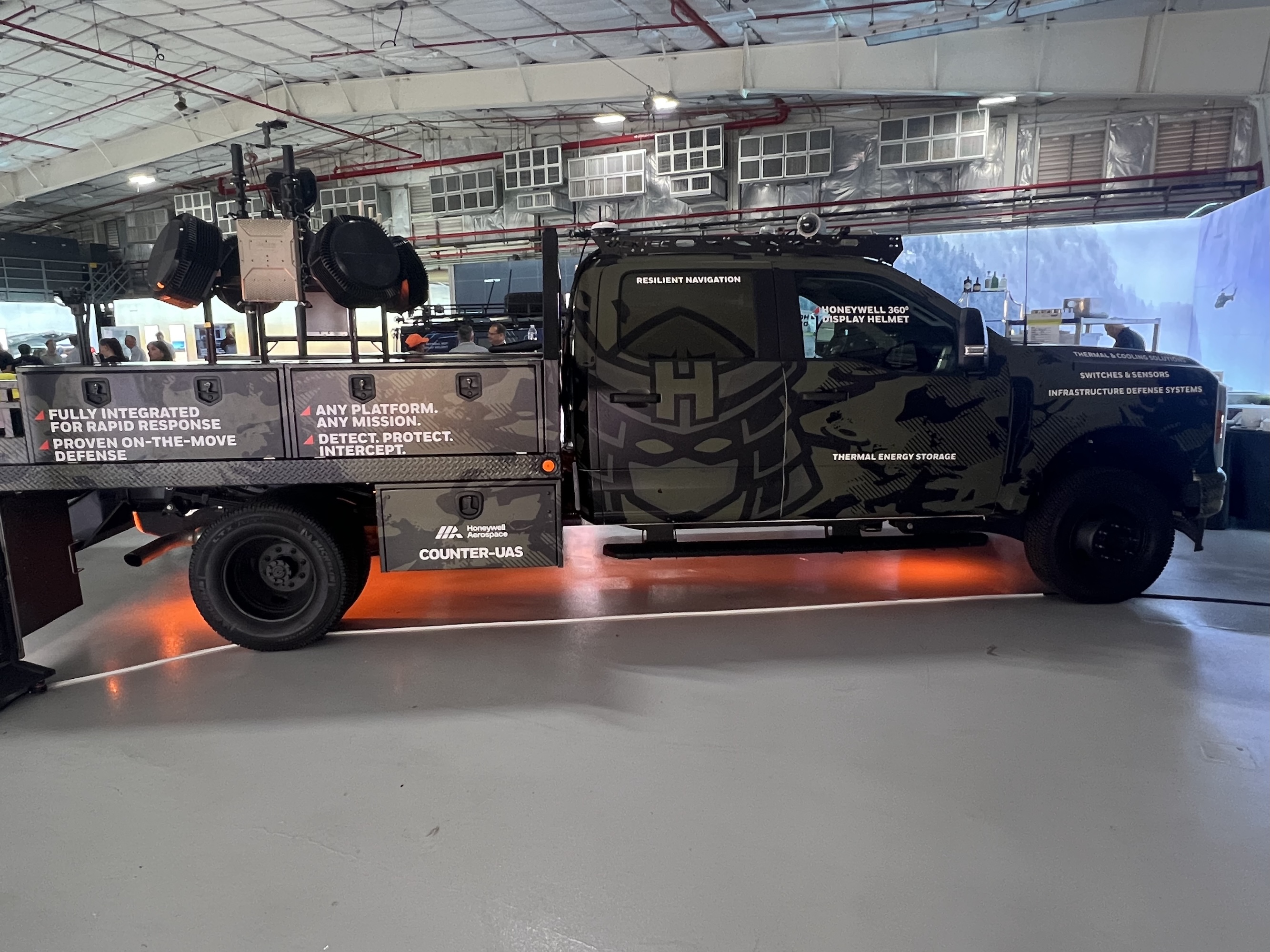
在美军协会年会上,霍尼韦尔航空展示了安装在福特F-150皮卡车后部的移动配置模型。科尼奇将其称为“绿色野兽”。霍尼韦尔航空也正与奥德赛航空合作开发SAMURAI系统的空中应用。该合作于2026年3月宣布,旨在将系统适配奥德赛的远程无人驾驶飞机Laila。双方表示,该项目建立在一年多的联合开发和系统集成工作之上。Laila旨在成为SAMURAI系统的首个空中应用,将系统从地面和移动配置扩展到空中使用。
At the Association of the United States Army’s annual meeting, Honeywell Aerospace displayed a mockup of the mobile configuration mounted on the back of a Ford F-150. Konicki called it the “Green Beast.”Honeywell Aerospace is also developing an airborne application of SAMURAI with Odys Aviation. Announced in March 2026, the collaboration aims to adapt the system for Odys’ long-range Laila uncrewed aircraft. The companies said the effort builds on more than a year of joint development and systems-integration work. Laila is intended to be the first airborne application of SAMURAI, extending the system beyond ground-based and mobile configurations.
科尼奇表示,SAMURAI也可配置用于固定场所防护和海上作业。根据任务需求,客户可能在建筑或设施周围布置设备,使用移动配置在活动期间进行临时防护,或在分布式位置放置传感器以覆盖更大区域。
Konicki said SAMURAI can also be configured for fixed-site protection and maritime operations. Depending on the mission, customers might position equipment around a building or installation, use a mobile configuration for temporary protection at an event, or place sensors at distributed locations to cover a larger area.
另外,霍尼韦尔航空于10月12日宣布,其全资子公司EMS防御技术公司被选中参与国土安全部反无人机合同车辆。该为期五年、多中标的合同车辆上限为15亿美元,于7月31日授予,8月1日生效。
Separately, Honeywell Aerospace announced Oct. 12 that its wholly owned subsidiary, EMS Defense Technologies, was selected for a Department of Homeland Security counter-drone contract vehicle. The five-year, multiple-award vehicle has a $1.5 billion ceiling, was awarded July 31 and took effect Aug. 1.
科尼奇表示,霍尼韦尔航空与国际合作伙伴合作,包括立陶宛、斯洛伐克和哥伦比亚,并在客户希望使用特定传感器或效应器时,可整合当地采购的设备。
Konicki said Honeywell Aerospace works with international partners, including Lithuania, Slovakia and Colombia, and can integrate locally sourced equipment when customers want to use particular sensors or effectors.
对于保护空军基地或其他场所的客户,科尼奇表示,公司可评估雷达、摄像头和其他传感器的最佳布置位置,以最大化覆盖范围。
For customers protecting an air base or another site, Konicki said the company can assess where radar, cameras and other sensors should be positioned to maximize coverage.
其规划过程可以绘制覆盖充足的区域,识别缺口并建议对设备布局进行调整。随后,公司可以进行Konicki所描述的红队评估,检视对手可能从何处发射无人机以及这种方式可能如何影响该地点的防御。该分析将帮助客户根据该地点及其潜在威胁定制传感器布局和其他系统组件。
Its planning process can map areas with adequate coverage, identify gaps and recommend adjustments to equipment placement. The company can then conduct what Konicki described as a red-team assessment, examining where an adversary might launch a drone and how that approach could affect the site’s defenses. The analysis will help customers tailor sensor placement and other system components to the site and its potential threats.