数周以来,商品市场最热门的话题一直是柴油价格的飙升。造成这一现象的原因并非原油短缺,而是能够将石油转化为燃料的炼油厂不足:由于伊朗战争,海湾地区的大多数炼油设施仍与全球市场隔绝;而许多俄罗斯炼油厂也因乌克兰的袭击而停产。这种供应紧张局面还带来了一个较为隐蔽的副作用。硫磺是采矿、农业和芯片制造的关键原料,同时也是燃料生产的副产品。因此,硫磺同样处于短缺状态。由此在全球范围内造成的影响才刚刚开始显现。
FOR WEEKS the hottest topic in commodity markets has been the soaring price of diesel. The cause is not a shortage of crude but of refineries able to turn oil into fuel: most Gulf facilities remain cut off from global markets by the war in Iran and many Russian ones are offline owing to Ukrainian strikes. That squeeze has a quieter side-effect. Sulphur, a vital input for mining, farming and chipmaking, is a by-product of fuel production. So it, too, is in short supply. The damage around the world is only beginning to show.
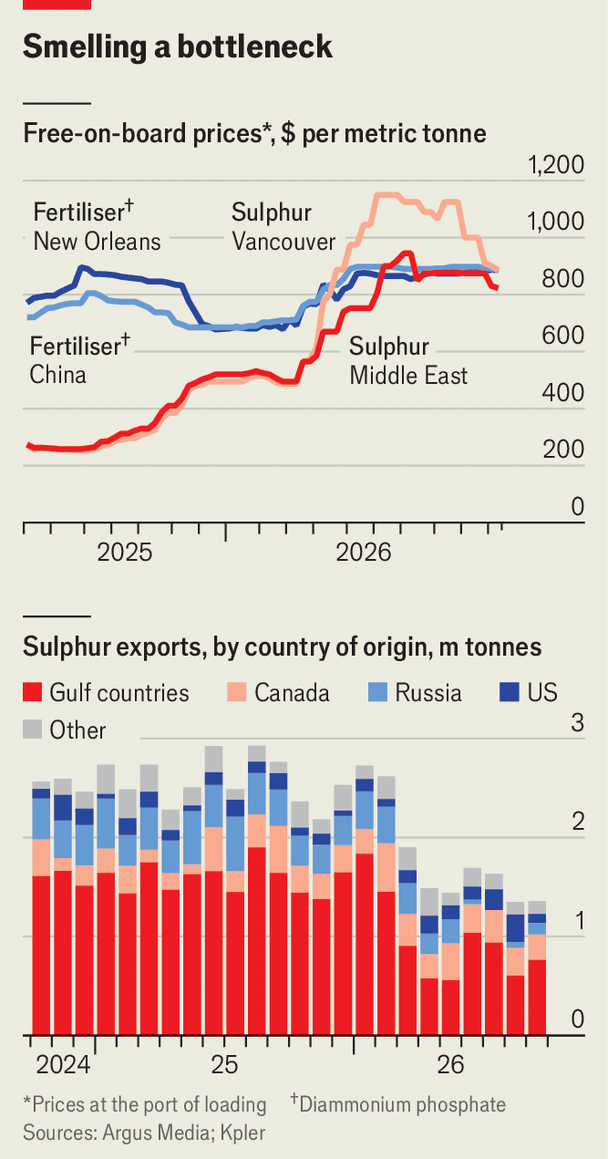
尽管全球能源体系在2026年初还拥有充足的燃料储备,但硫磺市场在伊朗战争爆发前就已处于紧张状态。俄罗斯曾禁止出口硫磺,以保障本国化肥和矿业公司的供应,导致其出口量从2025年的480万吨——占全球贸易量的15%——降至2026年迄今的180万吨。胡塞武装对部分沙特出口货物所经红海航线的袭击,以及美国可能对加拿大征收关税的威胁,也并未缓解这一局势。2月,中东地区的固体散装硫磺价格达到每吨500美元,高于一年前的340美元(见图表,上图)。
Whereas the global energy system entered 2026 with ample fuel stocks, sulphur markets were tight before the Iran war. Russia had banned exports to preserve supplies for its fertiliser and mining firms, cutting shipments from 4.8m tonnes in 2025—15% of globally traded volumes—to 1.8m tonnes in 2026 so far. Houthi attacks on the Red Sea route used by some Saudi exports and the threat of American tariffs on Canada have not helped. In February Middle Eastern solid bulk sulphur fetched $500 a tonne, up from $340 a year ago (see chart, top panel).
霍尔木兹海峡危机进一步加剧了这种短缺。该海峡的关闭导致全球近四分之一的硫磺产量和一半的海运出口被困于海湾地区。6月,美国与伊朗达成协议,使在冲突中滞留的货物得以释放,硫磺运输量一度回升;但7月停火协议破裂后,运输量再次下降。数据公司Kpler的Ishan Bhanu指出,目前运输量仍比战前水平低三分之二(见图表,下图)。
The Hormuz crisis has exacerbated this shortfall. The strait’s closure trapped nearly a quarter of global sulphur production, and half of seaborne exports, in the Gulf. Shipments rebounded in June, when a deal between America and Iran freed cargoes stuck amid the fighting, but fell back again when the ceasefire broke down in July. They remain two-thirds below pre-war levels, notes Ishan Bhanu of Kpler, a data firm (see chart, bottom panel).
红海和阿曼海岸港口的装货量并未高于战前水平,这意味着货物改道运输的情况微乎其微。将硫磺通过卡车运过沙漠并非可行替代方案:仅一次3万吨的运输量就需要大约1,000辆卡车。此外,现有船队大多是为运输液态的熔硫而建造的,而非散货船所承运的固态硫磺。价格报告机构Argus Media的Amba Coombe预计,中东地区的硫磺出口量将在2026年降至1,100万吨以下,而2025年则为2,050万吨。
Loadings from ports on the Red Sea and Oman’s coast are no higher than before the war, implying little rerouting. Trucking sulphur across the desert is no alternative: a single 30,000-tonne shipment would need around 1,000 lorries. Moreover, existing fleets are mostly built for molten sulphur, a liquid, not the solid kind that bulk carriers ferry. Amba Coombe of Argus Media, a price-reporting agency, expects Middle Eastern exports to fall below 11m tonnes in 2026, from 20.5m tonnes in 2025.
海湾地区出口量的锐减促使更多生产商限制出口。除了延长禁令的俄罗斯外,印度、哈萨克斯坦和土耳其在战争爆发后也暂停了运输。许多限制措施至今仍然有效;尽管美国加拿大的出口量有所增加,非海湾地区的出口量仍比战前水平低40%。
Vanishing Gulf flows have led more producers to restrict exports. Besides Russia, which has extended its ban, India, Kazakhstan and Turkey suspended shipments after the war began. Many restrictions remain in force; despite higher shipments from America and Canada, non-Gulf exports are still 40% below pre-war levels.
供应减少导致6月份多个地区的硫磺货价每吨突破1,000美元,创下纪录。此后价格略有回落,但这并非因为供应增加,而是如此高的价格抑制了中国以外的市场需求。中国的需求下降速度更快,但原因不同。中国过去曾进口硫磺,将其转化为酸后再出口,去年这一做法占全球贸易总量的40%以上。然而,今年5月政府禁止酸类出口,目前相关出口量几乎为零。
Reduced supplies pushed prices of sulphur cargoes from many regions past $1,000 a tonne in June, a record. They have come down a little since, not because supply has risen but because such high prices have crushed demand outside China. Chinese demand has fallen even faster, though for a different reason. The country used to import sulphur, convert it into acid and re-export it, accounting for more than 40% of globally traded volumes last year. In May, however, the government banned acid exports; they are now practically at zero.
在各类买家中,芯片制造商受影响最小:它们只需要极少量的酸。相比之下,铜和镍矿商则需要大量使用酸来从矿石中浸出金属。得益于铜价高昂,智利和非洲的铜生产商有能力支付高成本。而向全球出口廉价镍产品的印尼镍矿商则处境更为艰难。他们的生产成本已经上升,而客户——主要是中国电动汽车电池制造商——则拥有充足的库存和足够的市场影响力,能够维持镍价低位。在印尼,硫磺采购量已下降75%,矿商也提前安排了设备维护工作。
Of the buyers, chipmakers are the least affected: they need only tiny amounts of acid. Copper and nickel miners, by contrast, use loads of it to leach metal from ore. Copper producers in Chile and Africa can pay up thanks to the high prices the red metal commands. Indonesian nickel miners, which are exporting their cheap product to the world, are in a tighter spot. Their production costs have risen while their customers—mostly Chinese makers of batteries for electric cars—maintain enough stock and market power to keep nickel prices down. In Indonesia sulphur purchases are down by 75% and miners have brought forward maintenance.
此次冲击对磷酸盐肥料生产商最为严重:生产十吨肥料大约需要四吨硫磺。许多公司最初都削减了产量,暂停或减缓了美国、巴西、埃及和摩洛哥工厂的运作。5月,总部位于佛罗里达州的摩西克公司(Mosaic)将当前的硫磺短缺称为自2008年以来该行业最严重的危机。随后,许多生产商调整了产品结构,转向硫磺消耗更少的低养分品种。此举加上库存的消耗,使肥料出口得以维持在较高水平。但价格却大幅飙升。
The blow is hardest for producers of phosphate fertilisers: making ten tonnes of the stuff requires about four tonnes of sulphur. Many firms cut output at first, halting or slowing down plants in America, Brazil, Egypt and Morocco. In May Mosaic, a Florida-based firm, described the sulphur crunch as the industry’s most severe since 2008. Many producers then shifted their product mix towards sulphur-sparing variants that deliver fewer nutrients. That, together with the depletion of stockpiles, has helped keep fertiliser exports at decent levels. But prices have surged.
中国和印度即将投产新的产能,但尚不足以缓解当前的短缺。新兴的硫磺替代品在能源和资本投入方面仍然更高。短期来看,只有海湾地区的供应恢复才能带来缓解,因为战前全球大多数新项目都计划建在该地区。“如今,全球市场已将硫磺视为一种战略资源,而不再仅仅是一种副产品,”库姆女士(Ms Coombe)表示。伊朗战争带来的一个副产品是,战略资源的清单正在不断延长。■ 如需获取经济、金融和市场领域重大事件的专业分析,请 《Money Talks》。
New capacity is due to come online in China and India, but not in time to ease the current crunch. Emerging substitutes for elemental sulphur remain more energy- and capital-intensive. In the short run relief can come only from a resumption of flows from the Gulf, where most of the world’s new projects were planned before the war. “The global market is now seeing sulphur as a strategic commodity rather than a by-product,” Ms Coombe says. One by-product of the Iran war is that the list of strategic commodities is lengthening.■ For more expert analysis of the biggest stories in economics, finance and markets, sign up to Money Talks, our weeklyr-only newsletter.