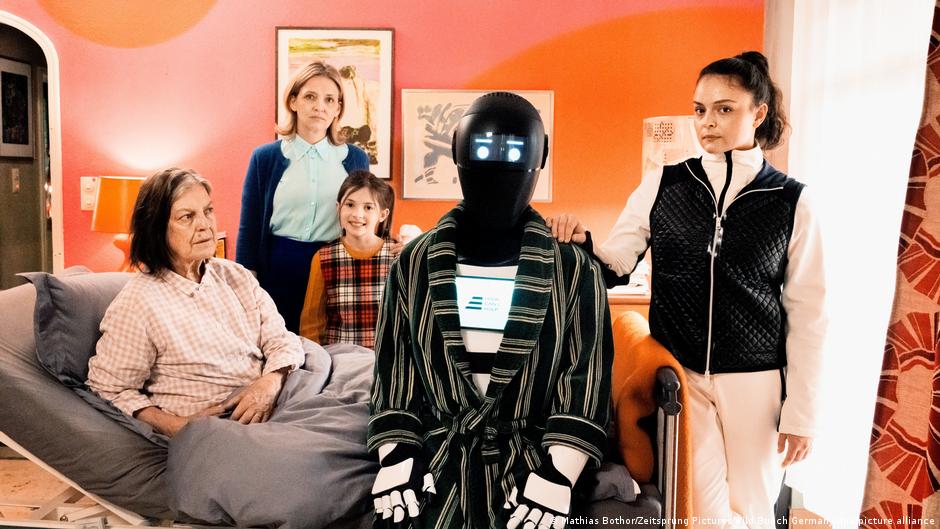
当全世界都在争论人工智能的危险性时,电影导演多丽丝·多里(Doris Dörrie)则探索了类人机器人可能会如何改变我们应对衰老、照护以及人们选择如何离世的方式。
While the world debates the dangers of artificial intelligence, filmmaker Doris Dörrie explores how humanoid robots could change the way we deal with aging, caregiving and how people choose to die.
在不久的将来,一台名为“巴甫洛维奇”的护理机器人接管了汉堡市温克勒女士的照护工作:快递包裹由机器人而非快递员配送;咖啡馆里,会说话、会服务的机器人在餐桌间穿梭;街道上,人们随处可见类人机器人遛狗——或者反过来,有人正带着自己的机器狗散步。
A care robot named Pavlovich takes over the care of Mrs. Winkler Hamburg in the near future: Instead of delivery drivers, robots deliver parcels. In cafés, talking and serving robots roll between the tables. On the streets, one encounters humanoid robots walking dogs — or the other way around, people taking their robot dogs for a walk.
这就是多丽丝·多里新片《温克勒女士离开家》(Frau Winkler verlässt das Haus)的故事背景。影片的核心围绕一位年迈女性展开:她在一次跌倒后无法再独立生活。由于她唯一的女儿无法提供长期照护,解决方案看似简单:一台内置“生命终结”(EOL)程序的护理机器人。这台机器人不仅能协助日常起居,在特定条件下还能协助自杀——即当当事人明确希望结束生命,并符合相关的医疗标准时。
This is the setting of Doris Dörrie 's new film, "Frau Winkler verlässt das Haus" ("Mrs. Winkler Leaves the House"). At the core of the plot is an elderly woman who can no longer live on her own after a fall. With her only daughter unable to provide permanent care, the solution seems simple enough: a care robot with a built-in EOL program, or "End of Life" mode. This robot not only assists with everyday life but can also provide assisted dying under certain conditions, namely when the person explicitly wishes to end their life and meets the relevant medical criteria.
多里的这部电影以令人惊叹的轻松笔触,探讨了多个重大的社会议题。其中包括德国、日本和中国等老龄化社会所面临的挑战、按照个人意愿离世的问题,以及一段引发内疚与责任思考的母女关系。尽管故事发生在德国,但这些议题在全球范围内都具有共鸣。
Dörrie's film tackles several major social issues with remarkable lightness. These include the challenges facing ageing societies such as Germany, Japan and China, the question of dying on one's own terms and a mother-daughter relationship that raises questions of guilt and responsibility. Even though the story is set in Germany, such issues resonate globally.
“我写的是那些个人上触动我、吸引我的主题,”多里在接受德国之声(DW)采访时说。
"I write about what personally moves and interests me," Dörrie tells DW.
作为当代德国最知名的电影导演之一,多丽丝·多里于1985年凭借喜剧片《男人……》一举成名,后来又凭借《樱花》和《来自福岛的问候》等影片获得国际认可。我们何时决定自己生命的终点?
One of the best-known contemporary German film directors, Doris Dörrie achieved her breakthrough in 1985 with the comedy "Men…," and later gained international recognition with films such as "Cherry Blossoms" and " Greetings from Fukushima Who decides when we die?
辅助自杀是我们这个时代最复杂的伦理问题之一。世界各地的法律差异巨大。一些国家在特定条件下允许积极安乐死,而另一些国家则禁止并将所有形式的辅助自杀定为犯罪。什么是辅助自杀?德国在这一问题上的立场又是什么?
Assisted suicide is one of the most complex ethical questions of our time. Laws vary considerably around the world. While some countries permit active euthanasia under certain conditions, others prohibit and criminalize all forms of assisted suicide. What is assisted suicide and where does Germany stand?
要观看这段视频,以及多丽丝·多里(Doris Dörrie)在她的电影中所探讨的内容:当人工智能开始计算照顾老年人的成本,并权衡这种成本对社会而言是否还“值得”承担时,会发生什么?
To view this video , and In her film, Doris Dörrie asks what happens when AI begins calculating the cost of caring for an elderly person and weighing whether that cost is still "worth" bearing for society.
但多里指出,这一潜在理念并非新鲜事。她提到了日本关于“奈良山”的传说,该传说也出现在影片中。根据这个传说,由于食物不足以养活所有人,最大的孩子必须将年迈的父母带到山上,并在那里让他们等死。“这在某种程度上,也正是我们目前所面临的争论:我们真的负担得起让老年人活得更久吗?”
But the underlying idea isn't new, Dörrie says, pointing to the Japanese legend of Narayama, which is also mentioned in the film. According to the legend, the eldest children were responsible for taking their ageing parents to a mountain and leaving them there to die because there was not enough food for everyone. "And that's also the debate we are currently facing to a certain extent: Can we really afford to let older people live longer and longer?"
在多里的电影中,老年人一旦达到某种健康状况,就可以自行做出决定,但之后无法改变主意。然而,自由地做出决定究竟意味着什么?“这是一个棘手的问题,”多里说,“因为关键在于,人们在多大程度上是被迫做出这一决定的——不仅因为从经济角度更划算,还因为自己不再给亲人——在这个案例中,就是自己的女儿——带来负担……” 影片常常以间接的方式,并伴随着大量黑色幽默来提出这些问题。
In Dörrie's film, elderly people are allowed to make their own decisions once they reach a certain state of health, but they can't change their minds afterwards. Yet what does it really mean to make a decision freely? "It's a tricky situation," says Dörrie, because the question is to what extent one is also pressured into making this decision, "not only because it makes more economic sense, but also because one is no longer a burden on one's loved ones — in this case, one's daughter..." The film often raises these questions indirectly and with plenty of dark humor.
在某个场景中,一位护理顾问向温克勒夫人(Mrs. WOLKLER)介绍“生命末期”(EOL)功能时,将其描绘成一个极具吸引力且尤其直接的额外选择,仿佛她从此便无需再有任何担忧。多里斯·多里(左)与演员安吉拉·温克勒和劳拉·托克尽管算法,仍保持亲近多里对在她的电影中妖魔化人工智能并不感兴趣——恰恰相反。
At one point, a care adviser presents the EOL feature to Mrs. Winkler as an attractive and, above all, straightforward additional option, making it sound as though there would be nothing more for her to worry about. Doris Dörrie (left) with actors Angela Winkler and Laura Tonke Staying close despite the algorithm Dörrie is not interested in demonizing AI in her film — quite the opposite.
在电影中,安吉拉·温克勒所扮演的老妇人给护理机器人起名为帕夫洛维奇,它帮助这位老妇人重新发现生活的乐趣,并走出家门。
In the film, the care robot, which Mrs. Winkler names Pavlovich, helps the elderly woman rediscover some of her zest for life and get out of the house.
“当你穿越德国旅行时,你会到处看到小房子,”多里说,“而统计数据表明,每两栋房子中就有一栋住着独居的老年人。如果人工智能在这种情况下能够提供帮助,为什么不使用它?”这位电影制作人表示,她想在电影中探讨的正是这种模糊性。将事物简单地划分为黑白既不有趣,而且在她看来也不准确。
"When you travel through Germany, you see small houses everywhere," Dörrie says, "and statistics show that an elderly person lives alone in every other house. If AI can help in these circumstances, why not use it?" The filmmaker says it's precisely this ambiguity she wants to explore in her film. Dividing things into black and white would neither be interesting nor, in her view, accurate.
多莉·多里和她的摄制组在拍摄过程中也对人们能够多快与机器人建立情感纽带感到惊讶。她将此归因于人类大脑。”我们会把任何会动、会说话的东西视为有生命的存在。我们无法控制自己,”她解释道。而这正是我们在与人工智能互动时需要关注的地方,多里说。“我们有多少次真正意识到自己是在与机器而不是有生命的存在交谈?这些都是我们仍需学习的东西。”
Dörrie and her film crew were also surprised during filming by how quickly people can develop an emotional bond with a robot. She attributes this to the human brain. "We regard anything that moves and speaks as a living being. We can't help it," she explains. And that is precisely what we need to pay attention to when interacting with AI, Dörrie says. "How often are we truly aware that we are talking to a machine rather than a living being? These are things we still have to learn."
机器人如何帮助解决中国的养老危机 人类与机器的区别 从人工智能的发展来看,人类与机器之间的界限似乎正变得越来越模糊。这就是为什么我们需要讨论这个问题,多莉·多里说。在她看来,当我们“无法再与技术保持距离,停止形成自己的思想”时,问题就会出现。
How robots are helping solve China's elderly care crisis The difference between humans and machines Looking at the development of AI, it seems that the boundaries between humans and machines are becoming increasingly blurred. That is precisely why we need to talk about it, Doris Dörrie says. In her view, things become problematic "when we can no longer distance ourselves from technology and stop forming our own thoughts."
作为人类,我们需要问自己我们是谁,什么才真正定义我们,多里说。”我认为机器人和我们之间存在着重大区别,那就是玩耍的能力。机器人可能能够发起一场游戏,她解释道,“但游戏本身是一种深刻的人类行为,因为它没有特定的意义或目的。”除了关于人类意味着什么的这些哲学问题,这位电影制作人还明确呼吁对人工智能进行监管:“在某个时候,我们也曾不得不就核武器问题进行国际讨论。我们过去讨论过各种各样的问题,我们不仅仅是谈论它们——我们还设法找到了解决方案,”她指出。
As human beings, we need to ask ourselves who we are and what truly defines us, Dörrie says. "I believe there is a major difference between robots and us, and that is the ability to play. A robot might be able to initiate a game, she explains, "but play itself is something profoundly human because it has no particular meaning or purpose." Alongside these philosophical questions about what it means to be human, the filmmaker also makes a clear call for AI regulation: "At some point, we had to discuss nuclear weapons internationally, too. We've talked about all kinds of issues in the past, and we haven't just talked about them — we've also managed to find solutions," she points out.
她说这是一件亟需解决的事情。“我相信我们也需要在这方面迅速行动。”本文最初是用德语撰写的。超逼真的机器人:太像人类了?
She says this is something that urgently needs to be addressed. "And I believe we need to move very quickly on this, too." This article was originally written in German. Hyperrealistic robots: too human?