位于肯尼亚首都内罗毕附近的马赛农场,可以说绿意盎然。其温室内的温度通过自然通风调节。由于农场靠近赤道,花朵全年每天都能享受12小时的阳光,因此无需人工照明。农场经理文森特·特雷尔表示,任何碳排放都会被追踪并报告。
Masai farm near Nairobi, Kenya’s capital, is arguably as green as they come. The temperature in its greenhouses is set by natural ventilation. Their proximity to the equator means the flowers get 12 hours of sunshine every day of the year, so artificial light is unnecessary. Any carbon emissions are tracked and reported, says Vincent Terer, the farm manager.
然而,欧洲那些注重环保的政策制定者却并不买账。每晚都有7至18吨鲜花从内罗毕空运出去,其中超过一半要经过6400公里的航程运往荷兰。这使得这些鲜花成为英国和欧洲零售商削减碳足迹时的重点关注对象。近来,一些欧洲超市和食品公司已经禁止,或表示计划限制新鲜农产品供应链中的航空运输。部分企业正将采购地从东非转向摩洛哥等地,因为后者可以通过海运出口。
And yet green-minded policymakers in Europe are unimpressed. Each night seven to 18 tonnes of its flowers are flown out of Nairobi, over half on the 6,400km journey to the Netherlands. This puts them in the sights of retailers in Britain and Europe seeking to cut their carbon footprints. Some European supermarkets and food companies have of late banned, or said they plan to restrict, air freight from their fresh-produce supply chains. Some are switching from east Africa to places like Morocco, which can send exports by sea.
像肯尼亚鲜切花产业这样的低碳非洲出口商,对气候变化的贡献几乎可以忽略不计。非洲拥有全球18%的人口,但历史二氧化碳排放量却不足4%。然而,非洲却特别容易受到伦敦智库odi的乔迪·基恩所说的“绿色挤压”影响:随着富裕国家采取措施减少全球供应链的碳排放,成本不断上升,市场准入也在缩小。1997年至2021年间,向世界贸易组织通报的环境相关贸易措施比例从8%上升至19%。
Low-carbon African exporters like those in Kenya’s blooming cut-flower industry contribute next to nothing to climate change. Africa has 18% of the world’s population but is responsible for less than 4% of historic carbon-dioxide emissions. Yet it is especially exposed to what Jodie Keane of odi, a think-tank in London, calls a “green squeeze”: rising costs and shrinking market access as richer countries adopt measures to decarbonise global supply chains. Between 1997 and 2021 the share of trade measures relating to environmental concerns notified to the World Trade Organisation rose from 8% to 19%.
受此影响最严重的,包括非洲的小型企业与农场,它们面临因气候变化影响逐渐显现而失去关键贸易渠道的风险。
Those most heavily burdened include Africa’s small businesses and farms that risk losing vital trade as the effects of climate change start to be felt.
阳光照射下在肯尼亚种植的花朵,其碳足迹比冬季在欧洲温室中加温种植的花朵要小。东非的花卉和水果出口通常作为定期客运航班的腹舱货物运输,因此仅产生微量的额外排放。然而,内罗毕非营利组织TradeMark Africa的戴维·比尔(David Beer)表示:“公众对飞机有着本能的抵触情绪,而对温室却没有这种反应。”
The carbon footprint of sunlit Kenyan flowers is smaller than those grown in heated European greenhouses in winter. East African flower and fruit exports often go as bellyhold cargo in scheduled passenger flights, adding only marginal emissions. Still, “the public has a visceral reaction to aeroplanes which they don’t have to greenhouses,” says David Beer of TradeMark Africa, a non-profit group in Nairobi.
非洲出口商面临的更直接挑战来自监管新规。欧盟新的森林砍伐规则将于12月生效,该规则要求进口商证明其可可、咖啡、橡胶、大豆、棕榈油、木材或牛肉产品并非在2021年之前为森林的土地上生产。如果无法提供充分证据,非洲出口商将面临失去市场准入的风险。
A more immediate crunch for the continent’s exporters is coming in the form of regulation. The eu’s new deforestation rules, which require importers to prove that their cocoa, coffee, rubber, soya, palm oil, wood or cattle products were not produced on land that was forest before 2021, are due to take effect in December. African exporters face losing market access if they cannot provide adequate evidence.
经过数月的争论和两次错过截止日期,最终规则已略有放宽。但基恩女士表示,像埃塞俄比亚这样许多农民在极小地块上种植咖啡的国家,仍未准备好应对这些变化。她与国际发展组织(ODI)的同事估计,埃塞俄比亚可能失去近三分之二的对欧咖啡出口,尽管自2020年以来,仅有20块咖啡种植地与森林砍伐有关。去年,欧盟从该国26.5亿美元的咖啡出口总额中购买了7.65亿美元。
After months of wrangling and two missed deadlines, the final rules have been eased a little. But countries such as Ethiopia, where many farmers grow coffee on tiny plots, are still not ready for the changes, says Ms Keane. She and her colleagues at ODI estimate that Ethiopia could lose almost two-thirds of its coffee exports to the eu, even though just 20 coffee plots have so far been linked to deforestation since 2020. Last year the bloc bought $765m of the country’s $2.65bn of coffee exports.
另一个重大担忧是碳边境调节机制(CBAM),即对铝和钢铁等特定工业商品的进口征收费用。该机制于1月生效,旨在通过要求外国供应商支付与欧洲供应商相同的碳价格,从而帮助净化全球供应链。非洲的可再生能源资源或许能为许多出口商带来优势。然而,根据该机制,非洲大多数商品的平均碳排放强度高于其竞争对手。此外,除南非外,目前还没有其他非洲国家实施碳定价,因此出口商必须全额支付欧盟的碳价,而无法扣除本国已支付的碳税。
Another big worry is the carbon border adjustment mechanism (cbam), a levy on imports of certain industrial commodities, such as aluminium and steel. The scheme, which took effect in January, is meant to help clean up global supply chains by making foreign suppliers pay the same carbon price as European ones. Africa’s renewable-energy resources could give many of its exporters an edge. But African production of most commodities under the scheme is, on average, more carbon-intensive than that of rivals. And no African country outside South Africa yet prices carbon, so exporters pay the full eu price with no deduction for a levy paid at home.
非洲企业和政策制定者担心,随着《碳边境措施》(CBAM)等环保法规的逐步扩大、覆盖更多产品,并且其他国家也纷纷效仿,非洲企业的竞争力将受到严重威胁。伦敦政治经济学院(LSE)的大卫·卢克(David Luke)表示:“我们正在见证一种新的贸易标准正在形成”——这意味着全球出口竞争力将越来越依赖于产品的碳减排情况,以及产品的质量和价格。
African businesses and policymakers fear a ratchet, as measures like cbam expand to cover more products, and other countries follow suit. “We are beginning to see a new form of standard emerge,” says David Luke of the London School of Economics (lse), so global export competitiveness will increasingly depend on verified carbon performance as well as quality and price.
那些缺乏完善监测与验证体系的国家(主要是非洲国家)将会处于劣势。非洲气候基金会(African Climate Foundation)和伦敦政治经济学院的菲罗兹·拉尔吉研究所(Firoz Lalji Institute)估计,如果该法规扩展到所有进口商品,非洲对欧盟的出口额可能会减少6%。
Countries without strong systems for monitoring and verification—ie, most African ones—will lose out. The African Climate Foundation and the Firoz Lalji Institute at lse estimate that if the scheme expands to cover all imported goods, African exports to the eu could shrink by 6%.
一些非洲出口商正在寻找替代市场。肯尼亚新鲜农产品公司Sunripe的负责人蒂库·沙阿(Tiku Shah)说:“我们有中东市场、印度市场,还有远东市场;这些市场并没有实施类似的环保标准。”2026年上半年,肯尼亚向中国出口的鳄梨数量增长了60%以上。不过,中国也有自己的非关税壁垒,比如严格的植物检疫规定。
Some African exporters are seeking alternative markets. “We’ve got the Middle East, we’ve got India, we’ve got the Far East,” says Tiku Shah, the boss of Sunripe, a Kenyan fresh-produce firm. “They don’t have these standards.”Kenya’s exports of avocados to China surged by over 60% in the first half of 2026.
此外,中东地区的买家价格波动较大,有时甚至会拖欠货款。西斯特·谢珀斯(Wester Schepers)是一位致力于帮助非洲农民满足欧洲标准的非营利组织成员,她指出这些因素也增加了出口的不确定性。
Yet China has its own non-tariff barriers, such as tough phytosanitary rules. And buyers in the Middle East offer unpredictable prices and, at times, fail to pay, notes Wester Schepers of colead, a non-profit that helps African farmers meet European standards.
因此,许多企业别无选择,只能进行调整。对于一些不易腐烂的产品(如鳄梨),海运可能是更可行的运输方式——因为海运每吨货物的二氧化碳排放量比空运低85%左右。TradeMark Africa组织正在埃塞俄比亚推广电动卡车,以应对未来CBAM法规可能扩展到运输环节的情况。肯尼亚公司Sian Flowers(其旗下拥有Masai Farm农场)也在响应买家对更精确的碳核算要求,通过建立模型来估算从机场到最终目的地的整个运输过程中的碳排放量。
Many firms therefore have little choice but to adapt. For some less perishable produce such as avocados, sea freight—which can emit up to 85% less carbon dioxide per tonne than air freight—is a viable alternative. TradeMark Africa is helping to introduce electric lorries in Ethiopia, partly in case cbam expands one day to cover transport as well as production. Sian Flowers, the Kenyan firm that owns Masai Farm, is responding to demands from buyers for more precise carbon accounting by building models to estimate emissions from the airport all the way to the final destination.
欧盟可以做更多来提供帮助。乌干达咖啡联合会(一个行业机构)的罗伯特·比亚鲁汉加认为,欧盟及该集团的咖啡烘焙商应分担遵守欧盟森林砍伐规则的成本。根据《巴黎气候变化协定》COP21中规定的富国应比穷国做更多工作以实现脱碳的要求,这应意味着非洲出口国在碳边境调节机制(CBAM)下应缴纳较低的碳价。
The eu could do more to help. Robert Byaruhanga of the Uganda Coffee Federation, an industry body, argues that the eu and the bloc’s coffee roasters should share the cost of complying with eu deforestation rules. The requirement for rich countries to do more to decarbonise than poor ones, laid out in the COP21 Paris climate-change agreement, should mean African exporters pay lower carbon prices under cbam.
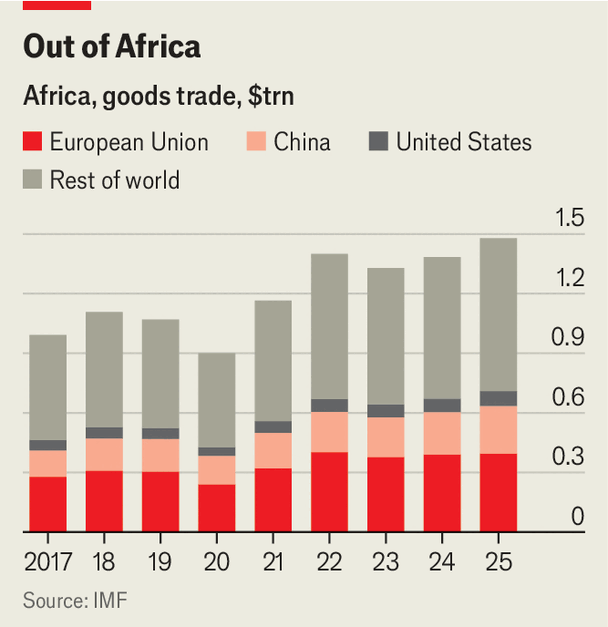
非洲未来政策中心的法坦·阿格德呼吁非洲建立自身的贸易脱碳基金。她说,非洲需要“真正开始在这项调整上进行投资”。欧盟几乎购买了非洲出口的三分之一。这种贸易伙伴关系太宝贵,不能被浪费。■ 订阅《分析非洲》周刊,及时了解世界上最年轻且最少被理解的大陆的动态。
Fatan Agged of the African Futures Policy Hub calls for Africa to set up establish its own trade decarbonisation fund. Africa needs to “really start investing in this adjustment”, she says. The eu buys almost a third of Africa’s exports. That trade partnership is too valuable to squander. ■ Sign up to the Analysing Africa, a weekly newsletter that keeps you in the loop about the world’s youngest—and least understood—continent.