中国外交官经常提到“修昔底德陷阱”的威胁,这一概念源自希腊历史学家修昔底德,他描述了既有势力斯巴达为抵抗新兴势力雅典的崛起而进行的斗争。然而,在对外援助领域,近年来这种激烈的竞争却令人遗憾地几乎不存在。另一种由经济史学家查尔斯·金德尔伯格(Charles Kindleberger)指出的陷阱也同样危险。
Chinese diplomats often talk about the threat of a “Thucydides trap”, named after the Greek historian who described how an incumbent power, Sparta, fought to resist the rise of an upstart, Athens. In the realm of foreign aid, however, such fierce rivalry has been sadly absent in recent years. Another trap, identified by Charles Kindleberger, an economic historian, looks dangerous, too.
他描述了当一个维持稳定的超大国在新兴力量尚未准备好或不愿承担其全球角色之前就放弃该角色时所发生的情况。在20世纪的两次世界大战之间,美国迟迟未能接过英国的担子。如今,多边援助领域也出现了类似的空缺。
He described what happens when a stabilising superpower cedes its global role before the emerging power is ready or willing to assume it. America was slow to fill Britain’s shoes in the interwar years of the 20th century. And there is now a similar gap in the realm of multilateral giving.
美国已经对其自身帮助创建的国际机构产生了疲惫。去年,它通过世界银行和联合国等多边组织提供的援助减少了一半。它已退出联合国世界卫生组织——并且仍然欠该组织钱款。
America has tired of the international institutions it helped create. Last year the aid it channelled through multilateral organisations like the World Bank and the UN fell by half. It has withdrawn from the UN’s World Health Organisation—and it still owes the WHO money.
中国本来可以大胆地冲进这个真空。事实上,它确实增加了资金投入。但其方式缺乏雅典式的果断。“中国目前既没有意愿也没有能力填补美国退出所留下的财政缺口,”华盛顿全球发展中心(Centre for Global Development)的贝娅塔·奇霍茨卡(Beata Cichocka)指出。
China could have rushed boldly into this void. And it has indeed stumped up more cash. But its approach lacks Athenian assertiveness. “China is not currently either willing or able to fill the financial gap that would be left behind by US withdrawal,” points out Beata Cichocka of the Centre for Global Development, a think-tank in Washington.
她与同事伊恩·米切尔(Ian Mitchell)一起,试图计算中国通过开发银行、联合国机构以及26个“垂直”基金(这些基金专门用于解决气候变化等具体问题)所提供的多边援助总额。中国自身还创立了一些这些机构,包括总部设在北京的亚洲基础设施投资银行和位于上海的新开发银行。
With her colleague Ian Mitchell she has tried to add up China’s contributions to multilateral aid, channelled through development banks, UN agencies and 26 “vertical” funds that collect money for specific problems such as climate change. China itself founded some of these institutions, including the Asian Infrastructure Investment Bank, based in Beijing, and the New Development Bank in Shanghai.
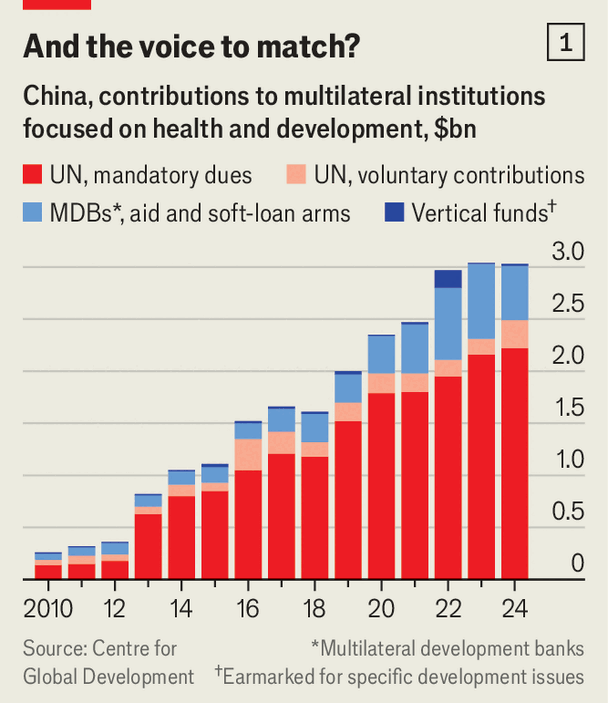
中国对这些机构的捐助在过去十年里急剧增加,从2014年的约10亿美元增至2024年的30亿美元以上(见图表1)。例如,中国已成为世卫组织成员国中最大的捐助国,承诺在五年内额外提供5亿美元。它还支持中国卫生官员宋莉在该职位明年空缺时担任该组织的负责人。
China’s giving to these bodies has increased steeply over the past decade, from about $1bn in 2014 to more than $3bn in 2024 (see chart 1). China has, for example, become the largest donor to the WHO among its member states, promising an extra $500m over five years. It has backed Song Li, a Chinese health official, to become the organisation’s boss when the position opens up next year.
中国还向世界银行旗下的国际开发协会承诺提供更多资金,该机构向全球78个最贫困国家提供援助和低息贷款。中国曾经也是这些艰难国家之一,从1981年至1999年失去资格之前,曾获得近100亿美元的优惠贷款。正如报告所指出的,中国“从主要借款国转变为重要捐助国,代表着多边发展融资中最显著的轨迹之一”。
China has also pledged more money to the International Development Association, a World Bank outfit that provides aid and cheap loans to 78 of the world’s poorest countries. China was itself once one of those hard-up countries, receiving almost $10bn in soft loans from 1981 until it ceased to be eligible in 1999. China’s “transformation from major borrower to significant donor represents one of the most remarkable trajectories in multilateral development finance”, as the report points out.
鉴于其他捐助国的显著撤退,这一转变尤为可贵。但中国的大部分多边增捐是强制性的,而非自愿的:由于其经济增长,它必须缴纳更多的会费。即便是向世卫组织承诺的5亿美元,也主要反映了会费的增加,这是根据现有零散信息判断的。中国在尽其所能。但它并未远超其职责范围。
This transformation is all the more welcome given the remarkable retreat of other donors. But much of China’s extra multilateral giving is mandatory, not voluntary: it must pay more dues because of its economic growth. Even the $500m pledged to the WHO mostly reflects an increase in membership dues, judging by the patchy information available. China is doing its bit. But it is not going far beyond its duty.
这或许并不令人意外。按世界标准,中国的人均GDP仍处于中等水平。正如米切尔先生指出的,中国仅刚刚达到各国通常“提升其捐助水平”的收入门槛。而且中国的捐助增加并未伴随其在所资助机构内投票权或发言权的相当提升。澳大利亚麦考瑞大学的冯庭康表示,中国政府“被这种感觉所占据:他们付出了,因此他们应该有[发言]权”。中国在世界银行的表决权份额仍低于6%。根据该行过去使用的公式,其份额应超过12%。
Perhaps this should not be a surprise. China’s GDP per person is still middling by world standards. It has only just reached the income threshold at which countries typically “step up their contributions”, points out Mr Mitchell. And China’s increased giving has not been matched by a comparable increase in voting power or voice within the institutions it finances. China’s government is “seized [by] this feeling that they pay and therefore they should have [a] say,” says Courtney Fung of Macquarie University. Its voting share in the World Bank remains at less than 6%. According to formulas the bank has used in the past, it should be more than 12%.
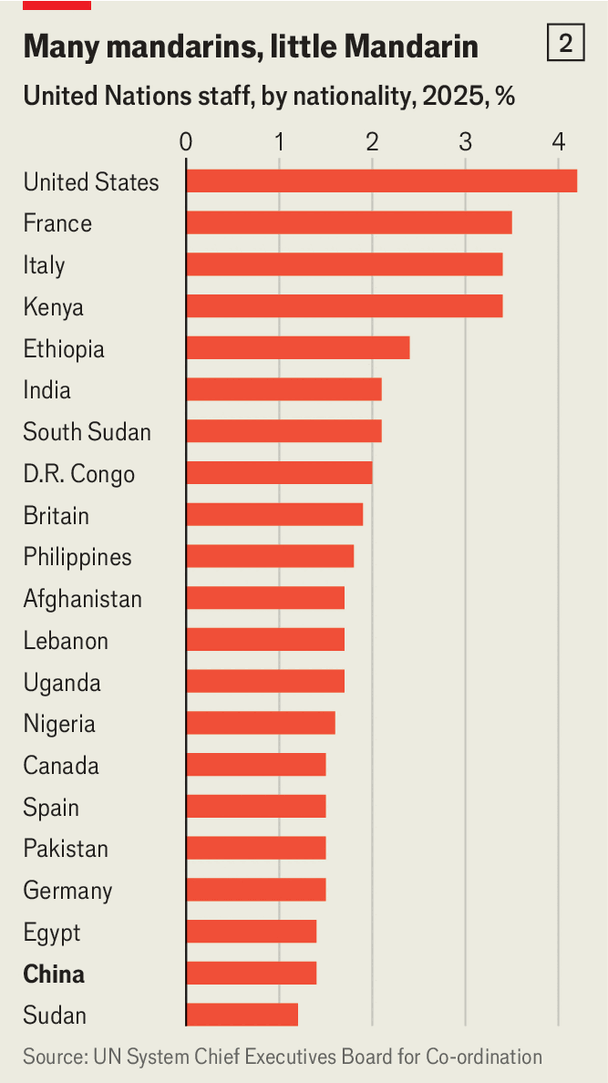
中国在联合国工作人员中的比例也很小:仅1.4%,排名第20位(见图表2)。中国正试图通过资助更多初级专业人员和其他新进入者来改变这一状况。2022-23财年,中国派出了773名实习生,而美国为532人。但该国的公务员仍面临语言障碍和不熟悉的工作习惯。
China’s share of UN staff is also tiny: 1.4%, ranking only 20th (see chart 2). It is trying to change that by funding more junior professionals and other entrants. China contributed 773 interns in 2022-23 compared with America’s 532. But the country’s civil servants still struggle with language barriers and unfamiliar work habits.
一些障碍是自我施加的。例如,中国在筛选候选人时会考察其爱国精神(这包括政治忠诚度)。冯女士表示,长期在国外工作的公务员担心他们的国内人脉关系“正在生疏”。也许雅典人也有同样的感受。
Some obstacles are self-imposed. China, for example, screens its candidates for patriotism (which includes political loyalty). And civil servants who have spent too long abroad worry that their home networks are “going stale”, says Ms Fung. Perhaps the Athenians felt the same way.