韩国一家专注于该国市场的顶级基金经理表示,当市场反弹时,盈利前景看好的AI硬件零部件股可能会跑赢存储芯片巨头。
Korea’s AI hardware component stocks with promising earnings potential will likely outperform the memory chip giants when the market rebounds, said a top fund manager focused on the country.
电容器制造商和AI基板生产商明年将从AI热潮周期的扩大中受益,Hana Asset Management Co.股票投资部门负责人兼组合经理李万燮(Lee Wang-seop)本周在一次采访中表示。他还看好可再生能源和能源存储供应商,预计数据中心服务的需求将持续存在。
Capacitor makers and AI substrate producers will benefit next year from a broadening of the AI-boom cycle, Lee Wang-seop, Hana Asset Management Co.’s head of equity investment division and portfolio manager, said in an interview this week. He’s also bullish on renewable energy and energy storage providers, anticipating ongoing demand for data center services.
他管理的7480亿韩元(5.58亿美元)基金的部分重仓股包括电容器制造商三星电机(Samsung Electro-Mechanics Co.)和锂电池开发商三星SDI(Samsung SDI Co.)。
Some of the top holdings in his 748 billion won ($558 million) fund include capacitor manufacturer Samsung Electro-Mechanics Co. and lithium-battery developer Samsung SDI Co.
“我们已将AI价值链中除半导体之外的其他领域纳入敞口,”李万燮表示,他在Hana的韩国IT基金以年内77%的回报率跑赢了99%的同类基金。“我们正大力关注盈利增长跑赢Kospi指数且盈利预估也在上调的公司所在领域的交汇点。”由于韩国股市严重依赖三星电子(Samsung Electronics Co.)和SK海力士(SK Hynix Inc.),投资者涌出长期持有的AI股,导致基准Kospi指数周四进入熊市。
“We have broadened exposure to other sectors in the AI value chain” beyond semiconductors, Lee said, whose Korea IT fund at Hana outperformed 99% of peers with a 77% year-to-date return. “‘We’re focusing heavily on the intersection of sectors with earnings growth that’s outpacing the Kospi and companies where earnings estimates are also being revised upward.”With the Korean equity market heavily relying on Samsung Electronics Co. and SK Hynix Inc., a rush to exit extended AI holdings dragged the benchmark Kospi into a bear market on Thursday.
李万燮的策略凸显了组合经理正在将投资重心转移到这两家公司之外,以捕捉与AI相关的收益,而非冒险错过供应链其他部分的反弹。
Lee’s strategy highlights portfolio managers repositioning beyond them to capture AI-linked gains, rather than risk missing a rally in other parts of the supply chain.
李万燮预计,市场反弹时,半导体材料、零部件和设备股将跑赢大型存储芯片制造商。他补充说,包括能源存储供应商在内的广泛领域,明年的净利润增长预计将超过Kospi指数。
When the market rebounds, Lee expects semiconductor materials, components and equipment stocks to outperform the large-cap memory manufacturers. A wide range of sectors, including energy storage providers, are projected to outpace the Kospi in net profit growth next year, he added.
“我们现在刚刚进入一个阶段,此时商品封装基板和多层陶瓷电容器(MLCC)的价格也开始急剧上涨,” Hana IT 韩国证券母基金投资信托的负责人李某说。“持续时间和涨幅可能没有内存那么大,但这种周期也预计会出现。这就是我对该行业最乐观的原因。” 半导体行业经历了价格涟漪效应,AI 需求首先从高端产品开始,例如高带宽内存。
“We are now just entering a phase where prices for commodity package substrates and multilayer ceramic capacitors (MLCC) are starting to rise sharply as well,” said Lee, who runs the Hana IT Korea Securities Master Investment Trust. “The duration and the magnitude may not be as big as memory, but such a cycle is projected to start as well. That’s why I’m most optimistic on the sector.”The semiconductor industry has gone through a pricing ripple effect, with AI demand first starting at premium products, such as high-bandwidth memory.
一旦这些供应变得更紧张、更昂贵,这种繁荣就会蔓延到日常芯片和零部件,如普通 DRAM 和 NAND。类似的动态可能也在封装基板行业上演,价格涨幅首先出现在高端产品上。
Once those supplies get tighter and more expensive, the boom spilled over to everyday chips and parts like regular DRAM and NAND. Similar dynamics may be at play in the package substrate sector, with price gains first in high-end products.
作为全球 AI 基板和 MLCC 领导者之一的三星电机股价今年已上涨超过三倍,远远跑赢存储器制造商。三星 SDI 的股价大约翻了一倍。
Shares of Samsung Electro-Mechanics, one of the global leaders in AI substrates and MLCCs, have more than tripled this year, far outpacing the memory makers. Samsung SDI has roughly doubled.
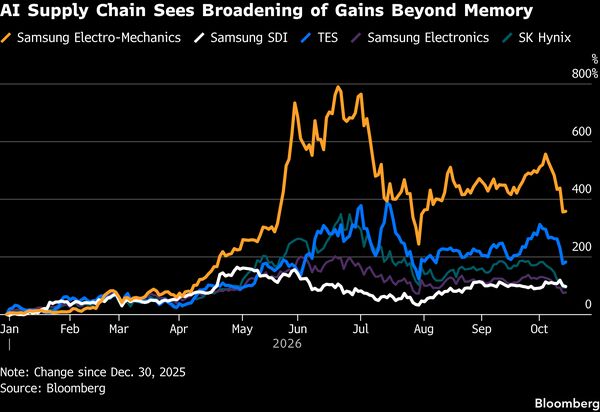
阅读:AI 繁荣推动亚洲鲜为人知的芯片供应商飙升 770% 尽管最近出现抛售,但专注于韩国的基金仍有望迎来丰收的一年,综合股价指数(Kospi)上涨约 35%。李某表示,他的基金跑赢了基准,主要得益于对前端芯片设备制造商(如 TES Co.)的早期布局。
Read: AI Boom Drives 770% Jump in Asia’s Lesser-Known Chip Supplier Despite the recent selloff, Korea-focused funds are still headed for a banner year, with the Kospi rising roughly 35%. Lee says his fund outperformed the benchmark, largely on early bets on front-end chip equipment manufacturers such as TES Co.
李某的基金仍略微超配三星电子和 SK 海力士,并密切关注它们对市场的超大影响。但投资者必须面对这样一个不确定性:即使通胀持续、借贷成本上升,且中国芯片制造商的竞争加剧,AI 投资能否保持韧性,李某说。
Lee’s fund remains slightly overweight Samsung Electronics and SK Hynix, keeping tabs on their oversize influence on the market. But investors must contend with uncertainties on whether AI investment can remain resilient even as inflation lingers, borrowing costs rise, and competition from Chinese chipmakers intensify, Lee said.
他正密切关注韩国芯片制造商 2027 年的盈利预估,市场对前景存在分歧,若分析师上调预测,则可能带来上行空间。他 radar 上的另一个指标是:即使 SK 海力士完成其股份回购计划后,外国投资者是否仍会继续抛售韩国股票。
He is closely watching 2027 earnings estimates for Korean chipmakers, with the market split on the outlook and potential upside should analysts lift their forecasts. Another indicator on his radar is whether foreign investors continue to sell Korean equities even after SK Hynix finishes its share buyback program.
他说:“对于韩国存储芯片制造商而言,过去那种规模的反弹将难以实现。” “我们将看到一些行业,其股价回报率可能超过半导体行业。”
“A rebound of the magnitude seen in the past will be difficult” for Korean memory makers, he said. “We will see sectors that can see larger share price returns than semiconductors.”