如同村民敦促邻居们一起对抗四处游荡的掠夺者一样,马克·卡尼试图联合世界上的中等强国。在1月于达沃斯举行的世界经济论坛上发表的一场演讲中,加拿大总理发出了中等国家团结起来的紧急呼吁。他向在场的权贵听众表示,这是一个弱肉强食的时代。他劝告说,旧的基于规则的秩序已不再能约束强者。较小的国家也不能逆来顺受,指望顺从能让自己安全。中等强国可以组成意愿联盟共同行动,否则就会“沦为盘中餐”。
LIKE a villager urging neighbours to confront a prowling predator together, Mark Carney sought to rally the world’s middle powers. In a speech in January to the World Economic Forum at Davos, Canada’s prime minister issued an urgent call for mid-ranked countries to unite. This is an age in which the strong prey on the weak, he told his audience of grandees. The old rules-based order no longer constrains the mighty, he advised. Nor can smaller countries roll over and hope that submission keeps them safe. Middling powers can act together in coalitions of the willing, or “be on the menu”.
他的同僚领导人们知道,卡尼先生主要是在警告他们关于美国和中国这两个当今大国中实力最强的国家。卡尼先生是根据经验发表这番言论的。在作为美国经济一个舒适却并不令人兴奋的附属地几十年后,加拿大发现自己成了美国总统唐纳德·特朗普发怒的对象。卡尼先生一直在努力减少其祖国的依赖性。其他中等强国一直在密切研究他与特朗普先生的对抗。然而九个月过去了,对那次达沃斯战斗号召的回应看起来明显参差不齐。
His fellow leaders knew that Mr Carney was mostly warning them about America and China, the strongest of today’s big beasts. Mr Carney was speaking from experience. After decades as a comfortable, if unexciting, annexe to the American economy, Canada finds itself the object of President Donald Trump’s wrath. Mr Carney has worked hard to reduce his homeland’s dependencies. Other middle powers have studied his confrontation with Mr Trump closely. Yet nine months on, the response to that Davos call to arms looks distinctly patchy.
在某些领域,卡尼先生的演讲与各国已经在采取的行动不谋而合。在这个充满经济胁迫、咽喉要道和供应冲击的时代,各国政府并不需要卡尼先生来告诉它们应当对冲风险、实现多元化并削弱全球霸凌者的影响力。
In some areas the Carney speech aligned with actions that countries were already taking. In this age of economic coercion, choke-points and supply shocks, governments do not need Mr Carney to tell them to hedge their bets, diversify and reduce the leverage of global bullies.
自该演讲发表以来,中等强国在少数几次场合站出来对抗大型侵略者并安然无恙。当特朗普先生威胁要入侵格陵兰岛,并承诺对任何阻挠他的国家实施毁灭性关税时,欧洲领导人们坚定地支持了格陵兰岛的统治者丹麦。面对金融市场的猛烈反应以及欧洲公开表示准备实施贸易反制措施所带来的震惊,特朗普放弃了占有的梦想,转而达成一项强化的安全条约。
Since the speech, on a few occasions middle powers have stood up to large aggressors and lived to tell the tale. When Mr Trump threatened to invade Greenland and pledged to impose crippling tariffs on any country that stood in his way, European leaders stood by Denmark, Greenland’s ruler. Taken aback by a ferocious reaction from financial markets and by Europe’s stated readiness to enact trade counter-measures, Mr Trump dropped dreams of ownership in favour of an enhanced security pact.
亚洲也出现了公然 defiance(反抗)的表现。尽管来自中国的压力极其巨大,包括对中国出口关键矿产实施限制,但日本首相依然拒绝为说出不便言明的真相而道歉。高市早苗的“罪过”是公开证实,中国对日本的民主邻国台湾发动进攻,将危及日本的国家安全。随着中国官员大肆辱骂并称她为战犯,高市女士在政治上无法退缩,也绝不会退缩。
Asia has witnessed shows of defiance, too. Despite intense pressure from China, including curbs on Chinese sales of critical minerals, Japan’s prime minister refuses to apologise for saying an inconvenient truth aloud. Takaichi Sanae’s offence was to confirm publicly that Japan’s national security would be imperilled by a Chinese attack on Taiwan, Japan’s democratic neighbour. As Chinese officials hurl insults and call her a war criminal, Ms Takaichi cannot back down, politically, and will not.
然而,中等强国每一次表现出反抗,就会有更多软弱无力以及权力真空无人填补的例子。一大问题在于,中等强国是一群各不相同的国家,对卡尼先生所哀叹的那个国际秩序怀有不同程度的怀旧情绪。许多全球南方国家一直将美国视为恶霸,并普遍对西方国家不可忍受的以自我为中心心存怨恨。巴西、南非或印度等地区重量级国家并不确信是谁任命了加拿大——这个平淡富裕、像香草奶昔一样的国家——来领导一个新的后美国世界秩序。
Yet for each instance of middle-power defiance, there are more examples of feebleness, and of leadership vacuums left unfilled. One big problem is that the middle powers are a disparate bunch, with differing degrees of nostalgia for the order that Mr Carney mourns. Plenty of countries in the global south have always seen America as a bully, and resent Western countries more generally as insufferably self-centred. Such regional heavyweights as Brazil, South Africa or India are not sure who appointed Canada—a blandly rich vanilla milkshake of a country—to lead a new post-American world order.
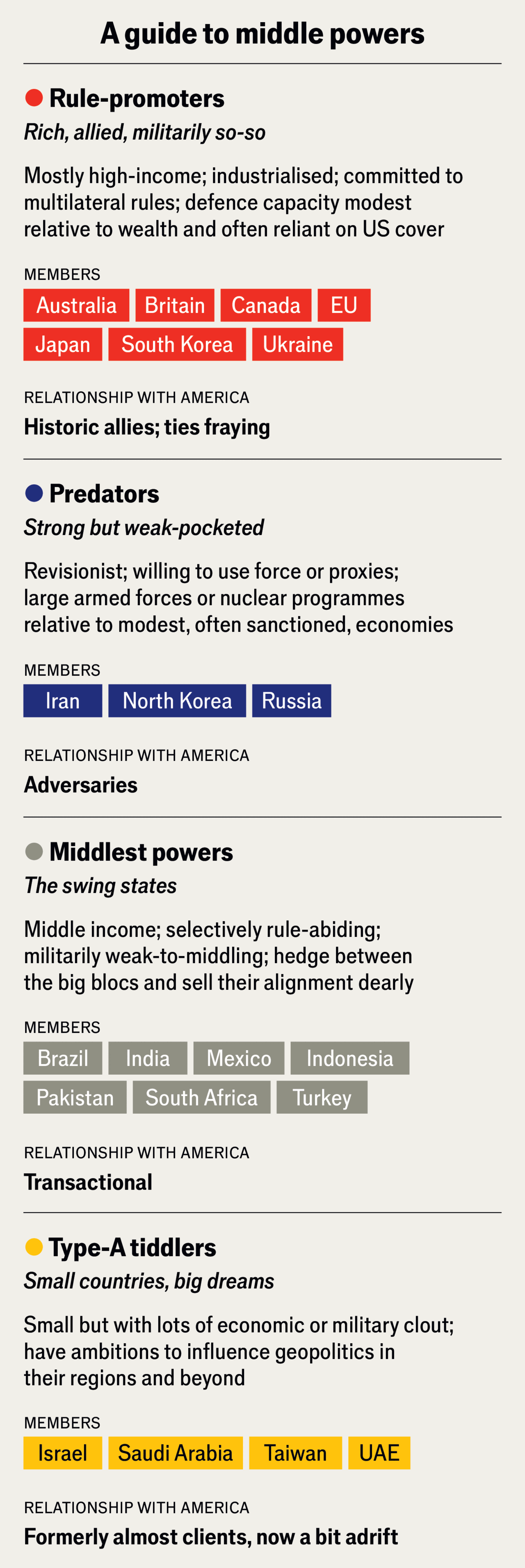
使卡尼先生的论调更加复杂的是,对于谁才算中等强国,甚至没有达成共识(见图表)。其中一个定义涉及有一定手段影响世界事件的国家,无论是通过其体量、地区影响力、财富、工业和技术实力、外交网络还是军事力量。G20集团中的十个或十五个成员可能轻松符合这一标准,从形形色色的欧洲大国到澳大利亚、加拿大、印度尼西亚、日本、墨西哥、南非、韩国和土耳其。
Further complicating Mr Carney’s pitch, there is no consensus as to who even counts as a middle power (see chart). One definition involves countries with some means to influence world events, whether that is a product of their size, regional clout, wealth, industrial and technological might, diplomatic networks or military power. Perhaps ten or 15 members of the G20 club easily fit the bill, from sundry European powers to Australia, Canada, Indonesia, Japan, Mexico, South Africa, South Korea and Turkey.
巴西和印度属于这一行列,尽管这两个国家的一些人渴望获得新兴大国的地位。俄罗斯自视为一个拥有核武器的超级大国,尽管其经济和人口困境以及对中国的依赖使其成为一个相当落魄的大国。尽管如此,俄罗斯不仅仅是一个中等地位的参与者:其总统弗拉基米尔·普京是少数被特朗普先生视为平起平坐的外国领导人之一,而俄罗斯的侵略行径让欧洲各国的政治家们夜不能寐。
Brazil and India belong on the list, though some in those countries aspire to emerging great-power status. Russia thinks of itself as a nuclear-armed superpower, though its economic and demographic woes, and dependency on China, make it a pretty mangy big beast. For all that, Russia is more than a mid-ranking player: its president, Vladimir Putin, is one of a few foreign leaders treated as a peer by Mr Trump, and Russian aggression haunts the wakeful nights of politicians across Europe.
有些小国控制着至关重要的技术,例如荷兰或台湾,这两地都是半导体供应链中不可替代的企业的所在地。接下来是那些在远离本土的地方拥有商业或军事利益的雄心勃勃的大国,例如以色列、沙特阿拉伯或阿拉伯联合酋长国。
There are small countries that control vital technologies, such as the Netherlands or Taiwan, both home to firms that are irreplaceable to semiconductor supply chains. Then come hyper-ambitious powers with commercial or military interests far from home, such as Israel, Saudi Arabia or the United Arab Emirates.
卡尼演讲中一个更简单的问题在于,它准确指出了当下的紧迫性,却误判了超级大国霸凌者目前构成的最大威胁。该演讲开篇就对“大国竞争”发出了警告,这是指主导国家之间争夺全球首要地位的斗争,尤其是美国和中国。卡尼先生呼吁“中间国家”避免选边站队,也不要在争夺巨头青睐方面互相竞争,而是应该“联合起来,开辟一条具有影响力的第三条道路”。
A simpler problem with the Carney speech is that it correctly noted the urgency of the moment, but misidentified the biggest threat currently posed by superpower bullies. The address opens with a warning about “great-power rivalry”, a reference to global struggles for primacy between dominant countries, notably America and China. Mr Carney called for “the countries in between” to avoid picking sides or competing with each other for the favour of the giants, and instead “combine to create a third path with impact”.
然而,九个月后,大国对抗带来的破坏性已被证明小于大国勾结。特朗普先生正在向普京先生购买柴油,以在期中选举前降低美国的燃油价格,并威胁要削减对乌克兰的军事援助。目前,脆弱的休战正在缓解美国和中国之间以及其他方面的贸易紧张局势。外交官们报告称,已经听到来自美国和中国的官员自豪地将各自的国家称为“两极”(G2),或者是一对无与伦比的强力组合。
Nine months later, though, great-power rivalries are proving less disruptive than major-country collusion. Mr Trump is buying diesel from Mr Putin to lower fuel prices in America before midterm elections, and threatening to cut military aid for Ukraine. A fragile truce is, for now, lowering trade and other tensions between America and China. Already, diplomats report hearing officials from America and China proudly calling their respective countries a G2, or a uniquely potent power couple.
然后是中国和俄罗斯日益深化的、不对称的反西方伙伴关系。中等国家在形势良好的一天可以挑战一个大国,但面对两个巨人、共同捍卫重叠利益时,它们的希望就更渺茫了。
Then there is China’s and Russia’s ever-deepening, lopsided anti-Western partnership. Middle countries can stand up to one great power, on a good day. They have less hope of challenging two giants, defending overlapping interests in concert.
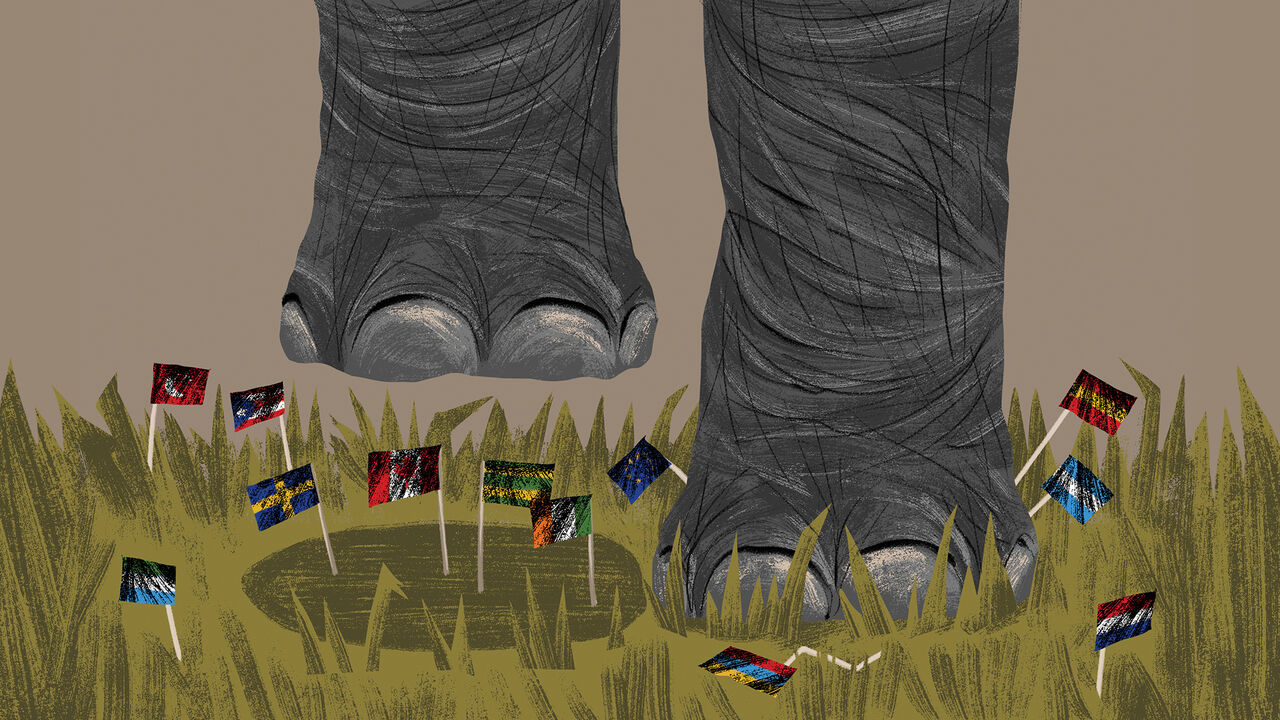
这种地缘政治动态早在多年前就被新加坡具有远见卓识( albeit ruthless)的创始人李光耀准确预见了。他说:“当大象相斗时,草木受害。”李光耀常这样形容美中对抗如何危及旁观者。不过,这个警告鲜少被引用的下半句是:“当他们亲热时,草木也会受害。”理论上,美国和俄罗斯仍然是对手。但在华盛顿,震惊的欧洲盟友发现自己正被特朗普政府的一些官员斥责,因为他们支持乌克兰。这种支持被称作对俄罗斯的挑衅。
This geopolitical dynamic was accurately predicted, years ago, by Singapore’s far-sighted if ruthless founder, Lee Kuan Yew. “When elephants fight, the grass suffers,” Lee would say, describing how America-China confrontations endangered bystanders. There is a less-often cited second half to that warning, though: “When they make love, the grass suffers also.”In theory, America and Russia are still adversaries. But in Washington horrified European allies find themselves being scolded by some officials in the Trump administration for backing Ukraine. Such support is called a provocation of Russia.
在纽约,联合国的外交官对美国、中国和俄罗斯在某些问题上如此紧密地合作感到惊讶,尤其是新秘书长的任命。怀疑的是,安理会的这三个常任理事国倾向于支持一位能够管理组织而不挑战大国的候选人——正如联合国内部所说的,是一名秘书,而非将军。
In New York diplomats at the UN express surprise at how closely America, China and Russia are working on some issues, especially the appointment of a new secretary-general. The suspicion is that those three permanent members of the Security Council favour a candidate who will administer the organisation, not challenge the big powers: a secretary, not a general, as the phrase goes at the UN.
目前尚不清楚美国和中国当前休战状态能维持多久。它在很大程度上是因为椭圆形办公室里坐着的那个人而存在的。如果说意识形态上的对华强硬派是指那些不赞成共产党铁腕统治的人,那么特朗普先生从来都不是这样的人。现在,在他的第二个任期内,他毫无兴趣去改变中国的体制,无论是就经济模式还是地区野心与中国对抗。
It is not clear how long the current truce between America and China can last. It exists largely because of one man, who sits in the Oval Office. Mr Trump has never been an ideological China hawk, if that means someone who disapproves of the Communist Party’s iron-fisted rule. Now, in his second term, he has no interest in changing China’s ways, whether that means confronting China over its economic model or its regional ambitions.
他对向中国出售大豆、兜售波音飞机以及确保中国稀土元素的供应更感兴趣。为此,他已指示其外交官和将军们避免与习近平主席开战,并搁置了对台军售承诺。从他们最近的峰会来看,特朗普先生和习近平先生都没有心思听取世界其他国家的要求,去允许对各自的人工智能领头羊进行更多监管。
He is more interested in selling China soyabeans, flogging Boeing planes and securing supplies of Chinese rare-earth elements. To that end, he has told his diplomats and generals to avoid starting a war with President Xi Jinping and is holding up promised arms sales to Taiwan. Judging by their recent summit, neither Mr Trump nor Mr Xi is minded to heed calls from the rest of the world to permit more oversight of their respective champions of artificial intelligence.
话虽如此,美中休战随时可能结束,因为中国领导层无论在大是大非还是小事上都在采取强硬态度。今年9月,特朗普先生在访问华盛顿期间竭力争取习近平先生,在安德鲁斯联合基地等地当面会晤,并给予了其他形式的尊重。特朗普先生原本期望中国能以实际行动回报他,例如增加中国柴油销量,从而在期中选举中帮助共和党人。
That said, the truce with China could end at any moment, for Chinese leaders are playing hardball in large ways and small. In September Mr Trump wooed Mr Xi during that visit to Washington, meeting him in person at Joint Base Andrews, among other shows of respect. Mr Trump expected China to repay him with actions to help Republicans in the midterms, for instance by boosting Chinese diesel sales.
然而,中国却在几天后限制柴油出口,激怒了这位总统。这种不稳定性凸显了中小国家面临的一个令人艳羡不来的抉择:它们究竟更倾向于特朗普先生基于将世界划分为势力范围而对中国采取妥协态度,还是更倾向于两个大国全面对抗的重演?
Instead, China enraged the president by curbing diesel exports just days later. This instability points to an unenviable choice facing smaller powers. Do they prefer accommodation of China by Mr Trump, based on a division of the world into spheres of interest, or a resumption of full-blown rivalry between two giants?
数量惊人的政治领导人对作为特朗普先生霸凌受害者的加拿大表示同情,但他们在闭门会议中却抱怨卡尼先生的建议过于天真,即中等强国只需要更勇敢一些。他们指出,并非每个国家都像加拿大那样幸运。加拿大人拥有丰富的石油、天然气和水力发电。由于地处美洲北部高地,威慑俄罗斯并非某些北约成员国所面临的紧迫任务。
A surprising number of political leaders express sympathy for Canada as a victim of Mr Trump’s bullying, but behind closed doors grumble about the naivety of Mr Carney’s advice that middle powers just need to be braver. Not every country is as lucky as Canada, they note. Canadians are blessed with abundant oil, gas and hydroelectricity. Secure in the high north of the Americas, deterring Russia is not the urgent task faced by some fellow members of NATO.
一位欧洲高级官员冷笑道,加拿大可以以欧洲人无法做到的方式与美国对抗。在日本和其他亚洲国家,人们对卡尼先生关于中等强国领导世界的言论感到不耐烦。东京方面有人称,只有美国才能威慑中国,而加拿大是不会拯救我们的。
Canada can confront America in a way that Europeans cannot, sniffs a senior European. In Japan and other Asian countries, there is impatience with Mr Carney’s talk of middle powers leading the world. Only America can deter China, it is said in Tokyo, and Canada is not about to save us.
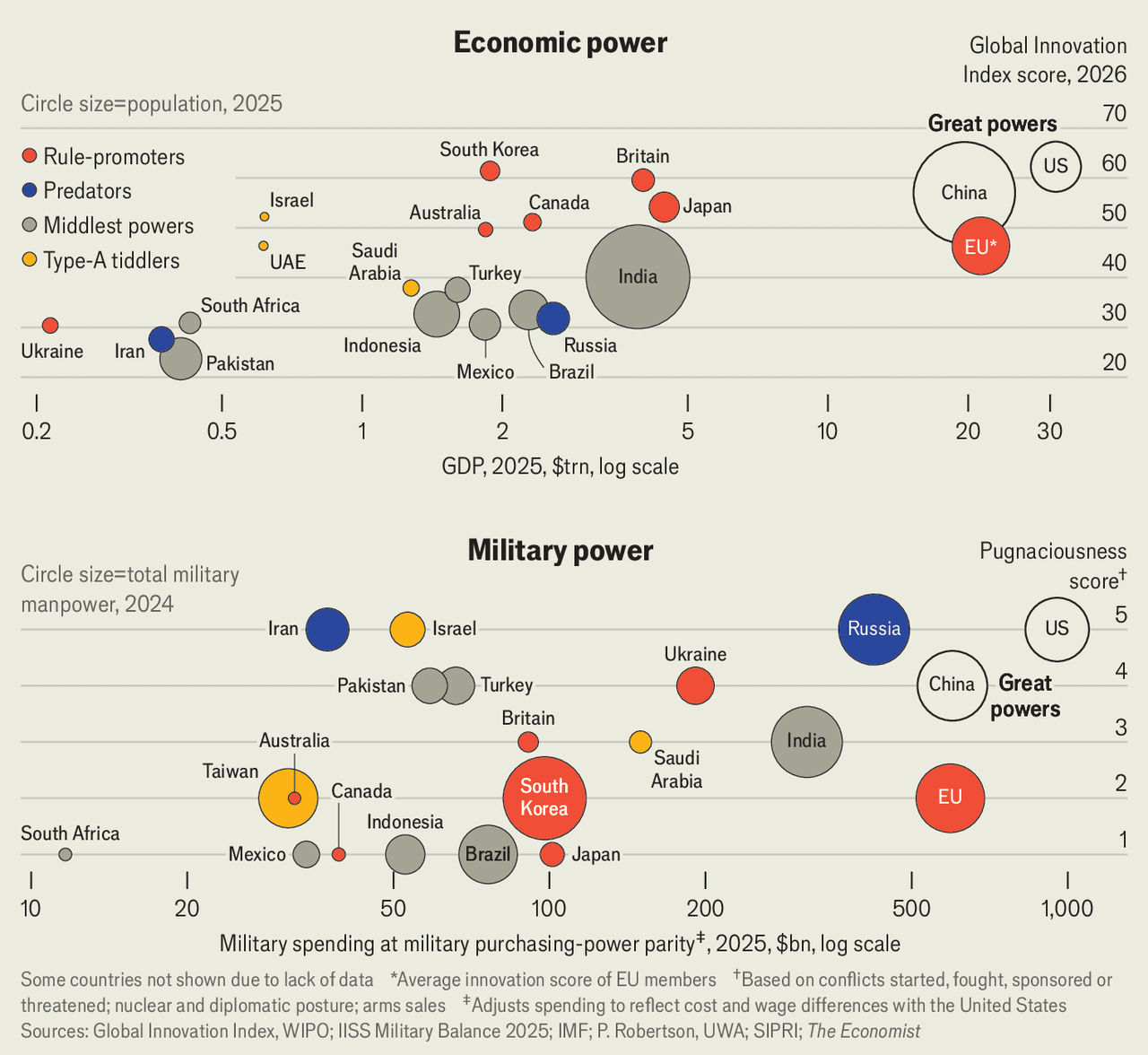
诚然,自他在达沃斯发表演讲以来的几个月里,中等强国取得了一些温和的胜利。以中国和欧盟之间的贸易争端为例,这个拥有27个成员国的集团迄今为止是整合程度最高、实力最强的中等强国联盟(见图表)。在10月15日欧洲峰会召开之前,欧盟领导人将在会上辩论是否建立强大的新型贸易武器,而中国似乎已主动提出削减插电式混合动力汽车的出口。
True, in the months since his Davos speech, middle powers have pulled off some modest wins. Take the trade dispute between China and the European Union, the 27-member bloc that is by far the most integrated and powerful coalition of middle powers (see charts). Ahead of a European summit on October 15th at which EU leaders will debate whether to create powerful new trade weapons, China appears to have offered voluntary cuts to exports of plug-in hybrid vehicles.
不过,这是一个微不足道的让步:混合动力汽车的销售并不是中国的核心利益。中国控制台湾的雄心则不在同一个量级上。如果围绕该岛爆发战争,没有任何中等强国联盟能迫使中国退缩。只有美国才能威吓管理中国人民解放军的强硬派。就此而言,在格陵兰岛问题上对抗特朗普先生是一场风险很低的争端。拥有这座北极岛屿是特朗普式的特殊执念,而不是在美国民众中获得广泛支持的事业。
This is a footling concession, though: sales of hybrid cars are not a core Chinese interest. China’s ambitions to control Taiwan are of a different magnitude. If war breaks out over the island there is no coalition of middle powers that could make China back off. Only America intimidates the hard men who run the People’s Liberation Army. Defying Mr Trump over Greenland was, for that matter, a low-stakes fight. Owning that Arctic island was a peculiarly Trumpian obsession, not a cause with popular support among Americans.
外国政府对卡尼演讲中的另一个说法持怀疑态度,即中等强国能够用它们自己的秩序取代一个已经消逝的、由美国主导的秩序。外交官们列举了没有美国(乃至中国)深度参与就无法解决的挑战,从应对气候变化、预防和管理大流行病,到最紧迫的人工智能治理。
Foreign governments look sceptically at another claim in the Carney speech, namely that middle powers can replace a lost, American-led order with one of their own. Diplomats tick off challenges that cannot be solved without deep American (and indeed Chinese) engagement, from tackling climate change to the prevention and management of pandemics and, most urgently of all, the governance of AI.
中等强国正在迅速实现其防务关系多元化。随着美国成为一个不太可靠的盟友和超负荷的武器供应国,北约成员国正在从瑞典、意大利和法国等国家购买更多装备。几个欧洲政府热衷于法国提出的将其核保护伞扩大到整个欧洲大陆的提议,尽管这只是作为美国更强大威慑力量的补充。
Middle powers are rapidly diversifying their defence relations. With America becoming a less reliable ally and an overstretched arms supplier, NATO members are buying more kit from such players as Sweden, Italy and France. Several European governments are keen on a French offer to extend its nuclear umbrella over the continent, though as an adjunct to America’s much larger deterrent.
由于“爱国者”导弹拦截弹供应短缺,海湾国家正在抢购韩国的防空系统。乌克兰正在向遭受伊朗攻击的海湾国家出售反无人机防御系统。在一个颇具2026年色彩的转折中,乌克兰企业占据了优势,因为乌克兰在其领土上击落的无人机,其原型是经俄罗斯升级的伊朗设计,而这些设计现在正流回伊朗。
With Patriot missile interceptors in short supply, Gulf states are snapping up South Korean air-defence systems. Ukraine is selling anti-drone defences to Gulf states under attack from Iran. In a 2026-worthy twist, Ukrainian firms have an edge because the drones that Ukraine shoots down over its territory are based on Iranian designs that were upgraded by Russia and which are now going back to Iran.
在其他领域,当中等强国寻求更大的自主权时,它们往往是在一个霸权与另一个霸权之间搞平衡。许多西方国家不喜欢在关键矿产上依赖中国。唯一可行的替代方案是加入围绕七国集团国家建立、由美国主导的非中国矿产买家俱乐部。因担心对中东或美国化石燃料依赖而感到忧虑的政府,则转向了中国制造的太阳能电池板、风力涡轮机和电池。
In other spheres, when middle powers seek greater autonomy, they are often balancing one hegemon against another. Many Western countries dislike relying on China for critical minerals. The main viable alternative is to join buyers’ clubs for non-Chinese minerals that are built around the G7 countries and led by America. Governments worried by their dependence on fossil fuels from the Middle East or America are turning to Chinese-made solar panels, windmills and batteries.
即使中等国家的联盟确实出现了,它们也并非全部都是良性的,或者符合卡尼先生关于由“B队”成员担保的有原则的世界秩序的愿景。今年8月由巴基斯坦、沙特阿拉伯和土耳其签署的集体防御条约《麦加协议》所维护的主要原则是,其他国家在招惹这三个国家时应该三思而后行。雄心勃勃的地区大国的松散集团正在苏迪安可怕的内战双方中进行干涉。
Even when coalitions of mid-ranking countries do emerge, not all of them are benign, or fit into Mr Carney’s vision of a principled world order underwritten by members of Team B. The main principle being upheld by the Mecca agreement, a collective-defence pact signed in August by Pakistan, Saudi Arabia and Turkey, is that others should think twice before messing with that trio. Loose groupings of ambitious regional powers are meddling on each side of Sudan’s ghastly civil war.
中等国家无足轻重的最鲜明例子涉及人工智能。由于美国和中国遥遥领先,并陷入争夺主导地位的斗争中,目前几乎没有迹象表明这两大巨头在人工智能安全和治理方面会进行认真的合作。为了让世界其他地区的声音被听到,芬兰和挪威在9月呼吁对前沿人工智能模型进行控制。数十个国家签署了该呼吁。英国没有签署。它希望凭借其领先的研究中心、人工智能安全研究所(AI Security Institute)以及间谍机构之间的紧密联系,与美国建立特殊的人工智能关系。
The starkest examples of middle-power irrelevance involve AI. With America and China far ahead, and locked in a struggle for primacy, there are few signs, for now, of serious co-operation between the giants on AI safety and governance. In a bid by the rest of the world to be heard, in September Finland and Norway called for controls on frontier AI models. Dozens of countries have signed the appeal. Britain has not. It hopes for a special AI relationship with America, based on its leading research centres and its AI Security Institute, and close ties between spy agencies.
以荷兰和韩国为首的另一组国家自2023年以来一直举行会议,主张在军事领域建立负责任的人工智能(简称REAIM,这是他们时髦的缩写)。肯尼亚将主办下一届REAIM峰会。美国出席了这些会议,这是积极的第一步,因为特朗普政府拒绝与联合国等机构就人工智能规则制定进行接触。
A separate group of countries, led by the Netherlands and South Korea, has held meetings since 2023 to argue for Responsible Artificial Intelligence in the Military Domain (REAIM, to use their snazzy acronym). Kenya will host the next REAIM summit. America attends the meetings, which is a positive first step, for the Trump administration refuses to engage with such bodies as the UN on AI rule-making.
更广泛地说,几乎没有证据表明美国和中国对人工智能落后者的观点感兴趣。诚然,特朗普政府目前对人工智能监管的怀疑态度有可能因前沿模型惊人的新能力而动摇。但即便美国国内出现更多支持放缓前沿研发的声音,这种反对意见——即中国可能会占据领先地位——仍将是无法回避的。合理的推测是,美国可能会通过进一步收紧中国实验室获取高端芯片及其制造工具的途径来放慢其脚步。
More broadly, there is little evidence that America and China are interested in the views of AI also-rans. True, it is possible that the Trump administration’s current suspicion of AI regulation will be shaken by staggering new capabilities in frontier models. But even if more support emerges for slowing work at the frontier in America, the objection—that China might take the lead—will remain unavoidable. Plausibly, America may seek to slow Chinese labs by further tightening their access to high-end chips and the tools for making them.
或者,“全速前进”派可能会占上风,美国将不顾对模型引发灾难的担忧而加速人工智能研究,唯恐让中国率先建立起灾难性的能力。
Or the full-speed-ahead crowd may win the day, with America accelerating AI research despite concerns about models causing catastrophe, for fear of letting China build catastrophic capabilities first.
在面临令人震惊的风险与机遇之时,大国很少对弱小者表现出宽宏大量。而这正是中等实力国家面临的挑战。在九个月后仍被人们津津乐道的一场演讲中,卡尼先生准确地指出了对加拿大及其同类国家有利的二战后秩序的终结。他提出的乐观解决方案却不那么经得起时间的考验。警惕与勇气是一个领导者和一个国家令人钦佩的品质。但在危险逼近之时,面对实力是无可辩驳的。■
In times of staggering risks and opportunities, great powers rarely show magnanimity towards their lessers. And there lies the challenge for the mid-ranked rest. In a speech still being talked about nine months later, Mr Carney rightly noted the ending of a post-1945 order that was good to Canada and its peers. His optimistic solutions are ageing less well. Vigilance and courage are admirable traits in a leader and in a country. But when dangers loom, there is no arguing with strength.■