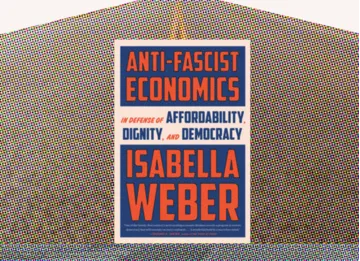
2021年底,随着通货膨胀飙升,阿默斯特学院经济学教授伊莎贝拉·韦伯在一篇专栏文章中为“战略性价格管制”进行了辩护。韦伯主张,鉴于价格管制在第二次世界大战期间被成功运用,政府对价格进行干预是一个明智的想法,且在美国历史上有着毋庸置疑的先例。“如果你的房子着火了,你不会等到火自己熄灭,”她写道。但在五年前,在长达数十年的新自由主义政策背景下,这个想法已经沉寂。韦伯遭到同行的无情嘲弄,其中包括许多左翼经济学家。
In late 2021, with inflation spiking, Isabella Weber, an economics professor at Amherst College, wrote a column for in which she mounted a defense of “strategic price controls.”Weber argued that government guardrails on prices were a sensible idea with a rather unassailable precedent in US history, given their successful use during World War II. “If your house is on fire, you would not wait until the fire eventually dies out,” she wrote. But five years ago, the idea had gone dormant amid several decades of neoliberal policies. Weber was ruthlessly mocked by her colleagues, including many left-of-center economists.
情况已经发生了变化。韦伯的核心经济学理念优先考虑让民主国家的每一位公民都买得起生活必需品,这一理念如今已获得势头。在德国,政府对天然气实施了“价格熔断”。在美国,纽约州议员佐赫兰·马姆达尼凭借包括免费公交、冻结租金和市政府经营杂货店等竞选纲领,轻松赢得了纽约市长选举。本周,韦伯做客播客节目,讨论她的新书《反法西斯经济学:捍卫负担能力、尊严与民主》。
Things have changed. Weber’s underlying economic philosophy, which prioritizes making the necessities of life affordable for every citizen of a democracy, has gained momentum. In Germany, the government instituted a “price break” on natural gas. In the US, New York state legislator Zohran Mamdani handily won the New York City mayoral election on a platform that included free busing, a rent freeze and city-owned grocery stores. This week on , Weber joins the podcast to discuss her new book, “Anti-Fascist Economics: In Defense of Affordability, Dignity, and Democracy.”
在政治谱系的另一端,我们还采访了彭博社记者奥斯汀·卡尔,探讨他关于马克·安德森的新报道。这位风险投资家在华盛顿的人工智能政策上已变得极具影响力。卡尔梳理了安德森从民主党捐款人到特朗普政府最亲密盟友和最强大资金支持者之一的转变轨迹,并探讨了他的影响力对人工智能监管辩论意味着什么。
On the other side of the political spectrum, we also talk to Bloomberg reporter Austin Carr about his new story about Marc Andreessen, the venture capitalist who’s become profoundly influential in Washington on artificial intelligence policy. Carr traces Andreessen’s path from Democratic Party donor to one of the Trump administration’s closest allies and most powerful financial backers, and explores what his power means for debates over AI regulation. Finally this week, we discuss the rumored merger of Starbucks Corp. and Chipotle Mexican Grill Inc. and propose a few alternative tie-ups.
在本周的最后,我们讨论了星巴克公司和奇波雷墨西哥烧烤公司合并的传闻,并提出了其他几项合并方案。
You can find the full conversation with Weber in this week’s episode, as well as an edited excerpt below.
你可以在本周的节目中找到与韦伯的完整对话,下方则是经过编辑的节选。
Weber: The reaction was as if I had proposed a pornography exhibition in the Vatican.
韦伯:当时的反应就好像我在梵蒂冈提议举办色情展览一样。我认为,经济学家对这个问题如此敏感的原因在于,归根结底,当他们考虑市场时,他们想到的是供求图表。在他们心目中,如果你对价格采取某种行动,那就好像你杀死了市场。而在现实中,市场远不止价格。
I think the reason that economists are so sensitive to this question is that, at the end of the day, when they think about markets, they think about the supply-demand diagram. In their minds, if you do something about the price, then it’s as if you had killed the market. In reality, markets are much more than prices. In the age of neoliberalism, we have been telling people that democracy is the greatest of all systems — as it is.
在新自由主义时代,我们一直在告诉人们,民主是所有制度中最伟大的——事实也的确如此。然后,在第二句话中,我们却说:“不幸的是,当涉及到你的基本经济利益时,我们能为你做的事并不多。”
And then, in the second sentence, we say, “Unfortunately, when it comes to your basic economic interests, there’s not much that we can do for you.”Weber: When you impose interest rates to cool down inflation, the idea is that inflation is demand-driven — that people have too much money in their pockets.
韦伯:当你通过加息来给通胀降温时,其逻辑是通胀是由需求驱动的——人们口袋里的钱太多了。因此,过多的钱追逐过少的商品。但如果我们把这一点转化为上一轮通胀中发生的情况——由供应链冲击引发的通胀,那真的不是由需求驱动的。这些供应链冲击是通过企业的定价行为在经济中传导的。企业保护甚至提高了它们的利润率。这意味着,如果你看一下美国在大流行期间单位利润的变化情况,你会发现它们的飙升幅度是史无前例的。
Therefore, too much money is chasing too few goods. But if we translate this to what happened in the last round of inflation, an inflation unleashed by supply shocks, that’s really not demand-driven. Those supply shocks were propagated through the economy by firm pricing behavior. Companies protected or even increased their profit margins. Which means if you look at what happened to unit profits in the United States during the pandemic years, you’ll see they jumped in ways they had actually never jumped before. You had this situation where people kept going to work to do their job but started to wonder whether they had enough money left at the end of the month to pay their bills.
当时出现了这样一种情况:人们每天继续去上班工作,但开始怀疑到了月底自己剩下的钱是否还够支付账单。而经济学家的回应却是:“让我们大幅加息来增加失业率。”这与民主的方法是不相容的。如果去询问的话,大多数人都会投票反对。
And the response from economists is, “Let’s jack up interest rates to increase unemployment.”That is not compatible with a democratic approach. The majority of people would vote against it if asked.
韦伯:从某种意义上说,特朗普一直在说我一直在说的话。但我认为他出于非常不同的原因在说这些。
Weber: In a sense, Trump has been saying what I’ve been saying. But I think he’s saying it for very different reasons.
我经常被问到一个问题:“好吧,你赞成价格管制,但法西斯也使用价格管制。所以价格管制难道不是法西斯的吗?”我要说的是,价格管制只是一种工具。在法西斯手中,它们的作用是压制人民。如果它们被民主政府用来在疫情、气候冲击或战争等危机中抵御成本冲击、捍卫人们的生计,那就是完全不同的另一回事。
A question I’m getting a lot of is, “OK, you are in favor of price controls, but fascists use price controls. So aren’t price controls fascist?”What I would say is that price controls are a tool. In the hands of fascists, they serve the goal of keeping people suppressed. If they are used by democratic governments to defend people’s livelihoods against cost shocks amidst a crisis like a pandemic, a climate shock or a war, they are quite a different thing.
韦伯:首先,战后的常识是确保私人权力不会达到足以挑战民主国家本身权力的集中程度。这实际上是对罗斯福一句名言的化用。其次,“受生活所迫的人不是自由人”,这也是罗斯福的名言。就我而言,一个民主国家要求其所有成员都能够谋生,这是常识。
Weber: First, it was common sense after the war to ensure that private power could not reach levels of concentration to challenge the power of the democratic state itself. That’s actually a paraphrase of a Roosevelt quote. And second, “necessitous men are not free men,” which is also a Roosevelt quote. And as far as I’m concerned, it’s common sense that a democracy requires all of its members to be able to make a living.