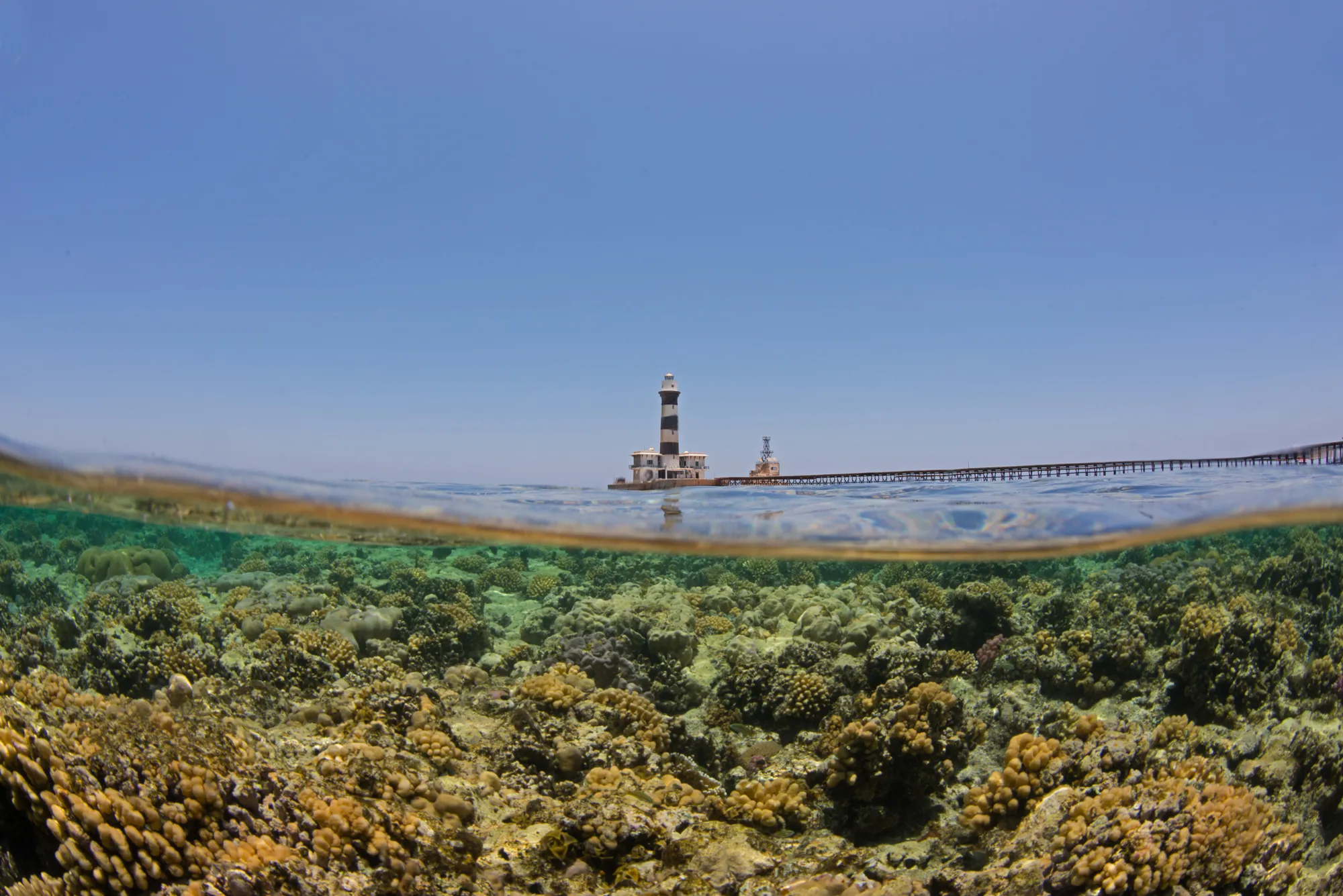
这是苏伊士运河大学海洋生物学教授、赫尔格达环境保护与保育协会(HEPCA)顾问马赫穆德·哈纳菲此前的预测。但在2023年和2024年的夏季,热浪给红海珊瑚生态系统带来了压力。由哈纳菲领导的HEPCA调查发现,2024年红海珊瑚普遍出现白化。在北部地区,受影响的珊瑚群落不足十分之一,但在更南部地区,白化导致一半珊瑚死亡。
That’s what Mahmoud Hanafy, a professor of marine biology at Suez Canal University and consultant for the Hurghada Environmental Protection and Conservation Association (HEPCA), has previously predicted. But in the summers of 2023 and 2024, heat waves strained Red Sea coral ecosystems. A HEPCA survey led by Hanafy found bleaching throughout the Red Sea corals in 2024. In the northern areas, less than a tenth of coral colonies surveyed were affected, but further south, bleaching took out half the corals.
科学家们正竭力拼凑这些事件对长期被描述为“超级珊瑚”的珊瑚礁意味着什么,因为它们拥有无与伦比的韧性。但现在的问题是,它们不仅能承受多少高温,还在于最近之前是什么保护了它们——这种保护是否还能持续。
Scientists are racing to piece together what these events mean for reefs long described as “super coral” for their unparalleled hardiness. But now the question is not just how much heat they can withstand, but what has protected them until recently—and whether that protection will hold.
在过热的海水中,寄居在珊瑚水母体中的藻类开始产生有毒物质。作为一种防御机制,珊瑚会排出这些藻类。这就是所谓的珊瑚白化,由于这些微生物是珊瑚的主要食物来源,白化事件会让珊瑚面临饥饿。
In overly warm waters, the algae nestled amongst the corals’ polyps begin to produce toxic substances. As a defense mechanism, the corals eject the algae. This is what is referred to as coral bleaching, and because these microscopic organisms are corals’ primary food source, bleaching events leave corals to starve.
这是炎热海水可能对珊瑚产生的其他负面影响之一,这不仅关系到珊瑚本身,也关系到珊瑚礁中所有其他生命。根据联合国环境规划署的数据,珊瑚礁覆盖海底面积不足1%,却支持至少25%的海洋物种——其中一些物种直到现在才刚刚被发现。
That’s among other negative impacts hot seas may be having on corals, which is an issue not just for the corals, but all the other life among the reefs. According to the United Nations Environment Program, reefs cover less than 1 percent of the seafloor yet support at least 25 percent of marine species—some that are only just now being discovered.
多年来,随着气温升高,红海北部的珊瑚礁一直相当稳定,而其他珊瑚生态系统却遭受了白化。卡塔尔国王阿卜杜拉科技大学(KAUST)海洋生态学家埃斯拉曼·奥斯曼认为,埃及珊瑚的进化史可能是其耐热性的可能解释。
For many years, northern Red Sea reefs remained quite stable as temperatures rose, while other coral ecosystems suffered bleaching. Eslam Osman, a marine ecologist at King Abdullah University of Science and Technology (KAUST), points to the Egyptian corals’ evolutionary history as a likely explanation for their heat tolerance.
据信,珊瑚是通过位于现今吉布提和也门之间的巴布-曼达布海峡(Bab al-Mandab Strait)扩散到红海中的。奥斯曼(Osman)认为,穿越这些水温特别高的水域起到了“自然筛选”的作用:只有那些耐热性强的珊瑚物种及其基因型才能存活下来,随后它们的后代才向北扩散到水温较低的区域。
Corals are believed to have spread into the Red Sea through the Bab al-Mandab Straight, which lies at the southern point of the sea between modern-day Djibouti and Yemen. Crossing through these especially warm waters acted as a natural filter, Osman posits. Heat-tolerant species and genotypes survived, and their offspring spread northwards into cooler waters.
然而,不同地区的珊瑚恢复能力存在差异,这也是汉纳菲(Hanafy)对“进化历史”作为解释埃及珊瑚礁恢复能力的主要因素持怀疑态度的原因之一。他更倾向于将珊瑚的恢复能力归因于水体的循环系统。
However, resilience varies across the region, which is part of why Hanafy is unconvinced that evolutionary history is the primary explanation for the resilience of Egypt’s reefs. He places greater emphasis on water circulation.
奥斯曼解释说,红海北部的水流方向会发生变化,这种变化会导致海水在垂直方向上的混合,从而将深层冷水带到海面。即使在周围空气温度较高的情况下,这样的水流条件也能帮助珊瑚抵御高温的影响。
The northern Red Sea experiences changes in current direction. This can create vertical mixing, which brings cooler water from far below toward the surface, he explains. These conditions could be buffering the corals against the heat even when the surrounding air temperatures remain high.
这种区别非常重要:珊瑚的存活可能与珊瑚本身的生物学特性或其共生藻类的作用关系不大,这或许可以解释为什么2024年红海的珊瑚会开始出现白化现象。
The distinction matters. The survival of these reefs may not have much to do with the biology of the corals or their symbiotic algae, and this might explain why the Red Sea corals began bleaching in 2024.
在2024年的热浪期间,海面异常平静,持续了大约一个半月的时间,这削弱了通常有助于保护珊瑚礁的水流循环系统。HEPCA(Horn of Africa Coral Protection Agency)的报告指出,水流循环能力减弱是导致珊瑚白化的一个因素;2024年7月异常低的潮汐也可能加剧了浅水珊瑚群落所承受的压力。
The sea remained unusually calm for about a month and a half during the 2024 heat wave, weakening the circulation he believes normally helps protect the reefs. HEPCA’s report identifies weak water circulation as a contributing factor in the bleaching. Exceptionally low tides in July 2024 may also have intensified stress on shallow coral communities.
奥斯曼承认平静的海面可能会使珊瑚白化现象更加严重,但他认为关于水流循环机制的解释仍需要进一步研究。“我并不否认这种可能性,”他说,“但我认为温度才是真正的问题所在。”这两种解释并不一定是相互排斥的;了解它们各自的相对重要性,有助于科学家评估这些珊瑚礁对未来热浪的脆弱程度。
Osman accepts that calm seas could have made bleaching more severe but says the circulation explanation needs further research. “I’m not denying the possibility of that,” he says. “But what I’m saying is, the temperature was the main issue.”The two explanations are not necessarily mutually exclusive. But understanding their relative importance could help scientists assess how vulnerable these reefs are to future heat waves.
保护红海珊瑚礁以应对下一波热浪的工作也在进行中,埃及政府正在指定新的保护区,并与联合国开发计划署以及全球珊瑚礁基金合作开展保护和可持续管理工作。
Work to protect the Red Sea reefs ahead of the next heat wave is also under way, with the Egyptian government designating new protected areas as well as partnering with the United Nations Development Program and the Global Fund for Coral Reefs on conservation and sustainable management.
奥斯曼认为这些举措是积极的一步,但他强调,保护需要持续的支持。“我们确实需要更稳定的财政资源,因为保护不是一年一度的行为。”对于哈纳菲来说,埃及珊瑚礁的未来还取决于气候变化是否会改变可能一直让珊瑚存活的海洋环流。
Osman sees such initiatives as a positive step but stresses that conservation requires sustained support. “We definitely need more stable financial resources, because conservation is not a single-year act.”For Hanafy, the future of Egypt’s reefs also depends on whether climate change alters the circulation that has perhaps been keeping the corals alive.
无论是什么原因解释了它们的异常韧性,地方层面的保护都无法阻止海洋变暖。“因此,关键在于减少二氧化碳和温室气体排放。任何其他解决方案只能争取时间,”哈纳菲补充道。此文首发于《连线》中东版。
Whatever explains their unusual resilience, local conservation cannot halt ocean warming. “Therefore, the key is to reduce carbon dioxide and greenhouse gases. Any other solution will just buy time,” Hanafy adds. This story originally appeared in WIRED Middle East.