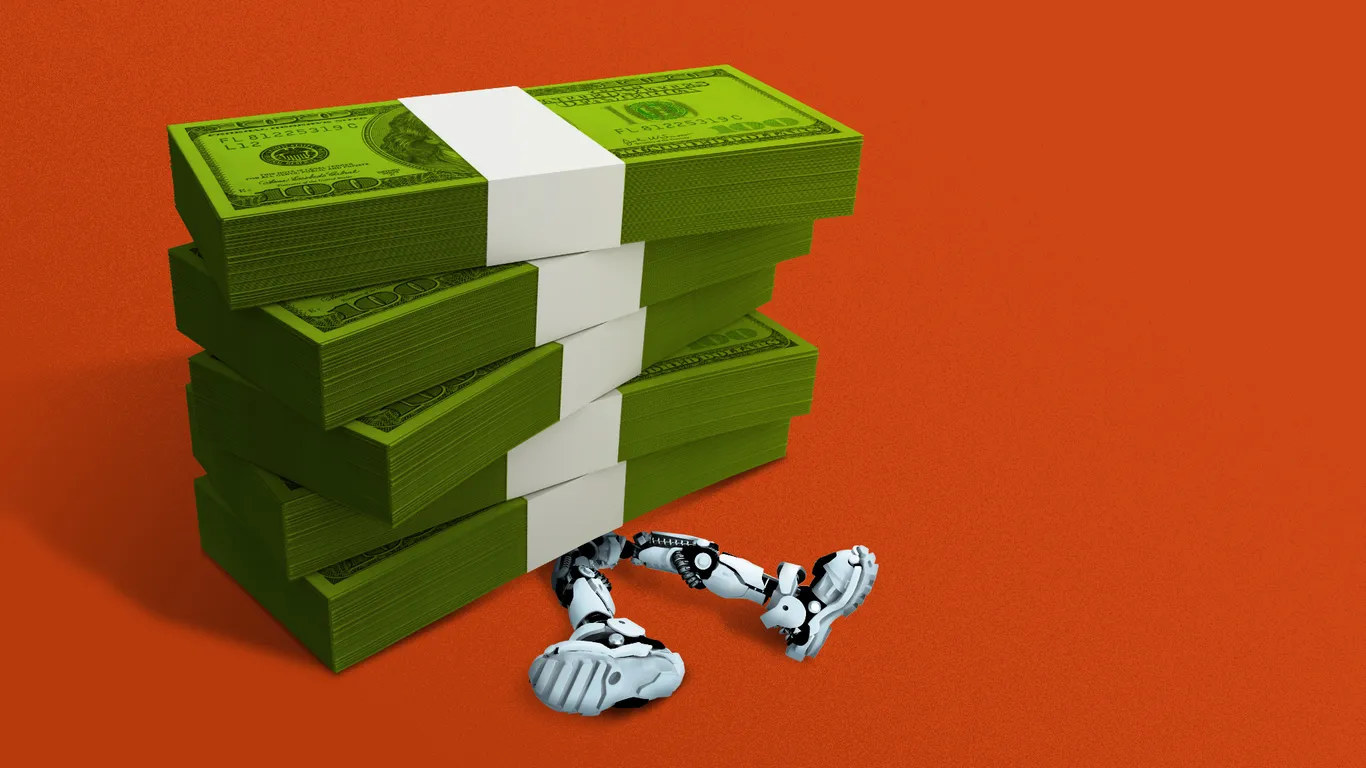
华尔街似乎已到达人工智能的上限,金融界人士开始直言不讳:所有这些人工智能支出看起来并不能带来回报,至少对所有人而言如此。
Wall Street appears to be hitting its limit on AI, and financiers are starting to say the quiet part out loud: All of this AI spending doesn't look like it can pay off, at least not for everyone.
为何重要:构建人工智能基础设施的成本与企业实际为使用这些设施支付的费用之间的差距正在扩大。随着为数据中心和芯片融资而累积的债务日益与经济现实脱节,华尔街的焦虑情绪正在上升。
Why it matters: The gap between what it costs to build AI infrastructure and what companies are actually paying to use it is widening. Wall Street's anxiety is surging as the debt piling up to fund data centers and chips looks increasingly disconnected from economic reality.
新闻驱动因素:人工智能基础设施支出与预期回报之间出现了巨大的差距。
Driving the news: A massive gap is opening up between AI infrastructure spending and expected returns.
- 虽然预计人工智能供应商将在 2030 年前在基础设施上投入 7 万亿美元,但 Gartner 的研究预测,同期相关收入最多只能产生 3.6 万亿美元。
• While AI providers are projected to spend $7 trillion on infrastructure through 2030, research from Gartner forecasts they will generate no more than $3.6 trillion in related revenue over that same period.
- 如果企业保持当前的投资速度,到 2032 年底,超过 4 万亿美元的人工智能基础设施支出可能面临减记风险。
• More than $4 trillion in AI infrastructure spending could be at risk of write-downs by the end of 2032 if companies maintain their current investment pace.
- Gartner 还预测,超过 80% 的专用人工智能云服务提供商(即新云)将在 2030 年前停止独立运营。
• Gartner also predicts that more than 80% of specialized AI cloud providers, known as neoclouds, will cease operating independently by 2030.
案例说明: CoreWeave 是规模最大的专用新云之一,与 Nvidia——人工智能热潮的金融和精神支柱——关系最为紧密,近期其股票和债务经历了多日抛售。
Case in point: CoreWeave, one of the largest neoclouds with among the closest ties to Nvidia — the AI boom's financial and spiritual foundation — has faced a multi-day selloff of its stock and debt.
- 收益率上升至 15% 以上,股价跌幅达 15.5%,随后在 Nvidia CEO 黄仁勋为公司发声后回升。
• Yields pushed above 15% and its stock tumbled 15.5% before rebounding after Nvidia CEO Jensen Huang spoke up on the company's behalf.
追踪资金流向:华尔街的消息人士曾告诉 Axios,只要人工智能建设以现金支付,就无需担心。但如今,三分之一的人工智能资本支出来自债务,资本市场已显现出严重疲劳的迹象。
Follow the money: Sources on Wall Street used to tell Axios that as long as the AI buildout was paid for in cash, there was nothing to worry about. But today, a third of the capex being spent on AI is coming from debt, and capital markets are showing signs of severe fatigue.
- 融资变得更加困难。根据《金融时报》报道,全球与人工智能相关的债务发行在 2026 年 9 月骤降至 230 亿美元,较 6 月的 1130 亿美元大幅下降。
• It's getting harder to secure financing. Global AI-related debt issuance plunged to $23 billion in September 2026, down sharply from $113 billion in June, per the Financial Times.
- 银行正积极收缩以避免集中风险,摩根大通首席执行官杰米·戴蒙确认其银行正在收紧信贷。
• Banks are actively pulling back to avoid concentration risk, with JPMorgan CEO Jamie Dimon confirming his bank is tightening up on credit.
- 基础设施项目和提供商正面临困境:最近,约180亿美元的银行贷款用于甲骨文数据中心园区,已陷入紧张状态;而英伟达支持的AI云服务提供商Firmus搁置了估值超过300亿美元的IPO计划。
• Infrastructure projects and providers are struggling: approximately $18 billion in bank loans for an Oracle data center campus recently slid into stressed territory, while Nvidia-backed AI cloud provider Firmus shelved an IPO that sought a valuation north of $30 billion.
聚焦:持续的支出建立在算力需求永不衰竭的信念之上 — — 但这一信念存在结构性裂痕。
Zoom in: The constant spending relies on the belief that compute demand will never falter — a belief that has structural cracks.
- Reflection AI联合创始人Ioannis Antonoglou告诉Semafor,企业可能需要“十年或二十年”来彻底围绕AI重塑其运营。
• Reflection AI co-founder Ioannis Antonoglou told Semafor that businesses may need "a decade or two decades" to fundamentally redesign their operations around AI.
- 这意味着企业将花费10到20年缓慢采纳今天正在以高昂成本构建的技术。
• That's 10 to 20 years of companies slowly adopting the technology that's being built (expensively) today.
潜台词:这导致了一种错位:数据中心和芯片需要今天进行巨额投资,但能够证明这种支出合理性的回报将需要数年才能实现。
Between the lines: This creates a mismatch: Data centers and chips require enormous investment today, but the returns that could justify that spend will take years to materialize.
- 直白地说,AI支出与AI收入之间存在巨大差距,这一差距在许多年内都不会缩小。
• Put bluntly, there is a massive gap between AI spending and AI revenue, one that won't close for many, many years.
- 同时,快速采用AI的公司正在变得更聪明,通过更高效地使用工具来降低成本,转向计算强度较低的开放权重模型。
• At the same time, companies that are adopting AI quickly are getting smarter about using tools more efficiently, turning to open-weight models that are less compute-intensive to cut costs.
现实检验:看看Anthropic的最新财报,以此作为对看空派的反驳。
Reality check: Look at Anthropic's latest financials for a counterpoint to the bears.
- 该公司正在大幅进账,第三季度自由现金流转正,且收入相比4月至6月期间增长了近50%。
• The company is raking in cash, turning free cash flow positive in the third quarter and growing revenue nearly 50% compared to the April-to-June period.
- 但即便Anthropic的惊人增长也已放缓,尽管这是可以预见的 — — 因为树木无法长到天上。
• But even Anthropic's staggering growth has slowed, albeit expectedly because trees can't grow to the sky. The bottom line:
结论:由债务推动的AI建设热潮不仅是科技投资者独自需要担忧的问题。
The debt-fueled AI buildout is not an isolated problem for tech investors alone to worry about.
- 股市和经济日益与AI热潮绑定。
• The stock market and economy have become increasingly tied up with the AI boom.
- 如果AI押注失败,市场和经济也可能随之受挫。
• If the AI bet doesn't work, markets and the economy could falter as well.