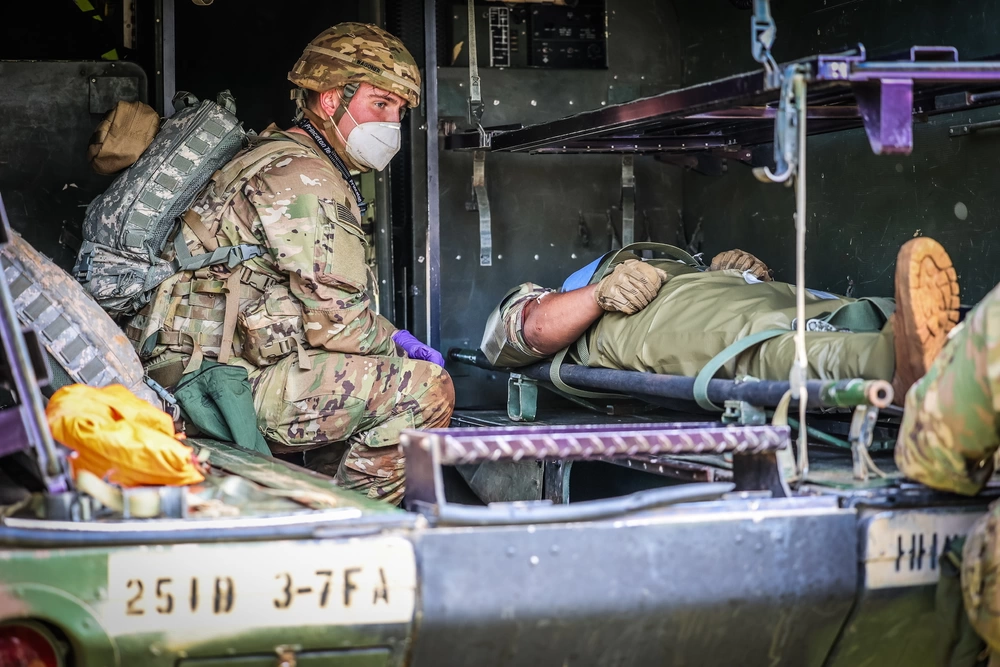
美国陆军战斗医疗团队正在尝试延长护理时间的方法,以备可能在印太战区发生的战斗,该地区距离遥远且疏散平台有限,影响患者及时获得外科护理。
U.S. Army combat medical teams are experimenting with ways to prolong care in preparation for a possible fight in the Indo-Pacific theater, where vast distances and limited evacuation platforms affect a patient’s timely access to surgical care.
在印太地区的战斗将与过去的战争(如伊拉克和阿富汗战争)不同,这使得维持“黄金一小时”标准变得困难。
A fight in the Indo-Pacific would look different from past wars, such as Iraq and Afghanistan, making maintaining the “Golden Hour” standard difficult.
驻扎在夏威夷福特沙弗的第18战区医疗司令部不再要求创伤性战斗伤员在60分钟内接受医疗护理并疏散到外科设施,而是重新定义该术语,意指将先进护理带到受伤地点。
Instead of requiring medical care and evacuation to a surgical facility to occur within 60 minutes of a traumatic combat injury, the 18th Theater Medical Command, based at Fort Shafter, Hawaii, is rethinking the term to mean bringing advanced care to the point of injury.
该地区的“距离暴政”使得实施黄金一小时变得困难,因为印太地区占世界表面积的50%以上。第18战区医疗司令部司令少将E·达林·考克斯周一在AUSA 2026期间接受《军事时报》采访时这样表示。
The “tyranny of distance” in the region makes implementing the Golden Hour challenging since it accounts for over 50% of the world’s surface, 18th TMC Maj. Gen. E. Darrin Cox told Military Times on Monday during AUSA 2026.
“过去,‘黄金一小时’的意思是将某人从战场送到医疗设施,用时60分钟,所以在太平洋地区,这可能不可能实现,”考克斯说。“所以当我们说黄金一小时时,我们指的是损伤的病理生理学,并在病理变得紊乱之前,在那段时间内将护理带给该患者。”随着自主系统在全球军队中变得越来越重要,该司令部正在尝试利用自主系统在受伤地点为患者提供延长护理,同时考虑到遭受攻击的可能性。
“In the past, what [the Golden Hour] has meant is getting someone from the battlefield to a [medical] facility in that 60 minutes, so here in the Pacific, that may not be possible,” Cox said. “So what we’re talking about when we say Golden Hour is the pathophysiology of injury and bringing care to that patient in that time before pathology becomes deranged.”As autonomous systems become increasingly relevant in militaries across the globe, the command is experimenting with ways it can assist patients with prolonged care at the point of injury, while keeping in mind the possibility of an attack.
尽管战争和医疗护理都是“人类活动”,但考克斯表示,自主系统是未来的一部分。这些系统可以通过管理患者的生命体征、对患者进行分诊、输送血液或监测患者来帮助提供护理,从而让地面上的医务人员能够照顾其他人。
Even though warfare and medical care are both “human endeavors,” Cox said, autonomous systems are a part of the future. The systems can help deliver care through managing a patient’s vital signs, triaging patients, delivering blood or monitoring a patient so a provider on the ground can take care of others.
“我们正在尝试自主运送血液和其他一类医疗物资,”科克斯说。“他们正在乌克兰尝试自主撤离战场上的伤员,因此在这一领域有很多工作要做。”“乌克兰的情况并非全部都能直接适用于您所处的太平洋海洋环境,但我们会吸取所观察到的经验,学到这些教训,然后尝试将其应用到我们所处的作战环境中,”他继续说道。
“We’re experimenting with autonomous delivery of blood and other Class A medical supplies,” Cox said. “They’re experimenting in Ukraine with autonomous evacuation of injured folks off the battlefield, so there’s a lot of work in that area.”“Not everything in Ukraine is directly applicable to the maritime environment you find yourself in the Pacific, but we take what we observe, we learn those lessons, and then we try to apply it to the operating environment that we’re in,” he continued.
在尝试自主系统的同时,第18运输司令部正与联合伙伴和盟友合作,以确保能够进入血液分发设施,并在国际日期变更线以西储存血液。
Alongside experimenting with autonomous systems, the 18th TMC is working with joint partners and allies to ensure access to blood distribution facilities, storing it west of the International Date Line.
“去年在‘泰利斯曼军刀’演习期间,我们成功地将血液从日本运送到了澳大利亚,”科克斯说。“这表明我们正在发展这样的网络,使我们能够根据不同行动的需求激增,将血液从潜在的储存地点运送到需要的地点。”科克斯说,对于危重创伤患者,血液及其成分在受伤点是必需的,无论是其他国家提供的血液供美国使用,还是提前储存在设施中的血液。
“We were able to successfully bring blood from Japan to Australia last year during the Talisman Saber exercise,” Cox said. “That demonstrates developing those networks where we can move blood from potential storage locations to the points of need as different operations would surge.”In critically injured trauma patients, blood and its components are necessary at the point of injury, Cox said, whether it’s blood provided by other countries for American use or stored ahead of time in a facility.
最佳选择是全血,但这需要现场采集,供应有限;而冷藏的全血保质期也有限。另一种选择是冷冻产品,包括血液和血浆,但它们需要使用专门的设备进行解冻。
The best option is fresh whole blood, but that requires collection on scene, which has a limited supply, and refrigerated fresh blood has a limited lifespan. Another option is frozen products, both blood and plasma, but they need to be thawed with specialized equipment.
科克斯强调,太平洋地区的许多伙伴,如菲律宾,正在发展自己的武装部队血液计划,在军医院储备血液并接受捐赠。美国正在寻求与一些联合伙伴(如澳大利亚和日本)达成血液共享协议,这些国家的检测协议与美国相似,并允许美国在美国伤员身上使用当地采购的血液。
Cox highlighted that many partners in the Pacific, like the Philippines, are developing their own armed forces blood program where they have a stockpile of blood in military hospitals and accept donations. America is looking to have blood-sharing agreements with some joint partners, like Australia and Japan, which have a similar testing protocol to America’s and allow for the U.S. to use blood procured locally on U.S. casualties.
“我们也与菲律宾的合作伙伴一起,”第18军兵团军士长詹妮弗·弗朗西斯对《军事时报》表示。“我们确保分享我们在野外所做的工作,以便提升他们自身的能力。因此,我们在菲律宾取得了巨大进展。”她表示,确保战场医护人员在冲突发生前熟悉这些概念和创新,需要对“方方面面”相关选项进行培训。
“We’re also with our partners in the Philippines,” 18th Command Sgt. Maj. Jennifer Francis told Military Times. “We ensure that we share what we’re doing in the field, so that we can enhance their own capability. So we’ve made huge strides there in the Philippines.”Ensuring that the combat medics are familiar with these concepts and innovations ahead of a conflict takes training on “anything and everything” related to the options, she said.
陆军拥有多个“护理层级”,但一切始于基本的自救训练和更高级的战斗生命救援训练,之后部分人员才能达到战场医护水平。
The Army has multiple “echelons of care,” but it all begins with basic self-care training and the more advanced Combat Lifesaver training before some reach the combat medic level.
“当你达到战场伤员救护时,这会更加全面一些,”弗朗西斯说。“他们掌握止血带的基本使用方法,然后进行从头到脚的创伤处理。”在印太地区,整体医疗护理并没有显著不同,但环境不同,这促使第18战区医疗司令部继续通过技术和培训进行创新,以保持与士兵的信任。
“Once you get to tactical combat casualty care, that’s a little bit more robust,” Francis said. “They have the basic application of tourniquet[s], and then going through some of the head-to-toe trauma.”In the Indo-Pacific theater, the overall medical care is not significantly different, unlike the environment, prompting the 18th TMC to continue to innovate through technology and training to keep trust with soldiers.
第18战区医疗司令部使用第8前方复苏与外科分遣队(FRSD),这是一个20人团队,能够在战区执行手术,科克斯表示。司令部正在尝试不同的帐篷与固定移动集装箱配置,这些集装箱可以装卸在陆军水上舰艇、陆地或地下环境中。
The 18th utilizes an 8th Forward Resuscitative and Surgical Detachment, or FRSD, which is a 20-person team that can execute surgery in the theater, Cox said, and the command is tinkering with different configurations of tents versus fixed mobile containers that can be taken on or off an Army watercraft, land or underground.
在2026年5月夏威夷举行的太平洋陆军力量研讨会与展览上,第8 FRSD在一套模拟手术舱的切割服上演示了护理模拟,该手术舱模拟了舰船上的手术单元。
At the May 2026 Land Forces of the Pacific Symposium and Exposition in Hawaii, the 8th FRSD demonstrated a care simulation on a cut suit which modeled a surgical unit aboard a vessel.
陆军医护人员在该活动上对《军事时报》表示,船只或舰艇应运送患者,因为大规模空中撤离的可能性较低。该团队开始使用自主小型多用途装备运输车(SMETs)——一种无人驾驶、八轮机器人战斗车辆,通过遥控操作——来运送患者。
Boats or ships should transport patients because evacuating by air en masse would be less likely, Army medics told Military Times at the event. The team began using autonomous small multipurpose equipment transports, or SMETs, uncrewed, eight-wheeled robotic combat vehicles guided with a remote control, to carry patients.