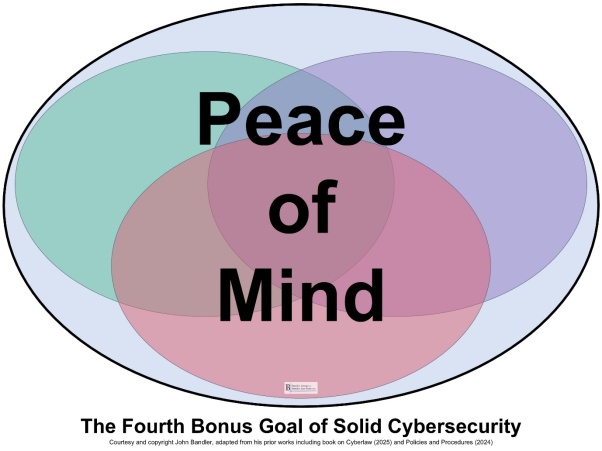
本栏目介绍三组三元组。首先是网络安全目标,它们将帮助您理解并优先考虑网络安全,以改进您的律师事务所或组织。这三个目标将帮助您实现一个重要的第四目标,甚至可以改善您的精神状态。
This column features a trio of triads. First are cybersecurity goals, which will help you understand and prioritize cybersecurity to improve your law firm or organization. These three goals will help you achieve an important fourth goal, which can even improve your mental state.
了解接下来的两个三元组有助于您与技术和网络安全提供商及专家智能地讨论网络安全原则,并更好地理解网络安全法律和框架。请考虑以下针对贵组织的三个网络安全目标:(1) 防御网络犯罪或其他严重失误,(2) 遵守法律要求,(3) 完成使命,包括通过提高效率和信息系统管理。
Knowing the next two triads helps you intelligently discuss cybersecurity principles with your technical and cybersecurity providers and experts, and to better understand cybersecurity laws and frameworks. Consider these three goals of cybersecurity for your organization: (1) Protect from cybercrime or other serious mishaps, (2) Comply with legal requirements, and (3) Fulfill the mission, including by improving efficiency and the management of information systems.
我们在之前的专栏中介绍了这些目标(参见《维护和改进贵公司或组织的网络安全计划》,《路透社法律新闻》,2026年2月17日),稍后将进一步讨论。
We introduced these goals in an earlier column (see, "Maintain and improve the cybersecurity program of your firm or organization", Reuters Legal News, Feb 17, 2026,) and will discuss further in a moment.
该文章中的韦恩图为每个目标绘制了一个气泡,有些区域重叠,有些区域独立。
The Venn diagram from that article showed a bubble for each goal with some areas overlapping and others distinct.
现在我们可以在此图基础上进行补充,并引入第四个目标——安心,它环绕着这三个目标。
Now we can add to that diagram and introduce the fourth goal, peace-of-mind, which encircles all three.
当组织诚实有效地努力实现这三个目标,同时尽其所能时,这将带来安心。这并不是绝对安全或成功的保证,但却是生活和商业所能提供的最大程度的确定性和保证。
When organizations work honestly and effectively to achieve the three goals, while doing their reasonable best, that provides peace-of-mind. This is not a guarantee of imperviousness or success, but as much assurance and certainty as life and business can provide.
相反,当组织忽视这三个目标,未能致力于其网络安全计划时,无法获得这种安慰。领导者会因重要行动未完成、损害风险增加而心怀忧虑,如同胃中有刺。
In contrast, when organizations ignore the three goals and neglect to work on their cybersecurity program, no such comfort can be achieved. Leaders are left with nagging worries in the pit of their stomach because important actions remain undone and the chances of damage are heightened.
如果他们成为网络犯罪的受害者,可能会被指控疏忽和马虎,且更难以反驳这一指控。让我们简要考察一下这三个目标各自包含的内容。
If they fall victim to cybercrime, they may be accused of being negligent and sloppy, and it will be harder to defend against that claim. Let's briefly consider what each of the three goals entails.
保护的目标是防止可能发生的不良事件,包括网络犯罪分子的攻击(数据泄露、勒索软件、基于电子邮件的欺诈和盗窃)以及系统中断。
The goal of protect puts focus on preventing the bad things that could happen, including attacks by cybercriminals (data breach, ransomware, email-based frauds and thefts) and also system outages.
保护侧重于传统的风险分析;思考可能发生的危害,然后决定如何应对——如果有必要的话。通常,这意味着采取措施防止这些事件首先发生,或减少可能造成的损害。
Protect is focused on traditional risk analysis; thinking about the harms that could occur, then deciding what to do about them — if anything. Often, this means taking steps to prevent them from happening in the first place, or reducing the damage that might result.
合规侧重于网络安全的法律和专业义务,每个组织都有相应的法律要求。
Comply focuses on the legal and professional duties of cybersecurity, and every organization has legal requirements there.
在最基本层面上,可以把它看作是简单的疏忽,以及组织应如何投入合理且勤勉的努力以实现合理的网络安全。
At the most basic level, think of simple negligence, and how organizations should expend reasonable and diligent efforts to achieve reasonable cybersecurity.
没有公司领导会说:“我们愿意采取疏忽和马虎的方式来处理网络安全。”面对外部人士的这种说法,他们会予以辩护和反驳,并试图展示事实来证明其网络安全措施是合理的。
No firm leader would ever say, "We are content to take the negligent and sloppy approach to cybersecurity." Faced with such a claim by an outsider, they would defend and contest it, and attempt to show facts to demonstrate their cybersecurity was reasonable.
不要等到发生网络犯罪或类似指控时才开始思考你的网络安全,现在就采取行动,以确保你以后能够抵御此类指控。这样做也能降低你 ever 受到此类指控的可能性。
Don't wait for a cybercrime or such a claim to start thinking about your cybersecurity, take the steps now to ensure you can defend against such a claim later. By doing so, you will also reduce the chance of ever being subjected to it.
律师在网络安全方面有特定的专业义务,涉及保护客户机密和资金。律师是网络犯罪的有利可图的目标,因为他们直接或间接参与了众多金融交易和付款。网络犯罪分子致力于入侵电子邮件账户并重定向资金转移,以窃取这些付款。
Attorneys have specific professional duties relating to cybersecurity and to protect client confidences and funds. Attorneys are lucrative cybercrime targets because they are involved directly and indirectly in a multitude of financial transactions and payments. Cybercriminals work to breach email accounts and redirect the transfers of funds to steal those payments.
所有州都对数据泄露通知施加法律要求,且许多州有网络安全要求。其他法律和法规可能适用,具体取决于行业。
All states impose legal requirements for data breach notification, and many states have cybersecurity requirements. Other laws and regulations may apply, depending on the sector.
总而言之,每位律师、律师事务所和组织都有与网络安全相关的法律要求,律师还承担着专业伦理责任。遵守这些规则能够提供保护并带来安心。
In sum, every attorney, law firm, and organization has legal requirements relating to cybersecurity, and attorneys have professional ethical duties. Compliance with those rules protects and gives peace of mind.
聚焦于使命目标,使我们能够审视当律师事务所、律师及其他人员正确管理其信息资产时,哪些事情可以顺利进行。他们可以高效地访问电子邮件、联系人和文件,从而将更多时间用于工作、生活和娱乐,而减少在IT系统上挣扎(或咒骂)的时间。
Focus upon the goal of mission allows us to examine all the things that can go right when law firms, lawyers, and others properly manage their information assets. They can efficiently access email, contacts, and documents, spending more time doing work, life, and pleasure, and less time struggling with (or cursing at) IT systems.
从许多方面来看,使命优先,因为没有任何组织仅仅存在是为了遵守规则,也不是仅仅为了防范网络犯罪。律师事务所的存在是为了服务客户(通常这也意味着带来收入),而每个组织都有其使命。
In many ways mission comes first because no organization exists just to comply with rules, nor just to protect from cybercrimes. Law firms exist to serve clients (often this means bringing in revenue too) and every organization has a mission.
这个“CIA”三原则是网络安全的基本原则,虽然不太直观,但值得了解,因为网络安全法律、框架和专业人士经常提到它。如果你之前从未听说过CIA三原则,那么现在当你再次阅读或听到它时,可以若有所思地点头。网络安全的三个目标是:
This "CIA" triad is a cybersecurity basic principle that is less intuitive but good to know since cybersecurity laws, frameworks, and professionals mention it. If you hadn't heard about the CIA triad before, now you can nod knowingly when you read or hear it next. The three objectives of cybersecurity are:
- 保密性 • 完整性 • 可用性。保密性意味着防止未授权用户访问系统或数据。密码、双因素认证以及数百种其他措施有助于保持我们的数据和系统保密和安全。当网络犯罪分子入侵律师事务所的电子邮件系统和文档时,保密性就被违反了。
•Confidentiality•Integrity, and•Availability. Confidentiality means keeping unauthorized users from accessing the systems or data. Passwords, two-factor authentication, and hundreds of other measures help keep our data and systems confidential and safe. When a cybercriminal breaks into a law firm's email systems and documents, confidentiality has been violated.
完整性意味着只有授权用户才能对系统进行更改。当网络犯罪分子利用律师的电子邮件系统发送一封误导银行转账的邮件时,完整性就被违反了。
Integrity means that only authorized users can make changes in your system. When a cybercriminal uses a lawyer's email systems to send an email which misdirects a bank wire, integrity has been violated.
可用性意味着授权用户在需要时能够访问他们的系统和数据。勒索软件和其他网络犯罪可能会导致数据和系统的可用性丧失。
Availability means that authorized users can access their systems and data when needed. Ransomware and other cybercrimes can remove the availability of data and systems.
为了实现这三个目标或三个目标,组织(和个人)可以应用适当的网络安全控制措施,这些措施也被称为网络安全防护。可以把它们看作是实现更广泛目标过程中更离散的任务或步骤。网络安全法律和框架也包含了这一概念。
In order to achieve the three objectives or three goals, organizations (and individuals) can apply appropriate cybersecurity controls, which are also known as cybersecurity safeguards. Think of these as more discrete tasks or steps along the way to a broader objective. Cybersecurity laws and frameworks incorporate this concept as well.
这些控制措施有不同的分类方式,但一种重要的方式是使用首字母缩写“PAT”,它代表•物理•行政•技术。
There are different ways to categorize these controls but an important way is with the initialism of "PAT," which stands for•Physical•Administrative, and•Technical.
物理控制措施以某种方式限制物理访问。锁门、控制访问的前台接待员、在公共场所保护好手机或钱包,都是物理控制措施的例子。
Physical controls restrict physical access in one way or another. Locking a door, a receptionist who controls access, securing your phone or purse while in a public place are all examples of physical controls.
行政控制措施包括规则、政策、程序和培训。您的组织应制定网络安全政策并开展网络安全培训。
Administrative controls include rules, policies, procedures, and training. Your organization should have a cybersecurity policy and conduct cybersecurity training.
技术控制措施是电子防护措施,例如防火墙、杀毒软件或监控软件。
Technical controls are electronic protections, such as a firewall, antivirus, or monitoring software.
这三种控制类型说明,网络安全不仅仅是关于技术方面,还包括许多其他方面,其中也包括律师专业范围内的内容。三个三元组。
These three control types illustrate that cybersecurity is not just about the technical aspects, but many others too, including those that are in the lawyer's wheelhouse. A trio of triads.
我们从较少人知但直观且简单的一个开始,以帮助我们理解为什么要进行网络安全以及可以实现什么。如果充分做到这些,我们就能获得第四个目标——安心,即知道我们在网络安全方面正尽我们合理且勤勉的最大努力。
We begin with the one that is less well known but is intuitive and simple to help us understand why we do cybersecurity and what we can achieve. Do these sufficiently and we get the fourth goal of peace-of-mind, knowing we are doing our reasonable, diligent best with cybersecurity.
另外两个是众所周知的,即使对普通观察者来说不太直观,也值得了解。网络安全专业人员对它们很熟悉,并且可以看到它们的模式被印在许多网络安全法律和最佳实践中。
Two are well-known and good to know, even though less intuitive to the casual observer. Cybersecurity professionals know them well and you will see their pattern imprinted upon many cybersecurity laws and best practices.
这些三元组并不能取代我们在之前文章中所讨论的构建和改进组织网络安全程序的更广泛过程。它们确实有助于持续改进和对您的项目的更深入理解。克服恐惧、不确定性和怀疑的倾向。
None of these triads replace the broader process of building and improving your organization's cybersecurity program, as we covered in prior articles. They do help with continual improvement and refined understanding of your program. Fight the tendency for fear, uncertainty and doubt.
请记住,随着您在组织网络安全方面每一步的改进,您将远离因任务和职责未完成而产生的烦恼,更接近于通过合理的网络安全甚至更好的防护所带来的安心。
Remember that for each step of improvement that you take with your organization's cybersecurity, you travel further away from the nagging worries of tasks and duties left undone, and closer towards your peace of mind with reasonable cybersecurity or better.