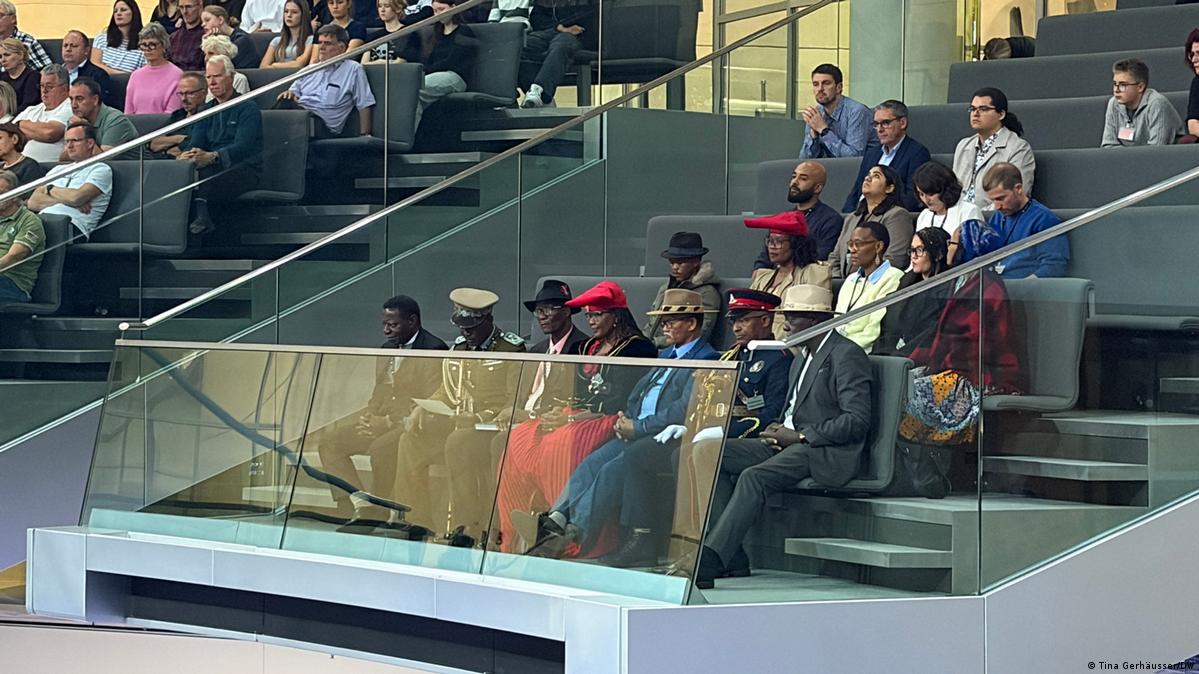
本周,高布·D·蒂莫蒂乌斯·弗雷德里克坐在德国联邦议院访客席的前排。他身着西装和帽子,从纳米比亚远道而来,亲眼目睹这场议会辩论。近120年来,他的家族一直在等待其祖先科尔尼利乌斯·弗雷德里克(有时拼作弗雷德里克斯)的遗骸归还。科尔尼利乌斯曾领导纳马人反抗德国殖民统治,并在德国第一个集中营鲨鱼岛上去世。
Gaob D. Timotheus Frederick was sitting in the front row of the visitors' gallery in the Bundestag this week. Wearing a suit and hat, he had traveled all the way from Namibia to see this parliamentary debate unfold. For almost 120 years, his family had been waiting for the return of human remains of their ancestor, Cornelius Frederick (sometimes spelled Fredericks), who had led the Nama resistance against German colonial rule and died on Shark Island in Germany's first concentration camp.
作为其曾祖父的代表,也是纳马传统领袖协会(NTLA)成员,高布·D·蒂莫蒂乌斯·弗雷德里克此行旨在要求德国作出“无条件道歉”。
In the name of his great-grandfather and as a member of the Nama Traditional Leaders Association (NTLA), Gaob D. Timotheus Frederick was there to demand an "unconditioned apology" from Germany.
坐在他旁边的是奥瓦赫雷罗传统权威机构的领袖,首席酋长穆津德·卡特朱阿。他身着制服,戴着白手套,手杖柄上雕刻着狮子头。在联邦议院辩论前,这位酋长表示:“我们呼吁联邦议院明确承认,对奥瓦赫雷罗人和纳马人所犯下的种族灭绝罪行。”许多人不禁要问,德国议会为何尚未这样做,或者德国政府为何至今未发表正式道歉。德国政府与纳米比亚有一份联合声明草案,其中德国政府承认“从今天的角度来看,[这]将被称为种族灭绝”。但目前尚无德纳和解协议。
Sitting next to him, in uniform and white gloves, with a carved lion on the handle of his walking stick, was the head of the Ovaherero Traditional Authority: Paramount Chief Mutjinde Katjiua. Speaking before the Bundestag debate, the chief said, "We call upon the Bundestag to recognize unequivocally the genocides committed against the Ovaherero and Nama peoples." Many people wonder why the German parliament hasn't already done this, or why the German government is yet to issue an official apology. There is a draft joint declaration with Namibia in which the German government acknowledges that "from today's perspective, [it] would be called genocide." But there is no German-Namibian reconciliation agreement.
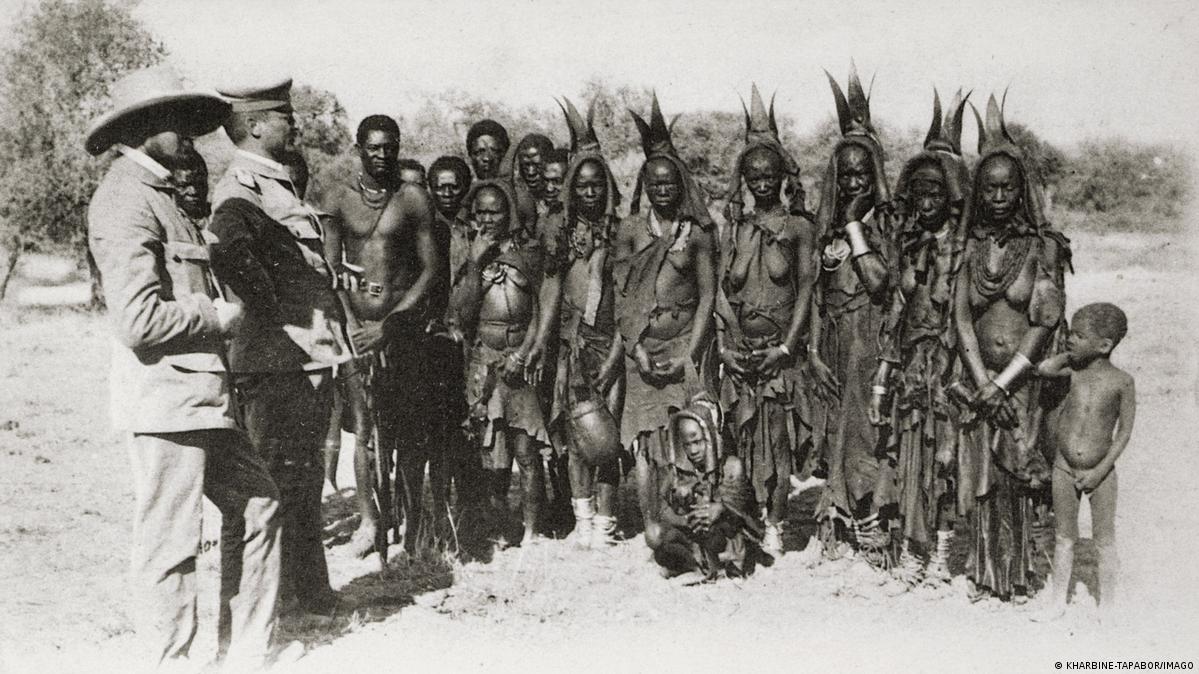
证据确凿:从1904年到1908年,德意志帝国对西南非洲的土著人民发动了灭绝战争,受害者包括奥瓦赫雷罗人(又称赫雷罗人)、纳马人、达马拉人和桑人。至少有10万人被杀害,同样数量的人流离失所。许多人被迫从事强制劳动和强制卖淫。当时进行的土地掠夺和没收,至今仍在影响他们的后代。
The evidence is overwhelming: From 1904 to 1908, the German Empire waged a war of extermination against the indigenous people of southwestern Africa, including the Ovaherero (also known as the Herero), the Nama, the Damara, and the San. At least 100,000 people were killed, and just as many displaced. Many were subjected to forced labor and forced prostitution. The land seizures and expropriation carried out at the time continue to affect their descendants today.
据汉堡大学历史学家于尔根·齐默尔介绍,德国联邦议院及政府缺乏正视这段历史的意愿。“虽然联邦议院曾通过关于亚美尼亚大屠杀、乌克兰大饥荒以及‘伊斯兰国’对雅兹迪人实施种族灭绝的决议,但却始终未承认德国对赫雷罗人和纳马人所犯下的种族灭绝罪行。”齐默尔对德国之声表示,只要具备相应的政治意愿,这一承认其实可以迅速实现。
According to historian Jürgen Zimmerer of Hamburg University, the Bundestag and German government lack the will to confront this episode in German history. "There are Bundestag resolutions on the Armenian genocide, one on the Holodomor [in Ukraine], and one on the genocide against the Yazidis [by the "Islamic State" in Iraq]. But there is no recognition of the genocide against the Herero and Nama by the German Bundestag." If there were any political will to do so, it could happen very quickly, Zimmerer told DW.
德国政府更倾向提供重建援助而非赔偿。德国左翼党联合赫雷罗人后裔代表起草了一份决议草案,呼吁官方正式承认历史罪行并给予赔偿,旨在实现“修复性正义”。纳米比亚最高酋长卡特吉乌阿则拒绝接受目前两国政府达成的协议,他指出:“发展援助无法替代全面的赔偿措施。”
German government prefers reconstruction to reparation The socialist Left Party instigated the debate in the parliament by drafting a resolution calling for full recognition and compensation in collaboration with representatives of the descendants. The goal: "Restorative justice." Paramount Chief Katjiua has rejected the existing agreement between the Namibian and German governments.
自2021年起,纳米比亚首都温得和克与德国政府一直在磋商一项联合声明,计划在未来30年内向纳米比亚提供11亿欧元(约合12.4亿美元)的重建资金。协议一旦签署,德国国家元首还将正式道歉。
"Development aid cannot substitute for comprehensive reparations," he said. Since 2021, Windhoek and Berlin have been negotiating a joint declaration that pledges €1.1 billion ($1.24 billion) in reconstruction aid to Namibia over 30 years. Once the agreement is signed, the German head of state is also set to issue a formal apology.
但外交部也警告称:“对赔偿的法律主张不能从种族灭绝的承认中得出。通过这些在全球范围内独一无二的谈判,纳米比亚和德国开创了新局面,并在面对殖民过去方面走在了前列。”政治学家安德烈亚斯·梅勒尔,安东·贝格斯特拉瑟研究所所长,持不同看法。他认为政府的计划听起来像是“支票簿外交。”根据齐默尔的说法,支付赔偿金的含义也涉及财务计算:“如果我们承认有义务向遇难者家属提供赔偿——考虑到二战期间数百万德国造成的受害者——这将毁掉我们。”
But the Foreign Ministry also warned: "Legal claims to compensation cannot be derived from the recognition of genocide. With these negotiations — which are unique worldwide — Namibia and Germany have broken new ground and are pioneers in confronting their colonial past." Political scientist Andreas Mehler, director of the Anton Bergstraesser Institute, sees it differently. He says the government's plan sounds like "checkbook diplomacy." According to Zimmerer, there is also a financial calculation to the implication of paying reparations: "If we were to recognize an obligation to provide reparations to the families of those killed — given the millions of victims of World War II, the victims of the Germans — it would ruin us."
德国议员在纳米比亚种族灭绝辩论中斥责极右翼AfD政府联盟协议中的承诺在现任德国政府的联盟协议中,即保守派基督教民主联盟(CDU)/基督教社会联盟(CSU)与中左翼社会民主党(SPD)之间的协议,在144页的协议文本中有四行概括了政府对与纳米比亚和解的承诺程度。
German MPs rebuke far-right AfD during Namibia genocide debate Promise in the government's coalition agreement In the coalition agreement of the current German government, between the conservative Christian Democratic Union (CDU)/Christian Social Union (CSU) and the center-left Social Democratic Party (SPD), there are four lines in the 144 pages that summarize the extent of the government's commitment to reconciliation with Namibia.
文本写道:“我们将加大力度,以应对殖民主义。”这包括在与原产国对话的框架下,开展跨国文物研究并推动文化财产的归还。特别关注的是建立一个庄严的纪念场所以及人类遗骸的遣返。
"We will intensify our efforts to come to terms with colonialism," the text reads. "This includes transnational research into artifacts and the restitution of cultural property in dialogue with the countries of origin. Particular attention will be paid to establishing a dignified memorial site and the repatriation of human remains."
但拜罗伊特大学的政治学家亚历山大·斯特罗-施特克尔伯格表示,与之前的德国中左翼政府相比,“这一问题的可见度已经下降。”
But political scientist Alexander Stroh-Steckelberg of Bayreuth University says that, compared to the efforts to address colonialism by the previous center-left German government, "the issue has lost visibility."
齐默尔则更为严厉:“我甚至不愿再称之为僵局。我认为,这届政府正在逆转人们对殖民主义不公所取得的提高认识方面的进展。”文化财产和人类遗骸的归还就奥瓦赫雷罗人的后裔而言,仍有大量工作待做:据信,德国仍藏有数万具人类遗骸。受害者的直系后裔——例如高奥布·D·提摩西乌斯·弗雷德里克——一直在世代为之努力,以愈合这些创伤。
Zimmerer is harsher: "I wouldn't even call it a stalemate anymore. I believe this government is rolling back the progress that has been made in terms of raising awareness of colonial injustices." Restitution of culture goods and human remains Much remains to be done, as far the descendants of the Ovaherero are concerned: Tens of thousands of human remains are believed to still be in Germany. Direct descendants of the victims — such as Gaob D. Timotheus Frederick — have been fighting to heal these wounds for generations.
今年3月,政府成立了一个由外交部牵头的协调委员会,该委员会表示,政府不愿“告诉原产国和社会应 reclaim 哪些文化文物和人类遗骸,应设定何种优先级,或应如何处理归还事宜。”
In March, the government established a coordination council, headed by the Foreign Ministry, which stated that the government did not wish to "dictate to the countries and societies of origin which cultural artifacts and human remains they should reclaim, what priorities they should set, or how restitutions should be handled."
外交部官员塞拉普·居勒尔,也是该协调委员会的主席,她为政府目前的行动进行辩护。她回顾了自己过去的官方访问——她已经访问过多哥,下周计划前往卢旺达和布隆迪——并声称:“无论我去哪里,我都因我们对过去的真诚和信任的态度而获得认可——同时也因我们对自由、安全和繁荣未来的坚定承诺而受到赞赏。”一个庄严的纪念场所?
Foreign Ministry official Serap Güler, chair of this coordination council, defends the government's actions so far. Recounting her own official trips — she has already been to Togo, and next week she plans to travel to Rwanda and Burundi — she claimed, "Everywhere I go, I receive recognition for our sincere and trusting approach to the past — as well as for our determined commitment to a future of freedom, security, and prosperity." A dignified place of remembrance?
齐默尔认为,德国“因以批判性视角审视自身历史并从错误中汲取教训而赢得了声誉”,他表示,这在国际舞台上代表着“巨大的文化资本”。但他担心,这一资本目前正被浪费。
Zimmerer argues that Germany "has earned a reputation as a country that takes a critical view of its own history and learns from its mistakes," which, he says, represents "enormous cultural capital" on the world stage. But he is concerned that this capital is currently being squandered.
殖民主义似乎并未被纳入政府的纪念政策。即使是文化国务部长沃尔夫拉姆·魏默尔最近提出在不来梅建立一个庄严纪念地的提议,齐默尔也认为这是试图“边缘化德国殖民罪行”。他指出,受害群体未被纳入其中,而德意志帝国的殖民首都——柏林和汉堡——也必须成为纪念场所。
Colonialism does not appear to be included in the government's memorial policy. Even in the recent proposal by Minister of State for Culture Wolfram Weimer to create a dignified memorial site in Bremen, Zimmerer detects an attempt to "marginalize German colonial crimes." He notes that victim groups have not been included and that the colonial capitals of the German Empire — Berlin and Hamburg — must also become sites of remembrance.
殖民军队中有95%从汉堡的巴肯港出发,其中包括下达消灭奥瓦赫雷罗和纳马人命令的指挥官洛塔尔·冯·特罗塔。齐默尔认为,在巴肯港建设新歌剧院而非纪念地,构成了“历史艺术洗白”的惊人案例。梅勒也希望关于纪念地的富有成效的辩论仍能进行,并且总体上,“更多地方将直面殖民历史”。
Ninety-five percent of the colonial troops set sail from Hamburg's Baakenhafen, including Commander Lothar von Trotha, who issued the orders to exterminate the Ovaherero and Nama. According to Zimmerer, the fact that a new opera house — rather than a memorial site — is being built at Baakenhafen constitutes a staggering case of "art-washing of history." Mehler also hopes that a productive debate on memorial sites will still take place and that, overall, "many more places will come to terms with colonial history."
与此同时,高奥布·D·提摩西乌斯·弗雷德里克继续呼吁共同努力来直面过去:“让我们为我们所代表的受影响社区提供机会,让他们有座位坐在谈判桌上,与他们讨论剩下的道路。”
Meanwhile, Gaob D. Timotheus Frederick continues to call for a collective effort to come to terms with the past: "Let us give opportunity to the affected communities that are being represented by us to have a seat on the table to discuss with them the rest of the way."