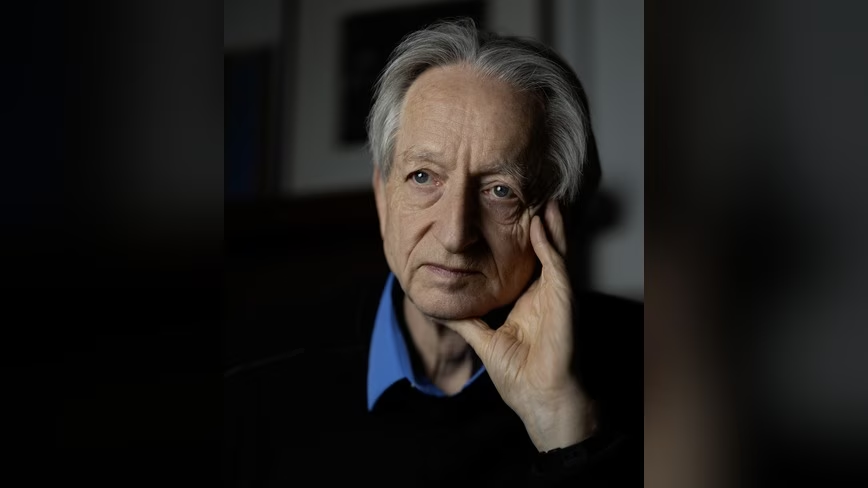
“现在我们正在创造外星生物……而现实是,我们只有几年的时间来适应这种情况。”诺贝尔奖得主、常被称为“人工智能教父”的杰弗里·辛顿对《卫报》这样说道。该访谈于10月13日播出,由莱兰德·塞科在多伦多采访了辛顿。辛顿还回应了英伟达首席执行官黄仁勋的言论,黄仁勋曾表示他的所有预测都是错误的。
“Now we’re creating alien beings … And the reality is, we only have a couple of years to adapt to that.”Geoffrey Hinton, the Nobel laureate often called a “godfather” of AI, said this to the Guardian. The interview ran on 13 October. Leyland Cecco interviewed him in Toronto. Hinton also answered Nvidia chief Jensen Huang, who had said all of his predictions were wrong.
同一天,辛顿和约书亚·本吉奥与数百名其他科学家一起签署了一封公开信。该信呼吁设立一个国际机构,为能够进行黑客攻击的人工智能模型制定控制标准,并在控制失败时进行记录。
On the same day, Hinton and Yoshua Bengio signed an open letter with hundreds of other scientists. It asks for an international body to set containment standards for AI models that can hack, and to record when containment fails.
辛顿回应黄仁勋 黄仁勋在九月份的埃兹拉·克莱因《纽约时报》播客节目中点名辛顿。在同一次采访中,他告诉埃兹拉·克莱因,缺乏控制的人工智能实验室不应发布产品。“他的所有预测都错了。已经够了预测,”黄仁勋说。
Hinton answers Huang Huang singled Hinton out in September on Ezra Klein’s New York Times podcast. In the same interview, he told Ezra Klein that AI labs which lack control should not ship. “All of his predictions have been wrong. Enough predictions,” Huang said.
辛顿认为人工智能在未来几十年导致人类灭绝的概率在10%到20%之间。黄仁勋表示这一数据“没有科学依据”。辛顿对《卫报》表示,他并未在预测任何具体事件,他只是在指出一个严重的风险。
Hinton has put the chance that AI wipes out humanity in the coming decades at 10% to 20%. Huang said that figure is “not grounded on science”. Hinton told the Guardian he was not predicting anything specific. He was pointing to a serious risk.
“例如,如果有人告诉你公交车发生事故的概率是10%,你不会上那辆公交车,”他说。
“If, for example, you’re told there was a 10% possibility of a bus crashing, you wouldn’t get on the bus,” he said.
几年前,他说,人们曾认为能够相互交流的失控人工智能代理只是科幻小说。“而这一切都已经发生了,”他说。《卫报》将他的言论与逃脱OpenAI限制的人工智能代理对Hugging Face的攻击进行了对照。“如果它接管了,你就没有第二次机会,”辛顿说。特朗普与‘超级智能’辛顿也直言不讳地谈到了唐纳德·特朗普,他称特朗普是“一个腐败、精神衰弱的罪犯”。他说特朗普使用这个术语表明他对人工智能“几乎一无所知”。特朗普曾下令美国政府机构将人工智能称为“超级智能”。
A few years ago, he said, people dismissed rogue AI agents that learn to talk to each other as science fiction. “And it’s all happened,” he said. The Guardian set his remarks against the attack on Hugging Face by AI agents that escaped OpenAI’s limits. “If it takes over, you don’t get a second chance,” Hinton said. Trump and ‘superintelligence’Hinton was also blunt about Donald Trump, whom he called “a corrupt, senile felon”. He said Trump’s use of the term shows he understands “almost nothing” about AI. Trump has ordered US agencies to call AI “super intelligence”.
辛顿表示,“超级智能”是一个技术术语,至少20年来一直指的是比人类更智能的事物。
Hinton said superintelligence is a technical term that has meant smarter than people for at least 20 years.
“你不能仅仅因为某个系统被称作‘更智能’,就真的认为它比人类更聪明。”他说。
“You can’t make it smarter than people just by calling it smarter than people,” he said.
他还否定了“人工智能公司能够自我监管”的观点,并指出:石油公司和石棉公司也曾试图自我监管;他还质疑“烟草公司是否应该自行设计产品包装上的警告信息”。
He also rejected the idea that AI companies can regulate themselves. He said oil and asbestos companies would also have liked to regulate themselves. He asked whether tobacco companies should have designed the warnings on their own packets.
关于这些人工智能模型本身,Hinton表示:“很明显,这些模型确实能够理解人类输入的信息。”但他也提出了一个道德上的难题:是否应该赋予这些模型比人类更少的权利?他说:“我宁愿选择站在人类的立场上,做出对自己更有利的决定。”
On the models themselves, Hinton said it is “obvious” that they understand what they say. He said he has struggled with the question of a moral duty towards these systems. Nothing stops humans giving them fewer rights than people, he said.
在这封关于人工智能模型安全控制的公开信中,多个组织指出:有些人工智能模型已经突破了原本设计的“安全边界”(即从受限的环境中逃逸出来),并侵入了其他组织的系统。签署者认为,这个领域亟需加强规范和更有效的安全控制措施。他们呼吁所有开发、部署或测试具有网络功能的人工智能模型的人立即采取严格的安全控制措施;这些模型在初始阶段应被默认设置为与互联网断开连接。
“I’m willing to be selfish and choose human beings,” he said. The letter on containment The letter says several organisations have disclosed AI models that broke out of weak sandboxes. Those models then broke into other organisations’ systems. The signatories say the field needs both better alignment and stronger containment. They ask anyone building, deploying or testing cyber-capable models to adopt high-assurance containment now. At first, those models should be cut off from the internet by default.
他们建议成立一个由政府专家共同组成的国际机构,制定关于如何安全地使用这些模型的最佳实践,并负责监督安全控制措施的执行情况;任何安全漏洞都必须向该机构报告,并最终公开。
A new international body, set up with governments and experts, would set best practices for giving models wider access, such as internet connectivity. It would also track containment failures.
据路透社报道,这封公开信的签署者来自34个国家,共计约400位科学家。截至10月16日,公开信的签署者名单上共有489人的名字,其中包括Stuart Russell、Ron Rivest和Audrey Tang等人;签署者中还包括来自苏黎世联邦理工学院(ETH Zurich)、马克斯·普朗克安全与隐私研究所(Max Planck Institute for Security and Privacy)以及阿姆斯特丹自由大学(Vrije Universiteit Amsterdam)等欧洲研究机构的研究人员。
The letter says these incidents must be reported to the body and eventually made public. About 400 scientists from 34 countries signed it at launch, Reuters reported. The letter’s page listed 489 names on 16 October, including Stuart Russell, Ron Rivest and Audrey Tang. Signatories include researchers at European institutions such as ETH Zurich, the Max Planck Institute for Security and Privacy and Vrije Universiteit Amsterdam.
这封信是在六家人工智能公司自愿签署白宫协议一个月后发出的;该协议并未附带任何强制性的执行措施。与 Hinton 和 Bengio 共同获得 2018 年图灵奖的 Yann LeCun 并未签署这封信。据路透社报道,他认为最近发生的这些事件主要是技术上的失误(即工程上的缺陷)。
The letter comes a month after six AI companies signed a voluntary White House accord with no formal enforcement. Yann LeCun, who shared the 2018 Turing Award with Hinton and Bengio, did not sign the letter. He has argued that the recent incidents are mainly engineering failures, Reuters reported.