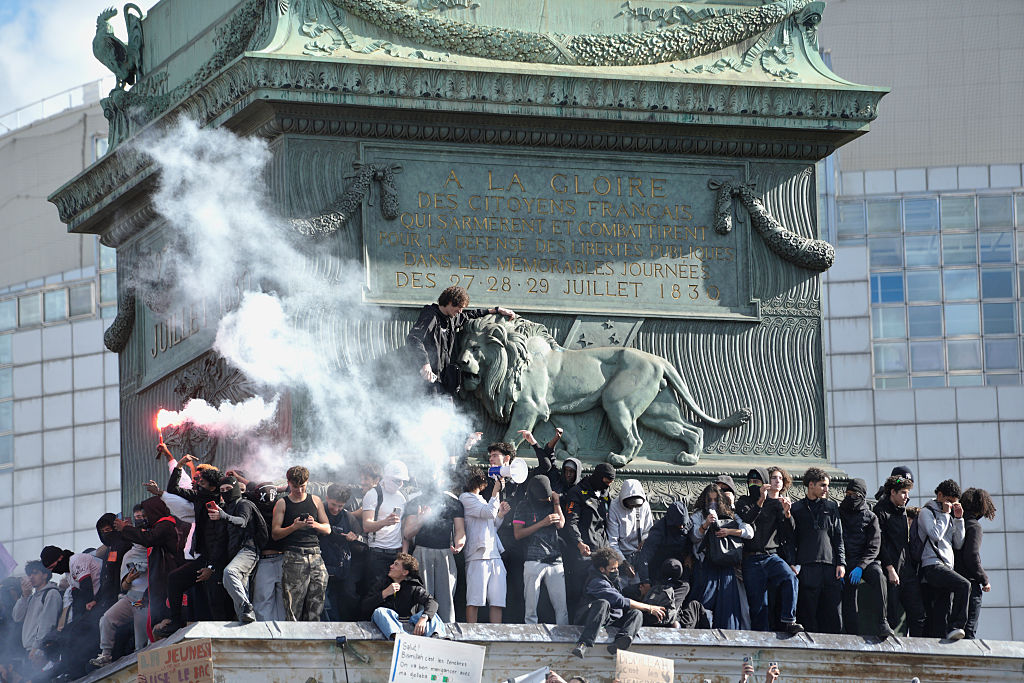
法国人喜欢走上街头,而且他们经常这样做。9月17日,位于巴黎郊区克雷泰伊的圣埃克苏佩里高中(该校条件较为艰苦)的学生因学校条件恶劣而爆发抗议:教师长期短缺,设施简陋,教育质量持续下降。两周后,抗议浪潮席卷法国各地。数百所学校和数十所大学的学生加入抗议行列,得到了家长、教师和工会的支持。在示威的第三周周二,法国全国有超过16万名学生和工会成员参加抗议。
The French like to take to the streets, and they do it often. On Sept. 17, students at Lycée Saint-Exupéry, a rather underprivileged high school in the Paris suburb of Créteil, erupted in protest over the abysmal conditions of their institution: chronic shortfall of teachers, poor facilities, long declining quality of education. Two weeks later, a wave of protests had swept cities across France. Students from hundreds of schools and scores of universities joined the protests, backed by their parents, teachers, and trade unions. More than 160,000 students and trade unionists protested across France on Tuesday in the third week of demonstrations.
法国从未在以高中生为主体的运动中见过如此多的暴力事件。截至目前,全国范围内的冲突已导致超过200名学生、85名学校工作人员和700名警察受伤。抗议者闯入学校,在某些情况下纵火焚烧被占领或被封锁的建筑。10月5日,法国北部城市朗斯的一名15岁男孩在抗议期间被警方投掷的手榴弹炸掉了一只手,这一事件凸显了当局自抗议一开始就采取的强硬镇压手段。超过6000名抗议者被捕,其中大多数是未成年人,后来均被无条件释放。
France has never seen so many violent incidents in a movement made up largely of high school students. So far, over 200 students, 85 school staff, and 700 police officers have been injured in clashes across the country. Protesters have broken into schools and, in some cases, set fire to occupied or blockaded buildings. On Oct. 5, a 15-year-old boy had his hand blown off by a police grenade during a protest in Lens in northern France, an incident that crystallized the heavy-handed response authorities had adopted from the earliest days of the protest. More than 6,000 protesters have been arrested, most of them minors, and later released without charge.
这些抗议爆发于马克龙主义近十年后——这种偏右、自上而下的治理方式正是法国总统埃马纽埃尔·马克龙所体现的。抗议也表达了更广泛的不满:人们对学校质量不均、大学录取决定以及潜在的种族歧视感到愤怒;年轻人觉得掌权者没有在倾听他们的声音,国家为他们提供的未来前景渺茫。
The protests erupted after nearly a decade of Macronisme, the right-of-center, top-down governing style that President Emmanuel Macron of France incarnates. And they express a broader discontent: anger over disparities in school quality, university admissions decisions, and latent racial discrimination, and a sense among young people that those in power were not listening to them, that the country offered them little hope for the future.
这些抗议活动也正值该国政治信任危机加剧之际。法国将于2027年4月举行总统选举,极右翼和极左翼在民意调查中领先。领跑者是玛丽娜·勒庞,她多年来一直致力于让其极右翼政党——国民联盟更具选举竞争力,同时围绕移民、犯罪以及谴责脱离群众的政治阶层展开竞选。她的政党已经是议会中最大的反对党,而总统选举后可能举行的临时立法选举可能会进一步巩固其地位。
The protests are also occurring amid a wider crisis of political confidence in the country. France is holding its presidential elections in April 2027, and the far-right and far-left are leading the opinion polls. The frontrunner is Marine Le Pen, who has worked for years to make her far-right party, the National Rally, more electable while campaigning on immigration, crime, and denunciation of an out-of-touch political class. Her party is already the largest opposition party in parliament, and a snap legislative election following the presidential vote could entrench it further.
另一方面是让-吕克·梅朗雄,法国不屈党的领袖,这是一个极左翼政党,他承诺将权力和资源大规模向工人阶级重新分配。两人都在很大程度上通过反对政治建制、许诺摆脱预算限制以及对欧盟的深刻敌意来赢得支持。
On the other side is Jean-Luc Mélenchon, the leader of France Unbowed, a far-left party, who is promising a sweeping redistribution of power and resources toward the working class. Both have built much of their appeal on opposition to the political establishment, the promise to wish away budget constraints, and deep hostility toward the European Union.
如果如今的法国感觉像是站在十字路口,那是因为它确实如此。战后时期由一批负责现代化经济、调节市场力量和定义公共利益的公务员所管理的大型福利和监管国家模式,已经走到了尽头。
If France today feels like it is at a crossroads, it is because it is. The postwar model of a large welfare and regulatory state, run by a class of civil servants charged with modernizing the economy, tempering market forces and defining the common good, has run its course.
战后法国的崩溃法国如今拥有欧洲最大的预算赤字之一:其公共债务占GDP的119.3%,预计明年将继续上升。人们对可能引发毁灭性金融危机的担忧日益加剧。借贷成本已升至如此高的程度,以至于法国的处境正被与希腊相提并论——希腊在2010年的债务危机曾威胁到欧元区的生存。而随着经济增长停滞不前,也没有简单的出路。
The collapse of postwar France France now runs one of Europe’s largest budget deficits: its public debt stands at 119.3 % of GDP and is expected to rise next year. Fears of a crippling financial crisis are growing. Borrowing costs have risen so high that France is drawing comparisons with Greece, whose debt crisis in 2010 threatened the survival of the Eurozone. And with economic growth stagnating, there is no easy way out.
如果说,法国反而需要增加开支:在国防方面,因为俄罗斯日益构成威胁,乌克兰战争持续,美国正在退出其作为欧洲安全保障者的传统角色;在新技术方面,因为这个曾经生产过协和式客机和高速列车的国家,如今在高科技创新和人工智能领域落后;在紧张的公共服务方面,从学校到医院再到被忽视的街区;以及在能够抵御气候变化日益加剧影响的基础设施方面。
If anything, France would need to spend more: on defense, as Russia grows more threatening, the war in Ukraine continues, and the United States retreats from its traditional role as Europe’s security guarantor; on new technologies, as the country that once produced Concorde and high-speed trains now trails in high-tech innovation and AI; on strained public services, from schools to hospitals to neglected neighborhoods; and on infrastructure capable of withstanding the growing effects of climate change.
历届法国政府都承诺扭转局面,为这些迫切需要的对国家未来的投资腾出空间,但没有一届成功。
Successive French governments have promised to turn things around and allow for these badly needed investments in the country’s future, but none has succeeded.
法国的困境更深层次。不平等一直是学生们的核心不满之一。他们并非没有道理。与许多国家一样,在全球化、工业衰退以及继承财富日益集中的共同作用下,过去二十年法国的经济不平等现象不断扩大。
The French malaise goes deeper. Inequality has been one of the students’ central grievances. They are not wrong. As in many countries, economic inequalities in France have widened over the past two decades under the combined effects of globalization, industrial decline, and the growing concentration of inherited wealth.
在《21世纪资本论》中,法国经济学家托马斯·皮凯蒂揭示了财富如何在代际间延续,并扩大了资本所有者与其他人之间的分歧。这种财富和权力的集中仍然深受怨恨:对许多人来说,马克龙总统的原罪仍然是他在进入政界前在罗斯柴尔德投资银行短暂工作过。
In Capital in the Twenty-First Century, the French economist Thomas Piketty showed how wealth perpetuates across generations and widens the divide between those who own capital and everyone else. This concentration of wealth and power remains deeply resented: for many, President Macron’s original sin is still his brief stint at the Rothschild investment bank before entering politics.
但最具伤害性的不平等形式在于别处:在于法国的国家精英主义神话,该神话认为人们的社会地位在很大程度上取决于他们的学业表现。在这个体系的顶端,是竞争激烈的大学校,这些精英高等教育机构培养了政治、文化和商业领域的领导人。
But the most injurious form of inequality lies elsewhere: in the power of France’s national meritocratic myth, which holds that people broadly owe their social position largely to their academic performance. At the top of that system sit the highly competitive grandes écoles, the elite institutions of higher education that have produced leaders in politics, culture, and business.
使神话如此腐蚀性的不是学业成就得不到回报,而是它仍然是一条相当可靠的通往更好工作、更高地位和权力职位的道路。在这种体制下,就读于经费不足的公立学校的学生,与就读于资源更充足学校且受教育程度更高的父母懂得如何驾驭体制的同龄人相比,面临着深刻的劣势。
What makes the myth so corrosive is not that academic achievement goes unrewarded but that it remains a pretty reliable path to better jobs, higher status, and positions of power. In such a system, students from underfunded public schools face a profound disadvantage compared with peers who attend better-resourced schools and whose better-educated parents know how to navigate the system.
私立学校提供了另一条途径,但仍被视为通过购买优势的方式而受到不待见。抗议活动在克雷泰伊爆出并不令人意外,克雷泰伊是巴黎郊外的一个工人阶级郊区,那里的学校长期资源不足。
Private schools offer another route, but are still frowned upon as a way to buy an advantage. It is no surprise that the protests broke out in Créteil, a working-class suburb just outside Paris, where schools are chronically under-resourced.
我们将永远拥有巴黎。种族和地理歧视也导致了法国的危机。法国法律禁止收集种族和民族统计数据;这一限制原则上是值得赞扬的,但在实践中存在问题。可见少数群体在法国的政治和商业精英中仍然严重代表不足。
We shall always have Paris Racial and geographic discrimination also contribute to the crisis of France. The collection of ethno-racial statistics is prohibited by French law; it is a laudable restriction in principle but problematic in practice. Visible minorities remain vastly underrepresented among France’s political and business elites.
许多根植于曾被法国殖民的非洲和亚洲国家的移民背景家庭, disproportionately 集中在城市郊外,那里的工作机会稀少,居民常常遭到其他地方雇主的歧视。
Families with immigrant backgrounds, many with roots in African and Asian countries once colonized by France, are disproportionately concentrated on urban peripheries, where jobs are scarce and residents often face discrimination from employers elsewhere.
伊斯兰恐惧症也在过去十年中,伴随中东冲突和一系列受伊斯兰主义启发的恐怖袭击而有所增长。曾经主要局限于极右翼的言论已经渗入主流右翼,在那里,“秩序”和“安全”的呼吁常常带有反移民的意味。马克龙对一些年轻人“去文明化”的引用,以及前内政部长布鲁诺·勒泰洛对2023年警察杀害一名青少年后所发生抗议活动中移民参与的描述为“向民族起源的倒退”,都体现了这种转变。
Islamophobia has also grown over the last decade amid conflicts in the Middle East and a string of Islamist-inspired terrorist attacks. Rhetoric once largely confined to the far right has seeped into the mainstream right, where calls for “order” and “security” often carry an anti-immigrant charge. Macron’s references to the “decivilization” of some young people and former Interior Minister Bruno Retailleau’s description of immigrants’ participation in the protests that followed the police killing of a teenager in 2023 as a “regression towards ethnic origins” are emblematic of that shift.
法国的精英主义理想还存在另一个问题:巴黎。政治权力、经济机遇、文化声望和精英教育在首都仍然高度集中。结果是巴黎与全国其他地区之间出现了深刻的经济鸿沟,而精英阶层基本生活在自己的圈子里,周围都是受教育背景、职业和假设相似的人,与全国大部分地区脱节。
There is another problem with France’s meritocratic ideal: Paris. Political power, economic opportunity, cultural prestige, and elite education remain extraordinarily concentrated in the capital. The result is a deep economic divide between Paris and the rest of the country and an elite that lives largely among its own, surrounded by people with similar educations, careers, and assumptions, and cut off from much of the country.
2018年至2019年的“黄背心”运动正是这种怨恨的早期社会爆发。学生们谴责巴黎与全国其他地区资源分配不均,或者抗议从克雷泰伊开始——该地离首都足够近,以至于这种对比不可能被忽视,这毫不奇怪。
The Yellow Vest revolt of 2018 to 2019 was an earlier social explosion of precisely that resentment. It is hardly surprising that students are denouncing the unequal distribution of resources between Paris and the rest of the country, or that the protests began in Créteil, close enough to the capital for the contrast to be impossible to miss.
当我母校——精英亨利四世中学(我曾是该校成绩较差的学生)的学生在运动第三周加入时,我注意到他们如何谨慎地描述自己是在“团结”地与较不 privilegié 的学校一起抗议。他们清楚自己站在鸿沟的哪一边。所谓精英主义,就这样了。
When students from my own former school, the elite Lycée Henri-IV, where I was a rather poor student, joined the movement in its third week, I noticed how carefully they described themselves as protesting “in solidarity” with less privileged schools. They knew which side of the divide they were on. So much for meritocracy.
冲向爱丽舍宫:法国的出路在哪里?随着明年四月总统选举的临近,各政党正争相在关系到这场未见减迹的抗议运动时定位自己。10月6日,超过25万人走上街头,当时高中生已被大学生、教师、家长和工会成员加入。更广泛的“全国抗议日”计划于10月17日举行。
Racing to the Elysée Where does this leave France? With the presidential elections approaching next April, political parties are scrambling to position themselves in relation to a protest movement that has shown no sign of abating. On Oct. 6, more than a quarter-million people took to the streets as high school students were joined by university students, teachers, parents and trade unions. An even wider “national day of protest” is planned for Oct. 17.
熟悉的和新的动态将共同塑造选举。熟悉的动态是第二轮投票的困境:选民可能再次被要求仅仅为了阻勒庞进入爱丽舍宫而支持来自对立政治阵营的候选人。勒庞在2017年和2022年均进入第二轮投票,并在民意调查中以较大优势领先。但这一次,落后于她的候选人阵营出现了异常分散的局面。两位曾在马克龙政府担任总理的人物——爱德华·菲利普和加布里埃尔·阿塔尔——正在参选;菲利普正与梅朗雄争夺第二位置,而阿塔尔则落后于他们两人。
Both familiar and new dynamics will shape the election. The familiar one is the runoff dilemma: voters may once again be asked to support a candidate from the opposite political camp simply to prevent Le Pen from reaching the Élysée. Le Pen made the runoff in both 2017 and 2022 and is leading the polls by a large margin. This time, however, the field trailing her is unusually fragmented. Two former prime ministers under Macron, Édouard Philippe and Gabriel Attal, are in the race; Philippe is competing with Mélenchon for second place, while Attal trails both.
无论结果如何,总统选举可能无法解决许多问题。一位来自极右翼民族联盟的总统可能发现自己在缺乏稳定议会多数或公众及公共部门广泛支持的情况下执政。而来自中间或左翼的妥协候选人可能面临与马克龙总统任期最后几年同样困扰的分裂议会——在此期间,法国两年内竟更换了五位总理。
Whatever the outcome, the presidential vote may resolve little. A president from the far-right National Rally could find herself governing without a stable parliamentary majority or broad support among the public or within the civil service. A compromise candidate from the center or left could face the same fractured parliament that has bedeviled the final years of Macron’s presidency, during which France has had five prime ministers in two years.
新的动态在于,法国正被全球如今司空见惯的力量深刻重塑:对民主的信任危机、保守派亿万富翁建立媒体帝国并资助意识形态运动、两极化的社交媒体、外国干涉选举,以及选民对超国家机构(包括欧盟)日益增长的不信任。
What is new is the extent to which France is being reshaped by forces now familiar across the globe: a crisis of confidence in democracy, conservative billionaires building media empires and financing ideological movements, polarizing social media, foreign interference in elections, and growing voter distrust of supranational institutions, including the European Union.
与美国不同,法国对竞选支出设有严格限制,但金钱仍在塑造更广泛的政治生态。自称为“保守自由主义者”的皮埃尔-爱德华·斯特兰(Pierre-Édouard Stérin)已投入大量资源,支持旨在推动右翼和极右翼议程的组织。实业家文森特·博洛雷(Vincent Bolloré)则打造了一个庞大的媒体帝国,其中包括CNews——一家类似福克斯新闻的频道,已成为民族主义右翼的重要平台。
France, unlike the United States, places strict limits on campaign spending, but money still shapes the broader political ecosystem. Pierre-Édouard Stérin, a self-described “conservative libertarian,” has committed substantial resources to organizations seeking to advance right-wing and far-right agendas. The industrialist Vincent Bolloré has assembled a vast media empire that includes CNews, a Fox News-style channel that has become an important platform for the nationalist right.
欧洲的命运 无论总统选举结果如何,欧洲的前景都令人担忧。勒庞或梅朗雄的总统任期将考验欧洲在乌克兰、与俄罗斯关系、移民、预算以及欧盟权威等各方面的凝聚力。但即使是更中间派的总统,也很可能缺乏足以有效执政的强大联盟,这与德国目前的情况相似,总理弗里德里希·默茨因不受欢迎以及极右翼选择党(AfD)支持率激增而举步维艰。
Europe on the line Whatever the result of the Presidential elections, the outlook is troubling for Europe. A Le Pen or Mélenchon presidency would test European cohesion on everything from Ukraine and relations with Russia to migration, budgets, and the authority of the European Union. But even a more centrist president would likely lack a strong enough coalition to govern effectively, mirroring the current situation in Germany, where Chancellor Friedrich Merz is hobbled by unpopularity and a surge in support for the far-right Alternative for Deutschland.
法国和德国共同占欧盟经济的约40%,两国首都的政治疲软将剥夺欧洲其传统引擎,而这恰恰是在一个特别危险的时刻。欧洲正面临三方面的日益加大的压力:中国的工业冲击,体现在每年约3600亿欧元的贸易逆差;俄罗斯对乌克兰的战争以及升级的“灰色战争”行动;以及美国对欧洲长期依赖的战后国际秩序的背离。与此同时,欧洲还必须为气候变化和人工智能带来的深刻变革做好准备。
With France and Germany together accounting for roughly 40% of the E.U. economy, political weakness in both capitals would deprive Europe of its traditional engine at a particularly dangerous moment. Europe faces mounting pressure on three fronts: China’s industrial onslaught, reflected in an annual trade deficit of roughly €360 billion; Russia’s war against Ukraine and escalating “gray warfare” operations; and the American turn against the postwar international order on which Europe has long depended. All this comes as Europe must also prepare for the profound disruptions of climate change and AI.
马里奥·德拉吉提出的解决方案——他在欧洲央行行长任期内因拯救欧元而闻名——呼吁加强单一市场的融合,增加投资和产业整合,并提升集体行动能力。法国对任何此类改革都不可或缺。一个政治上陷入瘫痪的法国将使欧洲在最不能承受弱点的时刻变得更加脆弱。即将到来的革命1789 年法国大革命的核心是废除贵族和神职人员的特权。
The remedy laid out by Mario Draghi, famed for rescuing the euro during his tenure as president of the European Central Bank, calls for greater integration of the single market, more investment and industrial consolidation, and a greater capacity to act collectively. France is indispensable to any such reforms. A politically paralyzed France would leave Europe weaker at precisely the moment when it can least afford it. The revolution still to come At the heart of the French Revolution of 1789 was the abolition of the privileges of the aristocracy and clergy.
近两个半世纪过去了,特权仍深植于法国社会之中,散布于近乎种姓般的各类社会和职业群体之中——从记者、律师、知识分子到公务员和工会成员,每个群体都拥有各自的优势、保障、养老安排以及对国家资源的诉求。其结果是一种政治格局:几乎所有人都认为改革刻不容缓,前提是由别人买单,而他们自身群体的优势则应保持不变。
Close to two and a half centuries later, privilege remains deeply embedded in French society, dispersed across an array of almost caste-like social and professional groups, from journalists, lawyers, and intellectuals to civil servants and unionized workers, each with its own advantages, protections, pension arrangements, and claims on state resources. The result is a politics in which almost everyone agrees that reform is urgently needed, provided someone else pays, and their own group’s advantages remain untouched.
如果这听起来像是对 1789 年的过度解读,不妨看看马克龙为其总统竞选所著书籍所选的标题:《革命》。他的总统任期或许并未完全具备革命性,但他许多更宏大的政策主张经得起时间的考验:世界各国政府已接受国家主导的产业政策、更大的战略自主权以及减少对化石燃料的依赖;与此同时,随着战后秩序的碎片化,对美国霸权的不信任以及呼吁深化欧洲一体化的声音日益获得关注。
If this sounds like an overreading of 1789, consider Macron’s own choice of title for the book that launched his presidential bid: Révolution. His presidency may not have proved entirely revolutionary, yet many of his larger prescriptions have aged well: governments around the world have embraced state-led industrial policy, greater strategic autonomy, and reduced dependence on fossil fuels, while distrust of American hegemony and calls for deeper European integration have gained traction as the postwar order fragments.
马克龙还可以声称自己在保存乃至在某些方面焕发法国传统优势方面作出了贡献:一个以核能为主的电力系统、在奢侈品、旅游和酒店业上的全球领导地位,以及一支深厚的科学人才储备——如今以米斯特拉尔为例,它是欧洲最接近世界级人工智能竞争者的力量。
Macron can also claim some credit for preserving, and in places renewing, France’s traditional strengths: an electricity system powered largely by nuclear energy, global leadership in luxury goods, tourism and hospitality, and a deep reservoir of scientific talent, now exemplified by Mistral, Europe’s closest thing to a world-class AI contender.
一位技艺高超的外交家、多边体制的坚定倡导者,马克龙在乌克兰、加沙、黎巴嫩、全球最贫困国家的债务减免以及气候变化问题上也坚持原则立场,同时在处理法国与美国、中国的关系时也十分谨慎。法国在联合国安理会的常任理事国地位赋予了其远超其经济规模的外交影响力,法国外交官们带着讽刺的意味将这种状态描述为“买经济舱票却坐头等舱”。
A skilled diplomat and relentless advocate for the multilateral system, Macron has also taken principled stands on Ukraine, Gaza, Lebanon, debt relief for the world’s poorest countries, and climate change, while carefully navigating France’s relationships with America and China. France’s permanent seat on the U.N. Security Council gives it diplomatic weight far beyond the country’s economic size, a status French diplomats ironically describe as “flying first class on an economy ticket.”
然而,这些主张和资产仍不足以扭转法国过去二十年来的衰落趋势。也许缺失的并非是政策层面的革命,而是政治文化的变革:一种新的社会契约,在这种契约中,为适应法国资源减少和相对实力削弱而必须付出的牺牲被接受,因为人们认为这些负担是公平分担的。如果这样的变革真的要到来,它更可能不是始于爱丽舍宫或各部委,而是始于街头要求被倾听的学生们。
Yet neither these prescriptions nor these assets have been enough to reverse France’s decline over the past two decades. Perhaps what has been missing is a revolution not so much in policy as in political culture: a new social compact in which the sacrifices required to adjust to France’s reduced means and diminished relative power are accepted because the burdens are seen to be shared fairly. If such a revolution is to come, it is less likely to start in the Élysée or the ministries than among the students in the streets demanding to be heard.