马斯克决定涉足美国移动电话服务业,这将面临与他此前所追求的任何事情都不同的挑战。这既不是一个新市场,也不是填补行业空白的补充性创新,比如他在电动汽车、低地球轨道宽带或在线支付系统方面的创新——这些正是他致富的领域。
Musk’s decision to wade into US mobile-phone services sets up a challenge distinct from anything he’s previously pursued. This is not a new market or an added twist that fills an industry gap such as his innovations with electric vehicles, broadband from low-earth orbit or an online payment system — the areas where Musk made his riches.
这是一场与三家根深蒂固的玩家展开的恶战。这可能会惠及无线用户,但对SpaceX的投资者而言,这将是昂贵且充满风险的,而且回报尚不确定。
This is a dogfight with three entrenched players. It’s likely to benefit wireless customers, but for SpaceX investors, it will be expensive and risky, and comes with an uncertain payoff.
美国2400亿美元的移动服务市场被AT&T公司、Verizon Communications公司和T-Mobile美国公司垄断,它们都在大力投入最新技术来升级网络,以保持彼此之间的领先地位,并满足消费者对带宽无止境的需求。要实现马斯克设想的混合网络——拥有1.5万颗专用于直连设备的卫星以及与传统运营商在城区竞争所需的地面基础设施——将需要耗资数十亿美元。SpaceX的卫星容量将扩大对农村和偏远地区的覆盖,但人们和利润并不集中在那些地区。
The $240 billion US mobile services market is dominated by AT&T Inc., Verizon Communications Inc. and T-Mobile US Inc., all of which spend heavily on the latest technology for their networks to keep ahead of each other and feed consumers’ insatiable demand for bandwidth. It will cost tens of billions of dollars to build Musk’s vision of a hybrid network with 15,000 satellites dedicated to direct-to-device and the ground infrastructure required to compete with the legacy carriers in urban areas. SpaceX’s satellite capacity will broaden coverage to rural and remote areas, but that isn’t where the people or the profits are concentrated.
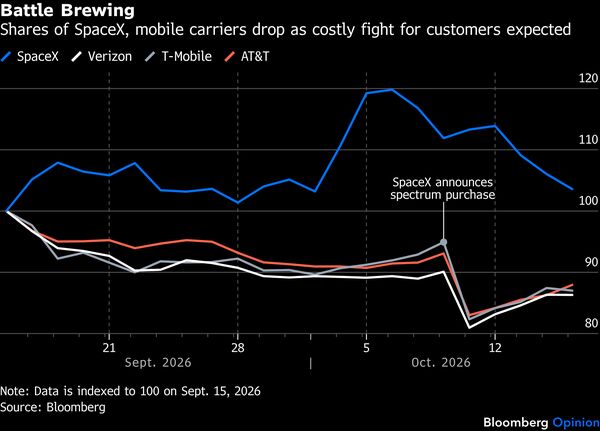
这留下了许多关于投资回报潜力以及建设网络所需时间的未解之问。可以肯定的是,AT&T、Verizon和T-Mobile会予以反击。就在马斯克明确表示有意成为第四大移动服务提供商的第二天,这三家公司的股价都出现了暴跌。本周,SpaceX的股价已下跌约9%。
This leaves many unanswered questions about the potential return on investment and the time it will take to build the network. You can bet AT&T, Verizon and T-Mobile will fight back. All three saw their stocks plummet the day after Musk made firm his intention to become a fourth large mobile service provider. SpaceX has dropped about 9% this week.
马斯克正计划进军一个用户增长几乎停滞的市场——因为绝大多数人早已拥有手机。投资者们迫切希望了解SpaceX的战略规划及潜在回报,尤其是考虑到该公司目前在其他项目上的投入已相当庞大。据悉,SpaceX正在建设太空数据中心网络,还计划斥资400亿美元采购英伟达公司的计算机芯片用于其人工智能项目xAI。马斯克的诸多宏伟愿景能否实现,关键在于能否实现“星舰”火箭的频繁发射,并成功回收该火箭的两个阶段,如此才能大幅降低发射成本。
Musk is planning a major push into a market with little or no subscriber growth because most people already have a phone. Investors need more details on SpaceX’s strategy and the potential returns, especially when the company is already spending so heavily on other projects. There are investments in a data-centers-in-space network and plans to reportedly borrow $40 billion to purchase Nvidia Corp. computer chips for its xAI venture. Many of Musk’s ambitions hinge on the ability to launch Starship frequently and to capture both stages of this massive rocket, which would drive down launch costs.
2025年,威瑞森、T-Mobile的运营利润率预计都将超过20%,AT&T的利润率也接近这一水平,这正是SpaceX的机遇所在。倘若SpaceX能以更低的价格提供同等质量的服务,便有望抢占部分市场份额。现有运营商也必然会展开价格竞争,这对消费者而言无疑是好事。不过,如果SpaceX的服务优势仅体现在信号覆盖范围更广、无信号盲区方面,那么其潜在客户就仅限于那些居住在或常去偏远地区的人群,这类目标市场规模十分有限。
The opportunity for SpaceX lies with operating margins of more than 20% for Verizon and T-Mobile in 2025 and close to that level for AT&T. If SpaceX is able to offer comparable service at a lower price, it could potentially carve out market share. The incumbents will compete on price, too — a win-win for consumers. If SpaceX’s offering is mostly around extended coverage and zero dead zones, then its appeal will be limited to those customers who live or venture to remote areas — a small addressable market.
上周,马斯克进一步推进相关计划:斥资购得了14兆赫兹的成对低频段频谱——这在无线通信领域属于极为珍贵的资源;同时还获得了美国联邦通信委员会的许可,得以建设直接面向终端设备的卫星网络。去年,SpaceX已同意以170亿美元的价格收购EchoStar公司持有的中频段频谱。即便完成了这两笔收购,SpaceX的频谱资源总量仍远不及三大传统运营商,未来还需通过公开拍卖或私下交易获取更多频谱资源。预计这些老牌运营商也会大量收购频谱,以保住自身优势地位。
Musk advanced his plans last week with the purchase of 14 megahertz of paired low-band spectrum — a premium asset in wireless telephony — and Federal Communications Commission approval to build out his direct-to-device satellite network. SpaceX last year agreed to pay $17 billion for EchoStar Corp.’s medium-band spectrum. Even with these two spectrum purchases, the company is far behind the big three’s capacity and will need to snap up more spectrum in auctions or private deals. Expect the legacy carriers to also gobble up more spectrum to keep their lead.
建设地面网络所需的投资很难确定。根据英国LS Telcom公司的频谱专家理查德·哈斯的说法,基站塔上的宏基站每个可能高达25万美元,具体取决于地区。SpaceX可能需要大约5万个这样的站点,这将使投资在上限达到120亿美元,他写道。这似乎并不过分。
The investment needed to build out a ground network is hard to nail down. The macro base stations at cell towers can cost as much as $250,000 each, depending on the area, according to Richard Haas, a spectrum expert with LS Telcom in the UK. SpaceX may need around 50,000 of these sites, which would put the investment at $12 billion at the upper range, he wrote. That doesn’t seem onerous.
建设网络成本的另一个迹象来自EchoStar旗下的Dish DBS Corp.的破产申请。该公司曾试图借助其在收购中获得的用户成为第四大运营商。EchoStar最终在频谱上花费了300亿美元,在无线基础设施上花费了160亿美元。该网络并未完全完成,且用户数量从2021年的850万降至破产申请时的6月份约740万。
Another indication of the cost of building out the network comes from the bankruptcy filing by Dish DBS Corp., a unit of EchoStar, which attempted to become a fourth carrier with the help of subscribers it picked up as part of an acquisition. EchoStar ended up spending $30 billion on spectrum and $16 billion on wireless infrastructure. The network wasn’t fully completed and subscribers had shrunk to about 7.4 million by the June bankruptcy filing from 8.5 million in 2021.
SpaceX是一家拥有独特卫星技术和雄厚资金的更具竞争力的对手,但它也正在赶超一个成熟的市场,在那里它必须从老牌玩家手中夺走客户。投资者知道,无论SpaceX是否能够站住脚跟,这场战斗首先会让所有人受到冲击。
SpaceX is a much more formidable competitor with unique satellite technology and deep pockets, but it is also playing catchup in a mature market, where it will have to wrestle customers away from legacy players. Investors know that whether SpaceX gains traction or not, the battle will first bruise everyone.