参议员亚当·希夫(D-加州)告诉我,他“一直在使用”聊天机器人,他对共和党在人工智能产业方面的做法持错误看法充满信心。希夫告诉我,美国人有理由认为人工智能革命是“正在发生在他们身上的事情,而不是为他们而发生的事情”。“人工智能产业领袖们自己已经明确表示需要联邦层面的保障措施。不可执行的自愿承诺和自我监管是行不通的。”
Sen. Adam Schiff (D-Calif.), who told me he uses chatbots “all the time,” appears confident Republicans are misplaying their hand with the AI industry. Americans have reason to feel that the AI revolution is “something that is happening to them, not for them,” Schiff told me. “AI industry leaders themselves have been clear about the need for federal safeguards. Unenforceable voluntary commitments and self-regulation will not cut it.”
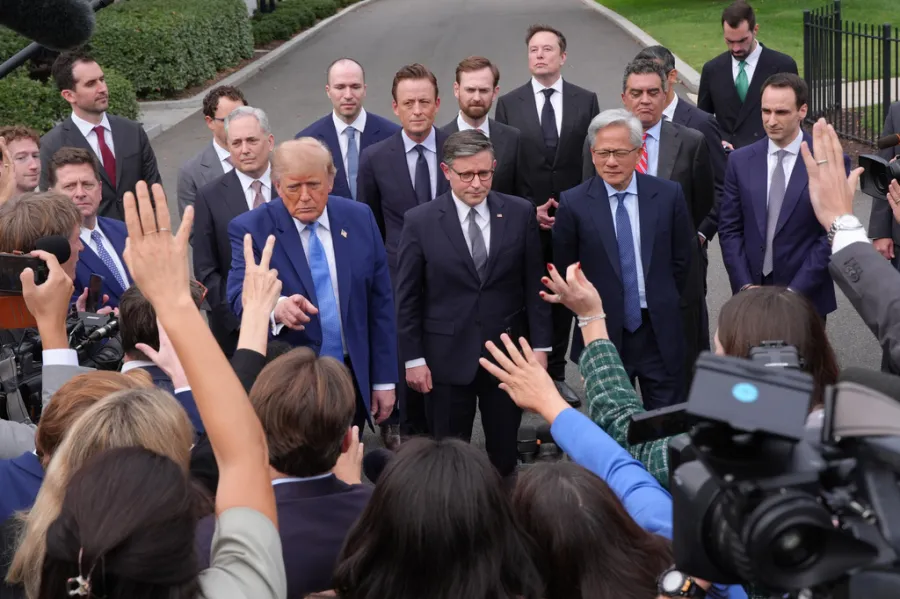
就在几周前的周二,白宫的氛围还要庆祝得多。特朗普总统在华盛顿特区接待了科技巨头们的“谁是谁”,以签署人工智能安全协议。(抱歉,超级智能或“SI”。)此次会议达成了特朗普所说的“在道德上具有约束力”的协议,旨在为共同利益发展人工智能。实现这一美好结果的手段是让行业“自我监管”和“自我调节”,而不是面临联邦监管。
A few Tuesdays earlier, the mood at the White House had been considerably more celebratory. President Trump hosted a who’s who of tech titans in Washington, D.C., for theg of an AI safety pact. (Sorry, superintelligence or “SI.”) The meeting yielded what Trump called a “morally binding” agreement to develop AI for the common good. The means of securing this happy outcome is to entrust the industry to “self-police” and “self-regulate” rather than face federal regulation.
美国人会接受行业自由改造他们生活的代价,作为国家伟大的代价吗?特朗普代表他的政党下了这个赌注——至少在修辞上,这与他在六月所说的话形成鲜明对比。被问及参议员伯尼·桑德斯(I-佛蒙特州)关于人工智能公有制的提议时,他表示,“这件事很有趣,几乎变成了与美国公众的伙伴关系,”据美联社报道。特朗普还告诉记者,他的选民和桑德斯的选民在经济问题上“不相上下”。
Will Americans accept an industry’s freedom to remake their lives as the price of national greatness? Trump has made that bet on his party’s behalf — a stark contrast, at least in rhetoric, to what he said back in June. Asked about Sen. Bernie Sanders’s (I-Vt.) proposal for public ownership of AI, he said, “There’s something very interesting about it, where it almost becomes a partnership with the American public,” according to the Associated Press. Trump also told reporters that his voters and Sanders’s “aren’t that far apart” on economics.
如果这一点属实,那么——正如一些共和党候选人现在正在发现的——美国霸权的承诺应该只能给那些怀疑自己在自身未来条款中几乎没有发言权的美国人带来有限的安慰。主张人工智能去监管化的倡导者在华盛顿找到了 receptive 受众,共和党候选人采纳了他们的口号:让大人工智能快速前进并打破事物,以免中国先一步到达。
If that much is true, then — as some Republican candidates are now discovering — the promise of American supremacy should offer limited comfort to Americans who suspect they’ll have little say in the terms of their own future. Advocates of AI deregulation have found a receptive audience in Washington, with Republican candidates adopting their refrain: let Big AI move fast and break things, lest China get there first.
“在[伯尼·]桑德斯的计划下,为期两年的暂停,这对我们国家的国家安全是危险的,因为两年后,中国将远远领先,我们将陷入巨大麻烦。”参议员达尔林·格雷厄姆(共和党-南卡罗来纳州)在几天前的参议院辩论中这样说,就在她的民主党对手称她为“数据中心达尔林”之后。虽然民主党在人工智能问题上显然存在分歧——包括希夫在内的许多人反对如此长期的暂停——但一些面临艰难选举的共和党人似乎对特朗普白宫的指令是否能帮助他们获胜持怀疑态度。
“Under [the] Bernie Sanders plan, a two-year moratorium, that is dangerous to the national security of our country because in two years, China is going to be so far ahead, we’re going to be in so much trouble,” said Sen. Darline Graham (R-S.C.) in a Senate debate days ago after her Democratic opponent dubbed her “Data Center Darline.”While Democrats are clearly fractured over AI — with many, including Schiff, opposed to such lengthy moratoriums — some Republicans facing tough elections seem to doubt the marching orders from Trump’s White House will help them win.
威斯康星州共和党州长候选人汤姆·蒂菲在一月份曾称数据中心为“令人兴奋的新技术”,并在国会投票加快其许可流程,他在初选后立即发布了一段詹姆斯·菲什巴克风格的“气场农场”剪辑视频,以此区别于他的对手“数据中心大卫·克劳利”。在密歇根州,共和党参议员候选人迈克·罗杰斯在亲民候选人阿卜杜勒·埃尔-赛义德成为民主党提名人两周后,支持对数据中心建设实施一年期的暂停,同时继续抨击埃尔-赛义德支持人工智能公有制的立场。
Tom Tiffany, the Republican nominee for governor in Wisconsin who in January called data centers an “exciting new technology” and voted in Congress to speed up their permitting, released a James Fishback-style “aura farming” edit video immediately following the primary election distinguishing himself from his opponent “Data Center David Crowley.”In Michigan, Republican Senate candidate Mike Rogers backed a yearlong moratorium on data center construction two weeks after affordability champion Abdul El-Sayed became the Democratic nominee, while continuing to attack El-Sayed’s support for public ownership of AI.
选民的担忧与特朗普想要绕过问题的方式之间存在明显不匹配:如果他能让美国人对“超级智能”足够兴奋,那么他的党的政治负担将自行解决。“那些回应公众情绪并就人工智能采取行动的共和党人,正是那些在竞争激烈选区的人。他们不是在接受上层的命令,”进步科技亿万富翁、前众议员亚历山德拉·奥卡西奥-科尔特斯(民主党-纽约州)幕僚长萨伊卡特·查克拉巴蒂告诉我。
There is a clear mismatch between voters’ misgivings on the ground and the way Trump wants to get around the problem: that if he can get Americans excited enough about “Super Intelligence,” his party’s political liabilities will take care of themselves. “These Republicans who are responding to public sentiment and doing something about AI are the ones in competitive races. They're not getting orders from the top,” Saikat Chakrabarti, the progressive tech multimillionaire and former Rep. Alexandria Ocasio-Cortez (D-N.Y.) chief of staff, told me.
民主党内部的争论可能仍会成为优势:一个仍在争论人工智能的政党,为其候选人——尤其是那些拒绝接受大型人工智能超级政治行动委员会资金的进步派——提供了空间,以阐述公众的担忧。
Democrats’ quarrels may yet prove an advantage: a party still arguing about AI gives its candidates, especially progressives who decline Big AI’s super PAC money, latitude to articulate the public’s misgivings.
“Schiff派认为我们应该制定一些法规;因为我们必须采取行动,”Chakrabarti继续说道。“我认为Bernie派对此最为重视,但他们目前的立场也是‘让我们先暂停,先弄清楚情况再说’。无论谁能够找到应对下一次危机的方案,谁就将在下次选举中赢得全国90%的选票。”Schiff本人告诉我,他正在起草一项立法提案,旨在“重新审视失业救济制度的运作方式”等相关问题,并计划在未来几个月内提交给相关部门审议。
“The Schiff wing is saying we should do some regulation because I know we have to say we have to do some regulation,” Chakrabarti continued. “I think the Bernie wing is taking it the most seriously, but even that answer right now is let’s pause and figure it out. Whoever has the answer to that next crisis is going to win 90 percent of the country in the next election.”Schiff, for his part, told me he is working on a legislative proposal “[rethinking] what unemployment compensation will look like” and other things, to be introduced in the coming months.
至少,目前各方已经在积极讨论这些问题了。德克萨斯州共和党参议员候选人Ken Paxton对此显得非常不满;詹姆斯·塔拉里科(James Talarico)的民主党竞选团队通过广告不断抨击他对于数据中心建设的立场模棱两可。Paxton私下里抱怨道:“我从未参加过一场让我对竞选活动毫无控制权的选举——所有决策似乎都来自华盛顿特区,我既无法决定宣传内容,也无法决定我们应该采取的行动。”
There is, at least, some figuring out underway. Texas Republican Senate candidate Ken Paxton, whom the Democratic campaign of James Talarico has shelled with ads about his ambiguous support for data centers, sounds less than delighted. “I’ve never been in a race where I felt less control over the campaign,” he lamented in private, “like, what issues are going to matter because it's all coming — you know — from DC. I don't control the message or what we're doing.”
与德克萨斯州共和党州长Greg Abbott一样,Paxton现在也支持加强对数据中心建设的监管措施(尽管他之前曾持较为支持的态度)。共和党人寄希望于:如果他们能在人工智能领域取得领先,美国人就会接受该行业为他们制定的任何政策。无论总统的意愿如何,他们越来越多地卷入了那些同样困扰民主党的争论之中。
Paxton, like Texas Republican Gov. Greg Abbott, now backs tighter restrictions on data center development after previously taking a more supportive stance. Republicans are making a considerable wager that the prospect of winning the AI arms race will reconcile Americans to whatever the industry has planned for them. They’re increasingly finding themselves drawn into the same arguments now consuming Democrats, whatever the president would prefer.
William Liang是一位居住在旧金山的作家,目前他正在为Connie Chan在加利福尼亚州第11选区的国会竞选活动提供志愿服务。
William Liang is a writer living in San Francisco. He volunteers for Connie Chan’s congressional campaign in California’s 11th District.