在本该相当平常的一天里,英国电网本周承受了意料之外的压力。当时并没有发生重大且意外的电厂故障或极端天气,苏格兰也产生了充足的风电。但网络瓶颈意味着,没有足够的电力能够输送到伦敦和英格兰东南部,这迫使电网运营商周一采取紧急行动,确保从法国获得额外的进口电力。
Britain’s power grid came under unexpected pressure this week on what should have been a fairly unremarkable day. There were no major, unexpected power-plant failures or extreme weather, and plenty of wind power was being generated in Scotland. But bottlenecks on the network meant not enough electricity could reach London and southeast England, forcing the grid operator to take emergency action on Monday to secure additional imports from France.
这一插曲暴露出英国电力系统长期存在的一个缺点:该国整体上可以拥有充足的电力,但仍然难以将其输送到需要的地方。英国在其电力需求集中的地方很远的地方建造了大部分不断增长的风电供应,而建设将这些电力输送至南方的基础设施的速度,却赶不上风电场增加的速度。
The episode exposed a longstanding shortcoming in Britain’s electricity system: The country can have enough power overall and still struggle to get it where it’s needed. The UK has built much of its growing supply of wind power far from where electricity demand is concentrated — and is adding wind farms faster than it can construct the infrastructure needed to carry that power south.
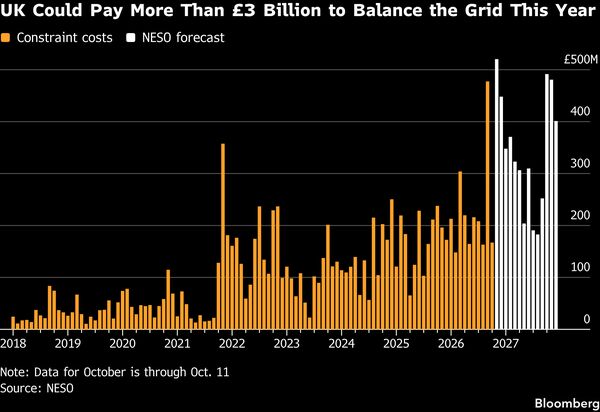
这种不匹配正变得越来越昂贵。LCP Delta汇编的数据显示,今年9月,英国支付了略超5亿英镑的创纪录资金来平衡其电力系统。这家能源咨询公司发现,10月的花费甚至可能更高,仅周一一天采取的行动就耗资3840万英镑(合5120万美元),创下单日最高纪录。
That mismatch is becoming increasingly expensive. In September, the UK paid a record of just over half a billion pounds to balance its power system, according to data compiled by LCP Delta. October could prove even more expensive, with actions taken on Tuesday alone costing £38.4 million ($51.2 million), a single-day record, the energy consultancy found.
LCP Delta电力交易主管希瓦姆·马尔霍特拉(Shivam Malhotra)表示:“这是我们会不断看到的情况。我们将看到这些纪录被打破。”不断攀升的账单反映了英国国家能源系统运营商(NESO)为平衡供需并保持网络顺利运行而支付的费用。这其中很大一部分涉及管理输电限制:花钱让苏格兰的风电场关闭,因为没有足够的输电能力将它们的电力向南输送,然后花更多的钱启动靠近各大城市的燃气电厂来替代。
“This is something we’ll keep seeing,” said Shivam Malhotra, head of power trading at LCP Delta. “We will see these records broken.”The mounting bill reflects what the National Energy System Operator pays to balance supply and demand and keep the network operating smoothly. A large part of that involves managing constraints: paying wind farms in Scotland to switch off because there isn’t enough transmission capacity to carry their power south, and then paying far more for gas plants closer to major cities to fire up instead.
FTI咨询公司高级董事总经理贾森·曼恩(Jason Mann)表示:“这些风电场的建设对这些电力将在哪里消耗的考虑非常有限。这些成本将在几代人的时间内被锁定。”本周提供了一个鲜明的例子。英国拥有充足的电力。它只是不在正确的地方。根据NESO的数据,预计将恢复服务的英格兰东南部输电基础设施仍然无法使用,这进一步限制了能够输送至该地区的电力量。就在NESO寻求来自法国的额外供应的同时,电力继续通过其他连接线从英格兰南部流向比利时、荷兰和法国。
“These wind farms were built with very limited consideration of where that electricity would be consumed,” said Jason Mann, senior managing director at FTI Consulting. “Those costs are locked in for generations.”This week offered a stark illustration of the problem. Britain had plenty of electricity. It just wasn’t in the right place. Transmission infrastructure in southeast England that had been expected to return to service remained unavailable, according to NESO, further limiting the amount of electricity that could be moved into the region. Even as NESO sought additional supplies from France, electricity continued flowing out of the south of England to Belgium, the Netherlands and France through other connections.
最终,买单的还是消费者。风大和晴朗的天气可以拉低批发电力价格,但当电网瓶颈迫使NESO支付其他地方的燃气电厂启动费用时,这些节省下来的资金就会被侵蚀。
Ultimately, consumers pick up the tab. Windy and sunny conditions can push wholesale power prices lower, but those savings can be eroded when grid bottlenecks force NESO to pay gas plants elsewhere to switch on.
英国能源大臣米亚塔·法恩布尔(Miatta Fahnbulleh)本周在议会听证会上承认了当前系统的缺点,称其“坦率地说不合时宜”。但她反驳了有关这些压力可能威胁供应的担忧,称她“100%确信今年冬天不会停电”。尽管如此,该系统的韧性还是受到了严格审查。英国天然气和电力市场办公室(Ofgem)正在调查NESO对6月极端酷热时期一起事件的处理情况,当时紧张的电力供应裕度给电网带来了压力。
The UK’s Energy Secretary Miatta Fahnbulleh acknowledged the shortcomings of the current system at a parliamentary hearing this week, calling it “candidly not fit for purpose.”But she pushed back against concerns that the strains could threaten supplies, saying she was “100% confident the lights won’t go out this winter.”The resilience of the system has nevertheless come under scrutiny. Ofgem is investigating NESO’s handling of an incident during a period of extreme heat in June, when tight power margins put the grid under pressure.
没有客户断电,但监管机构正在审查是否达到了相关安全标准。不太明确的是,潜在问题能以多快的速度得到解决。
No customers lost power, but the regulator is examining whether relevant security standards were met. What’s less clear is how quickly the underlying problems can be fixed.
FTI的曼恩表示,电网目前的许多问题可以追溯到2010年在时任能源大臣埃德·米利班德(Ed Miliband)任下实施的一项名为“连接与管理”的政策。该政策允许可再生能源项目在将电力输送给消费者所需的所有电网基础设施就位之前进行连接。
Many of the grid’s current issues can be traced to a policy implemented in 2010 under then-Energy Secretary Ed Miliband known as “connect and manage,” according to FTI’s Mann. The policy allowed renewable power projects to connect before all the grid infrastructure needed to carry their electricity to consumers was in place.
此后,两大政权的历届政府都补贴了风力发电的快速扩张,却没有配套建设相应的输电基础设施。其结果是,电力产生的地方与需要电力的地方之间存在越来越大的差距,而NESO弥合这一差距的工作也变得越来越昂贵。
Successive governments of both major political parties then subsidized a rapid expansion of wind generation without a comparable buildout of transmission infrastructure. The result is a growing gap between where electricity is generated and where it’s needed — and an increasingly costly job for NESO to bridge it.
甚至在该政策生效之前,这种风险就已经被发现了。2008年,时任能源监管机构Ofgem主席约翰·莫格(John Mogg)致信米利班德,警告称在输电能力扩大之前允许更多可再生能源在苏格兰并网,可能会导致限制成本“大幅增加”。当时,莫格警告称,限制成本已经达到约3亿英镑。根据NESO发布的数据和该电网运营商的预测,今年的数字可能是这一金额的10倍。
The risk was identified even before the policy took effect. In 2008, John Mogg, then chairman of energy regulator Ofgem, wrote to Miliband warning that allowing more renewable generation to connect in Scotland before transmission capacity was expanded could cause constraint costs to “increase significantly.”Back then, Mogg cautioned that the cost of constraints had reached some £300 million. This year the figure could be 10 times that amount, based on data published by NESO and the grid operator’s forecasts.
去年,米利班德在第二次担任能源大臣期间,拒绝转向分区电力市场,该市场本可以在英国各地引入不同的电力价格,以更好地反映电网的物理限制。例如,南方的较高价格可以向那里的燃气电厂发出启动信号,并在需要时通过互联线路向英国输送电力,而不是让NESO在市场结算后去纠正这些不平衡。
Last year, in a second stint as Energy Secretary, Miliband rejected a switch to a zonal electricity market, which would have introduced different power prices across Britain to better reflect the physical limitations of the grid. Higher prices in the south, for example, could signal gas plants there to switch on and electricity to flow into Britain through interconnectors when needed, rather than leaving NESO to correct for those imbalances after the market has settled.
随着这项改革被排除在外,英国转而严重依赖在南北之间建设更多的输电能力。
With that reform off the table, the UK is instead relying heavily on building more transmission capacity between the north and south.
丹麦海上风电公司沃斯集团(Orsted A/S)英国区主席本杰·赛克斯(Benj Sykes)表示:“英国的长期选择是在现代电网基础设施上进行一次性投资,还是年复一年地继续支付进口化石燃料的费用。”他说,政府和电网运营商需要加速电网升级、储能和其他形式的灵活性,既为了改善能源安全,也为了“解决消费者和企业面临的能源负担能力挑战”。
“The long-term choice for the UK is between investing once in modern grid infrastructure or continuing to pay for imported fossil fuels year after year,” said Benj Sykes, UK chair of Danish offshore wind company Orsted A/S. The government and transmission operators need to accelerate grid upgrades, storage and other forms of flexibility, he said, both to improve energy security and “tackle the energy affordability challenge” facing consumers and businesses.