
穆塔雷,津巴布韦 – 随着公共卫生服务资源紧张,津巴布韦的女性有时难以获取关于怀孕和分娩的可靠信息。一款本地开发的应用旨在回答她们的问题,并引导她们获得适当的护理,这体现了人工智能减轻超负荷卫生系统压力的潜力。
Mutare, Zimbabwe – With public health services stretched thin, women in Zimbabwe sometimes struggle to access reliable information about pregnancy and childbirth. A locally developed app aims to answer their questions and direct them to appropriate care, in an example of the potential of artificial intelligence to ease pressure on overloaded health systems.
今年早些时候,哈雷居民萨曼莎·穆龙格韦尼首次得知自己怀孕时,她感到害怕。
When Harare resident Samantha Murungweni found out she was pregnant for the first time earlier this year, she felt scared.
这位25岁的居住在格林代尔(首都的一个郊区)的女性,在当地诊所登记产前检查时,无法向助产士提出她所有的问题。津巴布韦的公共医疗机构常常排队很长。
The 25-year-old, who lives in Greendale, one of the capital's suburbs, wasn't able to ask midwives all the questions she had when she registered for antenatal care at her local clinic. Zimbabwe’s public healthcare facilities often have lengthy queues.
穆龙格韦尼向朋友和社交媒体寻求帮助——但她难以获得可靠的信息。
Murungweni sought help from friends and social media – but she struggled to get reliable information.
随后,一位朋友向她介绍了DawaMom,这是一款由人工智能驱动的聊天机器人,旨在提供与怀孕相关的信息。
Then a friend introduced her to DawaMom, an AI-powered chatbot designed to provide pregnancy-related information.
“我询问了哪些食物能让我们俩保持健康,”穆龙格韦尼在接受RFI采访时说,她是在第二孕期开始使用该服务的。
“I asked about food that would keep both of us healthy,” Murungweni, who started using the service in her second trimester, told RFI.
“我还询问了背痛、频繁排尿以及子宫内胎儿运动的问题。感觉就像在和一位真正的助产士交谈。”便捷访问:DawaMom由总部位于赞比亚的初创公司DawaHealth于2024年开发,为孕妇和母亲提供经过验证的医学信息,并通过WhatsApp将她们与持证健康工作者连接起来。
“I also asked about back pain, frequent urination and foetus movements in the uterus. It felt like I was talking to a real midwife.”Easy access Developed in 2024 by DawaHealth, a Zambia-based startup, DawaMom gives pregnant women and mothers validated medical information and connects them with licensed health workers via WhatsApp.
虽然使用聊天机器人是免费的,但用户需要为更高级的服务付费订阅,例如个性化监测或上门访视。
While accessing the chatbot is free, users must pay a subscription fee for more advanced services such as personalised monitoring or home visits.
DawaHealth的联合创始人兼首席执行官塔法兹瓦·卡利斯托·穆恩兹瓦表示,他们选择WhatsApp是因为南非洲数百万人已经在使用该平台与家人沟通,并直接从智能手机获取信息。
Tafadzwa Kalisto Munzwa, DawaHealth co-founder and chief executive officer, said they chose WhatsApp because millions of people across Southern Africa already use the platform to communicate with their families and access information directly from their smartphones.
“谷歌并非人人都能使用,因为互联网数据费用昂贵,但大多数人仍然保留着WhatsApp的数据套餐,”他对RFI说。开发者还希望使该服务比传统互联网搜索更可靠。
“Google is not accessible to everyone because internet data is expensive, but most people still keep a WhatsApp data bundle,” he told RFI. Developers also sought to make the service more reliable than a traditional internet search.
为确保医疗信息准确且符合当地背景,DawaMom 不会从互联网上的通用内容生成答案。相反,它使用一种称为检索增强生成(retrieval-augmented generation)的技术,仅基于经过验证的数据库提供响应。
To ensure medical information is accurate and relevant to the local context, DawaMom does not generate answers from general content on the internet. Instead, it uses a technique known as retrieval-augmented generation to provide responses based exclusively on a verified database.
穆恩兹瓦表示,团队从数十个医学来源编译了信息 — — 包括卫生部指南、世界卫生组织建议、医学院课程以及妇女健康方面的医院规程 — — 以建立权威知识库。
Munzwa said the team compiled information from dozens of medical sources – including Health Ministry guidelines, World Health Organization recommendations, medical school curricula and hospital protocols on women’s health – to create an authoritative knowledge base.
“超过25名卫生工作者将此内容翻译并验证为绍纳语、恩德贝莱语和通加语。DawaMom 给出的每一个答案都来源于此数据库,”他说。将服务适应津巴布韦的多语言环境也是建立信任的一部分。
“More than 25 health workers translated and validated this content into Shona, Ndebele and Tonga. Every answer DawaMom gives is drawn from this database,” he said. Adapting the service to Zimbabwe’s multilingual context was also part of establishing trust.
“今年我们还与来自津巴布韦各地的30多名女性合作,构建了英语-绍纳语代码切换数据集,”穆恩兹瓦说。“这使 DawaMom 能够理解人们实际的说话方式 — — 混合使用英语和绍纳语 — — 并以用户觉得自然易懂的绍纳语口音通过语音回复。”根据公司说法,DawaMom 迄今已支持超过20,000名用户。他们计划在2026年底前达到50,000名用户。
“This year we also worked with more than 30 women from across Zimbabwe to build an English-Shona code-switching dataset,” said Munzwa. “This lets DawaMom understand the way people actually speak, mixing English and Shona, and reply by voice in a Shona accent that users find natural and understandable.”According to the company, DawaMom has supported over 20,000 users to date. They are targeting 50,000 users by the end of 2026.
污名与姐妹情:一名肯尼亚妇女如何编织医疗革命 减轻卫生工作者压力 由于卫生部门资金不足以及熟练专业人员大规模出国,津巴布韦面临严重的卫生工作者短缺。
Stigma and sisterhood: how one Kenyan woman knitted a healthcare revolution Reducing pressure on health workers With a lack of funding in the health sector and mass migration of skilled professionals abroad, Zimbabwe faces severe shortages of health workers.
护士和医生工作负担沉重,尤其是在农村地区。根据世界卫生组织和卫生部的分析,2022年津巴布韦每10,000人仅有22名以上卫生工作者,低于世界卫生组织推荐的每10,000人45名的一半。
Nurses and doctors handle heavy workloads, especially in rural areas. Zimbabwe had just over 22 health workers per 10,000 people in 2022, less than half the World Health Organization’s recommended 45 per 10,000, according to an analysis by the WHO and Ministry of Health.
津巴布韦医疗分析与信息学网络(ZiMAIN)主席以利亚·达克瓦表示,该网络汇集了医疗专业人员、研究人员、数据科学家和技术专家,人工智能可以帮助减轻该国医护人员的压力——但前提是人工智能应用于支持他们,而非取代他们。
Elijah Dakwa, president of the Zimbabwe Medical Analytics and Informatics Network (ZiMAIN), which brings together medical professionals, researchers, data scientists and technology experts, says artificial intelligence can help ease the pressure on the country’s health workers – but only if it is used to support them rather than replace them.
“我们现有的临床医生可以专注于高风险病例,而不是被低急性就诊淹没,”他对法国国际广播电台(RFI)表示。
“Clinicians we have can focus on the high‑risk cases instead of being swamped by low‑acuity visits,” he told RFI.
达克瓦表示,构建强大的数字基础设施、改善连接性、使设备广泛可用以及提供培训,是医疗领域采用人工智能的关键。
Dakwa says building robust digital infrastructure, improving connectivity, making devices widely available and providing training are key to the adoption of AI in the health sector.
“当这些条件具备后,人工智能将成为力量倍增器:为医护人员提供更快速、更一致、更清晰的决策支持系统,并减少前往中央医院的不必要就诊,从而最终降低整个系统的拥堵和工作负荷。”背负肯尼亚农村医疗重担的女性识别高风险患者据达瓦健康公司(DawaHealth)的芒兹瓦表示,人工智能可以作为分诊过滤器,识别出需要紧急或面对面随访的女性,以及那些可以在家中无需就诊即可得到安抚的女性。
“When that is in place, AI acts as a force multiplier: faster, more consistent, clearer decision-support systems for health workers and fewer unnecessary trips to central hospitals, which ultimately reduces congestion and workload across the system.”The women carrying the burden of Kenya’s rural healthcare on their backs Identifying high-risk patients According to Munzwa of DawaHealth, AI can act as a triage filter, identifying women who need urgent or in-person follow-up and those who can be reassured at home without visiting a clinic.
“这意味着高风险患者不太可能被遗漏,并能优先接受随访,因此有限的人员和资源能产生更大影响,”他说。
“This means high-risk patients are less likely to be missed and are prioritised for follow-up, so limited staff and resources have more impact,” he said.
达瓦妈妈(DawaMom)将孕妇和母亲与持证医疗机构联系起来,并自动识别高风险女性,使公司能够对需要额外护理的人进行随访。
DawaMom connects pregnant women and mothers with licensed healthcare facilities and automatically identifies high-risk women, enabling the company to follow up with those who need additional care.
来自津巴布韦东部鲁萨佩的鲁滕多,曾使用聊天机器人了解妊娠早期的麻木和点滴出血情况。
Rutendo, from Rusape in eastern Zimbabwe, used the chatbot to learn about numbness and spotting in the first trimester of her pregnancy.
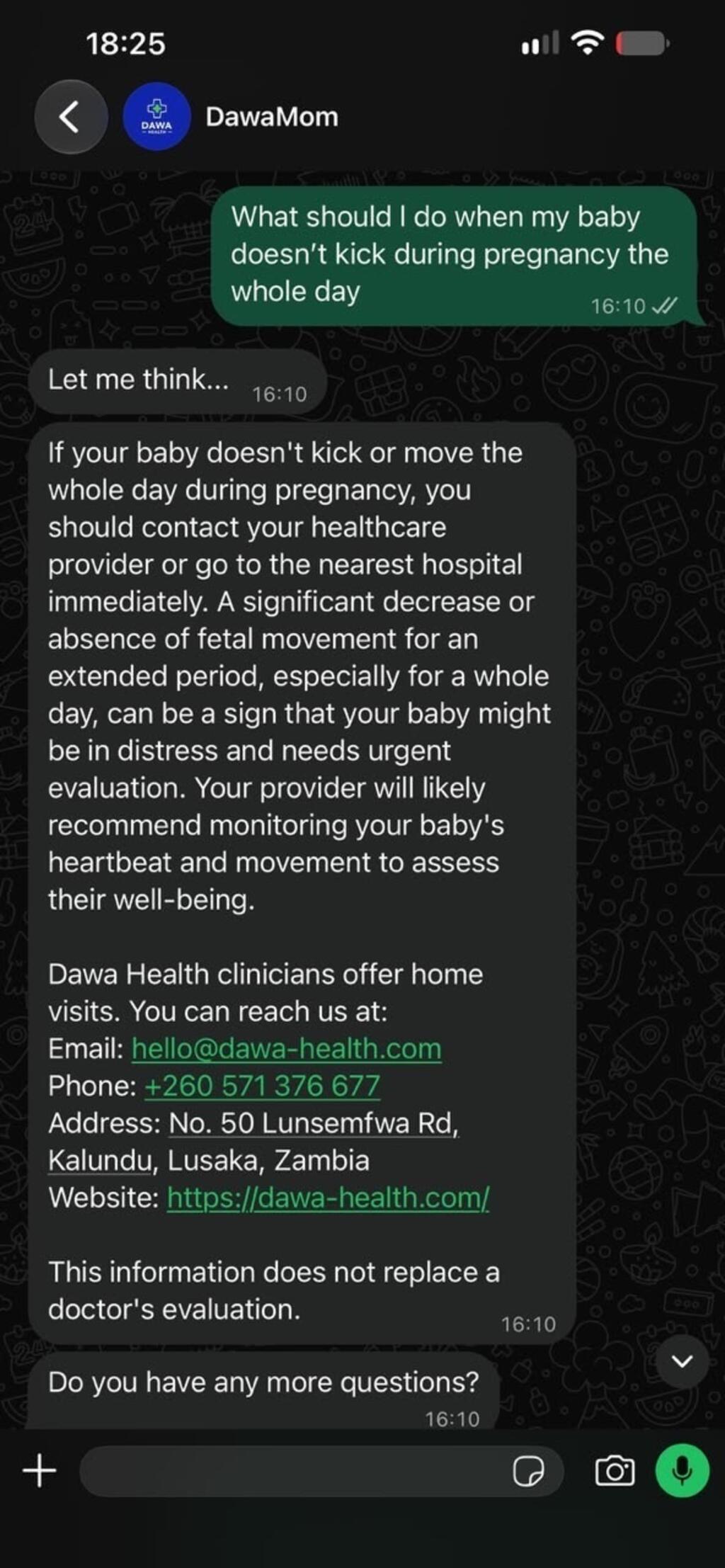
但有一天,当她处于妊娠晚期时,连续数天未感受到胎儿活动,这让她感到惊慌。非洲大陆在人工智能发展中有何作用鲁滕多咨询了达瓦妈妈,聊天机器人建议她立即就医。
But one day, when she was in her final trimester, she became alarmed after going for days without feeling any movement from the foetus. Why the African continent has a role to play in developing AI Rutendo consulted DawaMom and the chatbot advised her to see a doctor immediately.
她匆忙赶往附近的产检诊所,但为时已晚。胎儿因脐带缠绕而夭折,这种情况还可能给母亲带来危险的并发症。
She hurried to the nearby clinic where she was registered for antenatal care, but it was too late. The foetus had died after becoming tangled in the umbilical cord, a situation that can also lead to dangerous complications for the mother.
“这些信息救了我的命,”31岁的鲁滕多说道。她请求RFI不要使用她的全名。
“The information I got saved my life,” said 31-year-old Rutendo, who asked RFI not to use her full name.
上个月,穆伦格韦尼在哈拉雷顺利诞下一名女婴。DawaMom这款应用帮助她消除了对初为人母的担忧。
In Harare, Murungweni gave birth to a girl last month. DawaMom eased her fears about becoming a mother.
“它帮我顺利度过孕期,还让我获得了在其他地方难以获取的准确医疗信息,”她说道。
“It helped me navigate pregnancy and gave me access to accurate medical information I was struggling to get elsewhere,” she said.