赤道几内亚在比奥科岛成功实施了疟疾防控策略,通过二十年的数据收集、资金投入以及社区参与,显著减少了疟疾的发病率。
Equatorial Guinea has tackled malaria with a successful strategy on Bioko Island. The island has reduced malaria infections with two decades of data collection, funding and community engagement.
地点: 赤道几内亚马拉博(Monika Pronzuk Malabo)赤道几内亚拥有充沛的降雨、茂密的热带雨林以及高湿度环境,这些条件为蚊子的繁殖提供了理想的环境。几个世纪以来,由蚊子传播的疾病(尤其是疟疾)一直影响着这个中非国家的居民们的生活、工作乃至生死。
MONIKA PRONCZUK MALABO, Equatorial Guinea — With its torrential rains, tropical forests and omnipresent humidity, Equatorial Guinea provides the perfect conditions for mosquitoes to breed. For centuries, mosquito-borne diseases, in particular malaria, have dictated the fate of residents of this central African nation, impacting how they lived, worked and died.
然而,位于赤道几内亚大陆附近的比奥科岛却成功大幅降低了疟疾的发病率和死亡率。
But Bioko island, off mainland Equatorial Guinea, has managed to sharply reduce malaria infections and deaths.
比奥科岛的面积大约相当于美国罗德岛州的一半,该国采用了常见的防控措施:室内喷洒杀虫剂、使用蚊帐以及控制蚊子幼虫的数量。但其成功的关键在于一些难以复制的因素:长达二十年的细致数据收集、持续的资金支持,以及工作人员们不辞辛劳地挨家挨户开展工作以赢得居民的信任。
Bioko, roughly half the size of Rhode Island, has used familiar tools: indoor spraying, mosquito nets and keeping control of the larvae population. Its success, however, has depended on something less easily replicated: two decades of painstaking data collection, sustained funding and workers going door to door to win residents’ trust.
这个资源丰富的石油小国希望将这一防控策略推广到大陆地区,彻底根除疟疾。不过,要将比奥科岛的成功经验应用于整个国家面临诸多挑战——从漏洞百出的国际边境到庞大的国土面积都是亟待解决的问题。
the tiny, oil-rich country wants to bring that approach to its mainland and eliminate malaria altogether. But the expansion of Bioko’s strategy presents formidable challenges, from porous international borders to the sheer scale of the territory.
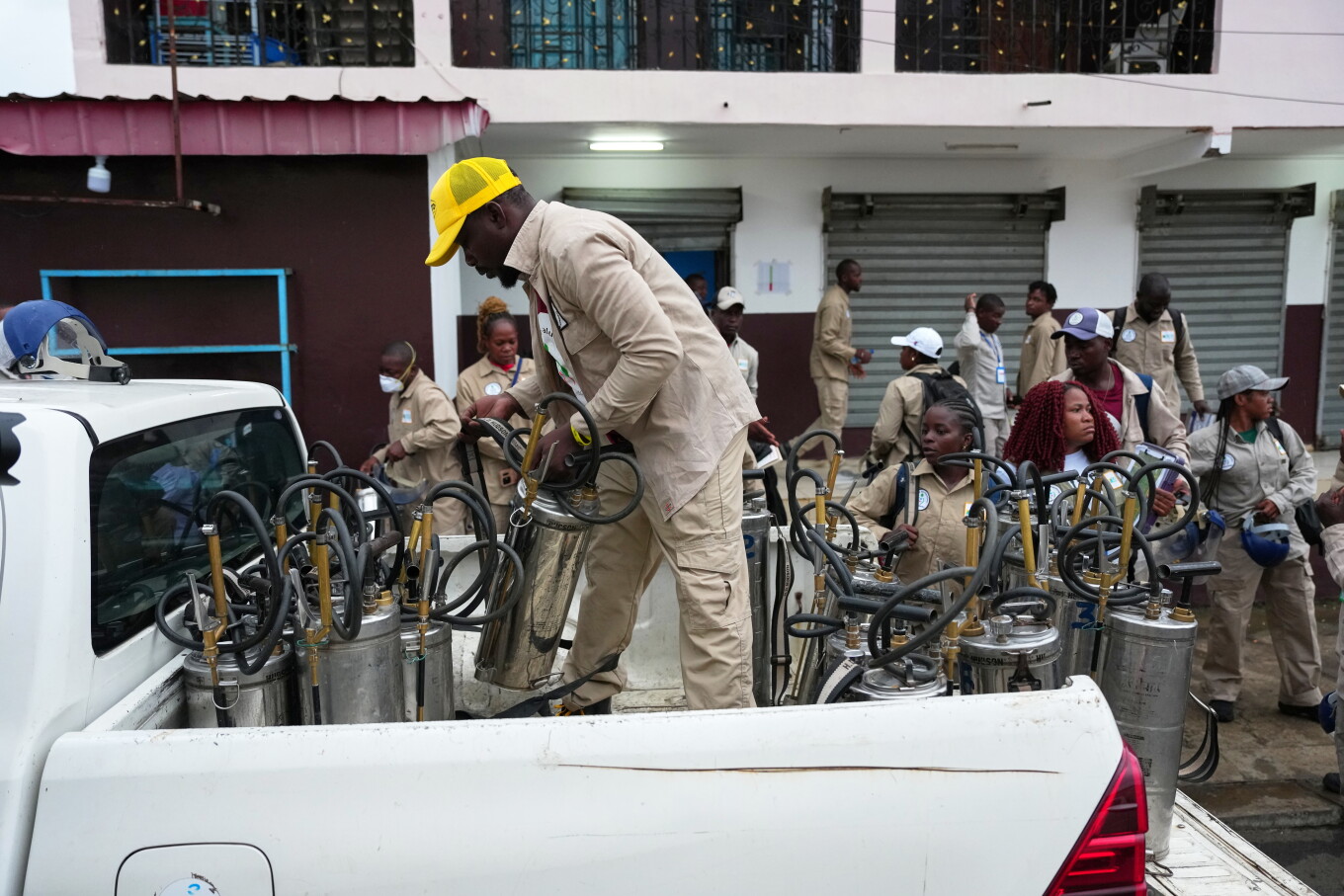
在比奥科岛最大的城市马拉博,一天清晨,一群工作人员手持杀虫剂喷雾器,在低矮的水泥建筑间穿梭;此时大雨正猛烈地敲打着铝制屋顶。
In Malabo, Bioko’s biggest city, a team of men and women equipped with insecticide sprayers squeezed between low-rise cement buildings on a recent morning, as heavy rain drummed on aluminum roofs.
“我们来到这里是为了向居民传达关键信息,让他们明白我们的防控措施的重要性,”项目协调员克里斯蒂娜·恩吉·奥托戈(Cristina Ngui Otogo)说道,“今天恐怕很难说服人们离开家门。”根据世界卫生组织(WHO)的最新数据,2024年共有约61万人死于疟疾,其中95%的病例和死亡病例发生在非洲国家。
“We are here to give key messages so that the population understands the importance of our interventions,” said Cristina Ngui Otogo, the program coordinator. “Today it will be hard to convince people to get out of their homes.”Around 610,000 people died in 2024 from malaria, according to the last available data from the WHO, and African countries accounted for 95% of global cases and deaths.
尽管技术取得进步,例如儿童新疫苗的研发,但非洲抗击疟疾的斗争已经停滞,使得该大陆实现2030年前消除疟疾的目标变得不太可能。撒哈拉以南非洲只有两个国家被世界卫生组织认证为无疟疾国家:毛里求斯和佛得角,它们都是岛国。
Despite technological advances, such as new vaccines for children, the fight against malaria in Africa has stalled, making it unlikely the continent can achieve its goal of eliminating the disease by 2030. Only two countries in sub-Saharan Africa have been certified malaria free by the World Health Organization: Mauritius and Cabo Verde, both of them island nations.
该项目利用数据实时调整策略。非洲疾控中心专家表示,生物科岛(Bioko)战略的一个关键要素是细致收集人口及其居住地的数据。
The program uses data to adjust strategy in real time Africa CDC experts say one key element of Bioko’s strategy is meticulously collecting data about the population and where people live.
“首先,我们进行了人口普查,统计了房屋数量和人口结构,”美国非营利组织MCD全球健康(MCD Global Health)的吉列尔莫·加西亚(Guillermo Garcia)说道,该组织负责实施该项目。“赤道几内亚没有地址系统,所以我们制定了自己的系统来绘制房屋数量和位置,并追踪喷洒情况和病例数量。”收集到的数据使得可以设计有针对性的干预措施,实时追踪其效果,并在必要时进行调整。数据团队会查看房屋喷洒的时间以及哪些房屋报告了疟疾病例,然后分析如何最好地预防未来感染。
“First, we did a population census with the number of houses and demographics,” said Guillermo Garcia of U.S. nonprofit MCD Global Health, which implements the program. “There is no address system in Equatorial Guinea, so we came up with our own system to map out how many houses there are and where, and track the spraying and the number of cases.”The collected data allows for designing targeted interventions, tracking their effectiveness in real time and adjusting them if needed. Data teams look at the timings of when houses were sprayed and which ones reported cases of malaria, then analyze how best to prevent future infections.
同理心是让人们参与的关键。该项目的核心在于那些耐心逐户走访、向居民解释策略并尝试说服他们同意对房屋进行喷洒的人。
Empathy is key for getting people on board The core of the program depends on people who patiently go from door to door and explain the strategy to residents, trying to convince them to get their houses sprayed.
本杰明·埃索诺(Benjamin Esono)是一名大学生,兼职担任喷洒人员,他说成功的关键在于同理心。
Benjamin Esono, a university student who works part time as a sprayer, said that the key to success was empathy.
“每个人都不同,所以你需要有不同的方式来与他们建立联系,”他说。
“Each person is different, so you need to have a different way of connecting with them,” he said.
“让居民参与进来并不总是容易的,”协调员恩圭·奥托戈(Ngui Otogo)说。有时需要多次尝试。
“It has not always been easy” to get residents on board, said Ngui Otogo, the coordinator. Sometimes it takes several attempts.
尽管时间尚早且雨势凶猛,但仍允许喷洒人员进入房屋的人之一是埃琳娜·恩通戈诺(Elena Ntongono),她是一名保安。她匆忙地换下睡衣后解释说,自己曾多次患上疟疾,最近一次是在七个月前。
One of those who let the sprayers in despite the early hour and pouring rain was Elena Ntongono, who works as a security guard. As she hastily changed from her pajamas, she explained that she had malaria multiple times, most recently seven months ago.
“病情并不严重,”她说,不过那次生病导致她不得不缺勤。对她来说,这是个大问题,因为她是家里的主要经济支柱。
“It wasn’t very serious,” she said, though it did mean she had to miss work. That was a big problem because she is the main breadwinner in the family.
她说,她希望以后能够避免再次生病,同时也希望保护自己11个月大的孙子——孙子至今还没有患过疟疾。“我很高兴自己的房子能够接受喷洒消毒处理,”她说。
She wants to avoid that in the future, she said, and to protect her 11-month-old grandson who has not had malaria yet. “I am very happy my house is being sprayed,” she said.
美国的石油公司为此项计划提供了资金支持。该岛上的防治工作主要由自20世纪90年代以来一直在当地运营的石油巨头们资助。过去二十年里,包括康菲公司(ConocoPhillips)和雪佛龙公司(Chevron Oil)在内的美国石油公司与政府共同投入了超过1.3亿美元用于抗击比奥科岛(Bioko Island)的疟疾问题。
US oil companies have helped fund the program Funding is a problem. The effort on the island has been funded by oil giants which have been operating there since the 1990s. Together with the government, U.S. oil companies, including ConocoPhillips and Chevron Oil, have invested over $130 million over the last two decades to fight malaria in Bioko.
直到今年早些时候,大陆地区才获得了类似的资金支持:政府和私营企业共同出资1.16亿美元,用于在大陆及安诺本岛(Annobon Island)推行疟疾防治计划。安诺本岛是一座偏远的火山岛,属于赤道几内亚最南端的省份。
No such funding had been available for the mainland until earlier this year, when a $116 million investment from the government and businesses was announced to roll out the program on the mainland and the Annobon island, a remote, volcanic island which forms the country’s southernmost province.
“政府和在赤道几内亚运营的美国石油公司之间存在共同的利益诉求,”该国卫生部长米托哈·奥多奥·阿耶卡巴(Mitoha Ondo’o Ayekaba)在接受美联社采访时说道。石油公司意识到,许多员工因疟疾而缺勤,从而影响了生产效率。
“There was a common shared interest” between the government and U.S. oil companies operating in Equatorial Guinea, Mitoha Ondo’o Ayekaba, the country’s health minister, told AP in an interview. Oil companies realized that many employees were off sick with malaria, decreasing their productivity.
得益于丰富的石油资源,赤道几内亚的人均收入在非洲国家中属于较高水平。然而,该国腐败现象严重,超过一半的人口生活在贫困之中。在那些人口密集的中产阶级社区中,许多房屋都是用劣质材料建造的,要么建得未完成,要么已经损坏。
Because of its oil wealth, Equatorial Guinea has one of Africa’s higher per-capita incomes. Yet the country is rife with corruption, and more than half its population lives in poverty. Many houses in the densely populated middle class neighborhood where the sprayers operated were built with low quality materials, left unfinished or damaged.
无人机和转基因蚊子或将成为新的工具。卫生部长阿耶卡巴在马拉博出生和长大。他说,他小时候每年都要因疟疾住院好几次,而他的两个5岁和7岁的孩子却从未感染过疟疾。
Drones and genetically modified mosquitoes could be added tools Ayekaba, the health minister, was born and raised in Malabo. He said that as a child, he was hospitalized several times a year because of malaria. His two children, ages 5 and 7, have never contracted it.
“在该计划启动之前,这种情况是难以想象的,”他说。当时,比奥科岛大约一半的人口感染了疟疾。如今,疟疾的流行率已降至7%左右,五岁以下儿童的死亡率下降了78%。
“That would have been unthinkable before the program was launched,” he said, when around half of Bioko Island’s population was infected with malaria. Now the prevalence of malaria is around 7%, and deaths of children under five decreased by 78%.
卫生部长表示,要吸引游客并确保经济增长,就必须在整个领土范围内根除疟疾。
Eliminating malaria from the whole territory is necessary to attract tourists and ensure economic growth, the health minister said.
该战略将结合在比奥科岛使用的方法,并推广世界卫生组织推荐用于儿童的R21疫苗。加西亚表示,计划是为全国30万名儿童接种疫苗,同时采用包括无人机在内的新监测方法,以发现蚊子的高发区域。
The strategy will combine the methods used in Bioko with the rollout of R21, a WHO-recommended vaccine for children. Garcia said the plan was to vaccinate 300,000 children across the country, as well as using new surveillance methods, including drones, to spot mosquito hot spots.
当局也在评估使用转基因蚊子,这些蚊子由加州大学戴维斯分校的专家正在研发。计划是释放这些不再携带疟疾寄生虫的转基因蚊子,以抑制野生蚊子的数量,或降低它们传播疾病的能力。
Authorities are also evaluating the use of genetically modified mosquitoes, which are being developed by experts at the University of California, Davis. The plan would be to release the genetically modified mosquitoes, which would no longer carry the malaria parasite, to either suppress the number of wild insects or reduce their capacity to transmit the disease.
疟疾是农村贫困地区的疾病。赤道几内亚当局坚称,比奥科岛的成功经验“完全可以在大陆地区复制”。
Malaria is a disease of rural poverty Authorities of Equatorial Guinea insisted that Bioko’s success was “perfectly replicable” in the mainland.
但专家指出,比奥科岛具有天然优势:它是一个岛屿,因此来自国外的传播风险较低。
But experts point out that Bioko has a natural advantage: It is an island, where the risk of transmission from abroad is reduced.
赤道几内亚大陆地区与两个疟疾流行率较高的国家——喀麦隆和加蓬接壤。蚊子和感染者可以在国家之间自由流动,因此取得成功需要各国政府之间复杂的协调。此外,大陆地区的面积也比比奥科岛大13倍。
Mainland Equatorial Guinea borders two countries with high malaria prevalence, Cameroon and Gabon. Mosquitoes and infected people can move freely from one country to another, and success requires complex coordination between the governments. The mainland’s surface is also 13 times bigger than Bioko.
“经验教训告诉我们,目前的这一揽子干预措施尚不足以在撒哈拉以南非洲大陆的任何国家消除疟疾,”约翰斯·霍普金斯大学医学院医学副教授、疟疾专家马修·M·伊波利托(Matthew M. Ippolito)博士说。
“What experience has taught us is that the current package of interventions is not sufficient for eliminating malaria from any country in continental sub-Saharan Africa,” said Dr. Matthew M. Ippolito, associate professor of medicine at the Johns Hopkins School of Medicine and a malaria specialist.
他说,消除疟疾需要根据当地的传播模式精确安排干预措施的时间,而这些模式即使在同一个国家内部也可能存在显著差异。即便如此,如果邻国的控制工作失败,感染也可能从邻国重新输入。但他表示,拯救生命“绝对的关键”是惠及民众的经济发展。
Eliminating malaria requires precisely timing interventions to local transmission patterns, which can vary significantly even within one country, he said. And even then, infections can be reintroduced from neighboring countries if their control efforts fail. But the “absolute key” in saving lives was economic development that trickles down to the population, he said.
“疟疾是一种农村贫困疾病,”他说,并补充称,如果没有“更好的住房、更好的医疗保健以及整体更佳的健康状况”,就无法与之对抗。关于非洲与发展的更多内容:
“Malaria is a disease of rural poverty,” he said, adding it cannot be fought without “better housing, better healthcare, and better health in general.”For more on Africa and development: