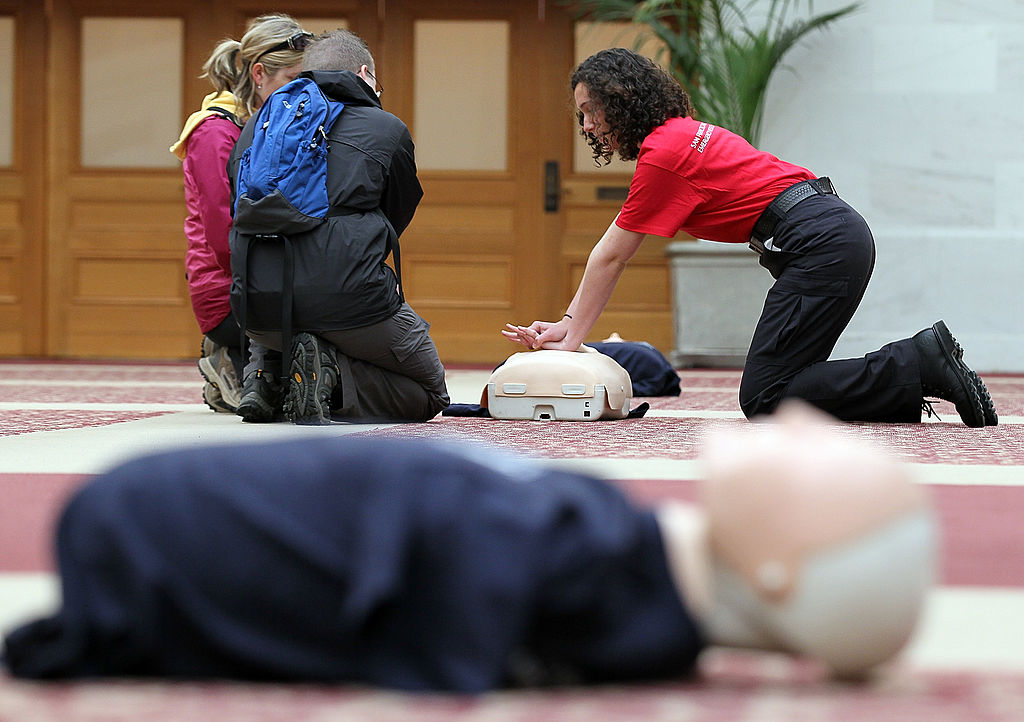
2024年,两名密歇根州高中生正坐在看台上观看师生篮球赛,当时他们的体育老师因心脏骤停倒地。他们刚在职业导向的护理技术中心学完心肺复苏术(CPR),于是立刻冲上前去施救,在急救人员到达前开始进行胸部按压并使用自动体外除颤器(AED)。
In 2024, two Michigan high school students were sitting in the bleachers during a student-teacher basketball game when their physical education teacher collapsed from cardiac arrest. They had both recently learned cardiopulmonary resuscitation (CPR) at a career-focused technical nursing center and rushed to help, beginning chest compressions and using an automated external defibrillator (AED) before emergency responders arrived.
正是由于他们的行动,老师得以存活,而他也是美国每年约35万例院外心脏骤停患者中的一员。大约十分之九的患者无法幸免。
Thanks to their actions, their teacher survived, and is one of approximately 350,000 Americans who experience an out-of-hospital cardiac arrest each year. Roughly nine out of ten will not survive.
我们常把生死之别描述为速度的问题:急救服务到达有多快,医院能否及时干预。但事实上,心脏骤停的结局往往取决于附近是否有人在最初几分钟内开始进行CPR——而这段时间通常不属于急救人员,而是属于最近的人:同学、老师、篮球赛上的陌生人,或是等车的人。每过一分钟未进行CPR,患者能否活到抵达医院的几率就会急剧下降。
We often describe the difference between life and death as a matter of speed: how quickly emergency services arrive and how fast a hospital can intervene. But in reality, cardiac arrest outcomes often depend on whether someone nearby begins CPR in the first few minutes, which rarely belong to emergency responders, but instead to whomever is standing closest: a classmate, teacher, stranger at a basketball game, or someone waiting for a train. Every minute without CPR sharply reduces the chances the patient will live long enough to reach a hospital.
学校在公共卫生中扮演着特殊角色。作为大多数美国人必经之地,也是他们可能唯一接受CPR培训的场所之一,高中课堂或许是培养下一代救生者的最佳机会。
Schools occupy a special role in public health. As a location most Americans pass through and one of the only places they may ever encounter CPR training, a high school classroom may be the best opportunity to prepare the next generation of lifesavers.
学校已经在演习火灾演练和封锁演练,以应对统计上罕见的危险。而心脏骤停则恰恰相反:发生频率远高,但演练远少。CPR技能可以在多年后派上用场——当心脏骤停发生在家中、健身房、机场或大学时,它可能挽救生命。要充分利用这一机遇,既需要有效教授CPR的资源,也需要确保每个学生都有机会学习的政策。
Schools already rehearse fire drills and lockdown drills for dangers that are statistically rare. Cardiac arrest is the reverse: far more common, and far less rehearsed. CPR skills can save lives years down the road when a cardiac arrest occurs at home, in a gym, at an airport, or at a university. Harnessing that opportunity requires both the resources to teach CPR effectively and the policies to ensure every student has the chance to learn it.
在欧洲,比利时、丹麦、法国、意大利、诺威、葡萄牙和英格兰通过国家要求或课程标准推行了学校心肺复苏(CPR)教育。丹麦提供了一个关于积极影响的明晰范例。从2001年至2010年,随着丹麦推出包括强制性学校心肺复苏教育在内的全国性复苏举措,旁观者实施心肺复苏的比率增加了一倍多,而院外心脏骤停后的30天生存率则增加了两倍多。
In Europe, Belgium, Denmark, France, Italy, Norway, Portugal, and England implemented school CPR education through national requirements or curriculum standards. Denmark offers a clear example of the positive impact. From 2001 to 2010, as Denmark introduced nationwide resuscitation initiatives including mandatory school CPR education, bystander CPR rates more than doubled, while 30-day survival after out-of-hospital cardiac arrest more than tripled.
一个核心挑战是如何大规模实施心肺复苏培训。“拯救儿童生命”(KIDS SAVE LIVES)国际倡议提供了一个切实可行的蓝图。该倡议得到了世界卫生组织的认可,呼吁从儿童时期开始,进行定期且适合年龄的基础生命支持教育。国际复苏联合委员会的研究表明,儿童从4岁起就可以学习生存链的早期环节,到12岁时能够进行有效的胸外按压,并能将技能传授给家庭成员及其他人。
A central challenge is how to implement CPR training at scale. The international KIDS SAVE LIVES initiative offers a practical blueprint. Endorsed by the World Health Organization, it calls for recurring, age-appropriate basic life support education beginning in childhood. Research from the International Liaison Committee on Resuscitation shows children can learn the early links in the chain of survival from the young age of 4, perform effective chest compressions by age 12, and pass skills to family members and others.
有些人可能会因为担心在实施心肺复苏时造成损伤(如肋骨骨折)而产生法律顾虑,从而在实施心肺复苏时犹豫不决,但每个州都有“好撒玛利亚人法”,为以善意提供紧急救助的人提供保护。一项对美国全美50个州从1989年至2019年的30年诉讼审查发现,没有任何一起案件表明提供心肺复苏的普通人因造成伤害而被追究责任。
Some may hesitate to perform CPR because of legal concerns over causing injury—like rib fractures—while administering CPR, but every state has Good Samaritan laws providing protections to people who render emergency aid in good faith. A 30-year review of U.S. litigation across all 50 states from 1989 to 2019 found no cases in which a layperson who provided CPR was held liable for causing harm.
美国在将心肺复苏教育引入学校方面也取得了显著进展。1984年,阿拉巴马州成为第一个要求将心肺复苏培训作为高中毕业条件的州。在此后的四十年里,各社区采取了不同的方法将心肺复苏引入课堂。在西弗吉尼亚州和阿拉斯加州,教育工作者工会正式支持了要求开展心肺复苏教育的立法,而在华盛顿州和伊利诺伊州,相关努力则是在为纪念因心脏骤停而丧生的学生而推进的。
The U.S. has also made significant progress in bringing CPR education into schools. In 1984, Alabama became the first state to require CPR instruction for high school graduation. Over the four decades since, communities have taken different approaches to bring CPR into the classroom. In West Virginia and Alaska, educators’ unions formally backed legislation requiring CPR education, while efforts in Washington and Illinois advanced in memory of students lost to cardiac arrest.
目前,43个州要求在高中毕业前接受某种形式的心肺复苏教育。加利福尼亚州、科罗拉多州、夏威夷州、马萨诸塞州、内布拉斯加州、新罕布什尔州和怀俄明州是仍未实施该要求的七个州。其中几个州已经采取措施扩大心肺复苏教育。马萨诸塞州投资42.5万美元,在公立学校扩大心肺复苏教育;科罗拉多州在全州卫生教育指南中包含实操心肺复苏和AED使用教学,但未要求学校必须提供此培训。
Today, 43 states require some form of CPR education before high school graduation. California, Colorado, Hawaii, Massachusetts, Nebraska, New Hampshire, and Wyoming are the seven that remain. Several are already taking steps to expand CPR education. Massachusetts invested $425,000 to expand CPR education in public schools, while Colorado includes hands-on CPR and AED instruction in its statewide health education guidelines but stops short of requiring schools to provide it.
加利福尼亚州州长加文·纽瑟姆最近签署了一项决议,指示教学质量委员会在该州下一版健康课程框架中加入高中心肺复苏内容。旧金山正采取更广泛的做法,急救人员和消防员正在努力为10万名社区成员提供心肺复苏培训。
California Gov. Gavin Newsom recently signed a resolution directing the Instructional Quality Commission to include high school CPR in the state’s next health curriculum framework. San Francisco is taking an even broader approach, with paramedics and firefighters working to train 100,000 community members in CPR.
有证据表明,法律可以转化为救命行动。一项对20个州近30万例院外心脏骤停的研究发现,在实施高中心肺复苏教育法律的州,旁观者进行心肺复苏的可能性比未实施该法律的州高12%。
There is evidence that laws can translate into lifesaving action. A study of nearly 300,000 out-of-hospital cardiac arrests across 20 states found that patients had 12% higher odds of receiving bystander CPR in states with high school CPR education laws than those without them.
其他救命教育努力也可以提供参考路径。在佐治亚州,劳拉和拉里·盖伊夫妇在儿子去世后推动通过了“韦斯利法”,要求公立学校储备纳洛酮等过量用药逆转药物。2025年,该州启动了一项由阿片类药物和解基金资助的倡议,向全州公立学校提供过量用药逆转套件,并为工作人员提供培训资源。在印第安纳州,应急响应专业人员帮助在学校推广了“止血培训”(Stop the Bleed),该州“校园安全保障补助金”项目现在为学校出血控制项目和套件提供资金支持。
Other lifesaving education efforts can also offer a roadmap. In Georgia, Wesley’s Law, championed by Laura and Larry Gay after their son’s death, required public schools to stock overdose-reversal medication such as naloxone. In 2025, the state launched an opioid-settlement-funded initiative to provide overdose-reversal kits to public schools statewide, along with training resources for staff. In Indiana, emergency-response professionals helped expand Stop the Bleed training in schools, and the state’s Secured School Safety Grant program now offers funding for school bleeding-control programs and kits.
这两个例子都表明,本地领军人物和现有资金来源如何能够帮助将一个挽救生命的构想变成现实。扩大美国医学会、美国红十字会、亚当计划和美国心脏协会等组织之间的合作,也有助于在全国范围内普及心肺复苏(CPR)教育。
Both examples demonstrate how local champions and an existing source of funding can help turn a lifesaving idea into reality. Broadening collaboration among organizations such as the American Medical Association, American Red Cross, Project ADAM, and American Heart Association can also help expand CPR education nationwide.
在布法罗比尔队安全卫达马尔·哈姆林于2023年在球场上遭遇心脏骤停后,他成为了两党《HEARTS法案》的主要倡导者,该法案于2024年在国会获得一致通过。美国总统拜登于同年晚些时候将该法案签署成为法律,支持学校扩大获取自动体外除颤器(AED)的途径、普及心肺复苏和自动体外除颤器教育,以及制定心脏紧急应对规划。
After Buffalo Bills safety Damar Hamlin suffered cardiac arrest on the field in 2023, he became a leading advocate for the bipartisan HEARTS Act, which Congress passed unanimously in 2024. President Biden signed it into law later that year, supporting schools in expanding access to AEDs, CPR and AED education, and cardiac emergency response planning.
心脏骤停不会等待急救人员的到来。密歇根州一名教师在打篮球时晕倒时挺身而出的学生们,展示了如果在需要之前教授心肺复苏技能,将会创造怎样的可能。总有一天,美国每一位高中毕业生都将具备挺身而出并成为救护者的能力。
Cardiac arrest does not wait for emergency responders. The students who stepped forward when their teacher collapsed playing basketball in Michigan illustrate what becomes possible when CPR skills are taught before they are needed. Someday, every high school student in the U.S. could graduate prepared to step up and become a lifesaver.