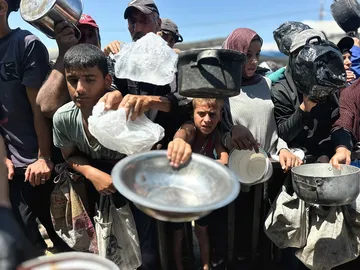
暂时远离逐分钟的新闻周期,来思考一下联合国安理会五个常任理事国中的两个所造成的后果:俄罗斯和美国因对乌克兰和伊朗发动非法战争,在逆转整整一代人在抗击饥饿方面的进展上,承担了很大责任。
Step away from the minute-by-minute news cycle for a moment and consider what two of the five permanent members of the United Nations Security Council have wreaked: Russia and the United States, with their illegal wars against Ukraine and Iran, share much of the blame for reversing a whole generation’s progress in the fight against hunger.
据上周刚刚发布、就在世界粮食日之前的新版《全球饥饿指数》显示,营养不良、儿童发育迟缓和儿童消瘦——这些都是相对饥饿的症状——的综合危害已经加剧,终结了此前二十年来的改善趋势。
According to the new Global Hunger Index, released last week just before World Food Day, the combined scourges of undernourishment, child stunting and child wasting — all symptoms of relative starvation — have become worse, halting a two-decade trend of improvement.
今年的指数数据反映了2021年至2025年期间122个国家的饥饿状况。但正如报告专家所明确指出的,美国总统唐纳德·特朗普于2026年发动的对伊朗战争将加剧这种恶化,除了2025年估计有6.45亿人处于“营养不良”状态之外,还将导致未来几年有数千万甚至数亿人陷入饥饿。
The numbers in this year’s index reflect hunger conditions in 122 countries during the years 2021-2025. But as the report’s experts make clear, the war that US President Donald Trump launched against Iran in 2026 will exacerbate the deterioration, condemning tens or hundreds of millions to hunger in the years to come, in addition to the estimated 645 million who were “undernourished” in 2025.
当然,在这些“多重危机”的时代,饥饿的蔓延有诸多原因,既包括人类无法控制的因素,如厄尔尼诺等天气模式,也包括人类不利地介入的情况,如气候变化。
The spread of hunger of course has many causes in these times of “polycrisis,” ranging from factors beyond human control, including weather patterns such as El Nino, to disruptions in which we humans had an unhelpful hand, such as climate change.
然而,对这些问题而言,至关重要的补充是战争的增加。负责收集此类统计数据的乌普萨拉冲突数据项目统计显示,2025年发生了65起国家层面的武装冲突,这是自二战以来的最高数字。
The crucial addition to those problems, though, is the increase in wars. The Uppsala Conflict Data Program, which collects such statistics, counted 65 state-based armed conflicts in 2025, the most since World War II.
战争以多种方式致命,其中一种就是阻止食物平民获得。这一点从苏丹到刚果民主共和国,再到加沙地带都成立。去年,自联合国开发出衡量饥饿危机的排名方法以来,首次同时在两个地方宣布发生灾难性饥荒——苏丹和加沙。
Wars are deadly in many ways, but one of them is keeping food away from civilians. That’s true from Sudan to the Democratic Republic of Congo and the Gaza Strip. Last year, for the first time since the UN developed a ranking method for hunger crises, catastrophic famine was declared in two places at once, Sudan and Gaza.
但如果所有战争都导致饥饿,有些战争导致的饥饿远比其他战争更远离战场。俄罗斯对乌克兰的侵略战争就是一个例子。在莫斯科发动入侵之前,这两个国家占全球小麦出口的大约30%。当这些货物在2022年主要通过黑海的运输被中断时,食品价格飙升,受影响最严重的是非洲和亚洲的贫困国家。
But if all wars starve, some starve a lot further afield from their battlefields than others. Russia’s war of aggression against Ukraine is an example. Before Moscow’s invasion, those two countries accounted for roughly 30% of global wheat exports. When those shipments, largely through the Black Sea, were disrupted in 2022, food prices spiked and the people worst affected were in poor countries in Africa and Asia.
今年美以对伊朗的战争是类似的冲击,这将在下一份饥饿指数中体现出来。美国、欧洲和其他富裕国家的消费者主要通过油价上涨感受到战争的影响,这是因为石油在霍尔木兹海峡运输途中被限制。贫困国家的人们也因能源价格上涨而受苦。
This year’s US-Israeli war against Iran is a similar shock, which will show up in the next hunger index. Consumers in America, Europe and other rich countries feel the war’s effects mainly at the pump, through higher fuel prices caused by oil being throttled on its way through the Strait of Hormuz. People in poor countries also suffer from more expensive energy.
但他们面临更大的问题。战争之前,世界大约30%的肥料出口经过霍尔木兹海峡——从尿素和氨到磷酸盐和硫磺。这些流动一度中断,如今仅以细流形式恢复。世界银行预测,例如尿素的价格将在今年飙升60%,仅在2027年才趋于稳定(前提是战争不会再次爆发)。
But they face a bigger problem. Before the war, about 30% of the world’s fertilizer exports traveled through the Strait of Hormuz — everything from urea and ammonia to phosphates and sulfur. Those flows stopped for a while, and are now returning to trickles. The World Bank projects the price of urea, for instance, to spike by 60% this year, before stabilizing only in 2027 (provided the war doesn’t flare up again).
贫困国家的农民实际上被排除在市场之外。由此,战争导致的肥料短缺直接导致其他地区出现饥饿、儿童发育迟缓和消瘦。(发育迟缓指儿童身高低于同龄儿童,消瘦指体重过轻。)这些冲击通常在敌对行动结束后仍会持续很长时间,因为农业市场需要时间恢复,而农民已经错过了整个播种和收获季节。
Farmers in poor countries are in effect priced out. In that way the shortages of fertilizer caused by the war directly cause starvation and child stunting and wasting elsewhere. (Stunting refers to children being too short for their age, wasting to being underweight.) These shocks typically persist long after hostilities end, because agricultural markets take time to recover, and farmers have already missed entire planting and harvesting seasons.
即使食品价格上涨1%,也与五岁以下儿童死亡率升高相关。负担不起食品的家庭往往首先削减最有营养的餐食,这会对儿童产生终身影响。(例如,在1997-98年亚洲金融危机期间,印尼贫困家庭的儿童如今平均来说比其他年龄段的人更矮、更肥胖。)2026年的伊朗战争将使许多非洲人、亚洲人以及其他地区的人在未来数十年内发育受阻。
Even a rise in food prices of 1% correlates with higher mortality of children under the age of five. Households that struggle to afford food tend to cut back on the most nutritious meals first, with lifelong effects for the children. (For example, Indonesians who were children of poor parents during the Asian financial crisis of 1997-98 are on average shorter and more obese than those in other age cohorts.) The Iran war of 2026 will stunt many Africans, Asians others for decades to come.
事实上,苦难的总体规模无法量化。来自安全研究所的埃塞俄比亚驻地研究员莫西斯·克里斯普斯·奥凯洛指出,由伊朗战争引发的新粮食危机对非洲国家的打击更为严重,因为这些国家没有钱却负债累累,且难民众多,同时还正承受气候变化导致的干旱之苦。
The overall scale of suffering is in fact impossible to quantify. Moses Chrispus Okello, an Ethiopia-based researcher at the Institute for Security Studies, points out that the new food crisis caused by the Iran war hits countries in Africa all the harder because they have no money but a lot of debt and refugees, and are already reeling under droughts caused by climate change.
由遥远战争引发的饥饿也往往点燃新的冲突,进而导致更大的不稳定和更严重的饥饿。萨赫尔地区抗旱常设政府间委员会的阿卜杜拉耶·莫哈马杜认为,该非洲地区饥饿与战争之间的关系是“循环”的。战争限制了对农业用地的进入和牧民的流动性,还扰乱了市场、供应链、人道主义准入和贸易。肥料的缺乏和饥荒的到来又会进一步恶化战争。
Hunger caused by a distant war also tends to ignite new conflicts, which then lead to even more instability and starvation. Abdoulaye Mohamadou at the Permanent Inter-State Committee for Drought Control in the Sahel argues that the relationship between hunger and war in that African region is “circular.”War restricts access to agricultural land and pastoral mobility and also disrupts markets, supply chains, humanitarian access and trade. The absence of fertilizer and the arrival of famine then worsen war.
那么,特朗普时期的美国对此饥饿危机又是如何应对的?显然不是通过试图减缓气候变化——特朗普让美国退出了旨在限制全球变暖的《巴黎协定》。
And how is the United States under Trump responding to this hunger crisis? Certainly not by attempting to slow climate change — Trump pulled the US out of the Paris Agreement that’s meant to limit global warming.
不仅是通过发送人道主义援助。政府拆除了原本的美国国际开发署。这些削减显然导致了,除其他影响外,非洲地区暴力和冲突的激增。美国以及其他国家也削减了对联合国世界粮食计划署的资助,并命令该机构停止其曾资助的特定项目,从也门到苏丹和海地。这种撤资将导致数百万额外死亡,尤其是幼儿。
Nor by sending humanitarian aid. The administration dismantled what used to be the US Agency for International Development. Those cuts demonstrably led, among other effects, to spikes in violence and conflict in Africa. America, along with other countries, has also slashed funding to the UN’s World Food Program, and ordered the WFP to stop work on specific projects it had financed, from Yemen to Sudan and Haiti. Such defunding will result in additional millions of deaths, especially of young children.
如此,联合国17个所谓可持续发展目标中的第二个——即在2030年前实现“零饥饿”——也随之落空。特朗普对联合国持轻视态度,毫无疑问会把这一失败归咎于该机构,而非他自己的政策,或他主动发动的中东战争。
So much for the second of the UN’s 17 so-called sustainable development goals, which was to achieve “zero hunger” by 2030. Trump, who disdains the UN, will no doubt blame this failure on that institution rather than his own policies, or the war of choice he launched in the Middle East.