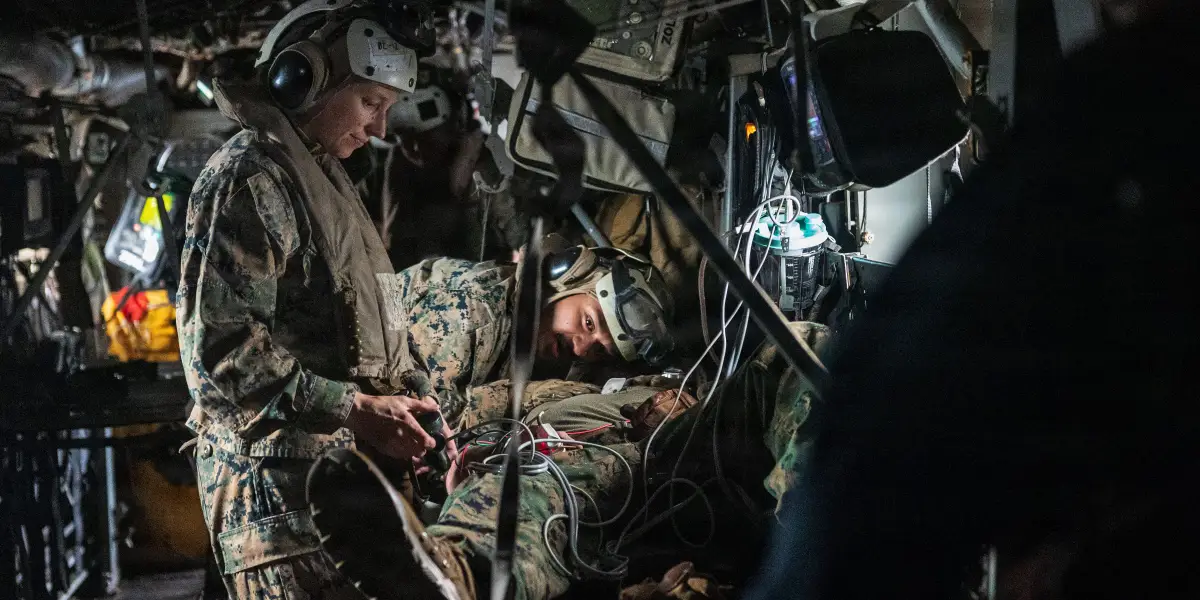
美国海军陆战队已开始部署新型医疗设备,旨在帮助受伤的军人在无法快速从战场撤离时存活。该新技术旨在储存血液、识别内部伤情,并在战场附近更及时地治疗受伤军人,因为军方正在为未来战争做准备,届时伤员可能无法在数小时甚至数天内到达医院。该设备包括改进的、更轻便的移动血液冷却装置、更好的血液加热装置以及小型人工智能辅助超声波设备,旨在帮助海军军医和其他医护人员在设备更轻便、对广泛医疗基础设施依赖更低的情况下治疗伤员。
The US Marine Corps has begun fielding new medical equipment meant to help troops survive when wounded service members can't be quickly evacuated from the battlefield. The new technology is designed to store blood, identify internal injuries, and treat wounded service members closer to the battlefield as the military prepares for future wars in which casualties may be unable to reach a hospital for hours or even days. The equipment includes improved, lighter-weight mobile blood coolers, better blood warmers, and small AI-assisted ultrasound devices and is designed to help Navy corpsmen and other providers treat casualties with less bulky equipment and less reliance on extensive medical infrastructure.
在伊拉克和阿富汗战争期间,美国的空中优势经常使直升机能够快速将受伤士兵撤离到战场附近装备完善且防护严密的医疗设施。然而,乌克兰战争中出现的无人机战争普及及其他技术进步,引发了人们对未来冲突中是否仍能实现快速伤员撤离的疑虑。如今,军方规划者认为,一个精密的敌人很可能拥有能够严重干扰伤员撤离、补给和通信等军事任务的工具。
During the wars in Iraq and Afghanistan, US air supremacy frequently allowed helicopters to quickly evacuate wounded troops to well-equipped and defended medical facilities near the battlefield. The proliferation of drone warfare and other technological advancements seen in Ukraine has, however, raised doubts about whether rapid casualty evacuations will be possible in future conflicts. Now, military planners assume that a sophisticated foe is likely to possess tools that could severely disrupt military tasks such as casualty evacuation, resupply, and communications.
海军上校沙里·根特里(Shari Gentry),海军陆战队副医务官,在弗吉尼亚州昆蒂科附近的媒体活动中对记者表示:“在9·11之后的中东战争期间,军方一直计划在一小时内将受伤士兵送往先进的医疗设施。‘而我们不认为这种情况还会出现。’”海军陆战队已开始将这些系统分发给医疗单位,部分设备已抵达部署在中东的部队。
Throughout the post 9/11 wars in the Middle East, the military planned on getting wounded troops to advanced medical facilities within an hour, said Navy Capt. Shari Gentry, the Marine Corps' deputy medical officer, speaking to reporters at a media event near Quantico, Virginia. "And we do not foresee that being the case." The Corps has already begun distributing the systems to medical units, with some equipment reaching troops deployed to the Middle East.
根据军方医疗指南,新设备之一是一种便携式冰箱,可储存大约30单位的血液,潜在地足以供四名严重受伤的海军陆战队员使用。
Among the new devices is a portable refrigerator capable of storing approximately 30 units of blood, potentially enough for four seriously wounded Marines, according to military medical guidance.
每个营级救护站将配备一台,使医务人员能够在战场附近获得血液供应。该设备重约60磅,取代了重量超过其两倍的旧系统,并使用海军陆战队已广泛使用的可充电电池。海军上校凯莉·赫普弗尔(Kyleigh Hupfl)表示,这种更小的冰箱使医疗团队能够在不依赖持续发电机或燃料补给的情况下维持血液供应,她是海军陆战队远程医疗系统的临床负责人。
Each battalion aid station is set to receive one, giving medical personnel a supply of blood closer to the battlefield. Weighing about 60 pounds, it replaces a system that weighs over twice as much and uses rechargeable batteries already common throughout the Marine Corps. The smaller refrigerator allows medical teams to maintain blood supplies without relying continuously on generators or fuel deliveries, said Navy Cmdr. Kyleigh Hupfl, the Corps' clinical lead for Expeditionary Medical Systems.
她表示,该能力已在中东证明了其用处。海军陆战队在各单位对现有冷藏设备可靠性提出担忧后加快了交付。一个单位告诉她,新设备使其在整个部署期间都能保持随时可用的血液供应。温度的微小偏差可能导致血液和其他药品失效。她说:“我们需要能够在不依赖重型发电机的情况下将冷链分发前移,并且需要以可持续的方式实现这一点。”
The capability has already proved useful in the Middle East, Hupfl said. The Corps accelerated delivery after units raised concerns about the reliability of existing refrigeration equipment. One unit told her that the new device allowed it to maintain a ready supply of blood throughout its deployment. Small deviations in temperature can render blood and other pharmaceuticals unusable. "We need to be able to bring cold chain distribution forward without relying on heavy generators, and we need to be able to do that in a sustainable way," she said.
该部队还在部署新型便携式血液加热器,其输送温热液体的速度快于之前的设备。该加热器通过将血液导入管道并在其进入患者静脉前进行加热来工作。这种温度对于防止低体温症至关重要,低体温症是受伤患者的严重并发症。另一项重大变化是配备人工智能辅助成像的便携式超声设备。此前,此类设备仅配备在战场医疗的较高层级,而新设备现在正被推向战术医疗的最低层级——即一级医疗设施(Role 1 facilities),在那里,海军军医和医生为受伤的海军陆战队员提供即时的生命救助。
The service is also fielding new portable blood warmers that can deliver warmed fluids faster than the previous equipment. The warmer works by passing blood through a tube, warming it before it flows into a patient's veins. Such warmth is crucial to prevent hypothermia, a serious complication in injured patients. Another major change involves portable ultrasound machines equipped with AI-assisted imaging. Previously held only at higher levels of battlefield medical care, the new machines are now being pushed toward the lowest level of tactical care, known as Role 1 facilities, where Navy corpsmen and physicians provide immediate life-saving care for wounded Marines.
人工智能软件帮助用户在超声图像中识别解剖结构,使经验较少的超声操作人员能够发现内出血或其他可能难以察觉的伤害迹象。
The AI software helps users identify anatomical structures on ultrasound images, allowing providers with less ultrasound experience to spot signs of internal bleeding or other injuries that might otherwise be difficult to detect.
该信息也有助于医疗团队确定哪些伤员需要最紧急的撤离或手术。海军少Matthew Brown是该旅远征医学系统首席生物医学设备技术员。Brown谈到这一困境以及前线医务人员正在部署的新超声设备时表示:“我有10个人受伤了,我应该先救谁?”他称,“到了最后,这才能救他们的命。”
That information can also help medical teams determine which casualties need evacuation or surgery most urgently, said Navy Chief Petty Officer Matthew Brown, the chief biomedical equipment technician for the Corps' Expeditionary Medical Systems. "I have 10 people that are hurt. Who should I get out?" Brown said of the dilemma and the new ultrasounds being fielded to front-line medics to address it. "And at the end of the day, that's what's going to save their life."