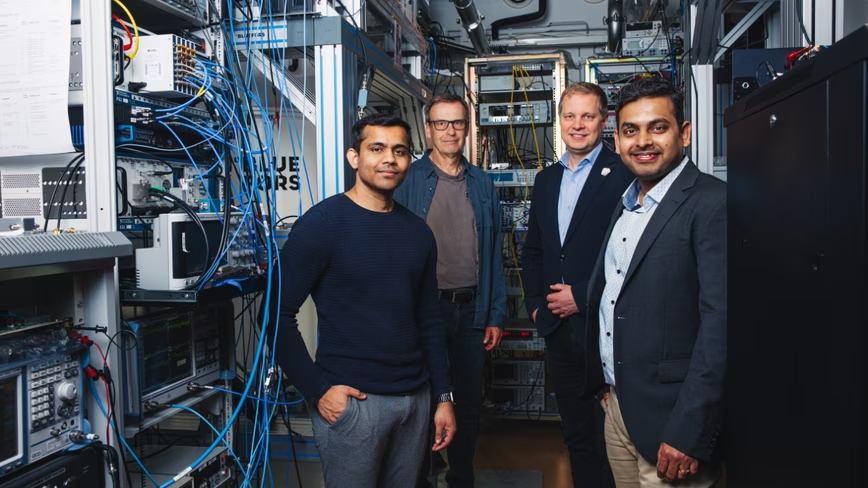
可以把量子计算机想象成一台非常精密的机器,需要在极低温环境下运行。处理器是真正执行计算的部分,但它需要大量配套设备才能工作。
Think of a quantum computer as a very delicate machine that needs to operate in extreme cold. The processor is the part that does the actual computing, but it needs a lot of supporting equipment to work.
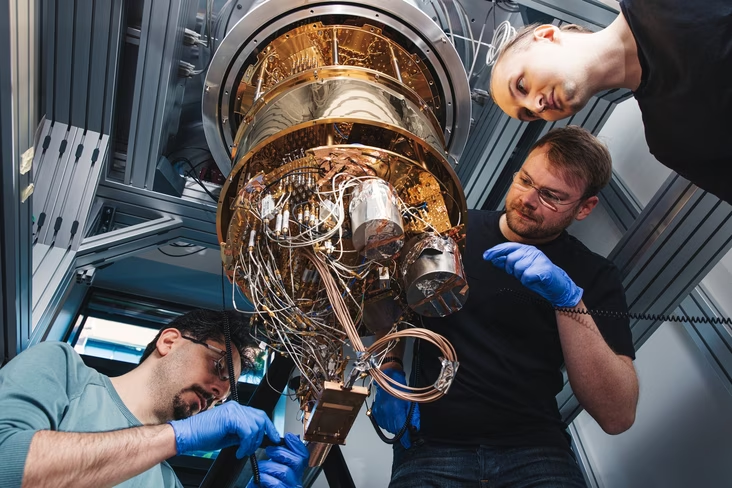
处理器被放置在一台特殊的制冷机内部,制冷机将其冷却到接近绝对零度的温度。电缆从制冷机外部连接到芯片,传输用于控制其微小计算单元(称为量子比特)的信号。
The processor sits inside a special refrigerator that cools it to temperatures close to absolute zero. Cables run from outside the refrigerator to the chip, carrying the signals that control its tiny computing units, called qubits.
问题在于,量子计算机越强大,管理所有这些连接就越困难。过多的电缆占用空间、使系统复杂化,并可能限制这项技术的扩展能力。
The problem is that the more powerful quantum computers become, the harder it gets to manage all those connections. Too many cables take up space, complicate the system, and can limit how far the technology can scale.
这正是Coherence Quantum想要解决的问题。这家芬兰初创公司正在开发技术,使量子计算机在规模扩大时更容易被控制。
That’s what Coherence Quantum wants to address as the Finnish startup is developing technology to make controlling quantum computers easier as they scale up.
这家从阿尔托大学分拆出来的公司位于埃斯波,已在由Lifeline Ventures领投的种子轮融资中筹集了278万欧元,MySQL前首席执行官Mårten Mickos也参与了投资。
The Espoo-based company, spun out of Aalto University, has raised €2.78 million in seed funding led by Lifeline Ventures, with participation from Mårten Mickos, the former CEO of MySQL.
用最简单的话来说,他们所做的就像是在试图控制一台极低温冷冻设备内部的数千个微小器件,那里几乎一切都必须经过专门设计才能运作。
To put this in the simplest way, what they are doing is like trying to control thousands of tiny devices inside a freezer so cold that almost everything has to be specially designed to work there.
每个器件都需要与外部世界连接,而增加的器件越多,布线就越复杂。这正是Coherence Quantum想要让这些连接更容易管理的地方。
Every device needs connections to the outside world, and the more devices you add, the more complicated the wiring becomes. And this is where Coherence Quantum wants to make those connections easier to manage.
为了更好地理解什么是量子计算机,以及这支由聪明人组成的了不起的团队在做什么,我向Aashish Sah(首席执行官)、Suman Kundu(首席技术官)、Erkki Soininen(首席产品官)和Mikko Möttönen(创始顾问)提了几个问题。
To better understand what a quantum computer is and what this amazing team of smart people is doing, I had to ask Aashish Sah (CEO), Suman Kundu (CTO), Erkki Soininen (CPO), and Mikko Möttönen (Founding Advisor) a few questions.
“仅仅从数百个量子比特增加到一千个量子比特,你就至少需要3000条控制线,”该公司首席执行官兼联合创始人Aashish Sah在接受我的独家采访时表示。
“Just by moving from hundreds to a thousand qubits, you would need at least 3,000 control lines,” Aashish Sah, the company’s chief executive and co-founder, told me in an exclusive interview.
“我们目前拥有的标准冰箱大约能容纳一千条控制线。所以公司已经面临一个瓶颈。”为了理解这为何重要,萨从公司自身描述中的两个词开始:“低温”和“量子”。遵循不同规则的电路“我们需要低温来观察量子行为,”他说。
“The standard fridges we have currently can fit about a thousand control lines. So there’s already a bottleneck that companies are experiencing.”To understand why this matters, Sah started with the two words that could make sense of the company’s own description: “cryogenic” and “quantum”. A circuit that obeys different rules“We need cold temperatures to observe quantum behaviour,” he said.
Coherence Quantum 所使用的量子位并非奇异粒子,而是用他的话说,“在芯片上制造的电路”,冷却到不再像普通电子器件那样运行,而开始遵循量子力学规则。量子计算机利用这种行为,以经典机器无法做到的方式处理信息。
The qubits Coherence Quantum works with are not exotic particles but, in his words, “electrical circuits made on a chip”, cooled until they stop behaving like ordinary electronics and start following the rules of quantum mechanics. Quantum computers use that behaviour to process information in ways a classical machine cannot.
萨说,构建量子位有六七种方式,包括被捕获的离子、中性原子和光粒子。Coherence Quantum 专注于两种直接集成在芯片上的量子位:超导量子位和自旋量子位,两者都只能在接近绝对零度的条件下工作。目前还没有人构建出能大规模解决实际问题的量子计算机。“我们还没到那一步;我们仍在努力达到那一步,”萨说。
There are six or seven ways to build a qubit, Sah said, including trapped ions, neutral atoms, and particles of light. Coherence Quantum focuses on two that are built directly into chips, superconducting and spin qubits, and both only work close to absolute zero. Nobody has yet built a quantum computer that solves useful problems at scale. “We’re not there yet; we are still trying to get there,” Sah said.
正如他所描述的,主要障碍是规模:从数百个量子位发展到数千个,最终达到数十万个,这一目标“随着我们对算法和应用的更深入了解而不断更新”。
The main obstacle, as he describes it, is size: going from hundreds of qubits to thousands, and eventually to hundreds of thousands, a target that “keeps updating based on our better understanding of algorithms and applications”.
与厨房冰箱不同的冰箱创始人一直称其为“冰箱”,于是我问这到底是什么意思,稀释冰箱长什么样。首席技术官苏曼·昆杜与这类设备打交道已超过十年。他解释说,低温物理学曾经意味着手动处理液态氦和液态氮。
A fridge unlike the one in your kitchen The founders kept calling it “the fridge”, so I asked what that actually means, and what a dilution refrigerator looks like. Suman Kundu, the CTO, has worked with the machines for more than a decade. Low-temperature physics once meant handling liquid helium and liquid nitrogen by hand, he explained.
现代稀释冰箱在封闭系统内循环一切,并将芯片冷却到约10毫开尔文,因此它更像是一种实验室仪器,而非厨房电器。
A modern dilution fridge circulates everything within a closed system and cools a chip down to around 10 millikelvin, making it more of a laboratory instrument than a kitchen appliance.
即便如此,温度可能仍然不够低;因为根据创始人的说法,量子比特(qubits)的实际工作温度通常在 50 到 70 毫开尔文之间,这比周围的冰箱温度要高好几倍——热量和噪声会通过导线传入量子比特中。降低温度可以使量子比特更加稳定,从而减少计算过程中的错误。
Even that may not be cold enough, as the founders say qubits often behave as though they were at 50 to 70 millikelvin, several times warmer than the fridge around them, because heat and noise leak in along the wiring. Bringing that figure down makes the qubits more stable, which in quantum computing means fewer errors.
目前,人们使用大型仪器在室温环境下生成控制信号,然后将这些信号传输到冰箱中;但这些电缆在传输信号的同时也会带来热量。据 Sah 介绍,从室温环境发送到冰箱中的控制信号中有超过 99% 的能量会在冰箱内部被耗散,从而导致冰箱温度升高,并产生干扰量子比特的噪声。在他看来,以当前量子计算行业的发展规模来看,这种设计方式在物理上和经济上都是不可持续的。
Today, heavy instruments at room temperature generate the signals that run a quantum processor and send them down into the fridge. Those cables bring heat as well as signals. According to Sah, more than 99% of a control signal sent from room temperature dissipates inside the fridge, warming it and creating noise that disturbs the qubits. At the scale the industry is aiming for, he called the approach “physically and economically unsustainable”.
他们已经提交了四项专利申请,其中第一项专利主要涉及某些能够显著减少热量对量子比特干扰的组件。Sah 表示,这些组件的效果非常好:它们能够将热量引起的干扰降低 100 倍。“如果热量无法直接传递到量子比特附近,就不会对处理器产生任何干扰。”他说。
They also have four patent applications, and Sah started with this one. It covers components that, he said, cut heat-induced qubit disturbance by a factor of 100. “If it doesn’t dissipate close to the qubit, it doesn’t create noise to the processor,” he said.
在采访之前,我查阅了 Sah 自己的相关研究——他开发了一种内置在芯片中的滤波器,该滤波器能够阻挡特定频率下的噪声。这项研究始于他在阿尔托大学(Aalto University)攻读博士学位期间,当时他师从 Mikko Möttönen;Möttönen 是 IQM 和 QMill 的联合创始人,同时也是 Coherence Quantum 公司的创始顾问。Sah 将这个问题称为“量子比特的隔离与控制难题”。
Before the interview, I had read up on Sah’s own research, on filters built into the chip that block noise at the qubit’s frequency. The work began during his doctorate at Aalto, in the lab of Mikko Möttönen, co-founder of IQM and QMill and now Coherence Quantum’s founding advisor. He calls the problem the “isolation and control challenge”.
量子比特只有在与外界完全隔离的情况下才能保持其脆弱的量子状态,但为了进行任何计算,它必须与电子设备相连。Sah 解释道:“如果能够将量子比特完全隔离起来,它的量子状态就能长时间保持稳定;不过这样一来,我们就无法利用它来执行任何实际任务了。”他还指出:“这虽然是一个完美的量子系统,但实际上根本无法发挥任何实际作用。”因为任何用于控制量子比特的导线,都会成为能量流失的途径。
A qubit retains its fragile quantum state only when it is isolated from its surroundings, yet it must be wired to electronics to run any calculation. “If you isolate it, it will live for a very long time,” he said. “This is a perfect quantum system, but you cannot do anything useful.”Every wire that lets engineers control a qubit is also a route for its energy to leak away, he explained. Physicists measure how long a qubit stays in its excited state as its relaxation time, known as T1: once a qubit is nudged from its lowest-energy state into a higher one, T1 describes how long it stays there before slipping back.
物理学家测量量子比特在其激发态中保持的时间,将其称为弛豫时间,即T1:一旦量子比特从最低能级被推入更高能级,T1描述了它在滑回原态之前能在那里停留多久。持续时间越长,它能完成的有用工作就越多。
The longer it lasts, the more useful work it can do.
他的第一种方法使用滤波器,阻断量子比特自身频率的噪声,同时以该频率的三分之一驱动它。这奏效了,但如此强力地驱动量子比特会将其推入不需要的状态。后续方案是一种可调滤波器,它随时间开关量子比特与外部世界的连接,成为该公司的第二项专利申请。
His first approach used filters that blocked noise at the qubit’s own frequency while driving it at a third of that frequency. That worked, but driving the qubit so hard pushed it into unwanted states. The follow-up, a tunable filter that switches a qubit’s connection to the outside world on and off over time, became the company’s second patent application.
第三项方案是在研发可调滤波器时偶然发现的;团队意识到,改变量子比特的耦合也会改变其寿命,从数百纳秒延长到数百微秒。这使量子比特变成了一个温度计,帮助建造者评估到达量子比特的热噪声并追踪其来源。第四项方案,该公司称之为“量子旋钮”,始于一个简单的观察。“并非所有量子比特的操作都需要同时进行,”萨赫说。
The third arrived by accident while working on the tunable filter; the team realised that changing the qubit’s coupling also changed its lifetime, from hundreds of nanoseconds to hundreds of microseconds. That turned the qubit into a thermometer, one that helps builders assess the thermal noise reaching the qubit and track down its source. The fourth, which the company calls a “quantum dial”, starts from a simple observation. “Not all operations on a qubit require you to do it simultaneously,” Sah said.
重置量子比特、读取它以及在其上运行操作发生在不同时间,因此该旋钮仅在需要时才连接每个功能。
Resetting a qubit, reading it out, and running an operation on it happen at different times, so the dial connects each function only when needed.
“如果将量子比特耦合到许多系统,它就会有许多系统可以衰减到,”他说。
“If you couple a qubit to many systems, it will have many systems to decay to,” he said.
更少的永久连接意味着寿命更长的量子比特,以及进入冰箱的线路更少。我想知道这些是否是行业目前还没有的零部件。
Fewer permanent connections mean a longer-lived qubit and fewer lines running into the fridge. I wanted to know whether these were parts the industry simply did not have yet.
“差不多吧,”萨赫说。许多组件已经存在多年,建造者仍然可以现成购买。Coherence Quantum拥有待批专利的组件,旨在屏蔽现有零部件会让其通过的噪声。
“Not quite,” Sah said. Many components have existed for years, and builders can still buy them off the shelf. Coherence Quantum has patent-pending components designed to shield the qubit from noise that existing parts let through.
核心思路是将信号处理流程中的某些环节移至温度较低的环境中(即“低温环境”),在这些环境中进行信号过滤和处理,从而更接近量子处理器;而不是将所有数据直接从上层系统传输到处理器。Sah将这一过程比作传统计算机技术的发展历程:从占据整个建筑物的真空管计算机,发展到如今的笔记本电脑。
The broader idea is to move parts of the signal chain into the cold, filtering and generating signals close to the processor instead of piping everything down from above. Sah compared it to classical computing’s journey from vacuum-tube machines that filled whole buildings to the laptop.
“我们虽然并没有在研发晶体管,但正在开发类似的电子元件,这些元件可以做到体积更小、更接近量子处理器的结构,并确保其性能达到相应水平,”他说。
“We’re not exactly developing transistors, but similar electronics that we can make compact, bring closer to the quantum processor, and make sure the performance is on par,” he said.
他指出,大型语言模型在技术发展上已经取得了显著进展,而机器人技术这个历史更为悠久的领域却仍然落后——这并非因为硬件工程师的工作强度降低了,而是因为物理系统需要经过更多的迭代和优化过程。
Large language models have raced ahead, he said, while robotics, a far older field, still lags, not because hardware engineers work any less hard but because physical systems need many more rounds of iteration.
“我们需要大量的硬件开发工作,才能完成计算机系统的这一部分设计。”Sah、Kundu 和 Erkki 都是物理学家,他们共同创立了一家公司。这个故事始于 2024 年左右,当时研究人员获得了将研究成果转化为实际产品的资金支持;他们在自己实验室进行的初步测试表明,他们确实能够降低量子比特(qubit)的工作温度。
“We need a lot of hardware development so that we can build this part of the computer.”Sah, Kundu, and Erkki are all physicists, and they started a company. The story begins around 2024, when the researchers secured research-to-business funding to turn the work into prototypes, and early tests in their own lab showed they could lower qubit temperatures.
“我们在科学领域拥有丰富的专业知识,但缺乏商业化和市场推广方面的经验,”Sah 说道。
“We had great expertise in science, but lacked business and commercialisation skills,” Sah said.
为了弥补这一短板,他们邀请了 Erkki Soininen 加入团队。Erkki 拥有超过 30 年的产品开发经验,此前曾在低温技术公司 Bluefors 工作。他在项目初期以顾问身份加入团队,后来决定“全身心投入”,并与首席技术官 Suman Kundu 一起共同创立了这家公司。
That gap brought in Erkki Soininen, a product veteran with more than 30 years of experience who previously worked at cryogenics maker Bluefors. He joined as an adviser during the Research-to-Business project, i.e., pre-spinout, then, in Sah’s words, “wanted to fully commit”, co-founding the company as chief product officer alongside chief technology officer Suman Kundu.
在我报道这个项目以及其他量子技术公司的过程中,我发现芬兰在量子研究领域始终扮演着重要角色。我很好奇:究竟是什么让芬兰在量子研究中具有如此独特的优势?
During my coverage of this story, and of other quantum companies, Finland keeps coming up, and I just wonder what makes it different for quantum research.
Olli Lounasmaa 于 1965 年在如今的阿尔托大学(Aalto University)创立了低温实验室,后来将该实验室在超灵敏磁测量技术方面的专长应用于大脑研究领域。
Olli Lounasmaa founded the Low Temperature Laboratory at what is now Aalto University in 1965 and later turned its expertise in ultra-sensitive magnetic measurement towards mapping the brain.
这些测量工作依赖于超导传感器,而萨赫认为它们与如今IBM、谷歌以及IQM所制造的量子比特之间存在着直接的关联。“需要有一位富有远见的教授来开拓某一研究领域,”他说道。
Those measurements relied on superconducting sensors, and Sah draws a direct line from them to the qubits IBM, Google, and IQM build today. “It takes one visionary professor to pursue a field of research,” he said.
如今,全球众多量子计算机研发机构都在使用Bluefors生产的稀释制冷机;这家公司正是于2008年从上述实验室中孵化出来的。IQM同样诞生于这一科研生态圈,与芬兰国家技术研究中心VTT并肩发展。
Bluefors, whose dilution refrigerators are now used by quantum computer builders around the world, spun out of that laboratory in 2008. IQM grew from the same ecosystem, alongside the national research centre VTT.
阿尔托大学还开设了量子技术专业的本科课程。据萨赫介绍,修读该专业的学生通常会到当地企业完成毕业论文,很多人也由此获得了人生中的第一份工作。
Aalto also runs a bachelor’s programme in quantum technology, which Sah said sends students into local companies for their theses and, often, their first jobs.
在人才资源本就稀缺的领域,“对北欧这类小国而言更是如此”,这样的人才培养渠道显得尤为重要。
In a field where talent is scarce, “especially for small countries like here in the Nordics”, that pipeline matters.
我真正想弄清楚的其实很简单:量子技术究竟能为当今的人类社会带来什么?
The actual answer I wanted to know was the simplest: what can quantum technology actually do for humanity, for our societies as they are now?
萨赫并未从夸耀前景入手,而是先讲述了历史。他指出,大多数物理学研究最初都源于好奇心,其实际用途则是在后来才逐渐显现的。他举例说,詹姆斯·克拉克·麦克斯韦的电磁理论后来促成了诸多技术的诞生,而这些技术连其提出者本人都难以想象。
Sah started with history rather than promises. Most physics, he said, begins with curiosity and finds its uses later, pointing to James Clerk Maxwell’s theory of electromagnetism, which went on to underpin technologies its author could never have pictured.
“从一开始,没人能断言研究这一物理学领域就能带来如此多的实际应用,”他说道。
“No one could have from day one said that by pursuing this field of physics, we’ll have this many applications,” he said.
他称量子力学“至今仍是对自然界最精准的描述之一”,并列举了量子计算机有望超越传统计算机的领域:化学研究、复杂材料物理学以及药物研发;至于金融与优化问题,其优势则尚不确定。
He called quantum mechanics “still one of the most precise descriptions of nature that exists”, and named the problems where quantum computers are expected to outperform classical ones: chemistry, the physics of complex materials, and drug discovery, with finance and optimisation less certain.
据他介绍,同样的物理原理如今已催生出“远比现有产品更为精准”的传感器,以及新型的安全通信技术。
The same physics is already producing sensors that are, he said, “much more precise than what is available”, as well as new forms of secure communication.
研发量子硬件需要巨额投入。Coherence Quantum公司则坚信:随着研究人员不断致力于开发能够自行检测并纠正错误的容错型量子计算机,产业界的投入也将持续增加。
Building quantum hardware requires significant investment, and Coherence Quantum is betting that industry spending will continue as researchers work towards fault-tolerant machines capable of detecting and correcting their own errors.
Coherence Quantum目前正致力于研发其创始人所称的“低温控制层”——这项技术的作用是将量子比特与外部电子设备连接起来。
Coherence Quantum is focusing on what its founders call the cryogenic control layer, the technology that connects quantum bits, or qubits, to the electronics outside the refrigerator.
创始人们认为,这一技术环节虽对整个量子计算系统至关重要,却远未像量子比特研发或量子软件开发那样受到重视。他们指出,随着量子计算机规模的不断扩大,这一控制层也必须同步演进才能满足需求。
The founders see this as an important part of the system that has received less attention than qubit development or quantum software. As quantum computers grow, they argue, this layer will need to evolve to keep pace.
此次获得的种子轮融资将用于公司在埃斯波建立实验室、开发早期产品原型、完善生产工艺以及扩充团队规模。
The company’s first seed round will support the development of a lab in Espoo, early product prototypes, manufacturing processes, and team expansion.
Lifeline Ventures的佩特里·科波宁表示:“若要让量子计算机实现规模化应用,围绕量子比特的配套架构也必须同步发展。”
“If quantum computers are going to scale, the architecture around the qubits has to scale with them,” said Petteri Koponen of Lifeline Ventures.
目前,该公司的首要任务仍是研发底层技术。萨赫预计,随着量子计算机技术的持续进步,相关实际应用也将陆续问世。
For now, the priority is building the underlying technology. Sah expects practical applications to emerge as quantum computers continue to develop.
“我们目前正处于系统搭建阶段,”他说道,“后续再探索更多应用场景。”打造更大规模的量子计算机并非单纯增加量子比特数量那么简单,还需要找到一种无需大量线缆即可控制所有量子比特的方法。
“We are currently at a stage to just build the system,” he said, “and find more applications down the line.”Building a bigger quantum computer isn’t just about adding more qubits, but it also means finding a way to control them all without filling the machine with thousands of cables.
这正是Coherence Quantum试图解决的问题。当前,量子计算机需借助大量线缆向处理器传输信号;但随着量子比特数量的增加,布线难度也随之上升,还会向本需保持极低温的运行环境引入多余热量。
And that’s the problem Coherence Quantum is trying to solve. Today, quantum computers rely on large numbers of cables to carry signals to the processor. But as more qubits are added, the wiring becomes harder to manage and brings unwanted heat into an environment that needs to stay extremely cold.
Coherence Quantum计划研发出可在低温环境下使用的微型控制组件,以此减少所需线缆的数量。倘若这一方案得以成功实施,未来打造更大规模的量子计算机时便无需再大幅增加布线量。
Coherence Quantum wants to reduce the number of cables by developing smaller components that can control qubits from inside the refrigerator. If the approach works, it could make it easier to build larger quantum computers without adding more and more wiring.