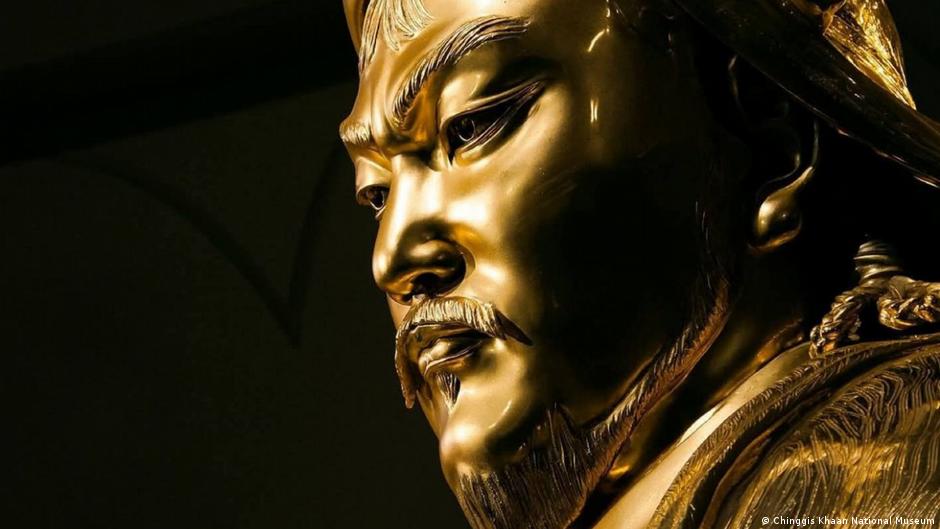
是历史上最激进的人物之一。他是一位嗜血的侵略者,其征服活动导致约4000万人死亡,同时他也是一位富有远见的政治思想家,建立了历史上最大的连片陆地帝国。
is one of history's most radical figures. A blood-thirsty invader whose conquests caused the deaths of an estimated 40 million people, he was also a visionary political thinker who established the largest contiguous land empire in history.
蒙古帝国缔造者于1227年逝世。在纪念他逝世800周年之际,柏林的詹姆斯-西蒙美术馆(James-Simon-Galerie)举办了名为“成吉思汗与蒙古世界:颠覆性人物的力量”的展览,探讨他的遗产以及“蒙古世纪”(1250年—1350年)。展览项目负责人马蒂亚斯·韦姆霍夫(Matthias Wemhoff)表示,这位统治者直到今天依然“极其具有现实意义”。
The founder of the Mongolian Empire died in 1227. Ahead of the 800th anniversary of his death, Berlin's James-Simon-Galerie explores his legacy and the "Mongol Century" (1250–1350) in the exhibition " Genghis Khan and the World of the Mongols The power of a disruptive individual The ruler remains "incredibly relevant" to this day, says Matthias Wemhoff, the director of the exhibition project.
这位考古学家对德国之声表示:“成吉思汗的时代——或者可以说是‘蒙古世纪’——生动地证明了,既定结构崩塌的速度有多快,庞大帝国从地图上消失的速度有多快,以及整个地貌彻底改变的速度有多快。”
"What the era of Genghis Khan — the 'Mongol century,' if you will — vividly demonstrates is how quickly established structures can collapse, how rapidly vast empires can vanish from the map and how swiftly the entire landscape can be utterly transformed," the archaologist tells DW.
韦姆霍夫说,这位富有个人魅力的领袖对世界产生的空前影响,也让人联想到当今正在引发突然且不可预测的社会巨变的颠覆性人物:“一直以来都存在这样一个问题:世界政治是由个人塑造的,还是由群体和社会学进程塑造的?”
The charismatic leader's unprecedented impact on the world also evokes present-day disruptive individuals who are triggering sudden, unpredictable societal shifts, says Wemhoff: "There's always been this question: Are world politics shaped by individuals or rather by groups and sociological processes?"
这家博物馆的馆长兼2026年一本关于这位游牧领袖合著书籍的作者表示,在这种情况下,答案是显而易见的:“如果成吉思汗没有出现,世界历史的进程真的会完全不同——其中的许多内容都与他这个人密不可分。”成吉思汗在蒙古国被尊为统一了草原交战部落的国家国父。这座雕像位于乌兰巴托的议会大厦内。世界最大帝国的缔造者成吉思汗于1162年前后出生,本名铁木真。
In this case, the answer is clear, says the museum director, who also co-wrote a 2026 book on the nomadic leader: "If Genghis Khan hadn't existed, the course of world history would truly have been entirely different — so much of it is inextricably linked to his person." Genghis Khan is revered in Mongolia as the founding father of the nation who united the warring steppe tribes. This statue is in the Parliament Building in Ulan Bator The founder of the world's largest empire Genghis Khan was born as Temüjin around the year 1162.
他的父亲是一位名叫也速该的蒙古首领,在他还是个孩子的时候就去世了。他的家族被自己的部落抛弃。为了巩固家族地位,铁木真在十几岁时杀死了同父异母的哥哥别克帖尔。
His father, a Mongol chieftain called Yesugei, died when he was still a child. His family was abandoned by its tribe. To secure his familial position, Temüjin killed his older half-brother, Bekter, when he was still a young teenager.
凭借其极具感染力的个性,他建立联盟、赢得追随者,最终成为蒙古草原的唯一统治者。1206年,他正式采用“成吉思汗”这一称号。
Thanks to his charismatic personality, he built alliances and found followers who helped him become the sole ruler on the Mongolian steppe. He formally adopted the title of Genghis Khan in 1206.
在鼎盛时期,蒙古帝国疆域约达2400万平方公里(约930万平方英里),东起中国和朝鲜,西至东欧部分地区和中东,占地球陆地总面积的16%以上。
At its peak, the Mongol Empire covered approximately 24 million square kilometers (about 9.3 million square miles), stretching from China and Korea to parts of Eastern Europe and the Middle East, and accounting for over 16% of the Earth's total land area.
游牧文化——毡房、传统服饰和乐器——在蒙古的“蒙古游牧冬季节”上受到礼赞。韦姆霍夫列举了他在位期间的多项创新:首先,成吉思汗改变了战争形态。指挥官因才干、纪律和忠诚而获提拔,而非基于贵族等级或部落忠诚。士兵被编制为十进制单位:10人、100人、1000人和10000人。
Nomadic culture, with yurt tents, traditional costumes and music instruments is celebrated here in Mongolia's 'Mongols Nomadic Winter Festival' Wemhoff lists various innovations under his rule: For one, Genghis Khan transformed warfare. Commanders were promoted for skill, discipline and loyalty rather than based on aristocratic rank or tribal loyalties. Soldiers were organized into decimal units of 10, 100, 1,000 and 10,000.
尽管按现代标准他不识字,但他也推动蒙古语首部文字的诞生,这使得建立国家官僚体系、统计人口与税籍、记录诏令、颁布法律判决和处理外交事务成为可能。
Despite being illiterate by modern standards, he also pushed for the introduction of the first written script for the Mongolian language, which allowed to build a state bureaucracy, track population and tax registers, record decrees, issue legal decisions and handle diplomacy.
一套法律体系得以建立,取代了分散的部落习俗,形成了统一的法律制度。他采用纸币,简化了贸易。
A set of laws were established that replaced fragmented tribal customs with a unified legal system. Trade was simplified through his adoption of a paper currency.
蒙古帝国全境还确立了宗教自由政策,允许所有人在无国家强迫的情况下信仰自己选择的宗教。
A policy of religious freedom was also established across the Mongol Empire, allowing all individuals to practice their chosen faith without state coercion.
在蒙古帝国之前,丝绸之路因地方冲突和重税而支离破碎。蒙古统治将整条路线置于单一权威之下,使长途旅行安全得多。
Before the Mongol Empire, the Silk Road was fragmented by local conflicts and heavy taxes. Mongol rule placed the entire route under a single authority, making long-distance travel vastly safer.
“paiza”充当了世界上最早的护照形式,为官方旅行者提供保护和欧亚大陆的安全通行。蒙古帝国以相对的政治稳定、经济增长和文化交流著称,历史学家称这个时代为“蒙古和平”。但“这一切伴随着难以置信的残酷。数以百万计的蒙古人受害者——大规模处决、对妇女的虐待——这些行为的规模前所未有,”温姆霍夫指出。
The 'paiza' acted as the world's earliest form of passport, granting official travelers protection and safe passage across Eurasia The Mongol Empire is known as a period of relative political stability, economic growth and cultural exchange, an era historians call the "Pax Mongolica." But "it all came with incredible levels of cruelty. The millions of people who fell victim to the Mongols — the mass executions, the abuse of women — this happened on a scale previously unheard of," notes Wemhoff.
权力中心的转移 展览以成吉思汗去世后发生的一场袭击拉开序幕,但这场袭击发生在距离柏林仅260公里(约160英里)的地方:1241年波兰西里西亚的列格尼察战役。它体现了蒙古人方法的残酷和激烈。
Shifting centers of power The exhibition opens with a raid that happened after Genghis Khan's death, but took place just 260 kilometers (around 160 miles) away from Berlin: the 1241 Battle of Legnica, in Silesia, Poland. It embodies the brutality and intensity of the Mongols' methods.
出现了“骑着小马的高度机动、敏捷的蒙古人——身穿鳞甲轻甲,戴着露出面部的头盔,挥舞着每分钟能射出20支或更多箭矢的弓,”温姆霍夫指出。
There came the "highly mobile, agile Mongols on small horses — lightly armored in lamellar gear, wearing helmets that left the face exposed, and wielding bows capable of firing 20 or more arrows in a single minute," points out Wemhoff.
身披重甲、骑着庞大战马的欧洲骑士在敌人面前毫无胜算。“当箭雨倾盆而下时,马匹最终倒下,骑士们最终仰面躺在地上,动弹不得,就像六月虫一样,”他补充道。“两种战斗风格根本不匹配。”蒙古人还利用欺骗来迷惑和困住对手。蒙古人的西征以至今仍影响世界政治的方式转移了历史权力中心。
European knights, heavily armored and mounted on large, massive warhorses, didn't stand a chance against their enemies. "When a hail of arrows rained down on them, the horses eventually went down, and the knights ended up lying on the ground, stuck on their back, much like a June bug," he adds. "The two styles of combat were simply mismatched." The Mongols also used deception to confuse and trap their opponents The Mongols' Western campaigns shifted historic power centers in a way that still impacts world politics today.
例如,在蒙古入侵基辅罗斯——第一个东斯拉夫国家——之后,其繁荣的首都基辅沦为人口锐减的废墟。莫斯科成为一个关键的地区强国,部分原因在于它选择与蒙古人合作,而不是进行抵抗。
For example, after the Mongol invasion of Kievan Rus', which was the first East Slavic state, its thriving capital Kyiv was reduced to a depopulated ruin. Moscow became a key regional power, partly because it chose to cooperate with the Mongols rather than pursue resistance.
“在我们的西欧集体记忆中,蒙古入侵几乎不起任何作用。这有点像是一则趣闻,”韦姆霍夫(Wemhoff)说。他指出,在西欧的标准学校课程中,成吉思汗及其直接继承人的时代几乎被忽略不计。
"In our Western European collective memory, the Mongol invasion plays hardly any role. It's something of an anecdote," says Wemhoff, noting that the era of Genghis Khan and his immediate successors is barely mentioned in standard Western European school curricula.
德国人主要通过1979年的欧洲迪斯科流行乐队“成吉思汗”(Dschingis Khan)才熟悉这个帝国奠基人的名字。该乐队曾代表西德参加欧洲歌唱大赛,演唱了一首同名夸张歌曲,将复杂的历史简化为极端的刻板印象。
Germans are mainly familiar with the name of the empire's founder through the 1979 Euro-disco pop band Dschingis Khan, which represented West Germany at the Eurovision Song Contest with a campy song of the same name that reduced complex history to extreme tropes.
但在东欧,蒙古入侵“从根本上改变了一切,”韦姆霍夫说。“而且改变得如此彻底,以至于我们今天依然能感受到其带来的后果。”展览“成吉思汗与蒙古人的世界”将于2026年10月21日至2027年4月18日举行。
But in eastern Europe, the Mongol invasions "changed everything fundamentally," says Wemhoff. "And so fundamentally that we that we still feel the consequences of it today." The exhibition "Genghis Khan and the World of the Mongols" runs from October 21, 2026, to April 18, 2027.