尽管投入了数十亿美元,并向深度学习模型输入了无穷无尽的视频,机器人在抓取物体方面仍不算出色。
Robots still aren’t that good at picking things up, despite billions of dollars of investment and endless videos fed into deep learning models.
这种情况可能即将改变,得益于Eka Robotics构建的一套操作架构,该架构包含一个力敏夹爪和一种新型深度学习模型。该初创公司由麻省理工学院教授Pulkit Agrawal和前Google DeepMind研究员Tuomas Haarnoja创立,刚刚完成了一轮1.5亿美元的A轮融资,投后估值达14.5亿美元,由风投基金a16z和F-Prime领投。
That may be about to change, thanks to a manipulation architecture built by Eka Robotics, which encompasses a force-sensitive gripper and a new kind of deep-learning model. Founded by MIT professor Pulkit Agrawal and former Google DeepMind researcher Tuomas Haarnoja, the startup just closed an $150 million Series A round that values it at $1.45 billion post-money, led by venture funds a16z and F-Prime.
“它们在某些任务上已经超越了超人类表现,因此我们认为在未来几个月内,许多灵巧操作任务将实现超人类表现,”共同领投该轮融资的a16z普通合伙人Raghu Raguram告诉《科技行者》(TechCrunch)。
“They are already exceeding superhuman performance for certain tasks, and so we think over the next few months there will be superhuman performance in many dexterous manipulation tasks,” Raghu Raguram, the a16z general partner who co-led the fundraising round, told TechCrunch.
在机器人演示层出不穷的时代,Eka的能力令资深机器人制造者震惊。
In an era of never-ending robotic demonstrations, Eka’s capabilities are shocking veteran robot builders.
伊利诺伊大学厄巴纳-香槟分校教授Kris Hauser表示,与他最近看到的其他机器人演示相比,Eka具有“惊艳因素”。Hauser说:“Eka机器人‘能够在无需重新训练的情况下适应大量不同物体’,并补充说它还具有一种‘类人感,令人毛骨悚然的人类感,即如果第一次失败,它会反复尝试’。”
Kris Hauser, a professor at the University of Illinois Urbana-Champaign, said it had a “wow factor” compared to other robot demos he saw recently. The Eka robot “was able to adapt to a large number of different objects without retraining,” Hauser said, adding that it also had an aspect of “humanness, creepy humanness that it would try over and over again if it failed the first time.”
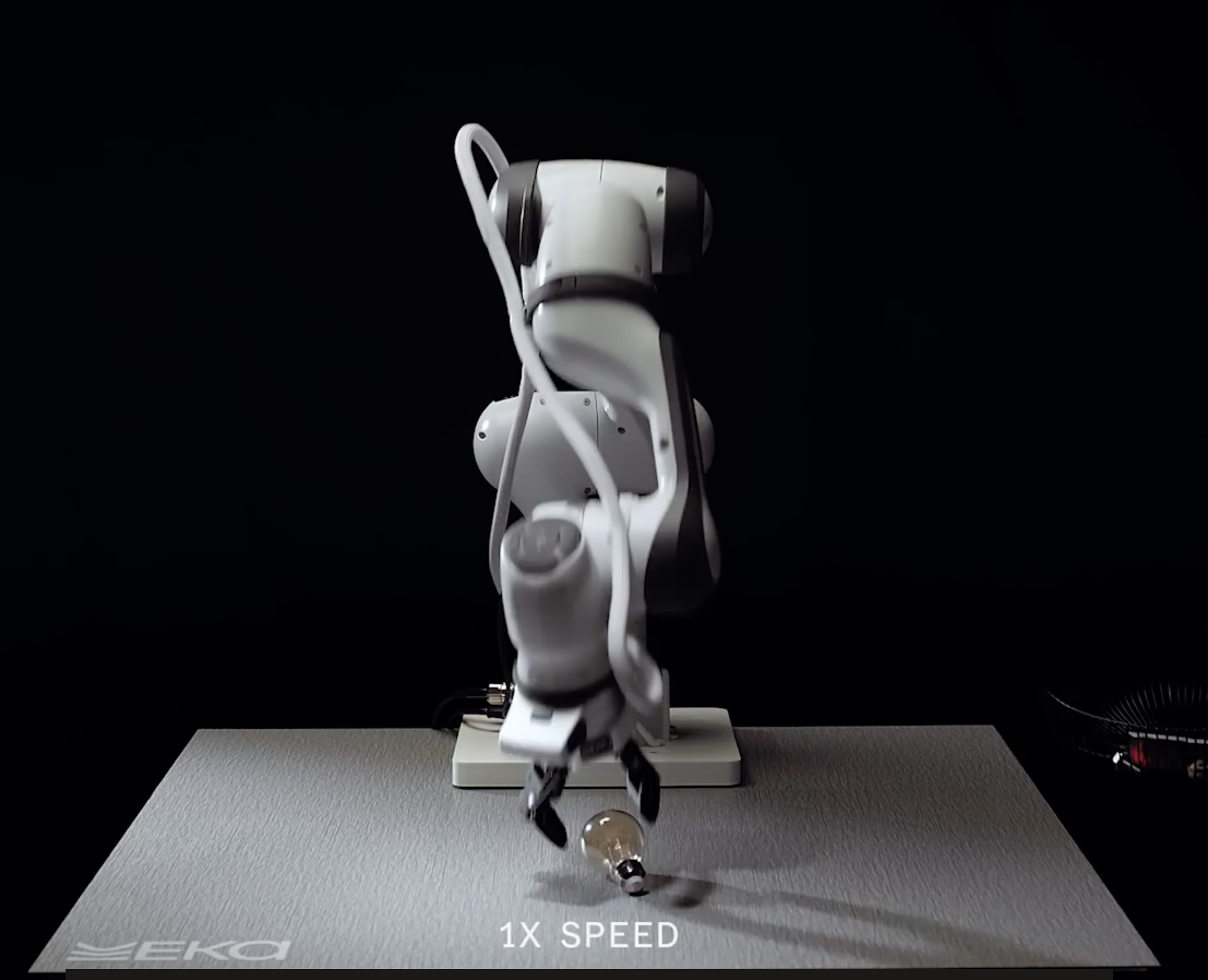
另一位机器人专家因在前沿实验室工作而要求匿名,他告诉《科技行者》,看到Eka机器人实际运行是一种情感体验,可比拟五到十年前机器人首次实现可靠腿式运动时的情景。亲自看看吧:值得注意的是机器人动作的流畅与迅速。它每小时能拾取约 1500 个重达 1 千克的物体,而人类约为 600 个;Eka 称其可靠拾取物体的成功率超过 95%。
Another roboticist, who asked for anonymity because of their work at a frontier lab, told TechCrunch that seeing Eka’s robot in action was an emotional experience, comparable to when robots first achieved reliable legged locomotion five to ten years ago.
而且机械臂力量大到在如此高速运动时会伤到自己。这表明,正如这位前沿实验室观察员所言,“他们非常信任自己的算法不会把机器人弄坏。我想知道他们一路上弄坏了多少台机器人?”当这位前沿实验室机器人专家见到 Eka 的机器人时,递给它一颗覆盆子,这显然是该实验室最爱的测试物品。“一台庞大沉重的机器人冲向我的手臂,又刚好及时减速、轻轻触碰我,这种体验我现在说话时仍能感受到它留在身体里,”他们对 TechCrunch 说道。
Take a look for yourself:
这些能力源于基础模型的构建方式。这里采用的不是视觉-语言-动作模型 —— 那类模型旨在理解语言、视觉输入与动作之间的关系 —— 而是视觉-力-动作模型,专注于语言、力输入与动作之间的关系。对当前生成式 AI 机器人模型方向持批评态度的人士,如 Rodney Brooks,认为若不尝试表征力与触觉,这些模型终将失败;Eka 的成果表明,这类批评者是有道理的。
What’s notable here? How smoothly and rapidly the robot moves. It can pick up about 1,500 objects that weigh up to 1 kg in an hour, compared to about 600 for a human; Eka says it reliably picks up objects more than 95% of the time. And the robot arm is strong enough to hurt itself as it moves that quickly. That indicates, per the frontier lab observer, that “they have a lot of trust in their algorithm not breaking the robot. I wonder how many robots they broke along the way?”When the frontier lab roboticist met Eka’s robot, they handed it a raspberry, the lab’s apparent favorite test item. “The experience of a big, heavy robot rushing towards my arm and then slowing down just in time and very gently touching me is a feeling that I am, as we speak, carrying this feeling in my body,” they told TechCrunch.
“视觉并非解决最后这一毫米问题的主要手段,”Eka联合创始人Agrawal告诉TechCrunch。“视觉只能大致告诉你物体在哪里、姿态如何,但实际的抓取、实际的搜寻是通过力来完成的。”Eka不得不设计一种独特的机械手,它比传统夹爪更灵活,并包含更多力传感器;它会对接触做出反应,这也是它不会把覆盆子捏碎的原因。
These capabilities are a consequence of how the foundational model was built. Rather than a vision-language-action model — which is trained to understand the relationship between language, visual inputs, and actions — the schema here is a vision-force-action model, which focuses on the relationship between language, force inputs, and actions.
出于显而易见的竞争考虑,创始人们对如何实现这一点守口如瓶,但归根结底是利用物理模拟器来模拟机器人在尝试抓取物体时将遇到的多种力,并以此创建一个可大规模运行的强化学习环境。他们表示,能在几分钟内生成数千小时的机器人经验。
Critics of the current direction of generative AI robotics models, like Rodney Brooks, say that they will fail without an attempt to represent force and touch; Eka’s results suggest such critics have a point.
“Eka不再局限于从人类演示等途径收集的数据,而是通过强化学习推进这种方法,让机器人能够超越给予它的任何演示,”Hauser表示。“真正令人振奋的是,他们能够不受训练所呈现数据的限制。”Agrawal和Haarnoja在加州大学伯克利分校读研究生时相识,是机器人控制强化学习领域的领军研究者。Eka的关键押注在于,这种技术可通过仿真大规模实现,而非依赖零工人员或机器人操作员花费大量时间执行任务所收集的视频。
“Vision is not the primary way in which you close this last millimeter problem,” Eka co-founder Agrawal told TechCrunch. “Vision tells you roughly where the object is, what the pose is, but the actual grabbing, the actual searching is happening through forces.”Eka had to design a unique robotic hand that was more flexible than traditional grippers, and included more force sensors; it reacts to contact, which is why it doesn’t crush the raspberry. The founders are cagey about how they achieved that for obvious competitive reasons, but it comes down to using a physics simulator to model the multiple forces the robot will encounter as it attempts to grasp something, and using that to create a reinforcement learning environment that can be run at scale.
仿真是实现其机器人可靠操作的关键,而在过去,对于需要与物体互动而非躲避物体的任务,这被证明更为困难。
They say they can generate thousands of hours of robot experience in minutes.
“EKA正在弥合普适性与性能之间的鸿沟,这困扰着许多现代机器人技术,”Agrawal认为。
“Rather than being limited to the data that you’re collecting from, say, human demonstrations, Eka is pushing through reinforcement learning this approach where the robot can surpass any kind of demonstrations that are given to it,” Hauser said. “What’s really exciting is that they’re able to not be limited to the data that is presented to them for training.”Agrawal and Haarnoja, who first met in graduate school at the University of California, Berkeley, are leading researchers in the field of reinforcement learning for robotics control. Eka’s key bet was that this technique could be done at scale through simulation, rather than relying on videos collected by gigworkers or robot operators performing tasks over many hours. Simulation was key to achieving their robot’s reliable manipulation, a feat that in the past that has proven more difficult for tasks that require interacting with objects, rather than avoiding them.
目前,最具泛化能力的物理 AI 模型——即那些能够尝试多种不同任务的模型——在这些任务上的表现并不出色。但仅针对单一任务训练出高能力的 AI 模型,可能无法为企业构建成立商业案例:生成式 AI 的承诺在于,机器人能够快速学习多种任务,甚至是新任务。
“What EKA is bridging is the generality-performance gap, which plagues a lot of modern robotics,” Agrawal argues.
当前的方法擅长制造出比以往更具通用智能的机器人——例如 Astra,即 ChatGPT 最新的大语言模型,能在陌生环境中操控机器人并完成任务,但速度缓慢且成本高昂。Eka 这类模型的承诺在于,它负责处理“物理性”,而更通用的模型则负责决定如何解决问题。例如,Astra 可能知道盘子洗碗机洗完后要叠放在橱柜里,但 Eka 的模型能够拿起盘子而不将其打碎。
Right now, the most generalizable physical AI models—the ones that can attempt lots of different tasks—aren’t particularly good at them. But AI models trained to be highly capable at a single task may not close the business case for a company: The promise of generative AI is that robots can quickly learn multiple tasks, even novel ones.
“该领域大多数人一直专注于规划,”Eka 联合创始人 Haarnoja 表示,“所以他们采取自上而下的路径:高层智能,向下推进至物理层面。而我们是从底层向上思考。”不过,Eka 仍需在实际应用中证明自己。该公司正与多家工业客户秘密开展试点项目,涉及拾取放置和线材操作等任务,但从实验室走向生产线的跨越,几乎与从仿真到现实的鸿沟一样巨大。
The current approaches are good at producing robots that are more generally intelligent than before — Astra, ChatGPT’s latest LLM, can operate a robot in an unfamiliar setting and perform tasks with it, but slowly and at a high cost. The promise of a model like Eka’s is that it handles the physicality while a more general model makes decisions about how to solve a problem. Astra, for example, might know that plates get stacked in a cupboard when they come out of the dishwasher, but Eka’s model is capable of picking up a dish without breaking it.
“最大的挑战在于当他们与系统集成商在真实的装配线上合作时,必须保证整整一年不出现故障,”Hauser 说。另一个未解之问是“这些技术能在多大程度上推广到不同任务?”他指出,目前看到的多是抓取放置,但许多增值的工业任务涉及的远不止抓取放置。
“Most of the field has been focusing on the planning,” Eka co-founder Haarnoja says, “so they approach from the top: high-level intelligence, pushing that down towards the physical. Whereas we think about it from the bottom up.”Eka still needs to prove itself in the field, though. The company is working in secretive pilots with a number of industrial customers doing pick-and-place and wire manipulation, but the leap from lab to line is almost as big as the gap between sim and real.
Agrawal 也关注可部署性;他表示,Eka 的抓手硬件成本不足 1,000 美元,额定使用寿命为 500 万次循环,但最终目标是达到标准工业机械手设定的 2000 万次循环门槛。
“What’s going to be a big challenge is when they work with integrators on real assembly lines, and it needs to run without breaking for an entire year,” Hauser said. The other open question is “‘how generalizable these techniques can be to different tasks?’ What I’ve seen is pick and place, but many industry tasks that are value added involve more than just pick-and-place.”Agrawal is also focused on deployability; right now, he says Eka’s gripper hardware — which costs less than $1,000 — is rated for 5 million duty cycles, but the ultimate goal is to hit the 20 million cycle bar set by standard industrial arms.
“我们正在构建的是整个工作流程的工程设计方法,但我们一开始非常务实,先挑选出两个垂直领域——抓取、排列、放置以及线材处理——并力争取得突破,”Agrawal 说。“一旦在这些领域取得突破,凭借我们正在开发的方法,未来的可能性将无限。”
“What we are building is that engineering of how to design entire workflows, but we are starting off being very pragmatic, and saying here are two verticals in pick, arrange, place, and wire handling, let’s make them be home runs,” Agrawal said. “Once we have made home runs on them, the sky is the limit in how much we can do with the approach we are developing.”