
随着持续高通胀制度的回归,美债在2025年有望继续失去作为60/40投资组合中股票对冲工具的青睐。
Treasuries are set to keep falling out of favour as an equity hedge in 60/40 portfolios amid a return to a persistently elevated inflation regime.
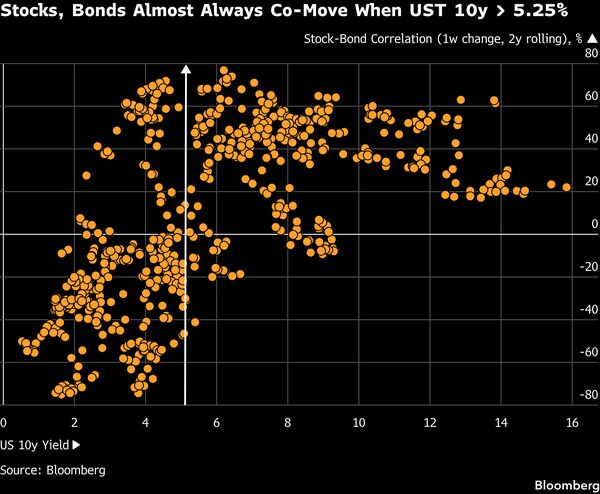
几周前我展示过,当10年期美债收益率持续高于5.25%至5.50%时,股票与美债的相关性几乎总是为正。不过,这引发了更多我们应当尝试解答的问题。
A few weeks ago I showed that when 10-year yields remain above 5.25%-5.50%, the correlation between stocks and Treasuries has almost always been positive. That, however, raises more questions we should try to answer.
具体来说:股债相关性为何存在拐点,为什么这一拐点出现在收益率约为5.25%时?在尝试回答这些问题时,我将说明为什么60/40投资组合不再能像过去那样依赖美债来对冲股票。
Specifically: why is there an inflection point in the stock-bond correlation, and why does this occur with yields around 5.25%? In trying to answer these I’ll show why 60/40 portfolios can no longer rely as much as they did on Treasuries as hedge for stocks.
在探讨此问题之前,先从关键投资含义开始。股债正相关意味着股票和债券可能同时下跌。在2000年至2020年的大部分时间里,相关性为负。这使得美债成为股票的绝佳对冲工具。
Before tackling this, let’s start with the key investment implications. A positive stock-bond correlation means that stocks and bonds can fall together. For much of the time between 2000-2020, the correlation was negative. That made Treasuries an excellent hedge for stocks.
不再如此。60/40投资组合以及风险平价策略的基础,后者基于同一原则,二者共同持有约1万亿美元至1.5万亿美元的美债,其前提正是此,但如果相关性持续为正,对美国国债的对冲需求可能会减弱。
No longer. The foundation of 60/40 portfolios as well as risk-parity strategies, which are founded on the same principle – and which together hold in the region of $1 trillion-$1.5 trillion of Treasuries – is based on this premise, but if the correlation is persistently positive, hedging demand for USTs is likely to weaken.
这只是推论,但我们可以尝试从经验上加以证明。下图显示,在相关性为负的年份里,股债相关性与风险平价策略收益率的敏感度(控制股票因素)通常同涨同跌。
This is just deduction, but we can try and show it empirically. The chart below illustrates that the stock-bond correlation, and the sensitivity of returns from risk-parity strategies (controlling for stocks), typically rose and fell together during the years when the correlation was negative.
这一关系在2020/2021年“暂时性”通胀上升期间依然存在,风险平价基金或许认为这并非根本性转变。然而,在过去两年中,风险平价策略对美债的敏感度继续降至15年低点,即使股债相关性最近再次上升。
The relationship persisted during the “transitory” rise in inflation in 2020/2021, with risk-parity funds perhaps reasoning this was not a fundamental shift. Yet over the last two years, risk-parity’s sensitivity to Treasuries has continued to drop to 15-year lows, even as the stock-bond correlation has most recently been rising again.
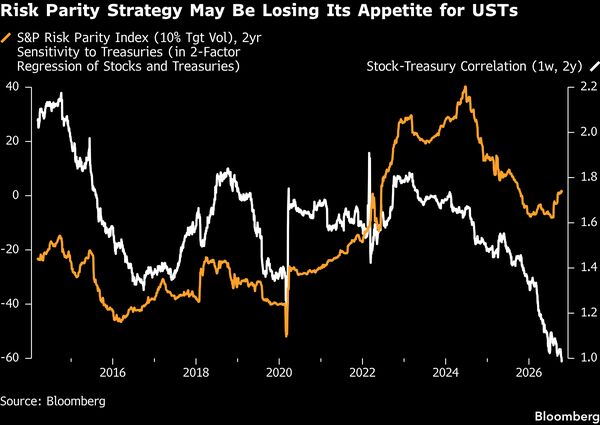
一朝被蛇咬,十年怕井绳。这表明风险平价基金已察觉到一种制度转变,它们不再能像过去那样高度依赖国债。
Once bitten, twice shy. This suggests that risk-parity funds have sensed a regime change where they can no longer rely on Treasuries as heavily as they used to.
但事情并未到此结束。股票和债券同步走势越来越多,这会自我强化。随着对国债需求下降,流动性减少,期限溢价上升,从而从结构上支撑收益率,并使股票和债券保持正相关。
It doesn’t end there though. Stocks and bonds moving together more becomes self-reinforcing. As demand for Treasuries drops, liquidity declines and term premium rises, structurally supporting yields and keeping stocks and bonds positively correlated.
那么,为什么更高的收益率与股债正相关联系在一起呢?事实上,最终驱动这一关系的并非收益率,而是通胀。这一观察触及了问题的核心。
So why is it that higher yields are associated with a positive stock-bond correlation? In fact, it’s not yields ultimately driving this relationship, it’s inflation. This observation gets us to the heart of the issue.
与收益率一样,通胀在股债相关性中也呈现出两极分化的关系:当核心PCE物价指数高于3%时,股债相关性几乎总是正相关。
With inflation, as with yields, a bifurcated relationship in the stock-bond correlation can also be seen, with the stock-bond correlation having almost always been positive when core PCE is above 3%.
事实证明,3%历史上一直是通胀发生非线性转变的水平。美联储2016年的一份论文指出,当失业率降至远低于自然失业率(即与充分就业和稳定物价压力相关的失业率)时,通胀会做出不成比例的反应。该论文得出结论:“美国历史上几乎没有证据表明,在平均通胀率远高于3%的水平上,能长期维持平稳、稳定的通胀制度”。
It turns out that 3% has historically been the level when non-linear shifts in inflation occur. A 2016 Fed paper notes that when unemployment falls sufficiently below its natural rate (ie the rate associated with full employment and steady price pressures), inflation responds disproportionately. The paper concludes: “Little in US history suggests a regime of stationary, stable inflation can be maintained for long at an average level of inflation much above 3 percent”.
此外,当通胀较低时(核心PCE低于2%),通胀冲击更有可能均值回归;而当通胀较高时,过去的通胀会流入预期,冲击会变得持久(从疫情到乌克兰和伊朗,近年来我们已见证多次此类冲击)。在高通胀制度下,价格压力变得更加持久且更具波动性。
Further, inflation shocks are more likely to be mean-reverting when it is low (core PCE less than 2%). When it is high, past inflation feeds into expectations and shocks become (from the pandemic to Ukraine and Iran, we have seen several such shocks in recent years). Price pressures become more persistent and more volatile in a high inflation regime.
核心PCE中3%的意义何在?低于这一水平时,通胀似乎更多被视为背景噪音;但当其上升并持续高于3%时,个人和企业可能开始更加关注它。
What is the significance of 3% in core PCE? Below this level inflation seems to be seen more as background noise, but when it rises – and persists – above 3%, individuals and firms likely start paying more attention to it.
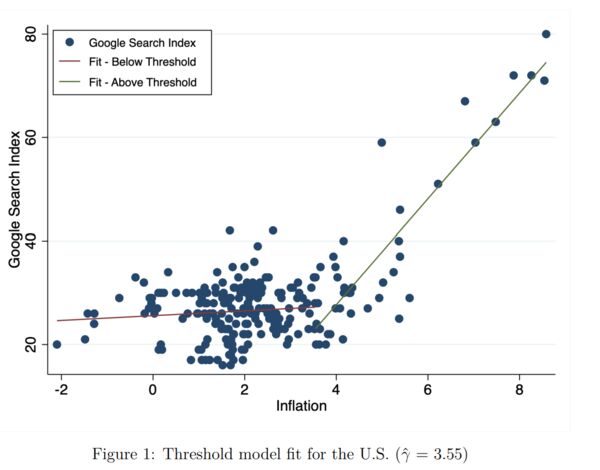
一份2022年GLO论文显示,当总体CPI通胀率超过约3.5%时,关于通胀的网络搜索量会显著增加(这一水平与基于两组数据长期平均差幅的约3%核心PCE相一致)。
A GLO paper from 2022, , shows that internet searches on inflation markedly pick-up above about 3.5% headline CPI (a level consistent with 3% core PCE based on the long-term average of the gap between the two series).
当整体通胀率较高时,更多商品和服务的价格个别上涨的可能性更大,且涨价过程更具连续性。当通胀处于高位时,它对工资谈判和购买决策也变得更加重要。
When inflation is higher overall, it’s more probable the prices of a greater number of goods and services individually are rising, and doing so more sequentially. And when inflation is elevated it becomes more relevant for wage bargaining and purchasing decisions.
所有这些都会吸引人们的注意,通胀预期更可能与通胀本身挂钩,从而诱发正反馈循环。
All of this grabs people’s attention, and inflation expectations are more likely to become anchored to inflation itself, inducing a positive feedback loop.
这会导致通胀持续处于高位,使美联储降息空间更小。因此,在经济放缓期间,或当放缓风险增加时,债券价格与股票价格的反向波动幅度减小,两种资产之间的相关性开始上升,回归其更典型的正相关状态(在过去120年的大部分时间里都是这样)。
This leads to persistently elevated inflation, leaving the Fed with less room to cut rates. Therefore in a slowdown, or when the risk of one increases, bonds move less inversely to stock prices, and the correlation between the two assets starts to rise to its more typical positive state (as it has been over the majority of the past 120 years).
最后,历史上,3%的核心PCE通常出现在10年期国债收益率约为5.25%的时候。我们现在已经确立了四个关键点:随着核心PCE重新回升至3%以上,且过去12个月平均水平略低于该水平,要摆脱本十年大部分时间陷入的高通胀体制,前景并不乐观。这对60/40投资组合来说绝非好消息。
Finally, 3% core PCE has historically occurred when the 10-year yield has been around 5.25%. We have now established four key points: With core PCE back above 3% and averaging just below that level over the last 12 months, the omens are not good for escaping the high inflation regime we have been trapped in for most of this decade. This is far from welcome news for the 60/40 portfolio.
column Story Link: The Treasury Market’s 3% Inflation Trap: MacroScope
column Story Link: The Treasury Market’s 3% Inflation Trap: MacroScope