一张简单的自拍可能蕴藏着关于你整体健康和长寿的惊人线索,尤其是在癌症患者群体中。
A simple selfie could hold surprising clues to your overall health and longevity, especially among people with cancer.
波士顿Mass General Brigham的研究人员开发出人工智能模型,他们表示,仅凭一张面部照片就能预测癌症患者的生物学年龄和生存几率。
Researchers at Mass General Brigham in Boston have developed artificial intelligence models that they say can predict a cancer patient’s biological age and chances of survival using nothing more than a single photograph of their face.
这项研究于周一发表在《柳叶刀·数字健康》期刊上,表明面部分析可能成为医生在评估患者生存几率、决定哪种治疗方案最适合癌症患者时的一个额外参考工具。
The research, published Monday in the journal The Lancet Digital Health, suggests that facial analysis could become an additional tool for doctors to consider when evaluating a patient’s chances of survival and when deciding which treatment approaches may work best for their cancer patients.
“我很惊讶地发现,仅凭一张面部照片我们就能捕捉到死亡风险的迹象,”研究作者、Mass General Brigham癌症研究所放射肿瘤科医生、Mass General Brigham医学人工智能项目教员雷蒙德·马克博士说。
“I was pretty surprised to find out that we could pick up signs of mortality risk from just a facial photograph,” said study author Dr. Raymond Mak, a radiation oncologist at Mass General Brigham Cancer Institute and a faculty member in the Artificial Intelligence in Medicine program at Mass General Brigham.
这些AI模型——基于超过4000万张面部图像训练而成——专门评估面部的不同方面,以衡量癌症患者的整体健康状况和生物学年龄。与衡量一个人生活了多少年岁的实际年龄不同,生物学年龄反映了身体在细胞和生理层面衰老的程度。
The AI models – trained on more than 40 million facial images – specifically assess different aspects of the face to gauge a cancer patient’s overall health and biological age. Unlike chronological age, which measures the number of years a person has lived, biological age reflects how well the body has aged at the cellular and physical level.
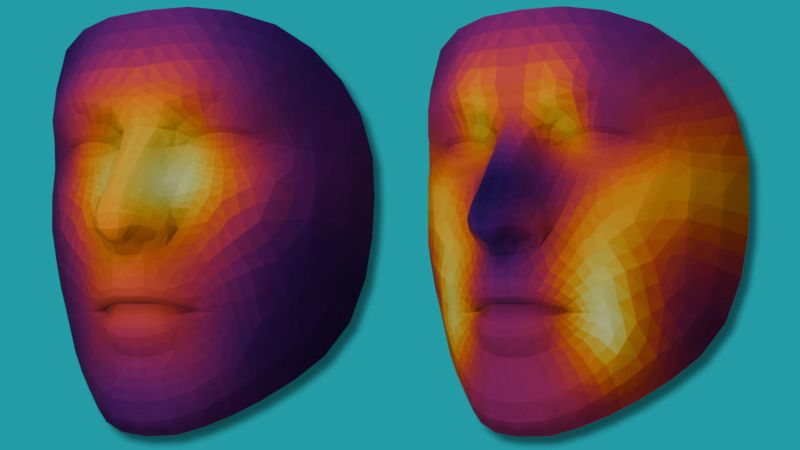
马克说,在评估生物学年龄时,AI模型考虑的面部部位包括:“年龄估算算法关注太阳穴周围区域、额头区域、眼上方区域,以及我们所谓的鼻唇沟,即连接鼻子到嘴角的线条。”
“The age estimation algorithm is looking at the area around the temples, the area on the forehead, above the eyes and then what we call the nasolabial fold, the line that connects the nose down to the corner of your mouth,” Mak said of what parts of the face the AI models consider when assessing biological age.
“相比之下,死亡风险预测算法关注的是面部完全不同的区域,”麦克说。“它关注的是鼻梁和眼下区域。”令人毛骨悚然的是,AI模型用于预测生物学年龄和生存率的面部区域,竟与古希腊医生兼哲学家希波克拉底在公元前400年左右撰写的《预后论》中提到的部位完全吻合,他在书中将“鼻尖锐利、眼窝凹陷、太阳穴塌陷”描述为肌肉萎缩和死亡风险的征兆。
“In contrast, the mortality risk prediction algorithm is looking at a totally different part of the face,” Mak said. “It’s looking at the bridge of the nose and the area under the eyes.”Eerily, the same regions of the face that the AI model assesses to predict biological age and survival are the same parts that Greek physician and philosopher Hippocrates referenced in the Book of Prognostics, written around 400 B.C., when he described “the nose sharp, the eyes sunken, the temples fallen in” as signs of muscle wasting and mortality risk.
“想到我们的算法可能正在复刻希波克拉底数千年前的智慧,这让我们震惊不已,”麦克说。
“To think that our algorithms might be replicating that wisdom of Hippocrates from millennia ago was mind-blowing to us,” Mak said.
麦克表示,AI算法并不知晓希波克拉底的古老文献,因为“我们的算法纯粹是在面部照片以及某人是否死亡、或其年龄这些数据上训练的”。
The AI algorithms had no awareness of Hippocrates’ ancient texts, because “our algorithms are trained purely on face photographs and then whether somebody died or not, or their age,” Mak said.
他补充道:“它并不纳入互联网上汇聚的文本、知识或智慧。所以听到希波克拉底的回响跨越千古出现在我们的算法中,令人感到非常诡异。”麦克及其同事最初构建了一个名为“健康识别面部基础人工智能”(FAHR-Face)的稳健AI模型,该模型在涵盖不同年龄和种族背景的4000多万张面部图像上进行了训练。
“It does not factor in the text, knowledge or wisdom that’s aggregated on the internet,” he added. “So hearing Hippocrates echo over millennia in our algorithms was very eerie.”
随后,该模型经过微调并作为基础,用于构建另外两个可执行特定任务的模型:FAHR-FaceAge模型可根据单张照片估算某人的生物学年龄,而FAHR-FaceSurvival模型则通过结合面部特征与其他临床信息,预测癌症患者的生存几率。
Mak and his colleagues originally built a robust AI model called the Foundation Artificial Intelligence for Health Recognition-Face (FAHR-Face) that was trained on more than 40 million facial images spanning diverse ages and ethnic backgrounds.
研究人员利用FAHR-FaceSurvival模型发现,在被模型判定为高死亡风险的122名癌症患者中,超过一半——52.5%——在评估后90天内死亡,符合预测结果。相比之下,在FAHR-FaceSurvival模型判定的最低风险组975名患者中,仅约2%在90天内死亡。
The model was then fine-tuned and used as a foundation to build two other models that could perform specific tasks: The FAHR-FaceAge model estimates the biological age of someone based on a single photo, and the FAHR-FaceSurvival model predicts a cancer patient’s chances of survival by combining facial features with other clinical information. With the FAHR-FaceSurvival model, the researchers found that among 122 cancer patients who were indicated by the model to have a high risk of death, more than half – 52.5% – died within 90 days of the assessment, as predicted.
在评估FAHR-FaceAge模型时,研究人员发现,在生物学年龄比实际年龄大20年以上的1060名患者中,有21%在90天内死亡。相比之下,在生物学年龄至少比实际年龄小10年的4195名患者中,约有6%在90天内死亡。
In comparison, only about 2% of the 975 patients in the lowest-risk FAHR-FaceSurvival group died within 90 days. When evaluating the FAHR-FaceAge model, the researchers found that 21% of the 1,060 patients whose biological age was more than 20 years above than their chronological age died within 90 days.
研究人员发现,面部的美容改变——如手术、肉毒素等注射剂或化妆——并未影响AI模型的表现。
In comparison, about 6% of the 4,195 patients with biological ages at least 10 years younger than their chronological age died within 90 days.
研究作者强调,他们的AI模型并非旨在取代医生或现有的临床评估。相反,他们将这项技术描述为一种新兴工具,未来或许能帮助医生评估患者健康状况,或在治疗方案的决策中提供参考。
The researchers found that cosmetic changes to the face – such as surgery, injectables like Botox or makeup – did not affect the AI models’ performance. The study authors emphasize that their AI models are not intended to replace physicians or existing clinical evaluations.
“如果我们能早早发现加速衰老或较高的死亡率评分,或许能筛查出这些人,或识别出可能从更早进行严重疾病进一步检测中获益的患者,”Mak说。
Instead, they describe the technology as an emerging tool that could someday help inform a doctor’s assessment of a patient’s health or their decision-making around treatment options.
虽然这项新研究仅在癌症患者中进行,但Mak表示,更多研究可能会揭示,在其他方面健康但对长寿感兴趣的人群中,是否会出现类似发现。
“If we can pick up accelerated aging or higher mortality scores early, we might be able to screen for those or identify patients who may benefit from further testing for serious conditions earlier,” Mak said.
埃默里大学研究主席、儿科和生物医学工程教授Wilbur Lam博士表示,该研究对AI技术的运用令人着迷,但仍需经过临床评估。
And while the new study was conducted only among cancer patients, Mak said more research could reveal whether similar findings may emerge among otherwise healthy people who may be interested in their longevity.
“这是一项极具说服力的研究,源自一个大型数据集,其将面部图像与生物学年龄以及癌症生存风险建立关联的结果似乎很稳健。然而,其真正的临床效用仍需通过前瞻性研究来证实,”未参与该研究的林某在一份声明中表示。
The study’s use of AI technology is fascinating but still needs to be evaluated clinically, said Dr. Wilbur Lam, research chair and professor of pediatrics and biomedical engineering at Emory University.
“此外,正如作者自己所暗示的,该工具能否准确用于特定亚人群仍是一个问题,”他说。“例如,对于具有特定面部特征、肤色、年龄组别的人群,其效果有多强,也需要通过前瞻性测试,该技术才能实现临床应用。”
“This is an extremely compelling study that stems from a large data set and its associations between facial images and biological age as well as cancer survival risk appear to be robust. Its true clinical utility, however, will need to be demonstrated prospectively,” Lam, who was not involved in the study, said in an“Moreover, as the authors themselves allude to, whether this tool can be accurately used for specific subpopulations remains a question,” he said. “For example, how strong the effects are for people with specific facial features, skin color, age groups will also need to be prospectively tested in order for the technology to be clinically implemented.”

英国科学媒体中心发布的一份声明中,萨里大学视频处理与机器智能教授米罗斯拉夫·博伯表示,该研究提供了“令人信服的证据”,证明接受放疗的癌症患者面部外观与生存之间存在统计学关联。
The study provides “convincing evidence” of a statistical link between facial appearance and survival in cancer patients receiving radiotherapy, Miroslaw Bober, professor of video processing and machine intelligence at the University of Surrey, said in a statement distributed by the UK-based Science Media Centre.
但“预测结果并不等同于解释结果。尽管提到了‘生物学年龄’,但人工智能是根据面部外观估算年龄,而非直接测量任何潜在的生物学衰老过程,”未参与该研究的博伯说。
But “predicting an outcome is not the same as explaining it. Despite the references to ‘biological age’, the AI estimates age from facial appearance rather than directly measuring any underlying biological ageing process,” said Bober, who was not involved in the study.
“作者将人工智能依赖的面部区域与医生描述的‘垂死相’联系起来。然而,该研究并未测试人工智能是否识别出了医生无法识别的特征,”博伯说。
“The authors link the facial regions the AI relies on to the ‘look of dying’ described by doctors. However, the study did not test whether the AI recognises anything a doctor would not,” Bober said.
“该研究尚未证明这些预测能在医生对患者整体健康状况和身体机能的评估之外,提供临床上有用的信息,而这些评估在研究中并未被测量,”他说。“这是一个有前景的概念验证,但尚未准备好用于临床。该工具仍需在不同医院和患者群体中,与医生自身的判断进行对比测试。”
“It has not shown that these predictions add clinically useful information beyond doctors’ assessments of a patient’s general health and fitness, which were not measured in the study,” he said. “This is a promising proof of concept, but it is not ready for clinical use. The tool still needs testing against doctors’ own judgement and across different hospitals and patient groups.”